
Does Retatrutide Need to Be Refrigerated? Storage, Shelf Life & Temperature Guide
Direct answer: Yes, retatrutide needs to be refrigerated once reconstituted. Store the liquid solution at 2-8 degrees C and use it within 28-30 days. Lyophilized (freeze-dried) powder is more stable - keep it at -20 degrees C for long-term storage, or in the fridge if you plan to use it within a few weeks.
Key Takeaways
- Lyophilized powder and reconstituted solution follow completely different storage rules - confuse them and you shorten your peptide's life dramatically
- Store unopened powder at -20 degrees C for long-term (up to 48 months); 2-8 degrees C fridge only if you'll use it within a few weeks
- Once reconstituted with bacteriostatic water, refrigerate at 2-8 degrees C and use within 28-30 days maximum
- Never store vials on the refrigerator door - temperature swings there can exceed 10 degrees C with each opening
- Keep all forms away from direct light; UV exposure breaks down amino acid residues even through glass
- Traveling with retatrutide is manageable - a quality insulin cooler and TSA-friendly documentation make it straightforward
Does Retatrutide Need to Be Refrigerated?
Does retatrutide need to be refrigerated? Yes. The short answer depends on which form you have:
- Reconstituted liquid: Must be refrigerated at 2-8 degrees C. Do not leave it at room temperature for more than 2-4 hours.
- Lyophilized powder (short-term use): Refrigerator storage at 2-8 degrees C is acceptable if you plan to reconstitute within a few weeks.
- Lyophilized powder (long-term storage): Freezer at -20 degrees C is the better option.
If you're asking does retatrutide need to be refrigerated in powder form or water - the answer differs by form. Powder tolerates cold storage without strict refrigeration for brief periods during transit. Water (reconstituted solution) must be refrigerated immediately after mixing.
If you don't put retatrutide in the fridge after reconstitution, degradation begins within hours. At room temperature, bacterial growth in the solution accelerates and the peptide bonds themselves begin hydrolyzing. After 4-6 hours at 20-25 degrees C, the solution should be discarded.
How Long Does Retatrutide Last in the Fridge?
How long does retatrutide last in fridge? The answer depends on whether you're asking about reconstituted liquid or lyophilized powder.
Reconstituted solution: 28-30 days when consistently refrigerated at 2-8 degrees C, handled cleanly, and protected from light. This is the most common question and the most important number to remember. How long does retatrutide last in the fridge after mixing is not negotiable - once the 30-day mark passes, discard and reconstitute fresh.
Lyophilized powder: Refrigerated life is much longer. Unopened, sealed vials can remain stable for months in a standard fridge. For the safest answer, though, freezer storage beats refrigerator storage.
A common follow-up question: will retatrutide last for 2 months made up in the fridge? No. Reconstituted retatrutide should not be kept for 2 months. The 28-30 day limit applies to liquid solution regardless of how carefully it is stored.
How Long Does Reconstituted Retatrutide Last?
Reconstituted retatrutide lasts 28–30 days in the refrigerator at 2–8°C. That's the answer most people are looking for, and it's the most important number in this entire guide.
The 30-day clock starts the moment bacteriostatic water hits the powder. Once you've mixed your vial, retatrutide is no longer in suspended animation — it's a liquid solution in which peptide bonds are slowly hydrolyzing, oxidation can occur, and microbes can theoretically grow despite the benzyl alcohol preservative in bacteriostatic water.
Reconstituted Retatrutide Shelf Life by Storage Condition
| Storage Condition | How Long Reconstituted Retatrutide Lasts |
|---|---|
| Refrigerated at 2–8°C, sealed, minimal septum punctures | 28–30 days |
| Refrigerated at 2–8°C, septum punctured 10+ times | 2–3 weeks (contamination risk rises with every draw) |
| Stored in the fridge door (temperature swings) | ~20 days (door fluctuations accelerate degradation) |
| Left at room temperature (20–25°C) | 4–6 hours maximum |
| Accidentally frozen (visible ice crystals) | Discard immediately — irreversible damage |
| Exposed to direct light (clear vial) | Reduced — wrap in foil if you cannot store in original box |
Can You Stretch Reconstituted Retatrutide Past 30 Days?
No. Do not stretch reconstituted retatrutide past 28–30 days, even if it still looks clear. Visible appearance is not a reliable indicator of potency — peptide bonds can hydrolyze and produce sub-potent solution that still looks identical to fresh medication.
If you're worried about waste, the better strategy is reconstituting smaller portions of your vial rather than mixing the entire vial at once. Most lyophilized retatrutide vials remain stable for months refrigerated and years frozen — so the unmixed powder is patient, but the liquid form is not.
Reconstituted Retatrutide vs Lyophilized Powder: Lifespan Comparison
The gap is enormous: months to years for lyophilized powder, 28–30 days for reconstituted solution. This is the single most important storage fact about retatrutide. If you remember nothing else from this guide, remember that the moment water meets powder, you start a 30-day countdown that cannot be paused, extended, or undone.
Retatrutide Shelf Life: Lyophilized Powder vs. Reconstituted Solution
Retatrutide shelf life depends almost entirely on which form you're storing. The two states have radically different stability profiles.
Lyophilized powder has water removed, which halts most degradation chemistry - hydrolysis, oxidation, microbial growth. Stored correctly, it lasts years. The retatrutide shelf life upon reconstitution, however, drops to weeks the moment water is reintroduced.
Reconstituted solution begins degrading immediately. Peptide bonds start breaking down. Even bacteriostatic water only slows microbial growth - it does not stop it indefinitely. What is the shelf life of a retatrutide vial once mixed? 28-30 days under optimal conditions; less if you're careless with temperature, light, or repeated septum punctures.
| Factor | Lyophilized Powder | Reconstituted Solution |
|---|---|---|
| Ideal storage temp | -20 degrees C (freezer) | 2-8 degrees C (refrigerator) |
| Shelf life (optimal) | Up to 48 months | 28-30 days |
| Fridge only (short-term) | Up to 24 months (unopened) | 28-30 days max |
| Can you freeze it? | Yes - preferred for long-term | No - causes irreversible damage |
| Light sensitivity | Moderate (store in original box) | High (wrap vial in foil) |
| Humidity sensitivity | Very high - never open cold | N/A (already in solution) |
| Condition | Shelf Life |
|---|---|
| Refrigerated at 2-8 degrees C, sealed, minimal punctures | 28-30 days |
| Refrigerated, septum punctured 10+ times | 2-3 weeks (higher contamination risk) |
| Left at room temp (20-25 degrees C) | 4-6 hours max |
| Frozen (ice crystals formed) | Discard - irreversible damage |
What Temperature Range Should Retatrutide Be Held At?
What temperature range should retatrutide be held at? The correct range depends on the form:
Lyophilized powder - long-term storage: -20 degrees C (-4 degrees F). At this temperature, molecular kinetic energy drops enough to halt most degradation pathways. Expect up to 48 months of stability for unopened vials.
Lyophilized powder - if using within weeks: 2-8 degrees C (36-46 degrees F) in a standard refrigerator. Acceptable for near-term use; not for month-over-month storage.
Reconstituted solution: 2-8 degrees C (36-46 degrees F) only. This is non-negotiable. Room temperature will degrade it fast - don't leave a drawn syringe sitting while you prep injection supplies.
Never exceed 25 degrees C (77 degrees F) for any form of retatrutide for more than a few hours. Above this threshold, degradation accelerates exponentially.
Ultra-cold (-80 degrees C): Used in research labs for multi-year storage. Overkill for most users, but extends stability beyond the 48-month mark.
What is the correct way to store retatrutide in practice: sealed in the original vial, in a secondary container on the middle or back shelf of your fridge, away from the door, protected from light with foil or the original box.
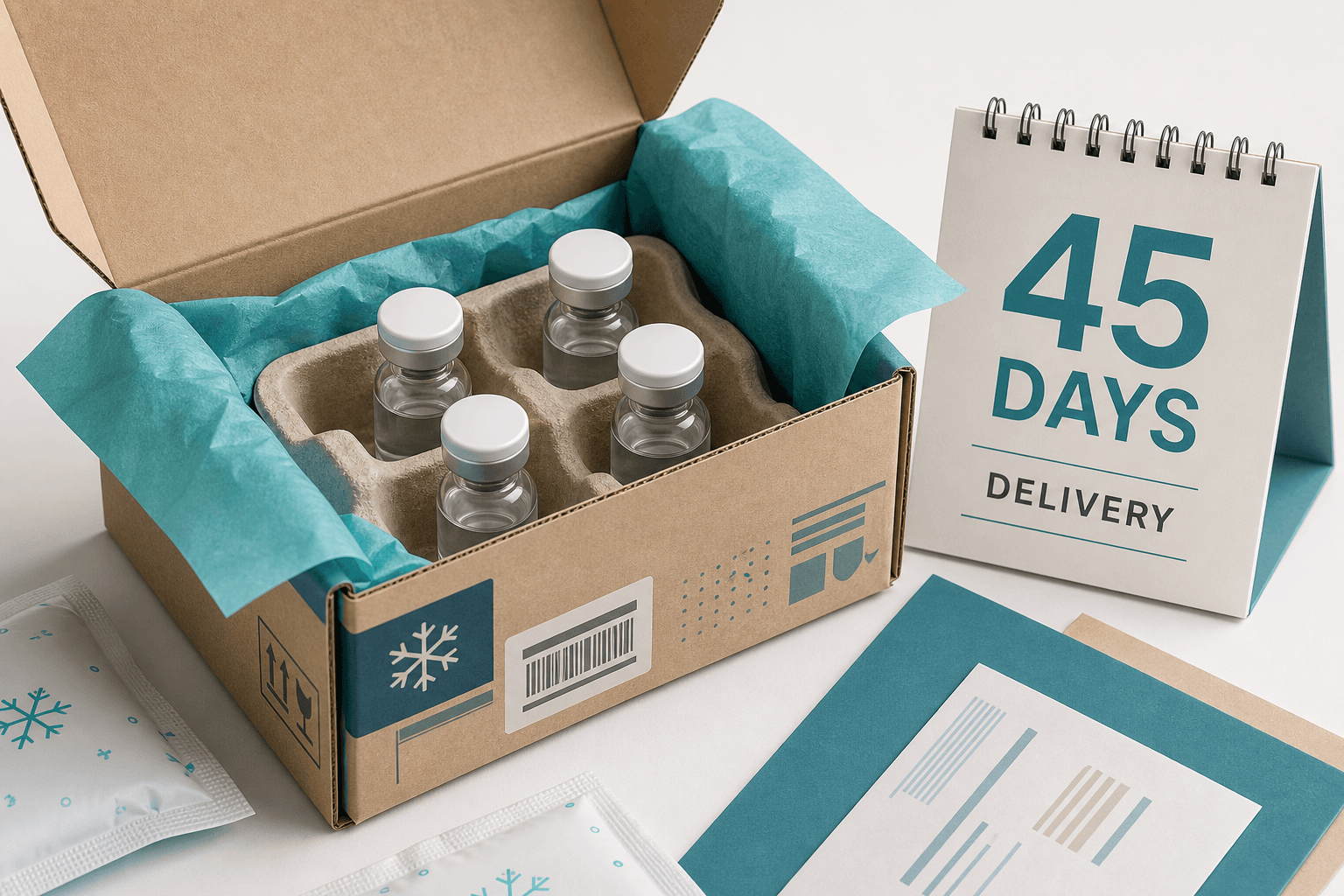
What If Your Vial Arrives Without an Ice Pack?
This is one of the most specific and common shipping concerns — searchers literally type "if my retatrutide came in mail without ice pack will that hurt it with outside temp being 80 degrees?" Here is the honest answer.
If the vial is lyophilized powder: A few hours at 80 degrees F (about 27 degrees C) during shipping is unlikely to cause major damage if the vial remained sealed and was not in direct sunlight. Lyophilized powder is significantly more resilient than reconstituted solution. Inspect the vial - the powder should still be white, dry, and loose. If it looks clumped or discolored, contact your supplier.
If the vial is reconstituted solution: This is more concerning. The 4-6 hour window at room temperature (and 80 degrees F / 27 degrees C is close to room temperature) is the upper limit. If the total transit time at that temperature was under 4 hours and the solution still looks clear and colorless, it is likely still usable. Over 4 hours or if you are unsure, the conservative call is to discard.
General rule for mail delivery without cold packaging: Most research peptide suppliers ship lyophilized powder, which is why a missing ice pack is usually a recoverable situation rather than an automatic loss. Still, a responsible supplier should use proper cold-chain packaging. If a vial arrives with no ice protection and the powder shows any moisture signs, request a replacement.
The temperature table for excursions:
| Excursion Scenario | Duration | Recommended Action |
|---|---|---|
| Reconstituted left at room temp (20-25 degrees C) | Under 2 hours | Return to fridge; use within 24 hours |
| Reconstituted left at room temp | 2-4 hours | Inspect carefully; use same day or discard |
| Reconstituted left at room temp | Over 4 hours | Discard - do not use |
| Lyophilized powder warmed to room temp briefly | Under 30 min (for temp equalization) | Normal - required before reconstitution |
| Lyophilized powder at room temp | Several hours (unsealed) | Return to freezer; reduce expected shelf life by ~15% |
| Lyophilized powder shipped without ice, 80 degrees F / 27 degrees C | Under 8 hours (transit) | Inspect on arrival; usually recoverable if vial is sealed and powder is dry |
| Any form exposed to 40 degrees C+ (hot car, direct sun) | Any duration | Discard - degradation is severe and fast |
| Reconstituted solution accidentally frozen (ice crystals) | Any duration | Discard - structure is physically damaged |
Freezing Retatrutide: What You Need to Know
The rules around freezing on retatrutide are simple but easy to mix up:
Lyophilized powder: freeze it. That is the preferred long-term storage method. The freeze-drying process specifically prepares the peptide for a frozen environment. Store at -20 degrees C for up to 48 months.
Reconstituted solution: never freeze it. When liquid solution freezes, ice crystals form and physically shear peptide chains at a molecular level. When the solution thaws, the peptide is structurally damaged - potency is reduced even if the solution still looks clear. Do not freeze reconstituted retatrutide to try to extend its life past 30 days. The only safe way to extend your timeline is to leave the powder un-reconstituted until you are ready to use it.
If you're reconstituting a 10 mg vial but only using 2-3 mg per week, consider reconstituting in portions rather than the whole vial at once.
Where in the Fridge to Store Retatrutide
The retatritude refrigerated life you get is heavily influenced by where in the fridge you keep it. The door is one of the worst locations - every opening exposes door shelves to ambient air, and temperature swings of 8-10 degrees C throughout the day are common in household fridges.
Put your vials on the middle or back shelf of the main compartment, toward the rear. Avoid:
- The door
- The crisper drawers (higher humidity)
- The shelf directly under the freezer compartment (can partially freeze reconstituted solution)
- Near the back wall if your fridge tends to freeze items
Store vials upright in a small secondary container with a desiccant packet. This protects from humidity and keeps them from rolling around.
Light Sensitivity: Why You Need to Cover Your Vials
Retatrutide contains amino acid residues with aromatic side chains that are vulnerable to photodegradation. Repeated light exposure causes measurable potency loss over time.
Practical steps:
- Keep vials in their original cardboard box inside the fridge or freezer
- If the box is gone, wrap the vial in aluminum foil
- Avoid storing vials in glass-door fridges or refrigerators with internal lighting that stays on
- When drawing a dose, minimize time under direct overhead lighting or near windows
Even amber vials only filter some UV. They are not a substitute for keeping vials stored away from light.
How to Tell If Your Retatrutide Has Gone Bad
Your vial does not come with an alarm when it degrades. Before every draw, inspect the solution.
Reconstituted solution - discard if you see:
- Cloudiness or haziness - should be completely clear; turbidity signals protein aggregation or contamination
- Visible particles or flakes - peptide aggregation or bacterial contamination
- Color change - should be colorless to very pale yellow; any yellow-brown tint indicates oxidative degradation
- Unexpected viscosity - if it is suddenly thicker than usual, something has changed
- Strong or unusual odor - harder to detect through the septum but worth noting
Lyophilized powder - discard if you see:
- Yellowing or browning of the powder (should be white)
- Clumping that does not separate - may indicate moisture absorption
- Powder stuck to the sides of the vial in a wet-looking pattern - moisture intrusion
If anything looks off, do not inject it.
Common Storage Mistakes That Degrade Retatrutide
These are the ones that actually happen:
1. Opening the vial straight from the freezer The powder is hygroscopic. Pull it out cold, pop the cap, and humid room air condenses on the cold powder. You have triggered hydrolysis before you even add water. Always let the sealed vial warm to room temperature (15-20 minutes) before opening.
2. Storing reconstituted solution in the fridge door Door temperature swings are real and cumulative. Over 2-3 weeks, this can meaningfully reduce potency.
3. Using regular sterile water instead of bacteriostatic water Regular sterile water has no preservative. Your reconstituted peptide becomes a microbial growth medium within days. Bacteriostatic water - which contains 0.9% benzyl alcohol - is the correct reconstitution medium.
4. Reconstituting the whole vial when you will only use part of it If you have a 10 mg vial and only need 2-3 mg per week, reconstituting the whole thing puts 3+ weeks of your supply on the 30-day clock immediately. Reconstitute in portions.
5. Leaving a drawn syringe sitting out Every minute at room temperature matters. Draw and inject in close succession.
6. Ignoring the frost-free freezer issue Frost-free freezers run periodic heating cycles. These create micro-freeze-thaw cycles. For lyophilized powder, this is not catastrophic short-term, but over 12+ months it adds up. Store toward the back, away from the door, in a secondary sealed container.
Ready to inject correctly after all this careful storage? See our guide on How to Inject Retatrutide.
Traveling with Retatrutide: TSA, Ice Packs, Temperature Excursions
Carry-on vs. checked luggage: Always carry-on. Cargo holds are not temperature-controlled and can get extremely cold or warm. Your peptide goes with you in the cabin.
TSA rules: Medically necessary liquids and injectables are exempt from the standard 100 ml liquid limit. Ice packs and cooling containers are permitted. Declaration is not required, but having a label or documentation speeds up screening.
Keeping it cold in transit:
- Use a quality insulin travel cooler or medical-grade cooler pack - these maintain 2-8 degrees C for 12-24+ hours
- Freeze gel packs solid the night before
- Wrap vials in a small cloth before placing them against gel packs to avoid accidental freezing of reconstituted solution
- For flights over 4-6 hours, check the cooler temperature when you land
Ready to Order? Get Quality Retatrutide That Arrives Cold-Chain Protected
Storage only works if you start with a product that was handled correctly from synthesis to your door. Ascension Peptides ships retatrutide with proper cold-chain packaging and third-party COAs - so you know what you're getting and it arrives in the condition it left.
Frequently Asked Questions
Does retatrutide need to be refrigerated? Yes - both forms require cold storage. Lyophilized powder is most stable at -20 degrees C long-term, though a refrigerator at 2-8 degrees C works for near-term use. Once reconstituted, the solution must be refrigerated at 2-8 degrees C and used within 30 days.
Can you freeze reconstituted retatrutide to extend its life? No. Freezing reconstituted solution causes ice crystal formation that physically damages the peptide structure. The solution may look the same after thawing, but potency is compromised. The only safe way to extend your timeline is to leave the powder un-reconstituted until you are ready to use it.
How long does reconstituted retatrutide last in the fridge? 28-30 days under ideal conditions: consistent 2-8 degrees C, minimal light exposure, and limited septum punctures. Do not stretch it.
What happens if retatrutide gets warm during shipping? Brief temperature excursions during transit (a few hours at room temperature) typically will not ruin lyophilized peptide. Most quality suppliers ship with ice packs rated for at least 48 hours. Inspect the packaging on arrival - if ice packs are completely melted and warm, contact the supplier. Reconstituted solution that reached room temp during shipping for longer than 4 hours should be discarded.
Can I store retatrutide in a regular kitchen fridge? Yes, but avoid the door, use a secondary sealed container, add a desiccant packet, and store toward the back. It works - be deliberate about it.
How do I know if my retatrutide has gone bad? For reconstituted solution: cloudiness, visible particles, color change (yellow-brown tint), or unusual thickness are all red flags - discard immediately. For lyophilized powder: yellowing of the powder or moisture clumping are warning signs. When in doubt, do not inject it.
Can I take retatrutide on a plane? Yes. Medically necessary injectables and their cooling containers are permitted through TSA security in carry-on luggage. Always carry-on rather than checking the bag - cargo holds are not temperature-controlled.
Retatrutide — how long does it last in the refrigerator? Lyophilized retatrutide powder lasts 18–24 months in the refrigerator at 2–8°C. Reconstituted retatrutide lasts 28–30 days in the refrigerator under ideal conditions: consistent 2–8°C temperature, minimal light exposure, and limited septum punctures. Past 30 days, peptide degradation accelerates and potency drops below reliable thresholds.
What temperature does retatrutide need to be stored at? Lyophilized powder: long-term storage at -20°C (freezer) is best; 2–8°C refrigeration is acceptable for near-term use. Reconstituted solution: must be held at 2–8°C in the refrigerator. Brief excursions to room temperature (under 4 hours) during dose preparation are tolerated, but sustained warmth above 25°C accelerates degradation rapidly.
What happens if you freeze GLP-1 retatrutide? Freezing reconstituted GLP-1 retatrutide causes ice crystal formation that physically tears the peptide chain, destroying potency even though the solution may look clear after thawing. Lyophilized powder, by contrast, tolerates and benefits from freezing at -20°C — that's its long-term storage state. Rule: never freeze reconstituted solution; always fine to freeze unreconstituted powder.
What is the retatrutide shelf life in fridge? Retatrutide shelf life in the fridge depends on form: unreconstituted lyophilized powder lasts 18–24 months at 2–8°C; reconstituted solution lasts 28–30 days at 2–8°C. The full retatrutide shelf life is longer if you freeze the powder (-20°C) — up to 36 months — but refrigeration is fine for any vial you plan to reconstitute within the next year.
How do I store retatrutide powder? Store retatrutide powder (lyophilized vial, before reconstitution) in the original sealed vial, in a freezer at -20°C for long-term storage, or in a refrigerator at 2–8°C for use within 12 months. Keep the vial in the dark — a paper bag or original carton inside the fridge works. Avoid the refrigerator door (temperature fluctuations) and do not store next to defrost vents.
If my retatrutide came in the mail without an ice pack at 80°F outside temp, will it hurt the peptide? Lyophilized retatrutide powder is remarkably resilient to short heat excursions — a few hours at 80°F (27°C) during transit usually does not meaningfully degrade unreconstituted powder. The risk rises with duration and peak temperature: 1–2 days at 80°F is borderline; over a week at 80–90°F is likely to cause measurable potency loss. If your vial arrived with no ice pack at 80°F, inspect the powder appearance (yellowing or clumping = degradation), contact the supplier for a replacement, and reconstitute and test cautiously if you choose to use it.
The information in this guide is for educational purposes only. Retatrutide is an investigational peptide not approved by the FDA. Consult with a qualified healthcare provider before using any peptide compound. Proper storage is essential for maintaining product integrity regardless of intended use.