If you want to buy cagrilintide, understand first that it is an investigational compound with no approval in any market, sold by research chemical suppliers rather than pharmacies, and that vendor quality is the dominant variable in what you actually receive. People searching how to buy cagrilintide are usually shopping on price, which is precisely the wrong metric for a 39 amino acid acylated peptide that is difficult to synthesise correctly.
Cagrilintide, originally designated AM833, is a long acting amylin analogue developed by Novo Nordisk. The natural hormone clears from the bloodstream within minutes and clumps into insoluble fibrils, both of which ruled it out as a weekly injection. Cagrilintide's residue swaps and its attached lipid chain solve both problems and stretch the half life to around eight days.
Why Vendor Quality Matters More Here Than Usual
The acylation is the hard part. A supplier can produce a peptide with the correct 39 residue backbone that fails to carry the fatty acid modification, and standard HPLC purity testing will not necessarily reveal it. HPLC tells you how much of the sample is one dominant species. It does not confirm that the species is the right one.
That is why mass spectrometry matters for this compound specifically. Molecular weight confirmation is what distinguishes correctly modified cagrilintide from a cheaper, unmodified analogue that will behave nothing like the trial compound.
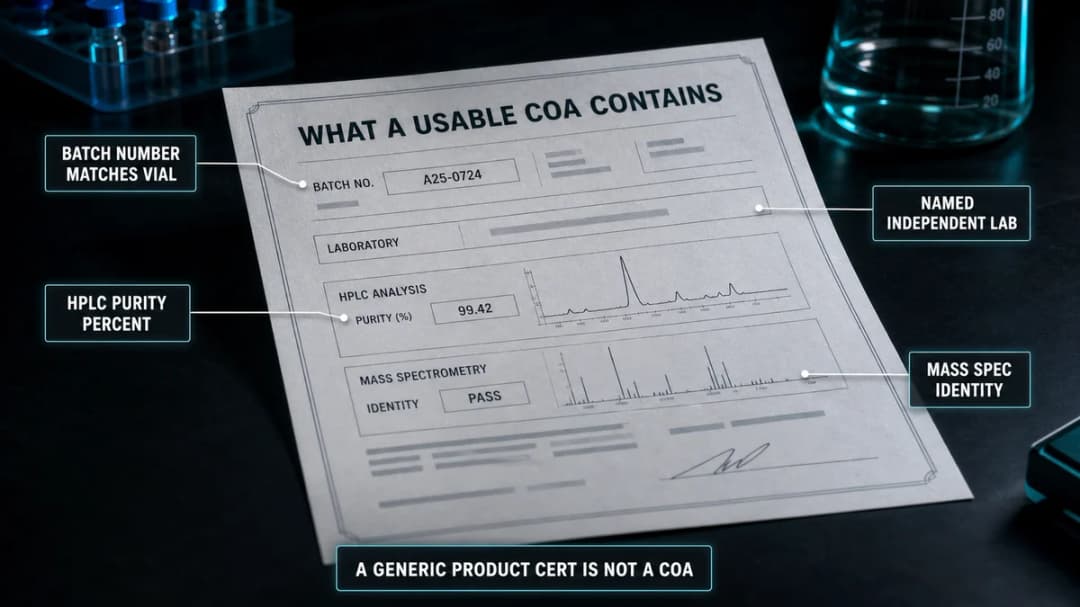
What a Usable Certificate of Analysis Contains
| Element | What to look for | Why it matters |
|---|---|---|
| Batch number | Matches the vial you received | A generic COA for the product line proves nothing about your vial |
| HPLC purity | 98 percent or higher, with the chromatogram shown | A number without a trace is an assertion, not a result |
| Mass spectrometry | Observed mass matching the acylated structure | The only practical check that the modification is present |
| Testing laboratory | An independent third party, named | In house testing is a self assessment |
| Date | Recent, and after the synthesis date | Old COAs get recycled across new batches |
| Water content and endotoxin | Present for lyophilised peptides | Moisture drives degradation, endotoxin matters for any injectable use |
If a supplier will not provide a batch specific document before purchase, that is the answer to the vendor question.
Where to Buy Cagrilintide
Cagrilintide is not a compound we keep a house vendor for. It is sold by research chemical suppliers, and the ones worth buying from publish third party batch specific certificates of analysis and hold purity at 98 percent or above by HPLC, which are the two things that separate a usable supplier from a reseller repackaging unknown material.
That standard is about process rather than promise. The reason to prefer a vendor with genuine third party COAs is not that the peptide inside will do anything in particular, it is that you know what is in the vial.
Realistic Pricing
Expect roughly 80 to 180 US dollars for a 5 mg vial from a supplier that actually tests its batches. Prices well below that band are a signal rather than a bargain, because correctly synthesising and purifying an acylated 39 residue peptide has a floor cost that no legitimate supplier can undercut.
Common failure modes at the bottom of the market include underfilled vials, unmodified analogues sold as cagrilintide, and blends cut with mannitol or bacteriostatic filler that inflate the apparent quantity.
Storage and Handling
- Lyophilised vials: store at minus 20 degrees Celsius for long term, protected from light. Short periods at refrigerator temperature during transit are normally tolerated
- Reconstituted: refrigerate at around 4 degrees Celsius and use within about 28 days
- Reconstitute with bacteriostatic water rather than sterile water if the vial will be accessed more than once
- Add the diluent slowly down the side of the vial, do not shake, and allow the powder to dissolve on its own
- Discard any solution that shows cloudiness, particulates or a colour change
Cagrilintide is engineered against aggregation, but that engineering is not a licence to mishandle it. Repeated freeze and thaw cycles degrade peptides regardless of how stable the sequence is.
What the Research Shows, Briefly
Phase 3 work in the REDEFINE programme tested cagrilintide 2.4 mg weekly alongside semaglutide 2.4 mg. Over 68 weeks in adults with obesity and without diabetes, the combination produced around 22.7 percent mean body weight reduction, semaglutide alone around 16.1 percent, cagrilintide alone around 11.8 percent, and placebo around 2.3 percent.
Earlier phase 2 work established the dose response for monotherapy up to 4.5 mg weekly over 26 weeks.
Those are the numbers driving demand. They come from a supervised clinical trial using pharmaceutical grade material, which is a different situation from a research vial bought online. For the full picture see our cagrilintide guide and the CagriSema guide.
Red Flags When Buying
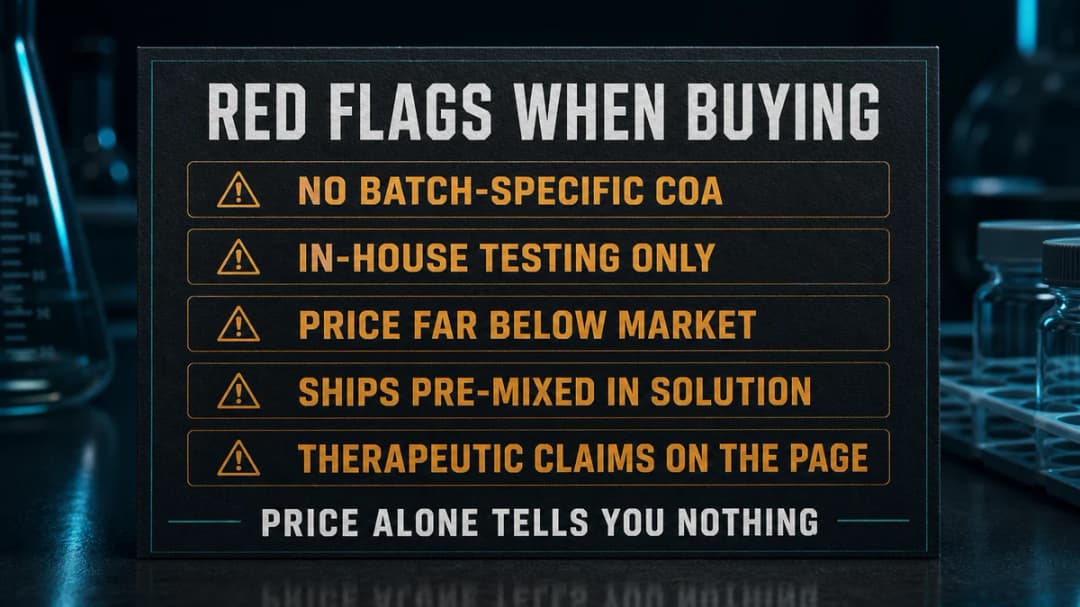
- No batch specific COA, or a COA without a visible chromatogram
- HPLC only, with no mass spectrometry, on an acylated peptide
- Prices far below the market floor
- Claims about weight loss results, dosing for humans, or medical benefit on the product page
- No named third party testing laboratory
- Vague or absent storage guidance
- Pressure tactics, countdown timers and bulk discounts as the main selling proposition
That fourth point is worth dwelling on. A supplier making human dosing claims about an unapproved compound is telling you something about their compliance posture, and by extension about how seriously they take everything else.
FAQ
Is cagrilintide legal to buy?
It is sold as a research chemical in most markets and is not approved for human use anywhere. Buying it for laboratory research is generally permitted; selling it for human consumption is not. Regulations vary by country and are worth checking locally.
How much cagrilintide is in a typical vial?
5 mg is the most common presentation, with 10 mg also available. Vial size and price per milligram are the two figures to compare across suppliers, since a cheap vial with less peptide in it is not cheaper.
Can you buy CagriSema?
Not as a finished product. CagriSema is Novo Nordisk's fixed combination of cagrilintide and semaglutide, still in the regulatory pipeline. What research suppliers sell is cagrilintide as a separate compound.
How long does cagrilintide last once reconstituted?
Around 28 days refrigerated, assuming bacteriostatic water was used and the vial has been handled cleanly. Sterile water without a preservative gives a much shorter usable window.
Why is mass spectrometry necessary for cagrilintide?
Because the fatty acid acylation is what makes the molecule long acting, and HPLC purity alone does not confirm it is present. A mass spectrometry result matching the expected molecular weight is the practical check that you have the modified peptide rather than a plain analogue.