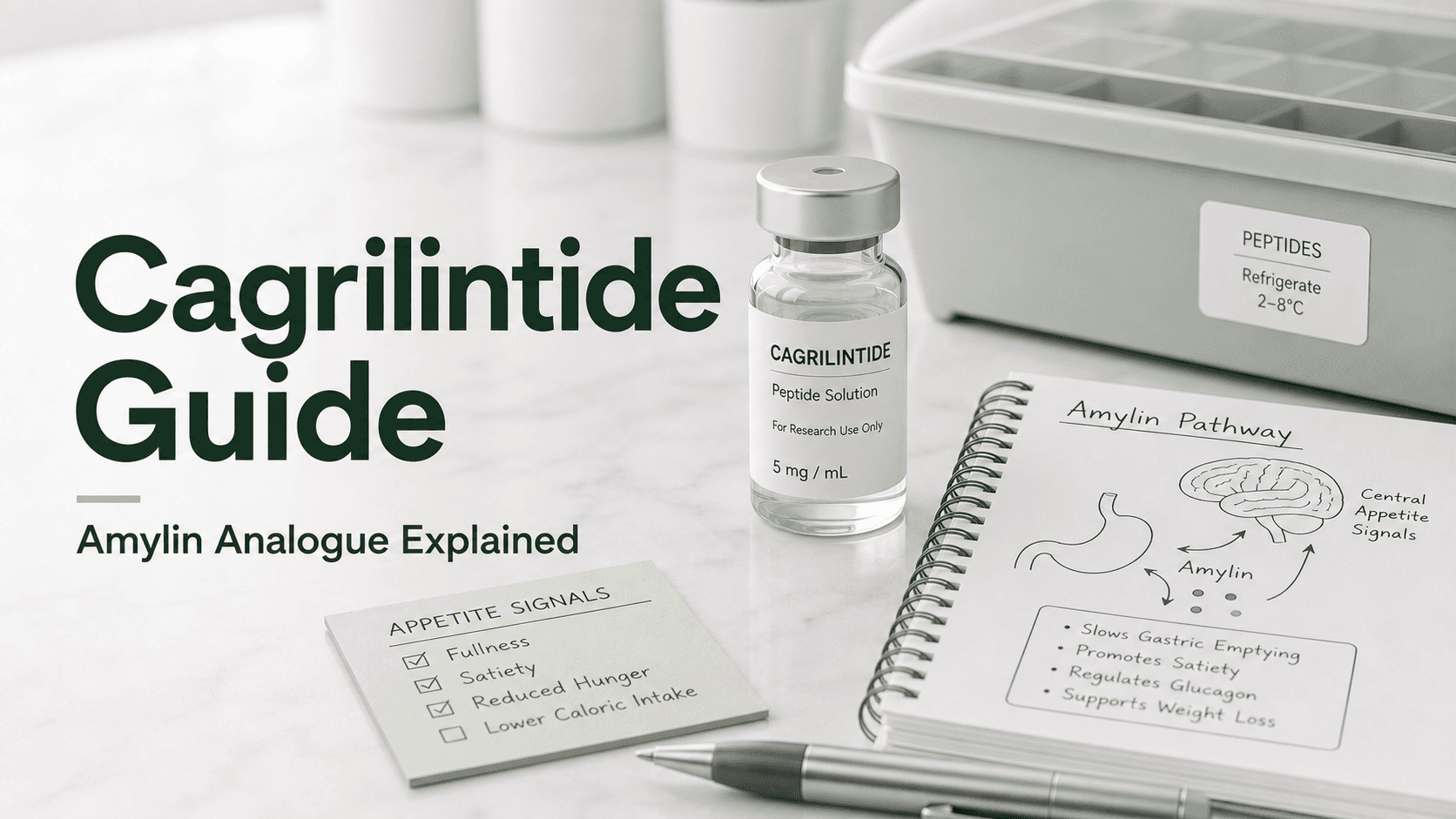
Cagrilintide is an investigational long-acting amylin analogue. It is best known because Novo Nordisk is studying it in combination with semaglutide as CagriSema.
Direct answer: Cagrilintide is not the same as a GLP-1 drug. It targets amylin-related pathways that influence satiety, food intake, and metabolic regulation. As of this draft, cagrilintide is not a routine FDA-approved standalone obesity medication. The most commercially important context is CagriSema, the cagrilintide 2.4 mg plus semaglutide 2.4 mg fixed-dose combination submitted to FDA in December 2025.
Why Amylin Matters
Amylin is co-secreted with insulin from pancreatic beta cells. It helps regulate post-meal glucose and satiety signals. Amylin analogues are interesting because they may complement GLP-1 effects without being identical to GLP-1 receptor agonists.
Cagrilintide Versus GLP-1s
| Topic | Cagrilintide | GLP-1 receptor agonists |
|---|---|---|
| Main pathway | Amylin analogue / related receptor activity | GLP-1 receptor activity |
| Appetite effect | Satiety and food-intake regulation | Appetite, gastric emptying, glucose-dependent insulin |
| Commercial status | Investigational in obesity contexts | Several approved products |
| Combination logic | Complements GLP-1 mechanisms | Often backbone therapy |
Safety Context
The main side-effect conversation overlaps with appetite and GI tolerability: nausea, vomiting, reduced appetite, and dose-escalation issues. Because cagrilintide is investigational in this context, readers should avoid research-market products and wait for regulated prescribing information. For readers who go looking anyway, our guide to buying cagrilintide for research explains how to vet a vendor.
Internal Reading Path
FAQ
Is cagrilintide approved?
Not as a routine standalone obesity medication in the way Wegovy or Zepbound are approved. Treat it as investigational unless a current official label says otherwise.

Is cagrilintide a GLP-1?
No. It is an amylin analogue, which is why the combination with semaglutide is scientifically interesting.
Can I buy cagrilintide online?
Research-market availability is not the same as approved, quality-controlled prescribing. Avoid unapproved products.
Evidence Level and Uncertainty
For cagrilintide guide, the strongest content separates established label information from clinical-trial findings, early mechanistic research, animal data, anecdotes, and speculation. Readers need to know what is known, what is promising, and what is still uncertain.
| Evidence type | How to interpret it |
|---|---|
| FDA label or prescribing information | Highest practical authority for approved use |
| Randomized clinical trial | Strong evidence for studied population and dose |
| Observational study | Useful but more confounded |
| Mechanistic or animal data | Hypothesis-generating, not proof of patient benefit |
| Anecdote or forum report | Can reveal questions, not reliable rates |
Questions to Bring to the Prescriber or Pharmacist
- Does my current dose and timing match the official label or my prescription?
- Are my symptoms or concerns expected at this stage, or do they suggest changing the plan?
- Should I delay escalation, restart lower, hold steady, or be evaluated before continuing?
- Are any of my other medications increasing risk, especially insulin, sulfonylureas, blood pressure medication, diuretics, or drugs affected by delayed gastric emptying?
- What exact symptoms should make me call urgently or seek same-day care?
- If cost or supply interrupts therapy, what is the safest backup plan?
Bottom Line for Cagrilintide Guide: The Amylin Analogue Behind CagriSema
The practical answer is rarely just one number, food list, or yes-or-no rule. For cagrilintide guide, the safest approach is to combine the direct answer with the variables that change it: product type, dose, timing, side effects, storage history, other medications, and the person's medical context. When those variables are unclear, the best next step is to ask the prescriber or pharmacist before acting.
Additional Scenarios Readers Commonly Compare
| Scenario | How to think about it |
|---|---|
| Symptoms started after a dose increase | Treat escalation as a likely contributor and ask whether to hold the dose longer |
| The plan changed because of supply | Confirm whether a restart or lower dose is safer after the gap |
| Advice online conflicts with the label | Use the label, pharmacy, and prescriber as the authority |
| The medication is compounded | Verify concentration, BUD, storage, sterility, and dose instructions directly with the pharmacy |
| The goal is maintenance | Prioritize sustainable intake, resistance training, monitoring, and follow-up |
More FAQ
Why do different websites give different answers?
Most differences come from assuming different products, concentrations, patient goals, dose histories, or risk tolerance. A chart or tip can be mathematically correct but still wrong for a specific prescription.
What information should I keep in my notes?
Keep the medication name, dose, date taken, pharmacy label, concentration if vial-based, side effects, food and fluid changes, weight trend, and any clinician instructions. This makes follow-up safer and more specific.
When is it better not to troubleshoot at home?
Do not troubleshoot at home when symptoms are severe, rapidly worsening, involve chest pain or fainting, include repeated vomiting or dehydration, suggest allergic reaction, or involve a possible dosing or storage error.
Detailed Reader Scenarios
A stronger page for cagrilintide guide needs to answer the situations people actually bring to search. The same keyword can represent a careful planner, someone with active symptoms, someone whose pharmacy instructions are confusing, or someone who is trying to decide whether the issue is urgent. The sections below turn the topic into practical scenarios without replacing medical judgment.
Scenario 1: Same active ingredient, different brand purpose
Some brands share an active ingredient but serve different labeled use cases. That matters for eligibility, dose escalation, insurance coverage, and how the clinician documents medical need. Do not assume that two brands can be swapped because a social post calls them the same.
Scenario 2: Better average results versus better personal fit
Search results often rank medications by average weight loss or glucose change. Real care also asks who can tolerate the medication, who can access it, who has contraindications, and who can maintain nutrition and follow-up. A lower average effect that is covered and tolerated can be more useful than a stronger option that causes repeated vomiting or cannot be filled.
Scenario 3: Side effects decide the plan
GI symptoms are not just comfort issues. They affect hydration, protein intake, constipation, glucose patterns, exercise, and whether someone can safely escalate. Any brand comparison should include tolerability, not only outcome headlines.
Comparison Questions That Matter More Than Headlines
| Question | Why it matters |
|---|---|
| What is the labeled indication? | Determines whether the use matches the product |
| What is the current dose and escalation plan? | Side effects often depend on dose speed |
| What product form is used? | Pen, vial, tablet, and KwikPen routines differ |
| What does insurance require? | Coverage can decide the practical option |
| What is the monitoring plan? | Diabetes, kidney risk, side effects, and weight trend need follow-up |
What a Strong Follow-Up Visit Covers
A good follow-up covers benefit, side effects, nutrition, hydration, bowel pattern, dose access, injection comfort, other medications, and the next dose decision. If the only metric discussed is scale weight, the visit is missing important safety and sustainability information.
References
- Novo Nordisk files NDA to FDA for CagriSema (cagrilintide 2.4 mg + semaglutide 2.4 mg), December 2025 — Drugs.com
- Coadministered once-weekly cagrilintide 2.4 mg and semaglutide 2.4 mg, phase 2 trial — PubMed
- Cagrilintide-semaglutide in adults with overweight or obesity and type 2 diabetes, phase 3 — PubMed
- Pramlintide, the synthetic analogue of amylin: physiology and effects — PMC