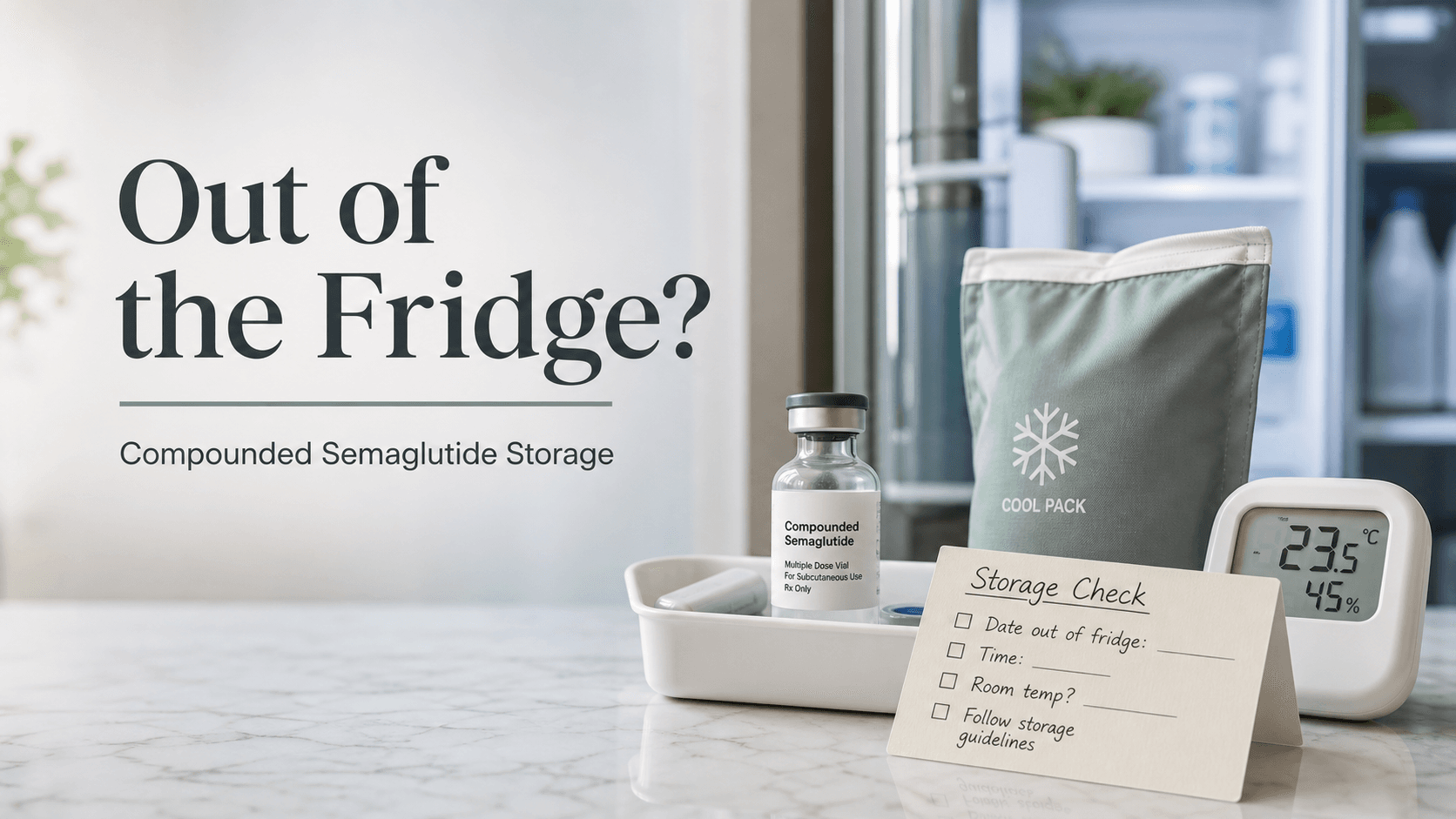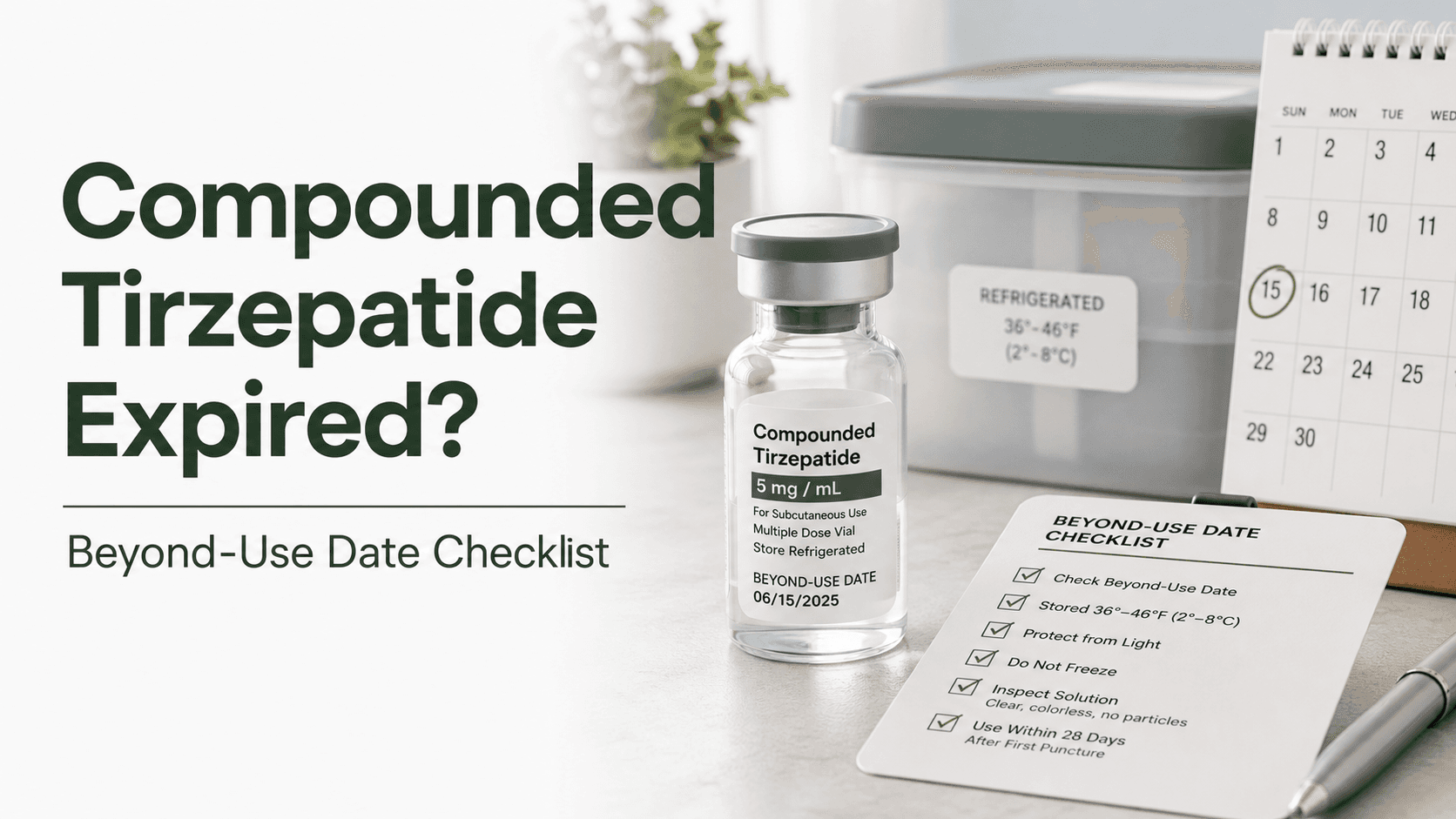
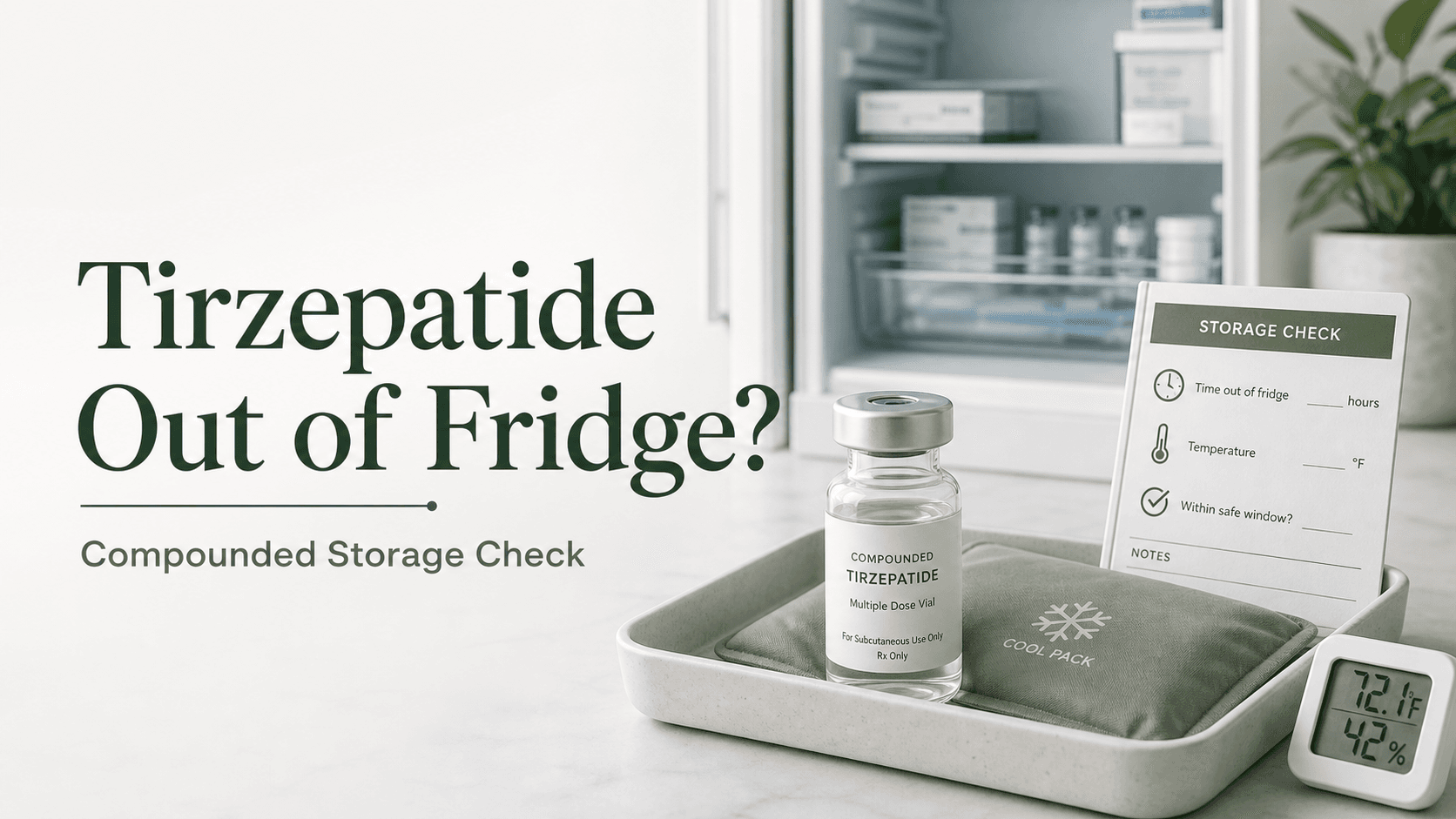
Compounded tirzepatide does not have one universal room-temperature rule.
Short answer: use the dispensing pharmacy's instructions. If the vial was left out, warmed, frozen, or exposed to heat during travel or shipping, call the pharmacy before using it.
What the Pharmacy Needs to Know
| Detail | Why it matters |
|---|---|
| Time out of fridge | Duration affects stability concern |
| Approximate temperature | Warm room vs hot car |
| Whether it froze | Freezing can be a discard issue |
| Whether the vial was punctured | Sterility matters |
| Beyond-use date | Compounded products expire |
Internal Reading Path
Storage Decision Tree
For how long can compounded tirzepatide be out of the fridge, the safest answer comes from the exact product label or the dispensing pharmacy. Branded pens, branded vials, compounded vials, and prefilled syringes can have different stability and sterility rules. Do not use a room-temperature rule from one product to justify using a different product.
Start with these questions: What product is it? Was it unopened, opened, or punctured? What was the highest likely temperature? How long was it out? Did it freeze? Does it look clear and particle-free? Is the expiration date or beyond-use date still valid? If any answer is uncertain, call the pharmacist.
| Situation | Safer next step |
|---|---|
| Hot car or direct sun | Call before use; heat exposure is high risk |
| Frozen product | Call; many peptide products should not be used after freezing |
| Cloudy or particles | Do not use until pharmacy reviews |
| Expired or past BUD | Replace rather than guessing |
| Compounded vial | Follow the pharmacy-specific BUD and storage instructions |
What to Say When You Call the Pharmacy
Use concrete details. Say the medication name, strength, dosage form, lot number if available, expiration or BUD, whether it was opened or punctured, how long it was out, the approximate temperature, and whether the appearance changed. Ask whether it should be used, discarded, replaced, or documented.
This matters because pharmacists can often make a better decision with specifics than with a general question like, 'Is it still good?'
Prevention for Travel and Weekly Routines
Store medication where temperature is stable, not in a car, checked bag, sunny window, freezer area, or bathroom. Use reminders for injection day, keep the box or pharmacy label until the medication is finished, and write the puncture or first-use date on compounded vials if the pharmacy recommends it. For travel, ask the pharmacy about insulated storage and what to do if the product is delayed or arrives warm.
Questions to Bring to the Prescriber or Pharmacist
- Does my current dose and timing match the official label or my prescription?
- Are my symptoms or concerns expected at this stage, or do they suggest changing the plan?
- Should I delay escalation, restart lower, hold steady, or be evaluated before continuing?
- Are any of my other medications increasing risk, especially insulin, sulfonylureas, blood pressure medication, diuretics, or drugs affected by delayed gastric emptying?
- What exact symptoms should make me call urgently or seek same-day care?
- If cost or supply interrupts therapy, what is the safest backup plan?
Bottom Line for How Long Can Compounded Tirzepatide Be Out of the Fridge?
The practical answer is rarely just one number, food list, or yes-or-no rule. For how long can compounded tirzepatide be out of the fridge, the safest approach is to combine the direct answer with the variables that change it: product type, dose, timing, side effects, storage history, other medications, and the person's medical context. When those variables are unclear, the best next step is to ask the prescriber or pharmacist before acting.
Additional Scenarios Readers Commonly Compare
| Scenario | How to think about it |
|---|---|
| Symptoms started after a dose increase | Treat escalation as a likely contributor and ask whether to hold the dose longer |
| The plan changed because of supply | Confirm whether a restart or lower dose is safer after the gap |
| Advice online conflicts with the label | Use the label, pharmacy, and prescriber as the authority |
| The medication is compounded | Verify concentration, BUD, storage, sterility, and dose instructions directly with the pharmacy |
| The goal is maintenance | Prioritize sustainable intake, resistance training, monitoring, and follow-up |
More FAQ
Why do different websites give different answers?
Most differences come from assuming different products, concentrations, patient goals, dose histories, or risk tolerance. A chart or tip can be mathematically correct but still wrong for a specific prescription.
What information should I keep in my notes?
Keep the medication name, dose, date taken, pharmacy label, concentration if vial-based, side effects, food and fluid changes, weight trend, and any clinician instructions. This makes follow-up safer and more specific.
When is it better not to troubleshoot at home?
Do not troubleshoot at home when symptoms are severe, rapidly worsening, involve chest pain or fainting, include repeated vomiting or dehydration, suggest allergic reaction, or involve a possible dosing or storage error.
Detailed Reader Scenarios
A stronger page for how long can compounded tirzepatide be out of the fridge needs to answer the situations people actually bring to search. The same keyword can represent a careful planner, someone with active symptoms, someone whose pharmacy instructions are confusing, or someone who is trying to decide whether the issue is urgent. The sections below turn the topic into practical scenarios without replacing medical judgment.
Scenario 1: The label and the internet disagree
Use the label and pharmacy instructions first. Internet articles often summarize branded storage rules, but compounded products, punctured vials, mailed medication, prefilled syringes, and pens can all have different requirements. If the product was exposed to heat, freezing, light, contamination risk, or an expired beyond-use date, the safest next step is to ask the pharmacy that dispensed it.
Scenario 2: The product looks normal
A normal appearance does not prove potency or sterility. Peptide medications can lose reliability without obvious color change. Appearance is still useful, but it is only one checkpoint. Cloudiness, particles, discoloration, damaged packaging, leakage, or a missing label should stop use until the pharmacy reviews it.
Scenario 3: The dose is due now
Do not let dose-day pressure force a guess. If a storage accident happens on injection day, call the pharmacy or prescriber and ask whether to use, replace, delay, or document the dose as missed. For diabetes patients, ask whether glucose monitoring should change while waiting for replacement.
Scenario 4: Travel or shipping caused the problem
Record the delivery time, ice-pack condition, vial temperature if known, package damage, and how long the medication sat outside. Many pharmacies need those details before replacing a product or judging whether a temperature excursion is acceptable.
Safe Handling Checklist
| Checkpoint | Use it only if... | Stop and ask if... |
|---|---|---|
| Date | Expiration or BUD is still valid | Date is expired, missing, or unreadable |
| Temperature | Exposure stayed inside written limits | It was hot, frozen, or unknown |
| Appearance | Clear and expected for that product | Cloudy, particles, color change, leakage |
| Container | Original labeled container | Unlabeled syringe, damaged vial, loose needle |
| Instructions | Pharmacy directions are clear | Advice conflicts or source is not the dispenser |
Why This Matters
The risk is not only reduced effectiveness. With compounded or transferred medication, sterility and handling can matter too. A dose that is weaker than expected can affect blood sugar or weight treatment. A contaminated or mishandled product can create injection-site or infection concerns. The practical answer is to preserve the product details, avoid guessing, and get a yes-or-no answer from the pharmacy.
Edge Cases That Change the Answer
For how long can compounded tirzepatide be out of the fridge, the usual advice can change when there is a long medication gap, a recent dose increase, active vomiting or diarrhea, diabetes medications that can cause low blood sugar, kidney disease, pregnancy planning, surgery or anesthesia, a compounded vial, or uncertainty about the exact product. Those details should be treated as decision points, not footnotes.
A practical way to handle edge cases is to pause and sort the issue into one of three buckets. The first bucket is routine planning: questions about meals, timing, cost, or what to ask at the next visit. The second bucket is same-week clinical guidance: persistent side effects, repeated missed doses, uncertain conversions, or a plan that cannot be filled. The third bucket is urgent evaluation: severe pain, chest symptoms, fainting, allergic reaction symptoms, dehydration, confusion, or a possible large dosing error.
| Bucket | Examples | Best next step |
|---|---|---|
| Routine planning | Meal changes, mild symptoms, coverage questions | Bring notes to the next visit |
| Prompt guidance | Persistent symptoms, switch timing, unclear label, storage uncertainty | Call prescriber or pharmacist |
| Urgent care | Severe pain, fainting, chest pain, allergic symptoms, dehydration | Seek same-day or emergency care |
Practical Takeaway
If a reader remembers only one thing from this page, it should be that how long can compounded tirzepatide be out of the fridge is context-dependent. The safest answer comes from matching the general information to the exact medication, dose, timing, symptoms, product label, and medical history. When those details are incomplete, the right move is to ask before acting.
Summary
For compounded tirzepatide, storage guidance comes from the pharmacy that made it. Do not use a different product's room-temperature window. If you are choosing a pharmacy, our guide to buying compounded tirzepatide covers what to check before you pay.
References
- U.S. Food and Drug Administration. Understanding the Risks of Compounded Drugs. (Compounded tirzepatide is not FDA-approved; storage and beyond-use limits are set by the compounder.)
- U.S. Food and Drug Administration. MOUNJARO (tirzepatide) injection — Prescribing Information. (Manufacturer refrigeration and room-temperature storage limits for branded tirzepatide.)