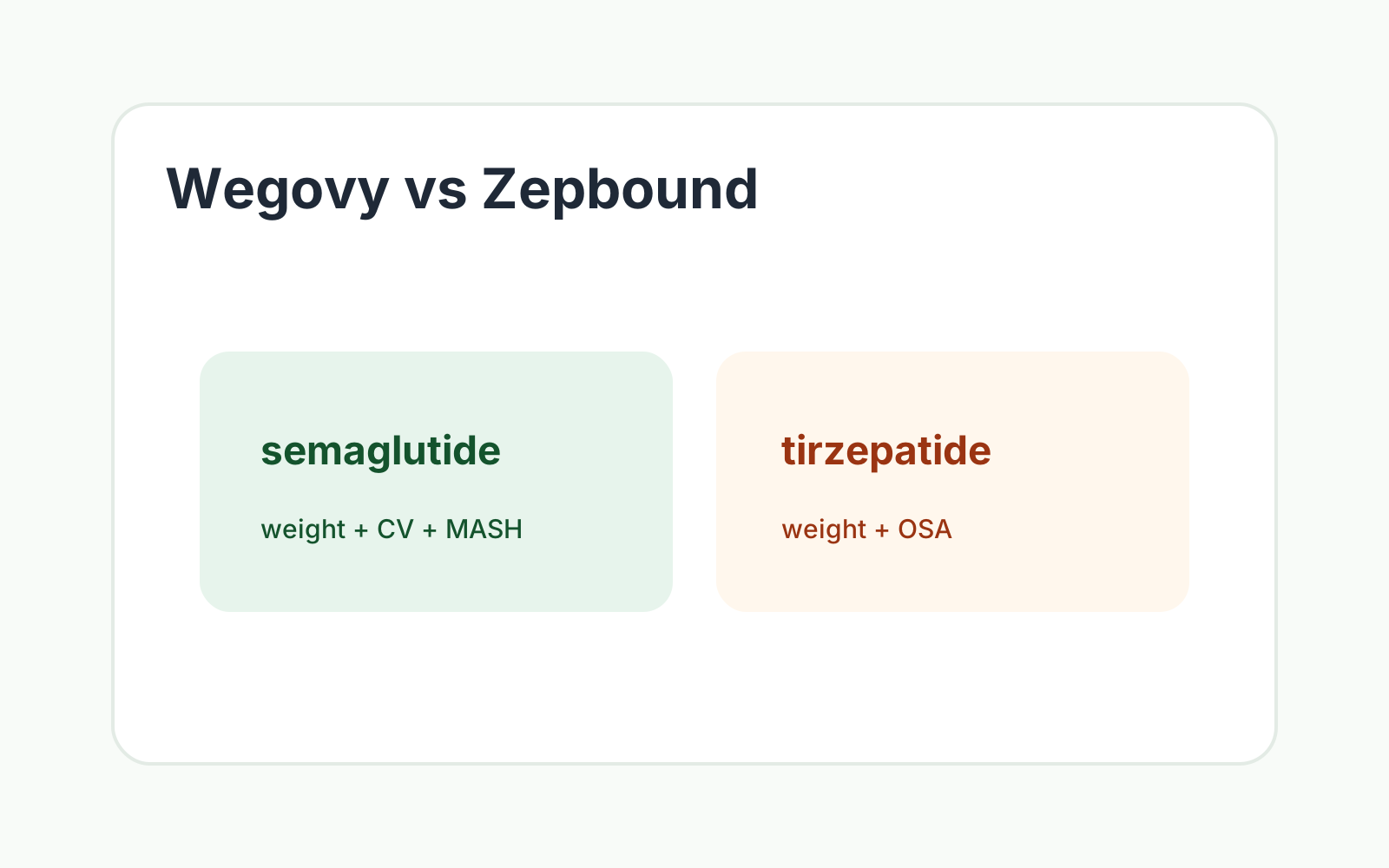
Wegovy and Zepbound are both used for weight management, but they are different medications.
Short answer: switching from Wegovy to Zepbound should be handled by the prescriber. Wegovy is semaglutide. Zepbound is tirzepatide. There is no universal one-to-one dose conversion. Whatever Wegovy dose you are on now, the Zepbound label starts everyone at 2.5 mg once weekly for four weeks.
What Changes
| Topic | Wegovy | Zepbound |
|---|---|---|
| Active ingredient | Semaglutide | Tirzepatide |
| Receptor activity | GLP-1 | GIP and GLP-1 |
| Usual rhythm | Weekly | Weekly |
| Main switch risk | Assuming equivalent doses | Same |
| Approved uses | Weight reduction (adults and ages 12+), cardiovascular risk reduction, noncirrhotic MASH with moderate to advanced fibrosis | Weight reduction (adults), moderate to severe obstructive sleep apnea in adults with obesity |
| Dose ladder | 0.25 → 0.5 → 1 → 1.7 → 2.4 mg weekly | 2.5 → 5 → 7.5 → 10 → 12.5 → 15 mg weekly |
| Maximum dose | 2.4 mg weekly, or 7.2 mg weekly with Wegovy HD | 15 mg weekly |
| Elimination half-life | About 1 week | About 5 days |
| Missed dose window | Take it if the next scheduled dose is more than 2 days away | Take it within 4 days (96 hours) |
Wegovy to Zepbound Conversion: The Two Dose Ladders Side by Side
Before anyone can talk about converting Wegovy to Zepbound, it helps to see that the two products do not even use the same number of steps. Wegovy escalates on a fixed calendar written into the label. Zepbound escalates in 2.5 mg increments with a minimum of four weeks on each dose, so the column below is the fastest schedule allowed, not a schedule anyone is required to follow.
| Time on treatment | Wegovy (semaglutide) | Zepbound (tirzepatide) |
|---|---|---|
| Weeks 1–4 | 0.25 mg weekly | 2.5 mg weekly |
| Weeks 5–8 | 0.5 mg weekly | 5 mg weekly |
| Weeks 9–12 | 1 mg weekly | 7.5 mg weekly |
| Weeks 13–16 | 1.7 mg weekly | 10 mg weekly |
| Weeks 17–20 | 2.4 mg weekly (maintenance) | 12.5 mg weekly |
| Week 21 onward | 2.4 mg, or 7.2 mg after at least 4 weeks at 2.4 mg | 15 mg weekly (maximum) |
Three details in that table trip people up.

- Zepbound 2.5 mg is not a maintenance dose. The label calls it a treatment initiation dose and explicitly states it is not approved as a maintenance dosage. The approved maintenance doses for weight reduction are 5 mg, 10 mg, and 15 mg. For obstructive sleep apnea they are 10 mg and 15 mg only.
- 7.5 mg and 12.5 mg are stepping stones. They exist so escalation can move in 2.5 mg increments, not as target doses.
- Wegovy now has a higher ceiling than most charts show. Semaglutide 7.2 mg (Wegovy HD) was approved in March 2026, and the current label allows escalation to it after at least four weeks of tolerating 2.4 mg when more weight reduction is clinically indicated. Older conversion charts stop at 2.4 mg.
Wegovy to Zepbound Dosage Conversion Chart
There is no FDA-recognized dose equivalence between semaglutide and tirzepatide. They bind different receptors, so a milligram of one is not a unit of the same thing as a milligram of the other. Any conversion chart you find, including this one, is clinical convention rather than label guidance.
What the label actually says is short and does not vary by row:
| Your current Wegovy dose | Zepbound starting dose per label | What prescribers weigh on top of that |
|---|---|---|
| 0.25 mg or 0.5 mg | 2.5 mg weekly for 4 weeks | Little tolerance history to carry over, so the standard ladder is the usual choice |
| 1 mg | 2.5 mg weekly for 4 weeks | Some prescribers start at 5 mg when 1 mg was tolerated without GI trouble |
| 1.7 mg | 2.5 mg weekly for 4 weeks | Same reasoning, decided on tolerance history rather than arithmetic |
| 2.4 mg | 2.5 mg weekly for 4 weeks | 5 mg is a common off-label starting choice because it is the lowest approved Zepbound maintenance dose |
| 7.2 mg (Wegovy HD) | 2.5 mg weekly for 4 weeks | No published data on this specific transition; expect the standard ladder |
Starting anywhere above 2.5 mg on day one is off-label prescriber judgment, not a labeled conversion. It is not fringe, though. A prospective study switched adults with type 2 diabetes from a stable GLP-1 receptor agonist, most commonly semaglutide 1 mg or dulaglutide 1.5 mg, directly to tirzepatide 5 mg. Over 12 weeks, 13.2% developed gastrointestinal events and 2% stopped tirzepatide because of adverse events. A separate retrospective review of 156 patients moved through a hospital system's own incretin interchange protocol found 96% tolerated the change, 58% moved to a higher strength, and the interchange cut time to maximum dose by a median of three months. Neither study used Wegovy-range semaglutide doses, so neither settles the 2.4 mg question.
What the Head-to-Head Trials Say About Equivalent Doses
The closest thing to an evidence-based conversion is the two trials that put the drugs against each other at named doses.
| Trial | Semaglutide arm | Tirzepatide arm | Result |
|---|---|---|---|
| SURPASS-2 (type 2 diabetes, 40 weeks, n=1,879) | 1 mg weekly | 5 mg weekly | Tirzepatide won: A1c −2.01 vs −1.86 points, and 1.9 kg more weight loss |
| SURPASS-2 | 1 mg weekly | 15 mg weekly | 5.5 kg more weight loss with tirzepatide |
| SURMOUNT-5 (obesity, no diabetes, 72 weeks, n=751) | 1.7 or 2.4 mg weekly | 10 or 15 mg weekly | −20.2% vs −13.7% body weight |
Read that as a direction, not a ratio. Tirzepatide 5 mg already outperformed semaglutide 1 mg, and tirzepatide 10 to 15 mg outperformed the full Wegovy maintenance range. Nothing in either trial licenses a statement like "2.4 mg equals 10 mg."
Timing the Transition: Last Wegovy Dose to First Zepbound Dose
Both labels say the same thing about overlap. Wegovy's states that concomitant use with any other GLP-1 receptor agonist is not recommended. Zepbound's states that coadministration with any GLP-1 receptor agonist is not recommended. Tirzepatide activates the GLP-1 receptor, so stacking the two is off the table.
A true pharmacologic washout is not practical. Semaglutide has an elimination half-life of about one week and, per the label, remains in circulation for roughly five to seven weeks after the last 2.4 mg injection. Waiting that out would mean more than a month with no treatment, appetite returning, and weight regain in progress.
So what happens in practice is a scheduled handoff rather than a washout. The common convention is to take the first Zepbound dose on the day the next Wegovy dose would have been due, about seven days after the last Wegovy injection. That interval is not arbitrary: it matches the only switching instruction the Wegovy label itself contains, which tells patients moving from the 2.4 mg injection to 25 mg oral tablets to start the tablets one week after discontinuing the injection. Pharmacy guidance on transitioning between weight-loss medications describes the same range of choices, from a same-day changeover for someone stable and tolerating treatment well to a one- to two-week gap for someone whose side effects were significant.
Two practical timing rules worth writing down:
- Zepbound's dosing day can be moved later, as long as at least 3 days (72 hours) separate two doses.
- If a Zepbound dose is missed, it can be taken within 4 days (96 hours). Past that, skip it and resume on the regular day.
Confirm the actual date with the prescriber before injecting anything. Insurance approval, pen availability, and an active bout of nausea all change the answer.
Questions to Ask
- Why are we switching: plateau, side effects, coverage, supply, or indication?
- When should the last Wegovy dose be taken?
- What Zepbound starting dose fits my tolerance history?
- Should escalation restart more cautiously?
- What symptoms mean I should call?
Safety Notes
Do not overlap medications unless the prescriber explicitly directs it. Do not copy online conversion charts as personal dosing instructions.
Is It Safe to Switch From Wegovy to Zepbound?
There is no labeled safety warning against changing from Wegovy to Zepbound. The warning that does exist is against taking them at the same time. Handled as a sequential switch with a proper restart, the transition is routine enough that it is done constantly for coverage and supply reasons. When coverage is the reason for the change, our page on whether a Zepbound generic exists covers what is available instead.
The risk is not the switch itself. It is the assumption that a high Wegovy dose buys a high Zepbound starting dose. Both drugs carry the same class-level cautions the prescriber is screening for, and those do not disappear because you have already tolerated one of them:
- Both are contraindicated with a personal or family history of medullary thyroid carcinoma or MEN 2.
- Both delay gastric emptying, which matters for other oral medications and for anesthesia planning before surgery or a procedure.
- Both raise the risk of pancreatitis, gallbladder disease, and dehydration from GI side effects.
- Both require a plan for insulin or sulfonylurea doses, because hypoglycemia risk changes.
- Wegovy's label says to discontinue at least two months before a planned pregnancy because of semaglutide's long half-life. Switching products does not reset that clock.
The honest summary: switching between Wegovy and Zepbound is safe in the same sense that starting either one is safe, provided the restart dose and the interval are set by someone with your chart in front of them.
Internal Reading Path
Why This Is Not a DIY Timing Decision
For switching from wegovy to zepbound, the main risk is treating a medication transition like a simple calendar swap. GLP-1 medications can have long half-lives, overlapping effects, and dose-escalation schedules designed to reduce side effects. If the switch happens too aggressively, nausea, vomiting, dehydration, reflux, constipation, or glucose changes can become harder to manage.
The prescriber needs to know the exact current medication, dose, last dose date, side effects, reason for switching, diabetes medications, pregnancy or procedure plans, and whether the new product is already approved by insurance.
Transition Planning Table
| Question | Why it matters |
|---|---|
| Why switch now? | Plateau, cost, supply, side effects, or indication changes the plan |
| How long since the last dose? | A long gap may require restarting lower |
| Were side effects active? | Switching during active GI symptoms can compound problems |
| Is diabetes medication involved? | Insulin or sulfonylureas can change hypoglycemia risk |
| Is there a procedure or pregnancy plan? | Washout guidance may be different |
| What is the backup plan? | Supply gaps and intolerance are common practical problems |
What to Monitor After the Change
The first several weeks after a change should be treated as a monitoring period. Track appetite, nausea, vomiting, bowel pattern, reflux, hydration, dizziness, glucose readings if relevant, weight trend, and whether protein intake is falling. The point is not to overreact to every symptom. The point is to catch patterns early enough to slow escalation or adjust the plan before symptoms become severe.
Tirzepatide reaches steady-state blood levels after about four weeks of once-weekly dosing, which is also the minimum interval between escalation steps. That is the practical reason a dose is judged at four weeks rather than at one: the first two injections do not represent what that dose will eventually feel like.
Converting Back: Zepbound to Wegovy
The reverse direction gets asked almost as often, usually when coverage flips or Zepbound side effects do not settle. The same rule applies in reverse: there is no validated zepbound to wegovy conversion, and being on 15 mg tirzepatide does not entitle you to start at 2.4 mg semaglutide. Readers asking that because of price can check our page on whether a Wegovy generic exists.
| Situation | The conservative approach |
|---|---|
| Any current Zepbound dose | Restart Wegovy at 0.25 mg weekly and follow the label escalation |
| Zepbound tolerated well, no GI symptoms | Some prescribers change over on the next scheduled dosing day |
| Zepbound caused significant side effects | A one- to two-week gap before the first Wegovy dose is a common choice |
| Coming off Zepbound after a long gap | Treat it as a fresh start, not a resumption |
Restarting Wegovy at its lowest dose regardless of the prior tirzepatide dose is the approach pharmacy guidance describes, for the same reason the forward direction starts low: the escalation schedule exists to limit GI adverse reactions, and tolerance to one molecule does not transfer to the other. Tirzepatide's half-life is about five days, so the drug clears somewhat faster than semaglutide but is still present for weeks after the last injection.
Questions to Bring to the Prescriber or Pharmacist
- Does my current dose and timing match the official label or my prescription?
- Are my symptoms or concerns expected at this stage, or do they suggest changing the plan?
- Should I delay escalation, restart lower, hold steady, or be evaluated before continuing?
- Are any of my other medications increasing risk, especially insulin, sulfonylureas, blood pressure medication, diuretics, or drugs affected by delayed gastric emptying?
- What exact symptoms should make me call urgently or seek same-day care?
- If cost or supply interrupts therapy, what is the safest backup plan?
Bottom Line for Switching From Wegovy to Zepbound: Timing, Dose Questions, and Safety
The practical answer is rarely just one number, food list, or yes-or-no rule. For switching from wegovy to zepbound, the safest approach is to combine the direct answer with the variables that change it: product type, dose, timing, side effects, storage history, other medications, and the person's medical context. When those variables are unclear, the best next step is to ask the prescriber or pharmacist before acting.
Additional Scenarios Readers Commonly Compare
| Scenario | How to think about it |
|---|---|
| Symptoms started after a dose increase | Treat escalation as a likely contributor and ask whether to hold the dose longer |
| The plan changed because of supply | Confirm whether a restart or lower dose is safer after the gap |
| Advice online conflicts with the label | Use the label, pharmacy, and prescriber as the authority |
| The medication is compounded | Verify concentration, BUD, storage, sterility, and dose instructions directly with the pharmacy |
| The goal is maintenance | Prioritize sustainable intake, resistance training, monitoring, and follow-up |
More FAQ
Can I switch from Wegovy to Zepbound?
Yes, with a prescription. Nothing in either label forbids changing from one to the other, and coverage changes, supply gaps, plateaus, and side effects are all common reasons prescribers do it. What the labels do forbid is taking both at once. So it is a sequential switch, with a stop date for Wegovy and a start date and starting dose for Zepbound.
Can you switch between Wegovy and Zepbound more than once?
There is no labeled limit on how many times you can move between them, and in practice people bounce between the two as formularies and shortages change. Each change is treated as its own restart decision, which means each one gets a starting dose set on current tolerance rather than on whatever dose you were at last time you took that drug.
Wegovy 1 mg is equal to what dose of Zepbound?
No dose of Zepbound is officially equal to 1 mg of Wegovy, because no equivalence has been established between the two molecules. The nearest evidence: in SURPASS-2, tirzepatide 5 mg beat semaglutide 1 mg on both A1c and weight, so 5 mg is more than a match rather than an equal. The Zepbound label still directs a 2.5 mg start.
What is the Wegovy equivalent to a 7.5 mg Zepbound pen?
There is no published equivalent. 7.5 mg is a titration step on the way to 10 mg, not an approved Zepbound maintenance dose, and no trial has compared it against any Wegovy dose. The two anchors that do exist bracket it: tirzepatide 5 mg outperformed semaglutide 1 mg in SURPASS-2, and tirzepatide 10 to 15 mg outperformed semaglutide 1.7 to 2.4 mg in SURMOUNT-5. Anyone quoting an exact Wegovy number for 7.5 mg Zepbound is guessing.
Do I need a washout period between Wegovy and Zepbound?
Usually not in the sense of waiting for the old drug to disappear, which would take five to seven weeks for semaglutide. The usual approach is a one-week interval, so the first Zepbound injection falls on the day the next Wegovy injection would have been due. A longer gap of one to two weeks is more often chosen when side effects on Wegovy were significant, and a same-day changeover is sometimes used for people who tolerated treatment well. The prescriber sets the date.
Why do different websites give different answers?
Most differences come from assuming different products, concentrations, patient goals, dose histories, or risk tolerance. A chart or tip can be mathematically correct but still wrong for a specific prescription.
What information should I keep in my notes?
Keep the medication name, dose, date taken, pharmacy label, concentration if vial-based, side effects, food and fluid changes, weight trend, and any clinician instructions. This makes follow-up safer and more specific.
When is it better not to troubleshoot at home?
Do not troubleshoot at home when symptoms are severe, rapidly worsening, involve chest pain or fainting, include repeated vomiting or dehydration, suggest allergic reaction, or involve a possible dosing or storage error.
Quick Self-Check Before Acting
Before making a decision based on switching from wegovy to zepbound, pause long enough to confirm the basics: exact medication, dose, date of last dose, product form, storage history if relevant, current symptoms, and any other medications that could change risk. Most GLP-1 mistakes happen when one of those details is assumed instead of verified.
If the question involves dosing, switching, storage, severe symptoms, pregnancy planning, surgery, diabetes medication, or a compounded vial, treat the article as preparation for a clinician or pharmacist conversation. The safest next step is often not to act faster. It is to bring better information to the person who can make the decision with you.
| Detail to confirm | Why it matters |
|---|---|
| Medication and form | Pens, tablets, branded vials, and compounded vials have different rules |
| Current dose | Dose history changes tolerance and restart decisions |
| Timing | Missed doses, gaps, and dose increases change the plan |
| Symptoms | Severity decides whether this is routine or urgent |
| Storage or expiration | Product reliability depends on label and pharmacy rules |
| Other medications | Insulin, sulfonylureas, blood pressure drugs, and diuretics can change risk |
Final Reminder
This is exactly the kind of GLP-1 question where the safest next step depends on details that may not be obvious from memory. Keep the product box, pharmacy label, dose history, and symptom notes available. If the situation involves uncertainty, do not solve it by repeating a dose, guessing a conversion, or relying on a social-media answer. Use the information here to ask a more precise question and get a safer answer.
Summary
Switching from Wegovy to Zepbound is a clinical transition, not a mg-to-mg conversion. Timing, tolerance, and coverage should drive the plan. The label answer to "what dose do I start on" is 2.5 mg once weekly for four weeks, whatever Wegovy dose you are transitioning from, and the usual interval is one week from the last Wegovy injection. Everything above that is a prescriber decision made on your tolerance history, not on a chart.
References
- U.S. Food and Drug Administration. WEGOVY (semaglutide) injection — Prescribing Information. (Wegovy is semaglutide, a GLP-1 receptor agonist.)
- U.S. Food and Drug Administration. FDA Approves New Medication for Chronic Weight Management (Zepbound). (Zepbound is tirzepatide, a dual GIP/GLP-1 receptor agonist — a different molecule with its own titration schedule.)
- Collins L, Costello RA. Glucagon-Like Peptide-1 Receptor Agonists. StatPearls, NCBI Bookshelf. (Half-lives, dose escalation, and side-effect management across the class.)
- Novo Nordisk. WEGOVY (semaglutide) injection and tablets — current Prescribing Information. DailyMed. (Escalation table 0.25 to 2.4 mg over 16 weeks, 7.2 mg maximum after 4 weeks at 2.4 mg, missed-dose rule, semaglutide half-life of about 1 week with 5 to 7 weeks in circulation, the injection-to-tablet switch at one week, and the statement that concomitant use with another GLP-1 receptor agonist is not recommended.)
- Eli Lilly and Company. ZEPBOUND (tirzepatide) injection — Prescribing Information. (2.5 mg initiation dose for all indications, 2.5 mg increments at four-week minimums, maintenance doses of 5, 10, and 15 mg, 96-hour missed-dose window, 72-hour minimum between doses, tirzepatide half-life of about 5 days, and the statement that coadministration with any GLP-1 receptor agonist is not recommended.)
- Novo Nordisk. FDA approves Wegovy HD (semaglutide 7.2 mg) injection. March 2026. (The higher Wegovy ceiling that older conversion charts predate.)
- Aronne LJ, Horn DB, le Roux CW, et al. Tirzepatide as Compared with Semaglutide for the Treatment of Obesity. N Engl J Med. 2025;393(1):26-36. (SURMOUNT-5: −20.2% vs −13.7% body weight at 72 weeks, tirzepatide 10–15 mg vs semaglutide 1.7–2.4 mg.)
- Frías JP, Davies MJ, Rosenstock J, et al. Tirzepatide versus Semaglutide Once Weekly in Patients with Type 2 Diabetes. N Engl J Med. 2021;385(6):503-515. (SURPASS-2: tirzepatide 5, 10, and 15 mg vs semaglutide 1 mg over 40 weeks.)
- Jabbour S, Paik JS, Aleppo G, et al. Switching to Tirzepatide 5 mg From Glucagon-Like Peptide-1 Receptor Agonists: Clinical Expectations in the First 12 Weeks of Treatment. Endocr Pract. 2024;30(8):701-709. (Direct switch to tirzepatide 5 mg from a stable GLP-1 receptor agonist; 13.2% GI events, 2% discontinuation at 12 weeks.)
- Hvisdas CM, Goode ND, Kim DH, et al. Characterization of Interchanging Incretin Analogs in Clinical Practice: A Descriptive Report. Endocr Pract. 2025;31(1):59-64. (156 patients moved through an institutional incretin equivalency protocol; 96% tolerated the interchange.)
- Shahid S. Switching between weight-loss medications. The Pharmaceutical Journal, 2026. (No validated dose equivalence between semaglutide and tirzepatide; restart at the lowest dose; same-day changeover versus a one- to two-week gap.)