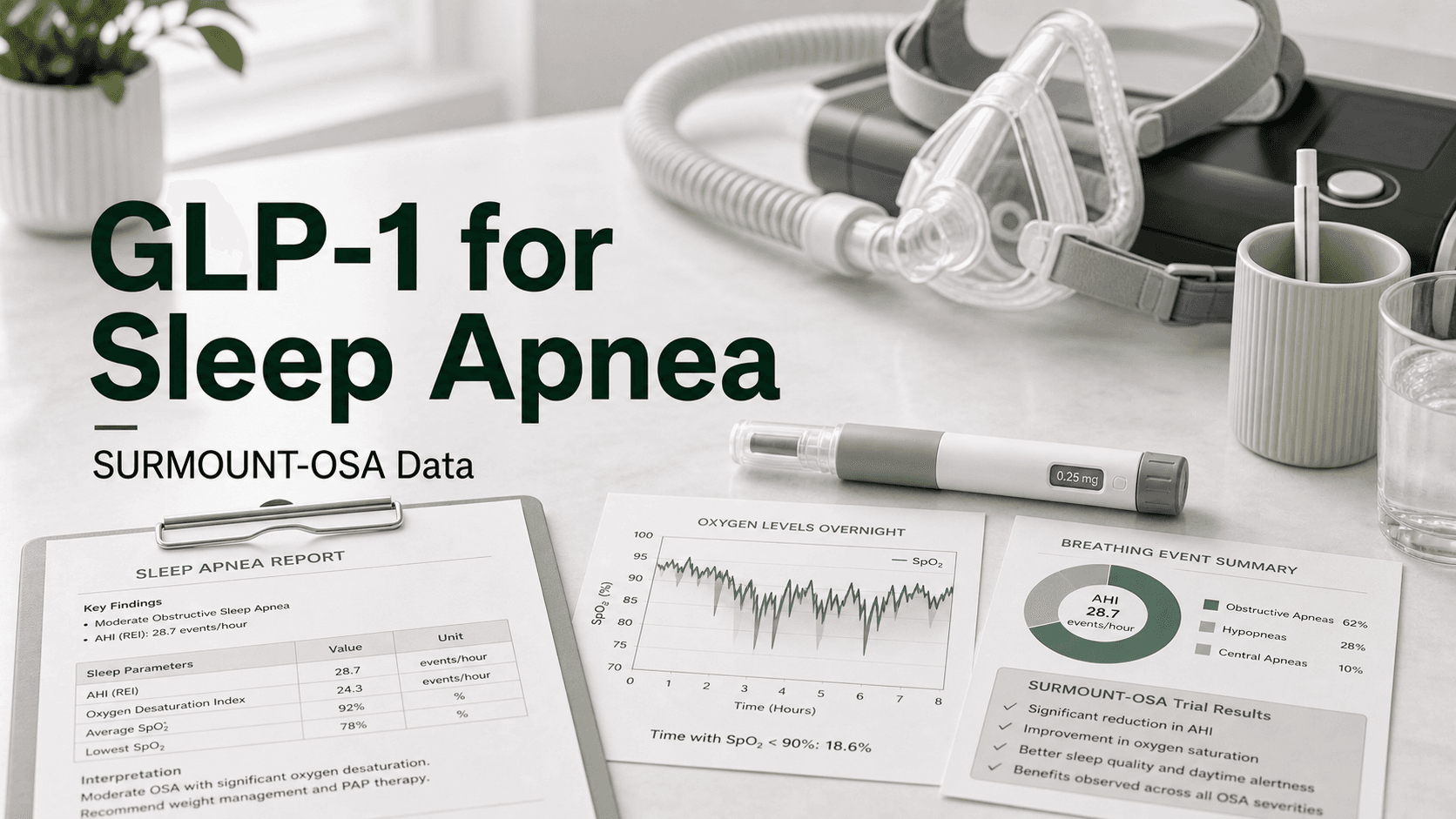
Tirzepatide for sleep apnea is now an approved use, not an off-label one. In December 2024 the FDA approved Zepbound, the tirzepatide brand for weight management, to treat moderate to severe obstructive sleep apnea in adults who also have obesity, making tirzepatide for sleep apnea the first medicine ever licensed for the condition.
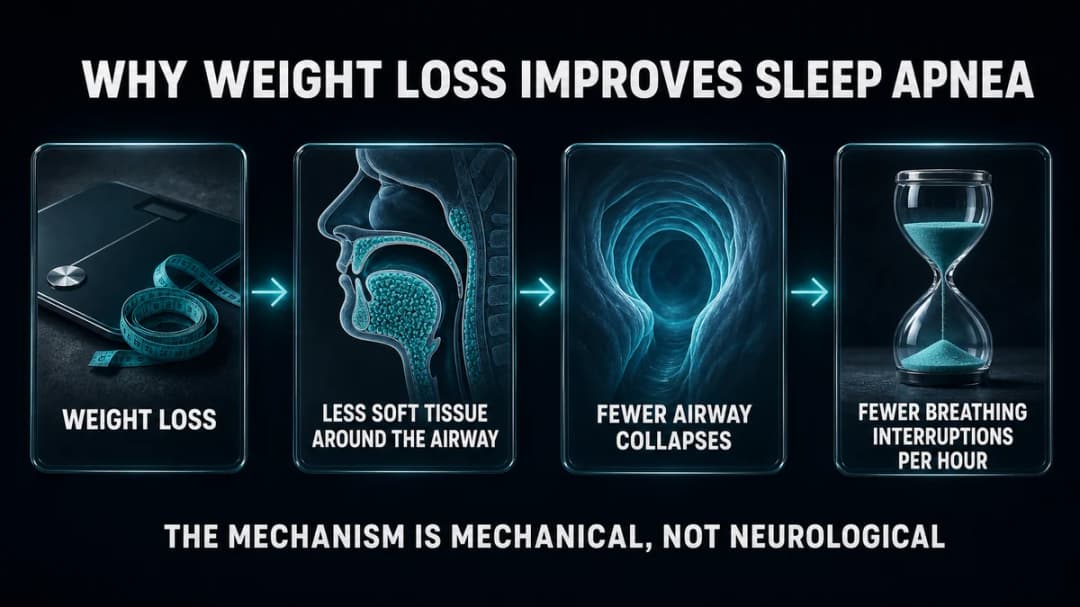
The mechanism is worth understanding before anything else, because it explains exactly who this helps and who it does not. Tirzepatide does not act on the airway. It causes substantial weight loss, and weight loss thins the soft tissue around the upper airway that collapses during sleep. If obesity is not what is closing your airway, this drug will not open it.
What SURMOUNT-OSA Showed
The approval rested on a programme of two 52-week trials, published in the New England Journal of Medicine in June 2024, enrolling 469 adults with obesity and moderate to severe obstructive sleep apnea. One trial studied people not using positive airway pressure therapy. The other studied people who were on PAP and intended to stay on it. Both measured change in the apnoea-hypopnoea index, the count of breathing interruptions per hour of sleep.
| Outcome at 52 weeks | Tirzepatide, no PAP | Placebo, no PAP | Tirzepatide, on PAP | Placebo, on PAP |
|---|---|---|---|---|
| AHI change, events per hour | About -25 | About -5 | About -29 | About -6 |
| Body weight change | About -18% | About -1% | About -20% | About -2% |
Roughly four to five in ten people on tirzepatide finished the trial no longer meeting the criteria for moderate to severe disease, compared with around one in seven on placebo. Adding tirzepatide to PAP therapy outperformed PAP alone on every measure, which suggests the two do different things rather than competing.
The trials also reported improvements in oxygen desaturation burden and in inflammatory markers, both of which follow from the same weight loss.
Why It Works, and Where It Does Not
In most cases of obstructive sleep apnoea in people with obesity, the problem is mechanical. Fat around the pharynx, tongue base and neck narrows the airway, and during sleep, when the muscles holding it open relax, it collapses. Remove enough of that tissue and the airway stays patent.
Tirzepatide is a dual agonist at the GLP-1 and GIP receptors. It reduces appetite, slows gastric emptying, and produces a sustained energy deficit. Over a year that translated into 18 to 20 percent body weight loss in the trials, which is where the airway benefit comes from.
Everything downstream of that logic follows:
- It does nothing for sleep apnoea in people who are not carrying excess weight
- It does nothing for central sleep apnoea, where the problem is the brain's respiratory signalling rather than a blocked airway
- It does nothing for structural causes: a small or set-back jaw, enlarged tonsils, a deviated septum, or nasal obstruction
A repeat sleep study after several months on treatment is what tells you which category you are in.
Tirzepatide for Sleep Apnea: Who Qualifies and How to Get It
The label is specific, and insurers are using it as the gate.
You fit the label if: you are an adult, you have a BMI of 30 or above, and you have a sleep study documenting moderate to severe obstructive sleep apnoea.
You do not fit the label if: your BMI is below 30, your apnoea is mild, your apnoea is central or mixed rather than obstructive, or you are under 18.
The practical route to a prescription:
- Get diagnosed properly. A prescription for this indication requires a sleep study on file. A home sleep test is usually sufficient. Suspected apnoea without documentation will not clear prior authorisation.
- See the right prescriber. A sleep physician, or a primary care doctor working with the sleep report. Some telehealth services now prescribe on this indication, but the sleep study requirement does not go away.
- Expect prior authorisation. Cover for the apnoea indication runs on a different track from weight management cover, and the paperwork is more specific: the sleep study result, a documented BMI, and often a record of PAP therapy having been tried or being unsuitable.
- Titrate, then re-test. The dose is escalated over several months, and a repeat sleep study at roughly six to nine months is what shows whether anything has changed.
Off-label prescribing does happen for people with a BMI between 27 and 30 who have other metabolic problems. Insurance is much less likely to follow.
Related reading: our guide to GLP-1 drugs for sleep apnoea.
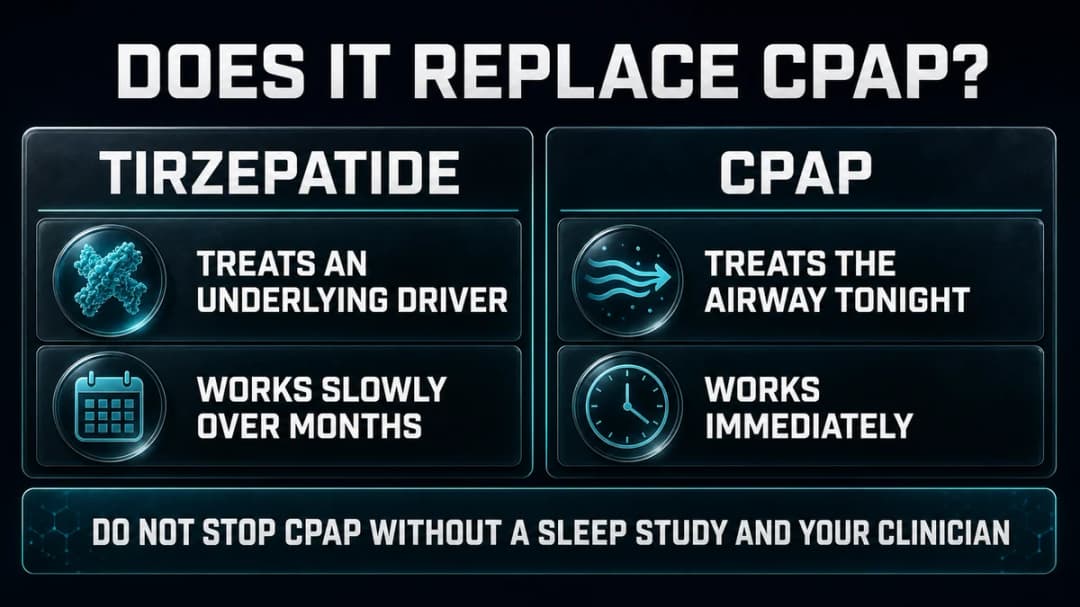
Does It Replace CPAP?
Not on its own, and not quickly.
The difference that matters is timing. Positive airway pressure works the first night it is used correctly. Tirzepatide works over months, as weight comes off, and the benefit in the trials accumulated across the full 52 weeks.
The sequence most sleep physicians use looks like this:
- Continue existing therapy while starting tirzepatide
- Titrate over four to five months to the highest tolerated dose
- Repeat the sleep study at six to nine months, once meaningful weight has gone
- If the repeat study is clean enough, discuss weaning PAP with the prescriber rather than stopping unilaterally
- Re-test periodically, because weight regain brings the apnoea back with it
Stopping CPAP because the drug is working, without a repeat study confirming it, is the main way people get this wrong.
Dosing
The schedule is the same as for weight management. There is no separate apnoea titration.
| Weeks | Dose | What is happening |
|---|---|---|
| 1 to 4 | 2.5 mg weekly | Tolerance-building starting dose, not a treatment dose |
| 5 to 8 | 5 mg weekly | Appetite effects become noticeable |
| 9 to 12 | 7.5 mg weekly | Escalation continues if tolerated |
| 13 to 16 | 10 mg weekly | A common maintenance point |
| 17 onwards | 12.5 or 15 mg weekly | Maximum doses, used where more weight loss is needed |
Most of the apnoea benefit in the trials came at the higher doses, which is also where most of the weight loss happened. See our tirzepatide dosage chart for the full schedule.
What the Months Actually Feel Like
This is the part that gets skipped, and it matters for anyone deciding whether to start.
Weeks 1 to 8. Nausea and appetite change are the dominant experience. A few kilograms come off. Sleep is not noticeably different, because not enough weight has gone to change the airway.
Weeks 12 to 20. This is usually where people, or more often their partners, notice the snoring has changed. Waking less at night, fewer morning headaches, less daytime sleepiness.
Months 9 to 12. The point at which a repeat study is worth doing. Many people test in the mild range by here, and a substantial minority test below the threshold for the condition entirely.
Side Effects
Nothing specific to the apnoea indication. The profile is the same one seen across the tirzepatide trials: nausea most commonly, then diarrhoea, constipation, vomiting and reduced appetite, mostly during dose escalation and mostly settling at a steady dose. A small percentage of people stop because of gastrointestinal effects.
More serious but less common concerns include pancreatitis, gallbladder disease, and the thyroid C-cell tumour warning carried by this drug class. See our Zepbound side effects and tirzepatide side effects pages.
Cost
This is where most people stall. The list price sits above $1,000 a month without coverage.
Options that reduce it:
- Insurance under the apnoea indication. Many commercial plans added it after the approval, with the documentation requirements described above
- Self-pay vials direct from the manufacturer, priced below the branded pen
- Manufacturer savings cards, which can bring qualifying commercially insured patients down substantially
- Compounded tirzepatide, which sits in a legally uncertain space that has narrowed considerably since the shortage ended
Medicare does not cover medicines prescribed for weight loss, though the apnoea indication has opened a narrow path on some Part D plans. See our pages on Zepbound cost without insurance and whether Medicare covers Zepbound.
When Tirzepatide Is the Wrong Answer
- Apnoea without excess weight. The cause is structural and needs an ENT assessment or an oral appliance, not a weight loss drug
- Central or mixed apnoea. Different mechanism entirely
- Severe apnoea with immediate cardiac risk. Waiting six to twelve months for a drug to work is not appropriate when the risk is now. Airway pressure therapy first
FAQ
Is tirzepatide FDA approved for sleep apnea?
Yes. Zepbound was approved in December 2024 for moderate to severe obstructive sleep apnoea in adults with obesity, the first medicine licensed for the condition. Mounjaro, the same drug under its diabetes brand, is not approved for this use.
How long before sleep apnea improves on tirzepatide?
Most people notice changes to snoring and night-time waking somewhere between weeks 12 and 20, which tracks with meaningful weight coming off. A repeat sleep study at six to nine months is what confirms whether the numbers have actually moved.
Can you stop CPAP once tirzepatide is working?
Only after a repeat sleep study shows the apnoea has improved enough, and in discussion with the prescriber. Stopping on the basis of feeling better is how people end up with untreated apnoea they think is resolved.
Does it work if I have sleep apnea but am not obese?
No. The entire mechanism is weight loss thinning the tissue around the airway. Apnoea in someone without excess weight is usually structural, and it needs a different assessment.
Will insurance cover it for sleep apnea?
Many commercial plans do, under a separate prior authorisation track from weight management. The usual requirements are a sleep study documenting moderate to severe obstructive apnoea, a BMI of 30 or above, and often a record of airway pressure therapy having been tried.
What about semaglutide for sleep apnea?
Semaglutide is not approved for this indication. It also produces meaningful weight loss, so the same mechanism plausibly applies, but the trial that would demonstrate it in apnoea specifically has not been run for semaglutide the way it has for tirzepatide.