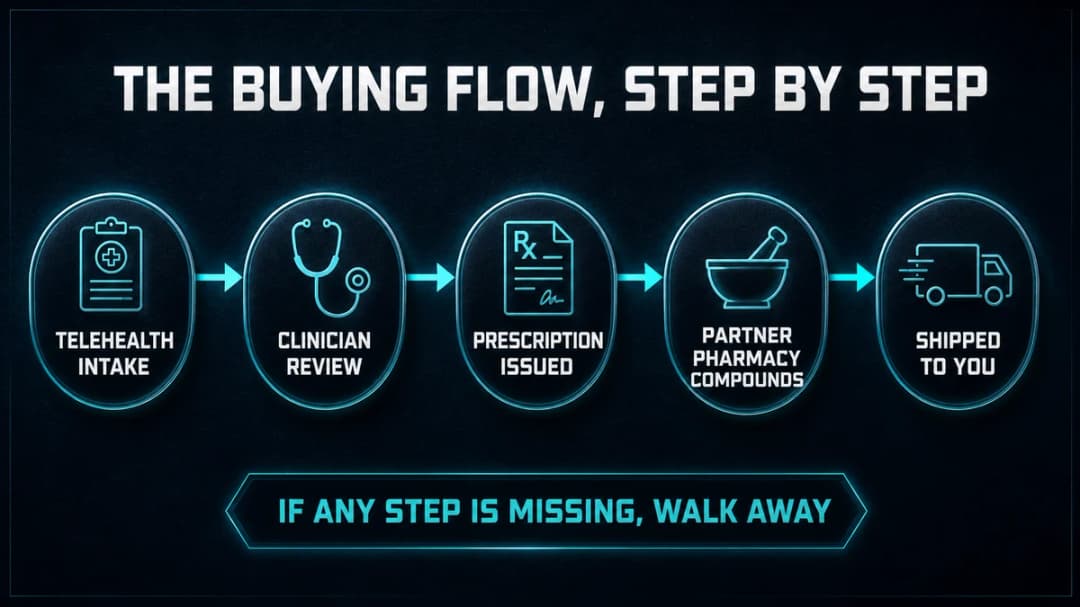
You cannot buy compounded tirzepatide the way people did in 2023, and in most cases you should not try. FDA's enforcement discretion for state-licensed 503A pharmacies compounding tirzepatide ended February 18, 2025, and for 503B outsourcing facilities on March 19, 2025. What survives is a narrow route: a 503A pharmacy filling a patient-specific prescription where your prescriber has documented a clinical need an FDA-approved product cannot meet. Meanwhile brand Zepbound self-pay runs $299 to $449 a month, close enough to compounded pricing that the cost argument for compounding is far weaker than it was.
This page is about the transaction, not the policy history. For background, compounded tirzepatide covers what it is and how the rules changed, and tirzepatide compounding pharmacy covers 503A versus 503B and checking a pharmacy's licence. What follows is what to verify, ask and refuse before money moves.
Be honest about the legal ground you are standing on
What is settled: mass compounding of tirzepatide under the shortage exemption is over. What is not settled: how much of the "personalised formulation" market is lawful. A 503A pharmacy may compound for an individual patient when a prescriber documents a clinical need the approved product cannot meet. A vitamin B12 blend prepared identically for thousands of customers, justified only by the additive, is contested ground rather than clearly legal ground.
On April 30, 2026 FDA proposed excluding semaglutide, tirzepatide and liraglutide from the 503B bulks list, finding no clinical need for outsourcing facilities to compound them from bulk substances. The comment period closed July 30, 2026 after an extension, and as of August 2026 there is no final determination. The 503B question is genuinely open; the 503A question is separate and turns on your individual prescription.
You are not the party FDA acts against; enforcement runs at compounders, prescribers and marketers. But a purchase on shaky legal ground is one with little recourse if the product is wrong.
Run the price maths first, because it may end the decision
The biggest change since the compounded boom is that the brand got cheaper. Prices below are from Lilly's Zepbound coverage and savings page, checked August 2026.
| Route | Monthly cost | Conditions |
|---|---|---|
| Zepbound self-pay, 2.5 mg | $299 | Refill within 45 days of previous delivery |
| Zepbound self-pay, 5 mg | $399 | Same refill window |
| Zepbound self-pay, 7.5 mg and above | $449 | Same refill window |
| Savings card, plan that covers Zepbound | As little as $25 | Max $1,300 savings per calendar year; expires 12/31/2026 |
| Savings card, plan without Zepbound coverage | As low as $299 | 1-month fill |
| Compounded via telehealth | Advertised entry near $199 in early 2026 | Usually the 2.5 mg starter dose |
A first year on brand self-pay, escalating a dose per month then holding at maintenance, lands near $5,200. Compare that against the compounded price at maintenance, not the headline starter price. See tirzepatide cost, cheapest tirzepatide and Zepbound savings card.
Two traps: the $449 tier depends on refilling within 45 days of your previous delivery, and compounded platforms advertise the starter dose then reprice as you titrate.
Vet the platform before you hand over a card
FDA publishes a telehealth red-flag list. Treat any one as a reason to stop:
- Claims the compounded drug is the same as an FDA-approved drug
- Deep discounts, or prices that seem too good to be true
- Medicine that looks different from what you received before, or arrives damaged or without instructions for use
- No screening and prescription by a licensed doctor before medicine is provided
- No licensed doctor available to answer questions after you receive it
- Spelling errors on the label, incorrect pharmacy addresses, or a pharmacy name you suspect is fraudulent
FDA's BeSafeRx guidance adds the positive test: a safe online pharmacy always requires a prescription, gives a US physical address and phone number, has a licensed pharmacist on staff, and is licensed with a state board of pharmacy.
The step most buyers skip: get the dispensing pharmacy's name and state licence number in writing before you pay, then check it against that state board's registry yourself. A platform that will not name the pharmacy before checkout has told you something.
A real consultation versus a rubber stamp
Most states treat an online questionnaire on its own as inadequate to establish the patient-provider relationship required to write a prescription, and some require a live audio-video encounter before a first GLP-1 prescription. A form that returns approval in ninety seconds is not a consultation, whatever the page calls it.
| Signal | Legitimate | Rubber stamp |
|---|---|---|
| Contact | Live video or phone with a named clinician | Web form only, instant approval |
| Prescriber | Named, licensed in your state, verifiable | Unnamed, or "our medical team" |
| History | Asks about pancreatitis, thyroid cancer, medications, pregnancy | Height, weight, payment |
| Dose | Titration plan matching the approved label | Dosing beyond label, or fast titration |
FDA has flagged adverse events in patients prescribed compounded tirzepatide beyond the approved label: larger single doses, more frequent dosing, faster titration. A platform offering a schedule the brand label does not support is a warning sign, not a feature. If you are unsure you qualify, GLP-1 qualifications sets out the criteria clinicians use.
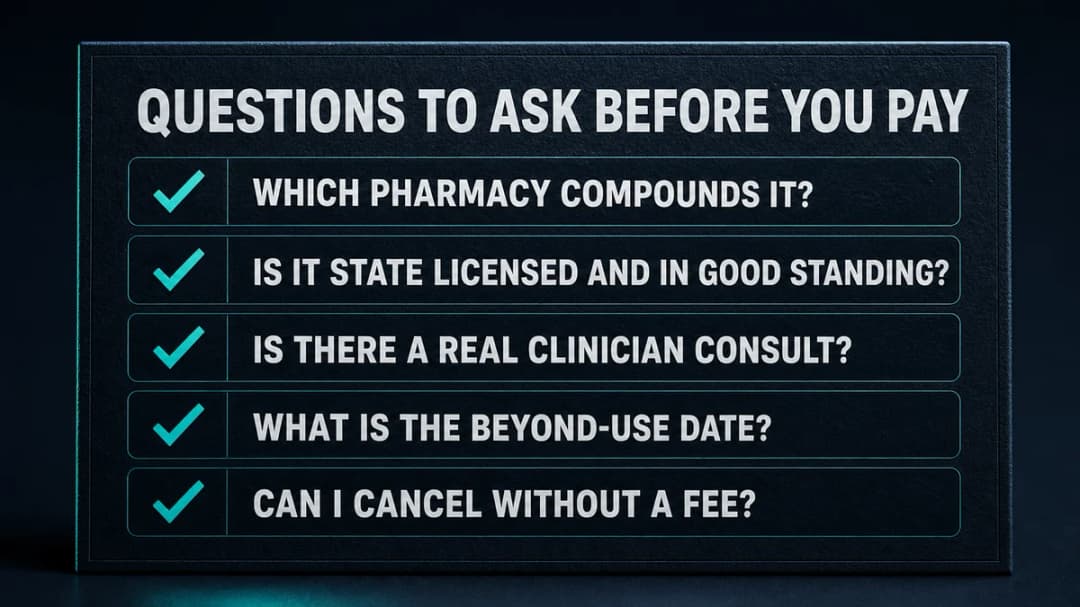
Questions to ask before you pay
| Ask | Good answer | Walk away if |
|---|---|---|
| Which pharmacy dispenses this, and what is its state licence number? | Named pharmacy, number you can verify | "We work with a network of partners" |
| Is it 503A or 503B, and what clinical need is documented on my prescription? | 503A, patient-specific, need recorded by the prescriber | Vagueness, or "everyone gets the same formula" |
| What is charged, when, and what changes when my dose goes up? | A written price at each dose tier | Only the starter price is quoted |
| What is your refund policy once the pharmacy has dispensed? | Stated plainly, usually no refund | Not disclosed until after payment |
| How do I cancel, by what deadline, and how? | Self-serve, no notice window games | Phone-only cancellation, long notice period |
Subscription lock-in is where the money actually goes wrong
Once a pharmacy has dispensed a prescription drug, refunds are generally not available. That makes the billing terms, not the product page, the thing to read closely.
The federal backstop people assume exists does not. The FTC's "click-to-cancel" negative option rule was vacated in full by the Eighth Circuit on July 8, 2025 in Custom Communications, Inc. v. FTC, days before it took effect. No federal rule now forces cancellation to be as easy as signup, and around 30 states have their own automatic renewal laws, so your protection depends on where you live.
What to check before the first charge:
- Prepaid multi-month plans. The per-month price drops, but you convert a monthly decision into a lump sum you cannot claw back.
- Notice windows. Some require cancellation days before the billing date; miss it and you are charged for another cycle.
- Auto-renew at the plan boundary. A six-month plan that silently renews into another six.
- Dose repricing. Confirm the maintenance-dose price in writing before starting.
- Your records. Ask whether you can obtain your prescription and chart notes if you leave. You will want them for whoever treats you next.
What should arrive, and how to read the label
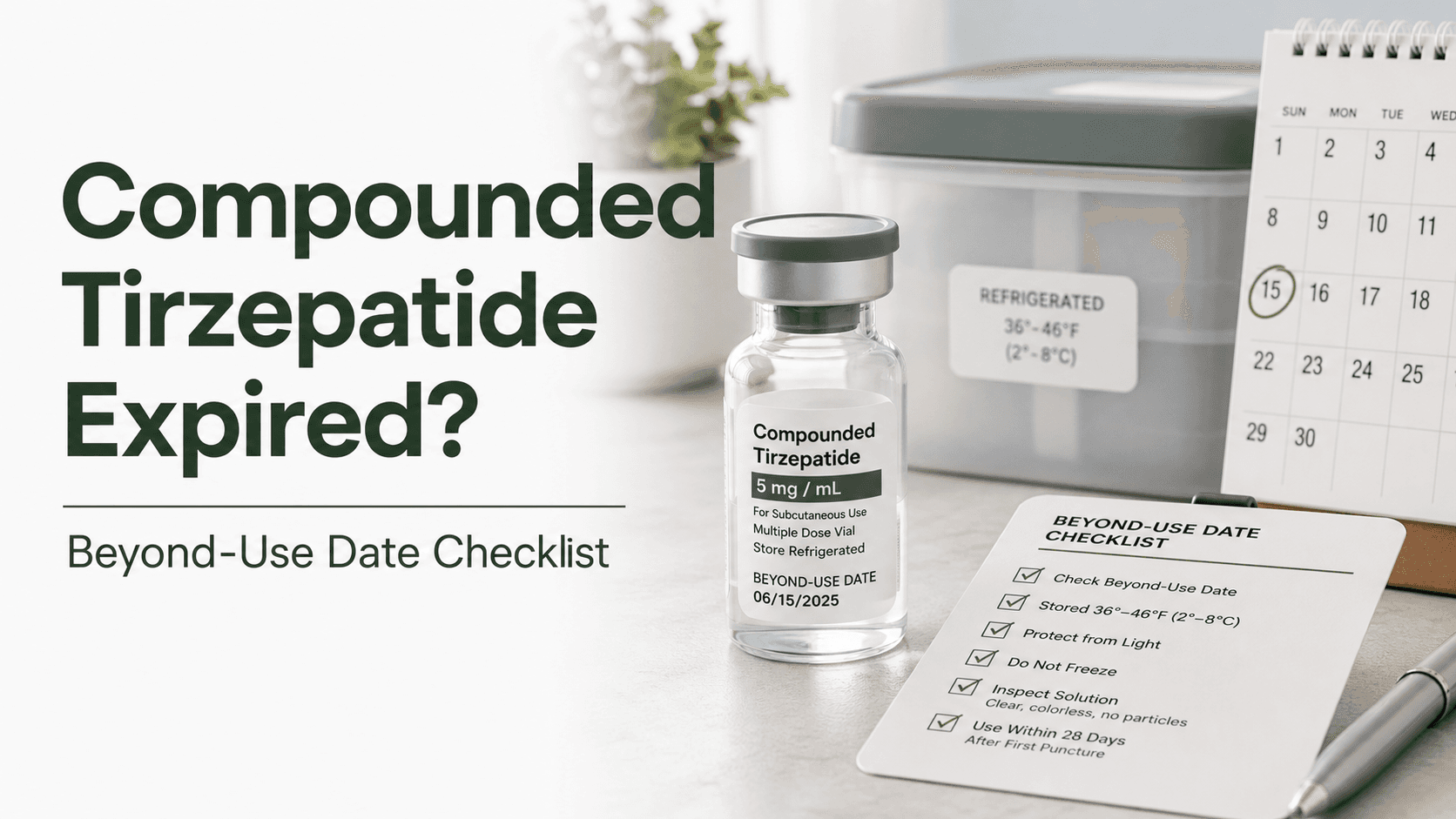
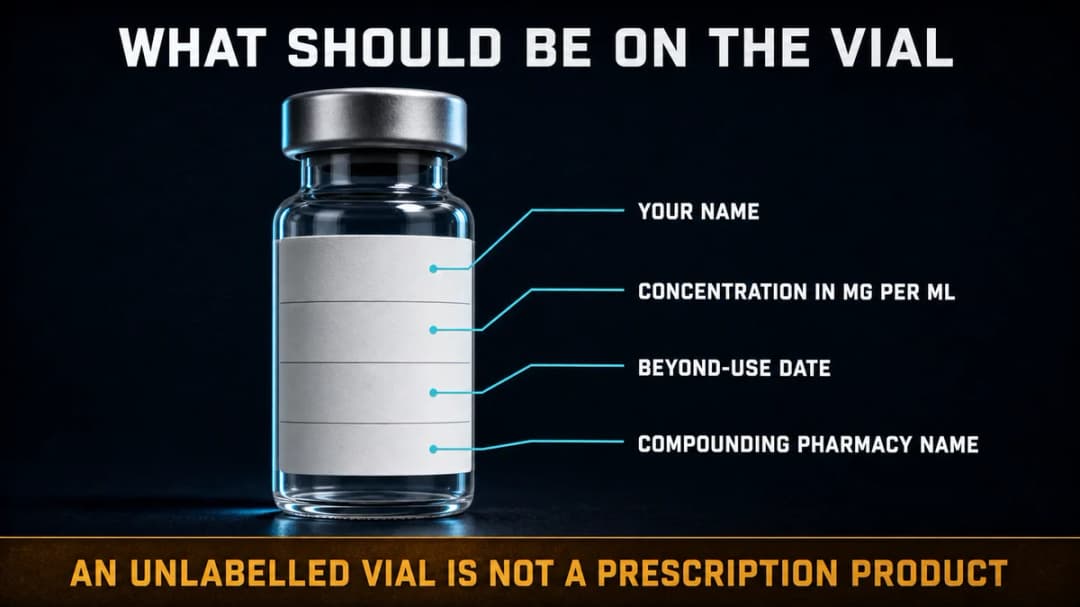
A legitimate dispense arrives labelled with the drug name, concentration, lot number, beyond-use date, and the compounding pharmacy's name and address.
The beyond-use date is the most informative thing on the vial: under USP <797> it encodes what quality process the pharmacy actually ran. Compounded tirzepatide is typically made aseptically from a nonsterile starting powder.
| How it was made | Max beyond-use date, refrigerated |
|---|---|
| Aseptic, nonsterile starting component, no sterility testing | 4 days |
| Aseptic, passed sterility testing (Category 2) | 45 days |
| Aseptic, sterility tested, full Category 3 requirements | 90 days |
So a vial you are expected to use for a month should have sterility testing behind it. Ask which category it was compounded under: a 28-day date with no sterility testing is a contradiction worth raising.
Two more checks on arrival. FDA advises not to use any injectable GLP-1 that arrives warm or with insufficient refrigeration, and has received complaints of exactly that. And confirm your dose in mg against the vial's mg/mL before drawing anything: FDA has documented patients self-administering many times the intended dose through confusion between units, millilitres and milligrams, some requiring hospitalisation.
FDA is also aware of fraudulent compounded tirzepatide whose labels name pharmacies that do not exist, or real pharmacies that did not compound the product. Call the pharmacy on the label and confirm they filled your prescription. To avoid the category, tirzepatide online and tirzepatide where to buy cover the approved routes.
Frequently Asked Questions
Can I still buy tirzepatide compound online in 2026?
Only through a narrow route: a state-licensed 503A pharmacy filling a patient-specific prescription where your prescriber documented a clinical need the approved product cannot meet. The mass-market version is gone. Hims announced its shift away from compounded medications on March 9, 2026, and Ro and Calibrate exited earlier. Sites still advertising open-access compounded tirzepatide deserve scepticism about what they are actually shipping.
Is it illegal for me to buy compounded tirzepatide?
Federal enforcement targets compounders, prescribers, marketers and importers rather than patients. That is not the same as saying your purchase is lawful or safe. Compounded drugs are not FDA approved, so FDA has not reviewed them for safety, effectiveness or quality, and your recourse is limited if something is wrong with what arrives.
Is there an oral compounded tirzepatide?
No. There is no oral tirzepatide of any kind, brand or compounded. Anything sold as an oral tirzepatide tablet or drop is misrepresenting what it is, and that alone tells you what kind of seller you are dealing with.
What about "research use only" tirzepatide from peptide vendors?
That material is not approved for human use and sits outside any pharmacy framework: no prescription, no pharmacist, no accountability for what is in the vial. If you buy it anyway, the harm-reduction minimum is a batch-specific third-party certificate of analysis matching your lot number. No vendor can be called safe, because that is not knowable from the outside.
Can I get a refund if the platform ships a dose I cannot use?
Usually not. A dispensed prescription drug generally cannot be returned or resold, so most platforms will not refund it. Settle refund and cancellation terms in writing before the first charge, not after an unwanted shipment.
How do I check the pharmacy on my label is real?
Search your state board of pharmacy's licence registry for the name and address on the label, then call the pharmacy and confirm they compounded your prescription. FDA's BeSafeRx pages link to state-licensed pharmacy lookups. If the address does not resolve or nobody answers as a pharmacy, stop using the product and report it to FDA.
Sources
- FDA's Concerns with Unapproved GLP-1 Drugs Used for Weight Loss — U.S. Food and Drug Administration
- FDA Proposes to Exclude Semaglutide, Tirzepatide, and Liraglutide on 503B Bulks List — U.S. Food and Drug Administration
- BeSafeRx: Considering an Online Pharmacy? — U.S. Food and Drug Administration
- Zepbound Coverage and Savings — Eli Lilly and Company
- USP Compounding Standards and Beyond-Use Dates — United States Pharmacopeia
- Online Prescribing: State Telehealth Policies — Center for Connected Health Policy
- Eighth Circuit Vacates FTC's Click-to-Cancel Rule Days Before Compliance Deadline — Latham & Watkins
- The era of $199 copycat weight loss drugs is ending — Yahoo Health