
Most enclomiphene side effects recorded in the trials were mild. Across 1,403 men in the phase 2 and 3 program, the event investigators most often linked to the drug was headache, at 1.6%, followed by hot flushes (1.1%) and nausea (1.0%). The serious concern is rarer: four blood clot or stroke events happened in men taking enclomiphene and none in men on testosterone gel or placebo, and that signal is a large part of why European regulators refused the drug in 2018.
This page sets out what the trial program actually counted. Most of the numbers come from the European Medicines Agency's 2018 assessment report, which holds the only pooled enclomiphene safety tables in the public record. It covers the common events, the 2024 comparison with clomiphene, clots, vision, estradiol, hematocrit, hair loss, the gaps nobody has filled, and the symptoms that mean stop and call a doctor.
Key Takeaways
- In the 324-man core trial pool, 35.8% of men on enclomiphene reported any adverse event, against 36.3% on placebo and 44.7% on AndroGel testosterone gel
- Four thromboembolic events (three deep vein clots or lung clots, one fatal stroke) occurred among 1,403 enclomiphene-treated men, all of whom had other risk factors; none occurred on testosterone or placebo
- Estradiol moved from normal to high in 55.6% of enclomiphene patients, against 10.1% on placebo and 35.3% on AndroGel
- A 2024 Baylor retrospective of 66 men found adverse events in 13.8% on enclomiphene versus 47% on clomiphene, though every man took clomiphene first
- Hair loss does not appear in any enclomiphene adverse-event table I found, and no trial I could open measured DHT
- Only 116 men took enclomiphene for 12 months or longer in the whole trial program
Where enclomiphene safety data comes from
Enclomiphene is the trans isomer of clomiphene, the fertility drug sold as Clomid. The short version for this page: it blocks estrogen feedback at the pituitary, so the body makes more LH, FSH and testosterone on its own. It is not FDA-approved, so there is no US label with a side-effect section to quote.
The individual trial papers do not help much on safety. The 2013 phase 2 paper by Wiehle and colleagues (BJU International) reports no adverse-event counts. The pooled phase 3 paper by Kim, McCullough and Kaminetsky (BJU International 2016), which covered the ZA-304 and ZA-305 trials over 16 weeks, says nothing about adverse events in its abstract, and the full text sits behind a paywall I could not get through. The ClinicalTrials.gov records for ZA-304 and ZA-305 showed no posted results when I checked on 2026-11-29.
That leaves the EMA public assessment report for EnCyzix (EMA/88321/2018), the European brand name. It pools 1,403 men from 13 phase 2 and 3 trials. Men in the main trials were treated for 12 to 18 weeks; 482 took the drug for more than 6 months and 116 for 12 months or longer. One quirk matters for reading the numbers: men in the main studies all started on 12.5 mg and some were moved up to 25 mg, so dose was never randomized. The EMA said it could not compare the two doses for safety, and noted that adverse events were reported more often at the lower dose.
Enclomiphene side effects in men: the common ones
The EMA lists the events that investigators judged at least possibly caused by enclomiphene, across all 1,403 men:
- Headache: 23 men (1.6%)
- Hot flush: 16 (1.1%)
- Nausea: 14 (1.0%)
- Muscle spasms: 12 (0.9%)
- Dizziness: 10 (0.7%)
- Fatigue, raised hematocrit, erectile dysfunction, raised PSA and increased appetite: 8 or 9 each (0.6%)
- Blurred vision, aggression, irritability and acne: 7 each (0.5%)
Those figures have no placebo next to them. The core trial pool does, and it changes the picture. Headache, the top complaint, ran at almost exactly the placebo rate.
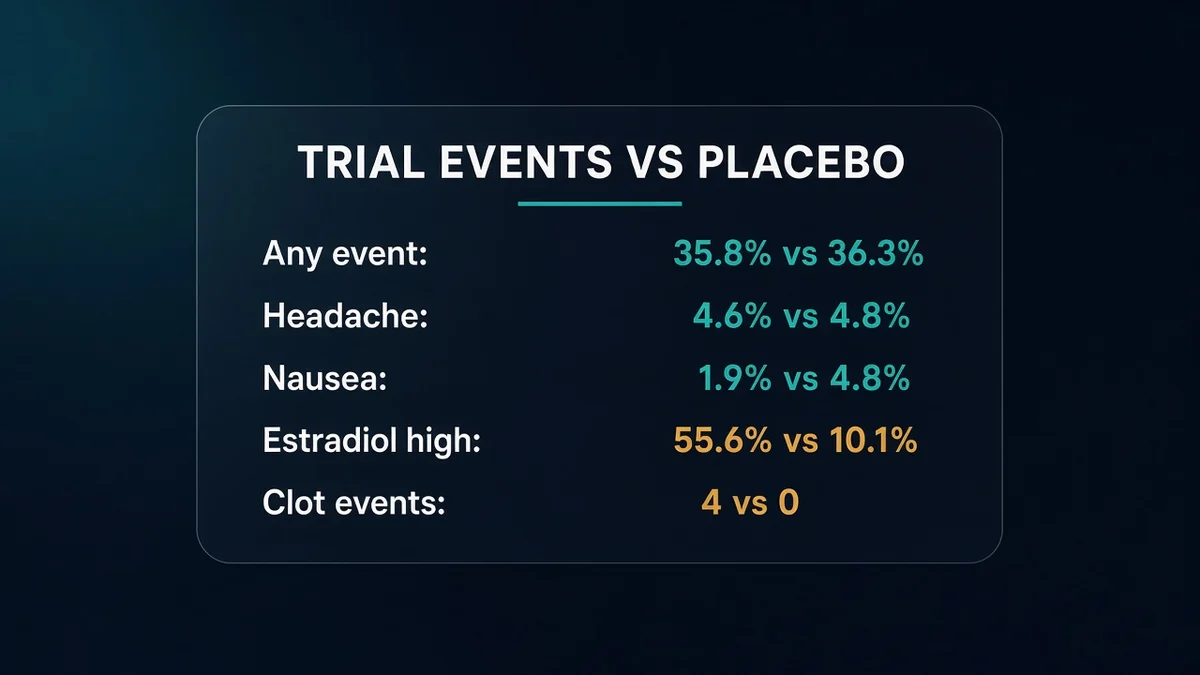
Enclomiphene side effects vs placebo and testosterone gel (core trial pool)
| Enclomiphene (n=324) | AndroGel (n=85) | Placebo (n=168) | |
|---|---|---|---|
| Any adverse event | 35.8% | 44.7% | 36.3% |
| Headache | 4.6% | 4.7% | 4.8% |
| Nausea | 1.9% | 1.2% | 4.8% |
| Hot flush | 0.9% | 0% | 0.6% |
| Decreased libido | 0.9% | 1.2% | 0.6% |
| Estradiol normal to high | 55.6% | 35.3% | 10.1% |
The EMA graded the events as mild in 12.1% of enclomiphene patients, moderate in 4.6% and severe in 0.9%. Withdrawal for adverse events was 5.3% on enclomiphene, 5.4% on AndroGel and 1.5% on placebo. The leading reasons for stopping enclomiphene were blurred vision, muscle spasm, headache and aggression, at 4 men (0.3%) each.
One caution on these headline rates. Elsewhere the same report gives an overall adverse-event incidence of 17.7% on enclomiphene, 19.7% on AndroGel and 8.7% on placebo for the wider phase 2 and 3 pool, without spelling out how that figure was defined. The two sets of numbers come from different pools and should not be mixed.
An open-label safety study, ZA-300, adds a longer window. Its ClinicalTrials.gov record shows 499 men treated for about six months plus eight weeks of follow-up. Headache affected 12 of 207 men (5.8%) in the 12.5 mg group and 23 of 283 (8.1%) in the 25 mg group; hot flushes 2 (1.0%) and 9 (3.2%); muscle spasms 10 (4.8%) and 12 (4.2%). There was no placebo arm, so these rates cannot be pinned on the drug. Serious events affected 6 and 9 men, and included one deep vein thrombosis in each group and a pulmonary embolism in the 25 mg group.
Enclomiphene citrate side effects on mood and sex drive
Psychiatric events judged at least possibly drug-related affected 45 men (3.2%). Aggression ran at 0.5% against 0% on placebo, while anxiety was the same in both groups (0.4%). Erectile dysfunction was reported in 0.6% on enclomiphene and in no one on AndroGel or placebo, although the EMA points out that it is a common feature of low testosterone itself. Breast enlargement appeared in 0.2%, and gynecomastia in 0.07%, below the 0.7% seen on AndroGel.
Enclomiphene vs clomiphene side effects: the 2024 Baylor comparison
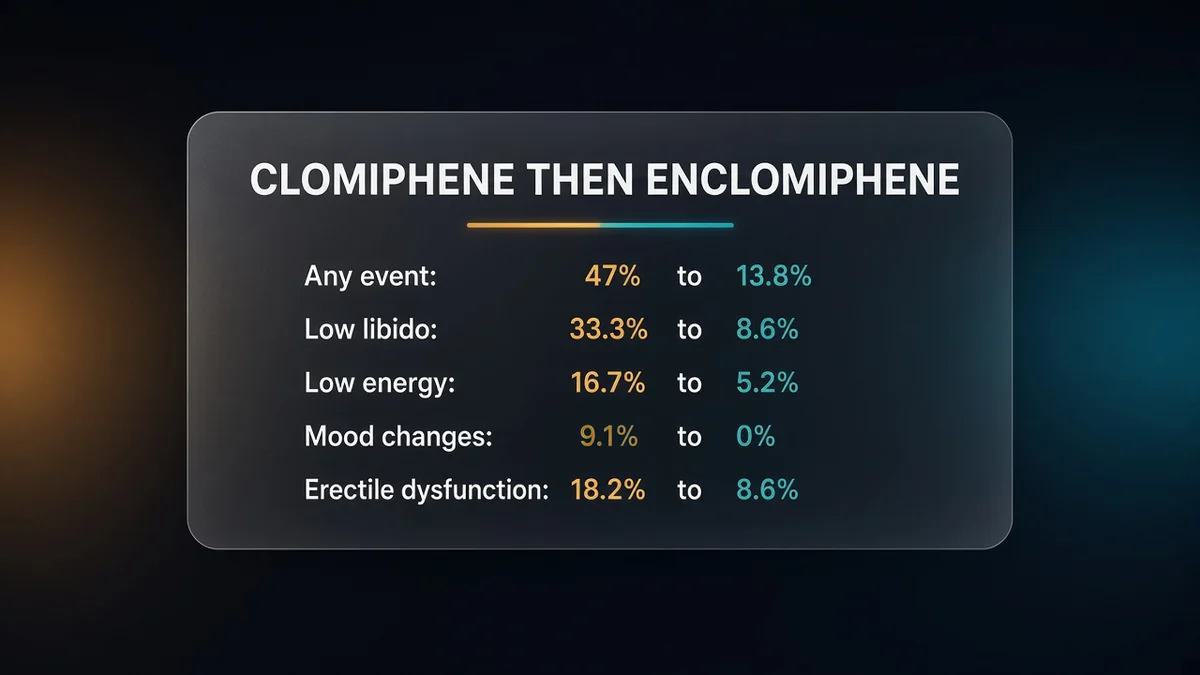
The clearest head-to-head data is a 2024 retrospective by Saffati and colleagues at Baylor College of Medicine (Translational Andrology and Urology). It followed 66 men with symptomatic low testosterone who took clomiphene and then switched to enclomiphene, each man serving as his own control. Median time on clomiphene was 18.7 months and on enclomiphene 8.9 months.
Share of men with each side effect: clomiphene then enclomiphene (Saffati 2024)
Median estradiol rose 17.5 pg/mL on clomiphene and fell 5.92 pg/mL after the switch (P = 0.001). Median testosterone rose 98 ng/dL on clomiphene and 166 ng/dL on enclomiphene, a gap that was not significant (P = 0.20). Gynecomastia appeared in 3% on clomiphene and in no one on enclomiphene.
The design limits how far this goes. Every man took clomiphene first, there was no washout, the doses were not reported, and men switched for different reasons, often because they disliked clomiphene. The enclomiphene percentages also appear to use 58 men as the denominator rather than 66, which the paper does not explain. The plausible reason for the difference is zuclomiphene, the other isomer in clomiphene, which acts more like an estrogen and lingers: a 2016 review by Rodriguez, Pastuszak and Lipshultz (Expert Opinion on Pharmacotherapy) gives it a half-life of about 30 days against roughly 10 hours for enclomiphene.
Blood clots: the signal behind the European refusal
The EMA identified four thromboembolic events in men taking enclomiphene: one deep vein thrombosis with pulmonary embolism, two deep vein thromboses, and one fatal ischaemic stroke. No such events occurred in men on testosterone products or placebo. A fifth case, a heart attack on placebo, was not accepted by the assessors as a thromboembolic event.
The case table shows how loaded these men were with other risk factors. Their BMIs were 39.4, 27.4, 40.2 and 41.8, and the events came after 34 to 289 days on the drug. One had just had knee surgery, one had taken a five-hour flight days earlier, one had a family history of clotting disorders and a hematocrit of 55.4%, and the man who died had untreated atrial fibrillation, diabetes and sleep apnoea.
The committee's majority still described enclomiphene as carrying "a potentially high risk of venous-thromboembolism" and cited it in recommending refusal in January 2018. A minority of members disagreed, arguing that every case had multiple risk factors and that labelling could manage the risk. The assessors could not say whether the clots came from the SERM class itself, from more red blood cells as testosterone rose, from higher estradiol, or simply from obesity. The clomiphene label is relevant here too: FDA's Clomid label lists pulmonary embolism, thrombophlebitis and stroke among postmarketing reports.
Vision changes and the cataract question
Eyes were a topic of special interest for two reasons: zuclomiphene appears to accumulate in animal eyes, and a dog study raised a cataract signal. In the placebo-controlled trials, eye disorders were reported in 1.6% of enclomiphene patients against 2.4% on placebo. Blurred vision affected 14 enclomiphene patients (1.0%) against 3 on placebo (0.8%), and 12 of those 14 reports came at the 12.5 mg dose. Cataract and blurred vision judged possibly drug-related were slightly more common than on placebo (0.3% vs 0% and 0.5% vs 0%).
Formal eye exams were reassuring. A cataract change of two steps or more was recorded in 1.1% of men on 12.5 mg (n = 660), 1.0% on 25 mg (n = 621), 4.1% on AndroGel or Testim (n = 172) and 1.1% on placebo (n = 348).
The clomiphene label is stricter. In women treated for infertility, visual symptoms such as blurring, spots and flashes occurred in 1.5% of patients, and the label says anyone with visual symptoms should stop treatment and have a full eye examination promptly, because some cases have been prolonged and possibly irreversible. Enclomiphene contains no zuclomiphene, but nobody has tested whether that removes the risk.
Estradiol, hematocrit and PSA: side effects that only show on bloodwork
Some of the more important effects produce no symptoms at all.
| Lab signal (EMA phase 2 and 3 data) | Enclomiphene | Testosterone gel | Placebo |
|---|---|---|---|
| Estradiol normal to high (core trial pool) | 55.6% | 35.3% | 10.1% |
| Hematocrit normal to above 54% | 2.9% (12.5 mg), 2.5% (25 mg) | 6.1% | 0.3% |
| Mean hematocrit change, points | +1.2 | +1.9 | 0.0 |
| PSA rise past the review's threshold | 9.3% | 6.1% | 5.1% |
| Testosterone peak above 1,040 ng/dL | 1.4% | 9.5% | 0.5% |
Estradiol. Raising testosterone gives the aromatase enzyme more to convert, so estradiol rises with it. The EMA flagged that rise as a possible contributor to clot risk. The 2013 phase 2b study by Kaminetsky and colleagues also listed raised estradiol among its side effects. Whether and how to manage it is a separate question for the prescribing clinician.
Hematocrit. Enclomiphene raised hematocrit less than testosterone gel did, but more than placebo (P < 0.0001 for both doses). In the Baylor cohort, median hematocrit went from 45.6% at baseline to 47.0% after enclomiphene. One trial patient whose hematocrit reached 55.4% later developed clots in the leg and lungs.
PSA. Rates of PSA rise were similar to AndroGel and slightly above placebo, with no dose effect. No prostate cancers were reported during the trials.
Enclomiphene hair loss: the DHT mechanism and the missing evidence
Male-pattern hair loss is driven by dihydrotestosterone (DHT). The enzyme 5-alpha reductase converts testosterone into DHT, and in men with a genetic sensitivity, DHT acting on scalp follicles shortens each growth cycle until the hairs thin out. Anything that raises testosterone can, in principle, raise DHT, and enclomiphene raises testosterone. That is the whole case for concern.
Here is how much direct evidence exists: very little, in either direction.
- Hair loss or alopecia does not appear in the EMA's non-serious event table for the core trial pool, which lists events down to 3 men (0.9%), or in its table of possibly drug-related events, which goes down to 0.5% of 1,403 men. Acne does appear, at 0.5%.
- No enclomiphene trial paper or registry record I could open reported DHT levels.
- The Clomid label lists "hair loss/dry hair" among events seen in under 1% of patients, but those patients were women taking short fertility courses.
- Several telehealth articles describe a comparison in which DHT rose in step with testosterone on enclomiphene and more steeply on testosterone gel. None named the study, and I could not trace the primary data, so treat that claim as unverified.
One indirect point is real. Enclomiphene mostly lifts testosterone into the normal range rather than above it: only 1.4% of men ever exceeded 1,040 ng/dL, against 9.5% on AndroGel. If hair loss tracks androgen exposure, enclomiphene should push less hard than high-dose testosterone. That is inference, not a measured outcome. A man who is already losing hair is exposing a known sensitivity to more testosterone, and that is worth raising with the prescriber before starting.
Is enclomiphene safe? What nobody has measured
For short courses in screened men, the common side effects in the trials looked much like placebo. The open questions sit elsewhere.
- Duration. Only 116 men took enclomiphene for 12 months or longer. The EMA said rare reactions may have gone undetected, particularly beyond 6 months.
- Outcomes. No trial measured heart attacks, strokes, fractures or fertility after stopping as endpoints. A phase 3 bone density study (ZA-303) is listed as completed on ClinicalTrials.gov with no results posted.
- Metabolites. The EMA judged that human metabolites had not been fully characterised, which left the long-term animal toxicology incomplete.
- Organ impairment. Moderate to severe kidney impairment roughly doubled blood levels, and the long-term consequences were described as unknown.
- Clomiphene as a proxy. A 2019 study by Krzastek and colleagues (Journal of Urology) followed 400 men on clomiphene for up to 84 months. Among the 120 treated for more than three years, 8% reported side effects (mood changes in 5, blurred vision in 3, breast tenderness in 2) and no significant adverse events were recorded. It was retrospective, and clomiphene is not enclomiphene.
- Product quality. US patients receive enclomiphene as a compounded drug that FDA has not reviewed, or as research-labelled capsules, so the trial safety data assumes a dose and purity that a given product may not match.
So the honest answer to whether enclomiphene is safe depends on the man. Someone with a prior clot, a BMI near 40, untreated atrial fibrillation or a high hematocrit sits in the group where the trial program's worst outcomes happened.
When to stop and see a doctor
Enclomiphene side effects male patients should treat as urgent
- Swelling, pain or warmth in one leg, or sudden shortness of breath or chest pain: possible clot, so seek emergency care.
- Sudden weakness or numbness on one side, facial droop or slurred speech: possible stroke, so call emergency services.
- Blurred vision, spots, flashes or other visual change: stop and get a prompt eye examination, as the clomiphene label instructs.
Report at the next appointment
Breast tenderness or a lump, new aggression or mood change, a headache that will not settle, hot flushes that persist, or a drop in libido or erections. Men in the Baylor cohort reported these less often on enclomiphene than on clomiphene, but they still happened.
Labs the literature monitors
Total and free testosterone, LH and FSH, estradiol, hematocrit and PSA, plus a semen analysis where fertility is the goal. The EMA used a hematocrit above 54% as its "high" cut-off. Which labs to repeat and when is a decision for the clinician who orders them.
Frequently Asked Questions
What are the most common enclomiphene side effects men report?
In the EMA's pool of 1,403 trial patients, the events most often judged drug-related were headache (1.6%), hot flushes (1.1%), nausea (1.0%), muscle spasms (0.9%) and dizziness (0.7%). In the placebo-controlled core trial pool, headache ran at 4.6% on enclomiphene and 4.8% on placebo, so much of it was background.
Is enclomiphene safe to take long term?
Nobody knows yet. Only 116 men in the trial program took it for a year or more, and no trial measured cardiovascular or bone outcomes. The longest follow-up data comes from clomiphene, where a 2019 study of 400 men found few side effects over up to seven years.
Does enclomiphene cause hair loss?
There is no direct evidence that it does. Hair loss does not appear in the published enclomiphene adverse-event tables, and no trial I found measured DHT. The theoretical risk comes from higher testosterone converting to DHT, which matters most for men already prone to male-pattern loss.
Can enclomiphene cause blood clots?
Four clot or stroke events occurred among 1,403 men on enclomiphene and none on testosterone gel or placebo, and every affected man had other risk factors such as severe obesity, recent surgery or a long flight. The EMA treated this as a real risk and cited it when refusing approval in 2018.
Does enclomiphene affect vision?
Blurred vision was reported in 1.0% of enclomiphene patients against 0.8% on placebo, and it was the joint most common reason men stopped. Formal eye exams found no excess of cataracts. Clomiphene can cause visual symptoms that occasionally persist, so any visual change is a reason to stop and see a doctor.
Are enclomiphene citrate side effects milder than Clomid's?
The one direct comparison says probably yes. In 66 Baylor patients, adverse events fell from 47% on clomiphene to 13.8% on enclomiphene, with the largest drops in low libido, low energy and mood changes. The study was retrospective and every man took clomiphene first, so it falls short of proof.
Does enclomiphene raise estrogen?
Usually, because more testosterone means more conversion to estradiol. In the main trials, 55.6% of enclomiphene patients went from a normal to a high estradiol reading, against 10.1% on placebo. Compared with clomiphene, though, estradiol tends to be lower.
Talking the risks through with a prescriber
The trial record supports a narrow conclusion. Over three to four months, the everyday side effects of enclomiphene were few and close to placebo, while the clot signal, the estradiol rise and the thin long-term record are what a careful prescriber will weigh against your own history and labs. If you are going the supervised route, our page on getting an enclomiphene prescription online explains how telehealth clinics and compounding pharmacies handle labs and follow-up. Price and batch-testing details for the research-labelled product are on our enclomiphene for sale page.
Medical Disclaimer: Enclomiphene is not approved by the FDA for any condition, and the European Medicines Agency refused its marketing application in 2018. This article summarises published trial and regulatory data for educational purposes. It is not medical advice, a dosing protocol or a recommendation for personal use. Low testosterone, infertility and any of the symptoms described here need proper diagnosis, so consult a qualified healthcare professional about any health concern, and seek emergency care for signs of a blood clot or stroke.