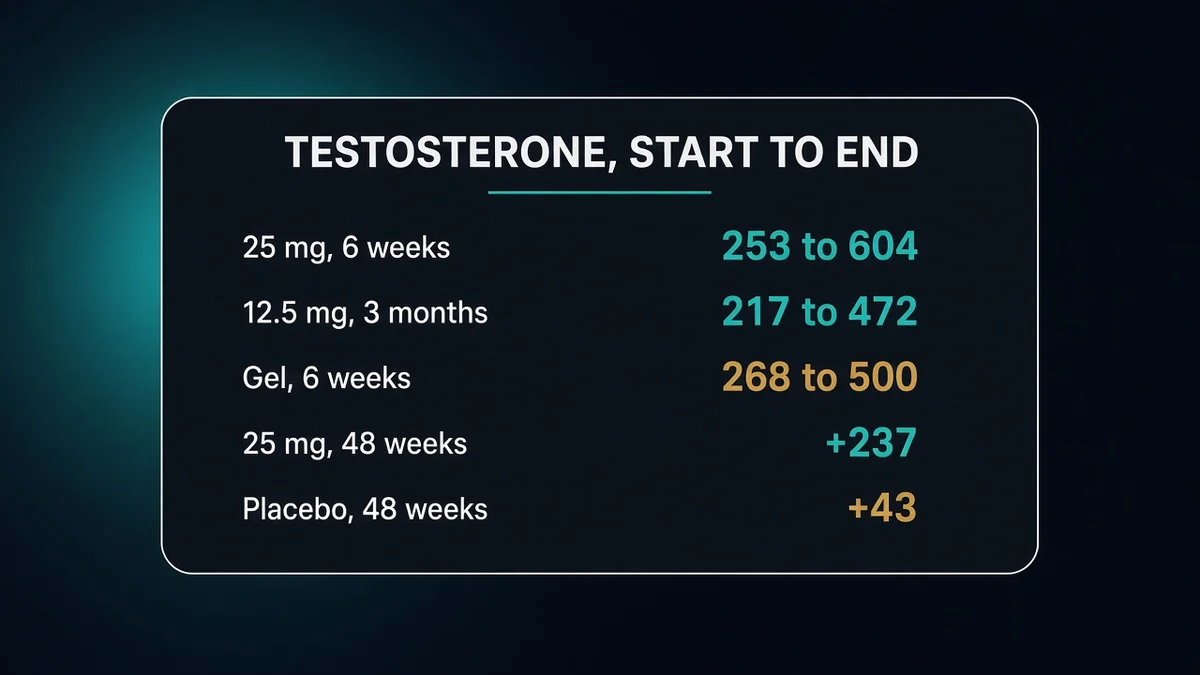
In the published trials of enclomiphene for low testosterone, mean morning total testosterone rose by roughly 110 to 360 ng/dL, depending on the study and the arm. The largest gain was in the 25 mg arm of a 2013 phase 2 study, which went from 253 to 604 ng/dL in six weeks. Every man enrolled had secondary hypogonadism, meaning his testes worked and his LH was low or normal, and no controlled trial measured whether the extra testosterone made men feel better.
This page lays out the testosterone numbers study by study, explains why the drug depends on a working pituitary, and separates what the trials showed (hormones and sperm) from what they did not (libido, energy, muscle).
Key Takeaways
- In Wiehle et al. (2013), six weeks of enclomiphene took mean morning testosterone from 265 to 420 ng/dL (6.25 mg), 295 to 404 (12.5 mg) and 253 to 604 (25 mg), against 268 to 500 on testosterone gel
- In a 3-month phase 2b trial, the 12.5 mg arm rose from 217.2 to 471.9 ng/dL and the 25 mg arm from 209.8 to 405.8, so a higher dose did not always mean a bigger rise
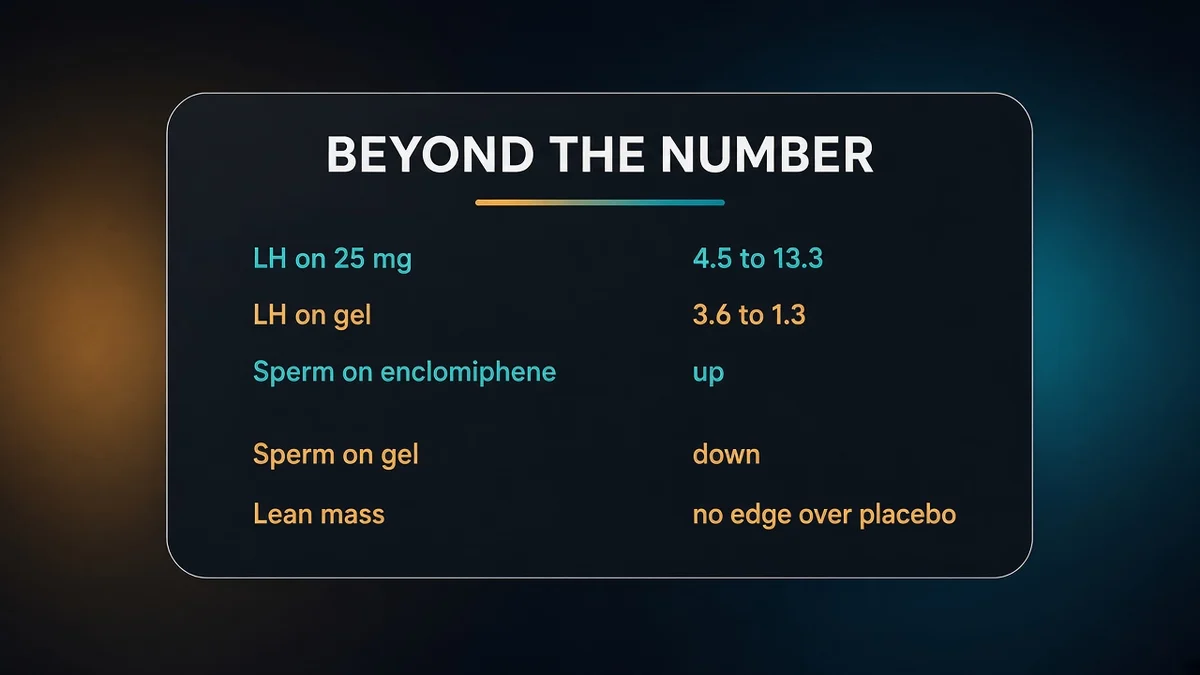
- LH rose on enclomiphene (4.5 to 13.3 IU/L on 25 mg) and fell on gel (3.6 to 1.3), which is the whole mechanism: the testes are told to work harder
- Pooled phase 3 data put the change in sperm concentration at +11.7% and +15.2% on enclomiphene versus -56.6% and -32.8% on testosterone gel
- In a 48-week trial with diet and exercise (ZA-205), testosterone rose by 174 and 237 ng/dL, yet lean mass and strength gains were not significantly different from placebo
- Every trial excluded men with high LH, so the data say nothing in favour of use in primary (testicular) hypogonadism
How enclomiphene raises testosterone
Enclomiphene is one of the two isomers in clomiphene, the fertility drug. It blocks estrogen receptors in the hypothalamus, which takes estrogen's brake off. The pituitary then releases more LH and FSH, LH drives the testes to make more testosterone, and FSH supports sperm production. The 2016 review by Rodriguez, Pastuszak and Lipshultz in Expert Opinion on Pharmacotherapy sets this out and gives enclomiphene a half-life of about 10 hours, against roughly 30 days for zuclomiphene, the other isomer.
Testosterone gel or injections put the hormone in from outside, and the brain responds by shutting LH and FSH down. Enclomiphene makes the body produce its own, so it cannot add testosterone the testes are unable to make.
Enclomiphene testosterone gains, trial by trial
These are group means from the primary papers or, where I could not open the full text, from the Rodriguez review. Every study was small.
Wiehle et al., BJU International, 2013. This randomized phase 2 study enrolled men aged 18 to 65 with morning total testosterone at or below 350 ng/dL on two occasions and LH under 12 IU/L. Arms of 12, 7, 12 and 13 men (per protocol) took enclomiphene 6.25, 12.5 or 25 mg daily, or 5 g of testosterone gel, for six weeks. At day 42 the 25 mg arm averaged 604 ng/dL and the gel arm 500 ng/dL, a difference that was not significant (P = 0.23).
Wiehle et al., Fertility and Sterility, 2014. A 3-month phase 2b trial enrolled 124 men and 73 finished. As summarized by Rodriguez, total testosterone went from 217.2 to 471.9 ng/dL on 12.5 mg, 209.8 to 405.8 on 25 mg, and 210 to 462.6 on topical testosterone. Here the lower dose ended higher, the reverse of the 2013 study, so be wary of any claim that more enclomiphene simply means more testosterone.
Kaminetsky et al., Journal of Sexual Medicine, 2013. In this open-label phase 2b study, 12 men who had been on testosterone gel stopped it, which dropped their morning testosterone to 165 ng/dL on average. They were then randomized to gel or enclomiphene. At six months, mean testosterone was 545 ng/dL on gel and 525 ng/dL on enclomiphene. (The abstract prints pg/dL, evidently a typo for ng/dL.)
ZA-205, completed 2017. Repros Therapeutics, the developer, ran a 48-week placebo-controlled trial in 50 obese men (BMI 30 to 42) with two morning testosterone readings at or below 300 ng/dL. Everyone dieted and trained with a personal trainer at least three times a week. Registry results (not a peer-reviewed paper) show mean testosterone changes of +173.81 ng/dL on 12.5 mg, +237.17 on 25 mg and +43.33 on placebo (P = 0.0034 and 0.0027 against placebo).
Kim et al., BJU International, 2016. Two parallel phase 3 trials (ZA-304 and ZA-305) randomized 265 overweight men aged 18 to 60, with morning testosterone at or below 300 ng/dL and LH under 9.4 IU/L, to enclomiphene 12.5 or 25 mg, testosterone gel 1.62%, or placebo for 16 weeks. The abstract and the Rodriguez review say testosterone reached the normal range on enclomiphene but give no per-arm values, and the full paper is paywalled, so I have left its numbers out.
Mean total testosterone at baseline and at end of treatment, by arm (ng/dL)
Baseline End of treatment
Put as gains, the pattern is easier to read:
| Study and arm | Length | Mean gain (ng/dL) |
|---|---|---|
| Wiehle 2013, 6.25 mg | 6 weeks | +155 |
| Wiehle 2013, 12.5 mg | 6 weeks | +109 |
| Wiehle 2013, 25 mg | 6 weeks | +351 |
| Wiehle 2013, testosterone gel | 6 weeks | +232 |
| Wiehle 2014, 12.5 mg | 3 months | +255 |
| Wiehle 2014, 25 mg | 3 months | +196 |
| Wiehle 2014, topical testosterone | 3 months | +253 |
| ZA-205, 12.5 mg | 48 weeks | +174 |
| ZA-205, 25 mg | 48 weeks | +237 |
| ZA-205, placebo | 48 weeks | +43 |
Enclomiphene arms landed in roughly the same place as testosterone gel, mostly between 400 and 600 ng/dL: the low to middle part of the usual adult range, not the top. And the ZA-205 placebo arm gained 43 ng/dL with diet and exercise alone, a reminder that weight loss accounts for some of any rise in an overweight man.
The 2013 paper also drew blood hourly for 24 hours. On gel, 16.4% of samples fell below 300 ng/dL and 6% went above 1,000. On 25 mg enclomiphene, none fell below 300 and 1% went above 1,000. Levels on the oral drug were steadier.
Secondary versus primary hypogonadism: who the evidence covers
In primary hypogonadism the testes themselves are failing, from genetic causes, injury or other damage. The pituitary pushes LH high, but the testes cannot answer. In secondary hypogonadism the testes are capable and the signal from the hypothalamus or pituitary is weak. Rodriguez and colleagues list obesity, metabolic syndrome and type 2 diabetes among the common drivers of the secondary form.
Enclomiphene only works on the signal. It needs a pituitary that can make more LH and FSH and testes that can respond. In a man whose LH is already high because his testes are failing, there is little reason to expect more LH to help, and no trial tested it. Every trial above screened men out on LH: below 12 IU/L in Wiehle 2013, below 9.4 IU/L in phase 3, 1.4 to 9.4 mIU/mL in ZA-205. The men were also heavy: mean BMI 34.7 in the 2013 study, BMI 30 to 42 in ZA-205.
So the answer to "for whom" is narrow: men with repeatedly low morning testosterone, LH that is low or normal, and in most studies excess weight. That is why a clinician orders LH and FSH alongside two morning testosterone tests. Without LH there is no way to know which kind of low testosterone a man has.
The one study that included men with the primary form is the 2024 Baylor review of 66 men, where about 22% had primary hypogonadism. It did not report their results separately, so it does not settle the question.
LH, FSH and sperm: the enclomiphene benefits that set it apart
If testosterone level were the only goal, gel would do. The difference is upstream. In Wiehle 2013, morning LH on gel fell from 3.6 to 1.3 IU/L. On enclomiphene it rose: 3.9 to 6.7 IU/L on 12.5 mg and 4.5 to 13.3 IU/L on 25 mg. FSH, which is not given numerically in that paper, rose significantly on 12.5 and 25 mg and fell on gel. In the 2014 phase 2b trial, as Rodriguez reports it, LH went from 5.3 to 11.9 mIU/mL and FSH from 9.4 to 14.9 on 25 mg, while on testosterone LH fell from 3.9 to 1.4 and FSH from 6.0 to 2.4.
Sperm follows FSH and the testosterone made inside the testes, and this is where the gap is widest:
- Kaminetsky 2013: on enclomiphene, sperm concentration ranged from 75 to 334 million/mL, and Rodriguez gives the mean as 176 million/mL. No man on gel had more than 12 million/mL.
- Kim 2016 phase 3 (as tabulated by Rodriguez): sperm concentration changed by +11.7% and +15.2% on enclomiphene in the two studies, against -56.6% and -32.8% on testosterone gel. The Kim abstract says enclomiphene kept sperm concentration in the normal range while gel caused a marked fall.
For a man who wants children, or wants to keep the option, this is the main benefit.
A related effect: in the 2013 study, seven days after the last dose the enclomiphene arms had not fallen significantly, and the 25 mg arm was still higher than the 12.5 mg arm (P = 0.012). A week is a short window, so this says little about longer-term recovery.
What the trials did not show: libido, energy and body composition
Rodriguez and colleagues wrote in 2016 that no enclomiphene study had evaluated symptoms or quality of life with validated tools, and that benefit was being assumed by analogy with clomiphene. I found no controlled trial since that changes this.
Libido and sexual function. No randomized enclomiphene trial I could open reported a libido score; even the Kaminetsky abstract, in a sexual medicine journal, reports only hormones and sperm. The 2024 Baylor retrospective (Saffati et al., Translational Andrology and Urology) tracked side effects, not benefits: decreased libido was recorded in 33.3% of men while on clomiphene and 8.6% after they switched to enclomiphene (P = 0.001). That is fewer complaints, which is not the same as improved desire. For the parent drug, a 2026 meta-analysis of clomiphene versus testosterone therapy (European Journal of Clinical Pharmacology) found similar testosterone levels but lower libido scores on clomiphene, findings the authors called preliminary.
Energy and mood. Again only the Baylor data, and again as side effects: decreased energy 16.7% on clomiphene versus 5.2% on enclomiphene (P = 0.044), mood changes 9.1% versus 0% (P = 0.03). Every man took clomiphene first, there was no washout, nobody was blinded and doses were not recorded, so the comparison is suggestive at best.
Muscle, strength and fat. ZA-205 is the only trial built to answer this, and its answer was no. Over 48 weeks, lean body mass rose by 3.14 kg on 12.5 mg, 2.40 kg on 25 mg and 1.05 kg on placebo, with neither enclomiphene arm significantly different from placebo (P = 0.71 and 0.45). Chest press and leg press gains were also no different. The placebo group lost the most weight (14.51 kg, against 4.36 and 6.15 kg on enclomiphene), for reasons the record does not explain. Only 40 of 50 men finished.
Other lab effects. IGF-1 fell on enclomiphene in the 2013 study, from 94 to 50 µg/L on 12.5 mg, against 103 to 90 on gel, though the authors said values stayed in the normal range. ZA-205's registry entry lists two serious events in the 12.5 mg arm (one heart attack, one ischaemic stroke) and none elsewhere. With 18 men in the arm that cannot show cause, but long-term safety is still open. The full picture is on our enclomiphene side effects page.
So enclomiphene effects on hormones and sperm are documented in small trials. Effects on how a man feels or performs are not. A rise in the number is a reasonable expectation in the right patient; feeling different is a hope the data have not tested.
How it compares with clomiphene and where it stands legally
Clomiphene contains enclomiphene plus zuclomiphene, the long-lived isomer that acts more like an estrogen. In the Baylor switch study, median testosterone rose 166 ng/dL on enclomiphene against 98 ng/dL on clomiphene (not significant, P = 0.20), while estradiol rose 17.5 pg/mL on clomiphene and fell 5.92 pg/mL on enclomiphene (P = 0.001).
Enclomiphene is not FDA-approved for any use. Repros took it through phase 3, but in the US it reaches patients only as a compounded prescription; the history is on our page asking is enclomiphene FDA approved. The American Urological Association's testosterone deficiency guideline asks for both low measured testosterone and symptoms before a man is treated as deficient, which is a sensible test to hold enclomiphene for testosterone to as well.
Frequently Asked Questions
Does enclomiphene raise testosterone?
Yes, in men with secondary hypogonadism. Every controlled trial I checked reported a rise in total testosterone, with mean gains of roughly 110 to 360 ng/dL over periods from six weeks to 48 weeks. It does this by raising LH, so it depends on a working pituitary and working testes.
How much does enclomiphene increase testosterone?
It depends on the study and arm. In Wiehle 2013 the 25 mg arm went from 253 to 604 ng/dL in six weeks, and in the 2014 phase 2b trial the 12.5 mg arm went from 217.2 to 471.9 ng/dL over three months. Most arms ended between 400 and 600 ng/dL, similar to testosterone gel.
Does enclomiphene work for primary hypogonadism?
There is no trial evidence that it does. Men with primary hypogonadism already have high LH because their testes cannot respond, and every enclomiphene trial excluded men with high LH. An LH and FSH test is how a clinician tells the two kinds apart.
Does enclomiphene improve libido and energy?
That has not been shown in a controlled trial. The only data come from a 2024 retrospective of 66 men, where complaints of low libido and low energy were less common on enclomiphene than on clomiphene. That measures fewer side effects, not a benefit.
Does enclomiphene build muscle?
The one trial that measured it, ZA-205, found no significant difference from placebo. Over 48 weeks with diet and exercise, lean mass rose 3.14 kg on 12.5 mg, 2.40 kg on 25 mg and 1.05 kg on placebo, and strength gains were similar across groups.
Where the evidence leaves you, and the research-capsule option
The case for enclomiphene for low testosterone rests on a handful of small, mostly developer-run trials. They show it lifts testosterone into the normal range in men with low or normal LH and protects sperm where testosterone therapy suppresses it. They do not show that men feel better. The route that matches the evidence is a clinician, repeat morning testosterone with LH and FSH, and follow-up labs. Our page on getting an enclomiphene prescription online explains how that works through telehealth and compounding pharmacies.
Enclomiphene is also sold outside the pharmacy system, for example as Swiss Chems enclomiphene capsules. They are labelled for research use only, not for human consumption, and they are not a pharmacy product, so no prescriber or pharmacist is involved. The code jqrlsday takes 10% off at checkout. Price, batch testing and what the lab reports do and do not prove are covered on our enclomiphene for sale page.
Medical Disclaimer: Enclomiphene citrate has no FDA approval for any condition. Research-labelled enclomiphene is not intended for human or veterinary use. This article summarizes published studies for education only and is not medical advice, a diagnosis or a dosing recommendation. Low testosterone has several causes that need testing to tell apart, so speak with a qualified healthcare professional before starting or changing any treatment.