MK-677 is not a peptide. Ibutamoren is a small molecule you swallow, and it works by switching on the same receptor that ghrelin uses. That one fact explains almost everything about it, including the effects most people do not anticipate.
- MK-677 (ibutamoren, sometimes written as ibutamoren mesylate or MK-0677) is a non-peptide small molecule, not a peptide and not a SARM.
- It is an orally active agonist at the growth hormone secretagogue receptor, better known as the ghrelin receptor.
- The best supported effect is a sustained rise in growth hormone and IGF-1. Effects on strength, body fat, and function are far less certain.
- Appetite increase, fluid retention, and reduced insulin sensitivity are recognized consequences of the mechanism, not rare surprises.
- It is not approved by the FDA for any use, it is sold for research purposes only, and it is banned in sport at all times.
What is MK-677, and why is it not a peptide?
Peptides are short chains of amino acids linked by peptide bonds. Insulin, sermorelin, and BPC-157 are peptides. MK-677 is not. It is a synthetic organic compound built around a spiropiperidine core, closer in structure to a conventional tablet ingredient than to anything your body assembles from amino acids.
The practical difference is not academic. Peptides are digested. Stomach acid and gut enzymes break peptide bonds, which is why almost every growth hormone secretagogue on the market has to be injected. MK-677 has no peptide bonds to break, so it survives digestion and reaches circulation when taken by mouth. That is the entire reason it exists as an oral compound while its injectable cousins do not.
A second correction is worth making at the same time. MK-677 is frequently sold alongside SARMs such as RAD-140 or LGD-4033. It is not a SARM. It has no meaningful androgen receptor activity and does not suppress natural testosterone the way selective androgen receptor modulators do. Grouping it with SARMs leads people to expect the wrong benefits and monitor for the wrong problems.
MK-677 at a glance
| Property | MK-677 (ibutamoren) |
|---|---|
| Chemical class | Non-peptide small molecule, spiropiperidine derivative |
| Approximate molecular weight | Around 529 g/mol as the free base, around 625 g/mol as the mesylate salt |
| Route | Oral, active when swallowed |
| Primary target | Growth hormone secretagogue receptor (GHSR-1a), the ghrelin receptor |
| Downstream effect | Increased growth hormone pulse amplitude, sustained IGF-1 elevation |
| Original development | Investigated by a major pharmaceutical company for frailty, sarcopenia, and related conditions |
| Regulatory status | Not approved by the FDA for any indication |
| Is it a peptide? | No |
| Is it a SARM? | No |
| Sport status | Prohibited by WADA at all times |
How MK-677 works in the body
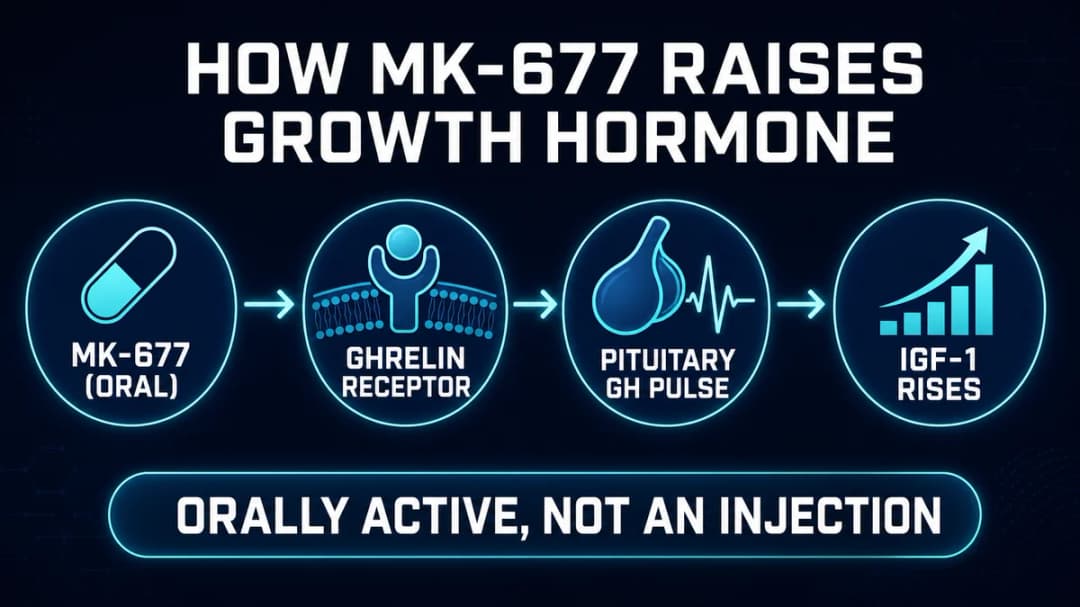
Growth hormone release is controlled by two opposing signals from the hypothalamus. Growth hormone releasing hormone (GHRH) pushes the pituitary to release, and somatostatin holds it back. Ghrelin, a hormone produced largely in the stomach, acts as a third input through its own receptor and amplifies release when it is triggered.
MK-677 mimics ghrelin at that receptor. It does not introduce growth hormone from outside the body. Instead it increases the size of the pulses your pituitary already produces, which raises circulating IGF-1, the liver-derived mediator responsible for most of what growth hormone is credited with. Because it works through your own signaling architecture, negative feedback remains partly intact, which is the usual argument for it being gentler than exogenous growth hormone.
The mechanism is also why the side effect profile is so predictable. Ghrelin is the hunger hormone, so an agonist at its receptor increases appetite, noticeably in most people. Growth hormone elevation drives sodium and fluid retention, which shows up as puffiness, ring tightness, or carpal tunnel type symptoms. Growth hormone also opposes insulin, so fasting glucose tends to drift upward. None of these are exotic reactions. They are the mechanism doing exactly what it does.
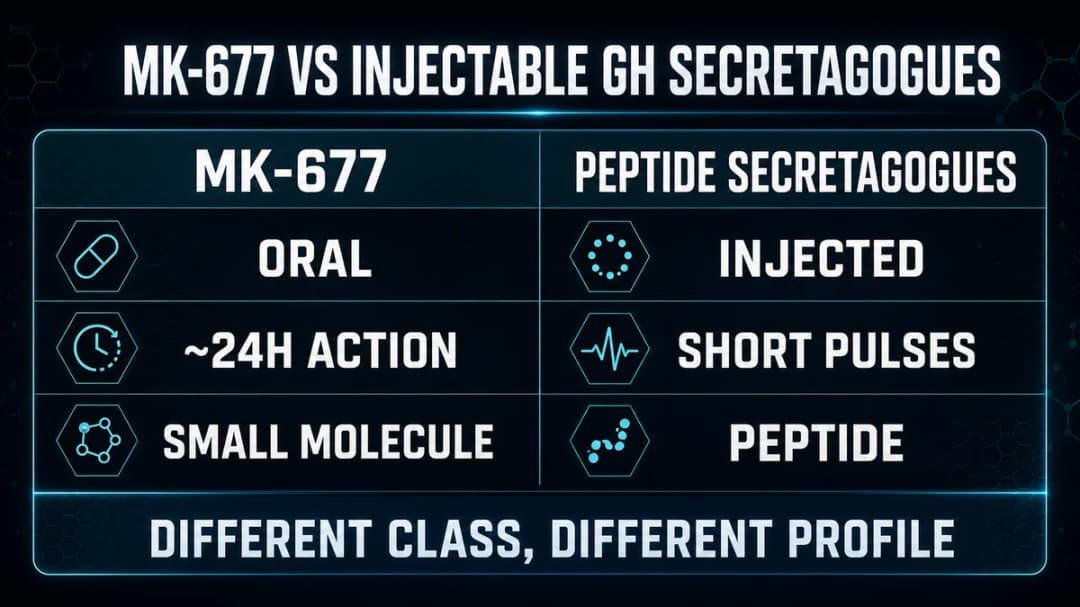
Reported elimination times are long enough that once-daily oral dosing keeps IGF-1 elevated around the clock, unlike short-acting injectables that produce a sharp pulse and then clear. Whether continuous elevation beats pulsatile elevation is an open question, and it is the central argument in the comparison between MK-677 and injectable GH secretagogues.
What the evidence actually supports
This is where honest coverage separates from marketing copy. The evidence for raising a biomarker is strong. The evidence for that biomarker translating into outcomes people care about is much weaker.
| Outcome | What research supports | Confidence |
|---|---|---|
| Raises growth hormone and IGF-1 | Demonstrated consistently in controlled human studies | High |
| Increases appetite | Predicted by mechanism and widely reported | High |
| Increases fat-free mass | Reported in older adults over extended dosing periods | Moderate |
| Improves strength or physical function | Not established, gains in fat-free mass did not reliably translate | Low |
| Changes sleep architecture | Some supporting data, though subjective reports outrun the evidence | Low to moderate |
| Reduces fat mass | Inconsistent across studies | Low |
| Raises fasting glucose, lowers insulin sensitivity | Reported in trials, a recognized concern | Moderate to high |
| Speeds recovery from injury or surgery | Investigated, endpoints not convincingly met | Low |
| Anti-aging or longevity benefit | No supporting human evidence | None |
The most important line in that table is the gap between fat-free mass and function. Clinical work in older adults found that extended dosing raised lean mass, but the strength and functional gains that would justify a treatment did not follow reliably, and development for frailty never reached approval. Some of the increase in lean mass is water, and water is not muscle.
For a longer treatment of how those numbers behave in practice, including why transformation photos are close to worthless as evidence, see our breakdown of MK-677 before and after results.
Why the side effect profile follows from the class
The full catalog of reported effects, along with monitoring questions, lives on the MK-677 guide hub. What belongs on this page is the narrower point that classification predicts the list. Because MK-677 is a ghrelin receptor agonist rather than a peptide analog of a releasing hormone, its unwanted effects are the receptor doing its ordinary job. Hunger is that receptor's native function, not a side reaction. Fluid retention, joint ache, and hand numbness track growth hormone shifting sodium and water. Rising fasting glucose tracks growth hormone opposing insulin. Grogginess is reported often enough to expect rather than to treat as unusual. None of it is idiosyncratic, and none of it is avoidable by finding a better source.
The concern raised least often is the most serious. Sustained IGF-1 elevation is a growth signal applied to every tissue, including tissue you would not want stimulated. There is no human evidence establishing that MK-677 causes cancer, and claiming otherwise would be irresponsible, but chronically elevating a proliferative signal without monitoring is a reason for caution. Anyone with an active or prior malignancy is exactly the wrong candidate. The insulin sensitivity question deserves similar weight for anyone with prediabetes, metabolic syndrome, or a family history of type 2 diabetes.
Where MK-677 questions usually land
Most people arriving at this compound have one of five specific questions. Rather than compress all of them here, this page routes to the full treatment of each.
| Your question | Where to read more |
|---|---|
| What do capsules contain, how are they dosed, what should I expect? | MK-677 capsules |
| Does it actually improve sleep and recovery? | MK-677 for sleep |
| What do real results look like over weeks and months? | MK-677 before and after |
| How does it compare to CJC-1295, ipamorelin, sermorelin, and tesamorelin? | MK-677 vs GH-releasing peptides |
| Oral convenience versus injectable precision, which fits me? | MK-677 vs injectable GH secretagogues |
The sleep question deserves a note, because it is the most oversold claim attached to this compound. Growth hormone release is naturally tied to slow wave sleep, so the idea has surface logic. The measured data on sleep architecture is thinner than community discussion suggests, and plenty of users report feeling groggier rather than sharper. Our page on MK-677 for sleep works through what the evidence does and does not show.
Dosing, and why this page will not hand you one
Nothing here is a protocol. MK-677 is not an approved medicine, no therapeutic dose has been established for any indication, and material sold online is not made to pharmaceutical manufacturing standards.
The one structural fact worth stating here is that published investigation used once-daily oral administration in the low tens of milligrams, because the compound survives digestion and acts over a long window. That schedule, rather than any particular milligram figure, is what separates it from injectable secretagogues requiring repeated weekly doses. Reported ranges, capsule contents, purity variability, and what a certificate of analysis can and cannot tell you sit in our guide to MK-677 capsules, and the evening-versus-morning timing argument is worked through in MK-677 for sleep.
Legal status, sourcing, and sport
MK-677 is not approved by the FDA for any indication. It is not a federally controlled substance in the United States, which is why it circulates openly, but it is also not legal to sell as a dietary supplement, and regulators have acted against products marketed that way. Material sold online carries a research use only label, and that label is the legal basis for the sale.
For competitive athletes the position is unambiguous. Growth hormone secretagogues are prohibited by the World Anti-Doping Agency at all times, in and out of competition, and MK-677 falls squarely within that category.
Because there is no regulated supply chain, product identity and purity are real variables. Certificates of analysis, batch identifiers, and third-party testing are the only meaningful signals available, and they are easy to fake. That sourcing problem applies to injectable alternatives too, as our comparison of MK-677 with other GH-focused compounds covers. We work through how to vet a source in our guide to where to buy MK-677.
FAQ
Is MK-677 a peptide?
No. MK-677 is a non-peptide small molecule. Peptides are chains of amino acids joined by peptide bonds, and MK-677 contains none. It is grouped with peptides in marketing and forum discussion because it targets the same growth hormone pathway as several genuine peptides, but structurally and pharmacologically it belongs to a different class. Its oral activity is a direct consequence of that difference.
Is MK-677 a SARM?
No. Selective androgen receptor modulators act on the androgen receptor. MK-677 acts on the ghrelin receptor and has no meaningful androgen receptor activity. It is commonly sold on the same sites as SARMs and mentioned in the same conversations, which is where the confusion comes from. It does not suppress endogenous testosterone through androgen receptor activity the way SARMs do.
Does MK-677 raise growth hormone permanently?
No. The effect depends on continued administration. Growth hormone and IGF-1 return toward baseline after discontinuation, generally over a period of weeks. There is no evidence that a course of MK-677 resets baseline growth hormone output to a higher level, and any body composition changes driven by the elevation are subject to the same reversal.
Why did pharmaceutical development stop?
Ibutamoren was investigated for conditions involving muscle loss and frailty. It did what it was designed to do biochemically, raising growth hormone, IGF-1, and lean mass, but the meaningful improvements in strength and physical function did not follow convincingly, and glucose effects were a concern in the target population. It never reached approval.
Should MK-677 be taken at night?
Evening dosing is the common practice, usually justified by the link between growth hormone release and deep sleep. The duration of effect is long enough that elevation persists across the day regardless of timing, so that argument is weaker than it sounds, and some users find evening dosing worsens morning grogginess. There is no established optimal timing, and nothing here is a recommendation to use it.
This article is for informational purposes only and does not constitute medical advice. MK-677 (ibutamoren) is not approved by the FDA or any comparable regulator for the treatment of any condition, and material sold online is designated for research use only. Nothing here is a recommendation, protocol, or instruction to obtain or use it. Any dose figures cited are reported ranges from published research or community discussion, not guidance. Growth hormone pathway compounds can affect blood glucose, fluid balance, and endocrine function, and they interact with existing conditions and medications. Speak with a qualified healthcare professional before making any decision about your health.