MK-677 (ibutamoren) is an oral, once-daily ghrelin mimetic that produces a sustained, around-the-clock rise in growth hormone (GH) and IGF-1, while injectable GH secretagogues such as ipamorelin, CJC-1295, GHRP-2, and GHRP-6 are administered by subcutaneous injection and tend to mimic the body's natural pulsatile GH release. The practical trade-off is convenience versus physiology: MK-677 is easier to take but drives a flatter, continuous hormonal signal with more appetite and water retention, whereas injectable peptides require needles and timing but reproduce sharper, shorter GH pulses with generally fewer fluid-related side effects. None of these compounds is FDA-approved for performance, body composition, or anti-aging use.
This comparison breaks down how each option works, what the clinical data actually shows, the side-effect profiles, and who each tends to suit.
Quick comparison table
| Feature | MK-677 (ibutamoren) | Ipamorelin | CJC-1295 (with DAC) | GHRP-2 / GHRP-6 |
|---|---|---|---|---|
| Class | Oral ghrelin mimetic (GHS-R agonist) | Injectable ghrelin mimetic (GHRP) | Injectable GHRH analog | Injectable ghrelin mimetics (GHRPs) |
| Route | Oral tablet/capsule | Subcutaneous injection | Subcutaneous injection | Subcutaneous injection |
| Typical frequency | Once daily | 1 to 3 times daily | 1 to 2 times weekly | 1 to 3 times daily |
| Approximate half-life | IGF-1 elevated up to ~24 h after one dose | ~2 hours | ~6 to 8 days | GHRP-2 ~15 to 30 min; GHRP-6 ~2.5 h |
| GH/IGF-1 pattern | Sustained, non-pulsatile | Pulsatile | Sustained background elevation | Pulsatile |
| Appetite effect | Strong increase | Minimal | None directly | GHRP-6 strong; GHRP-2 moderate |
| Water retention | Common | Less common | Less common | Possible |
| FDA approval | None (investigational) | None | None | None |
Half-life figures vary between sources and species; treat them as approximate ranges, not fixed values.
How MK-677 works
MK-677 is a non-peptide, orally active agonist of the growth hormone secretagogue receptor (GHS-R1a), the same receptor that the hunger hormone ghrelin binds. By mimicking ghrelin, it tells the pituitary to release GH while partly bypassing normal feedback inhibition. Because it is non-peptide and orally bioavailable, it survives digestion, which is why it can be taken as a tablet rather than injected.
The defining feature of MK-677 is duration. A single oral dose keeps IGF-1 elevated for roughly 24 hours, so once-daily dosing produces a continuous, relatively flat elevation in GH and IGF-1 rather than the discrete bursts the body normally generates. Reported GH and IGF-1 increases are substantial in clinical studies, and the compound also tends to raise cortisol modestly.
The most cited human trial is Nass and colleagues (2008, Annals of Internal Medicine), a study in healthy older adults using 25 mg per day. Over the treatment period it restored GH and IGF-1 toward levels seen in young adults and increased fat-free (lean) mass by roughly 1 kg. Importantly, it did not produce a measurable improvement in muscle strength or function, and it worsened insulin sensitivity and fasting glucose. Those two findings (lean mass up, strength flat, glucose worse) frame the realistic expectations for MK-677.
How injectable secretagogues work
Injectable secretagogues fall into two families that act on different receptors:
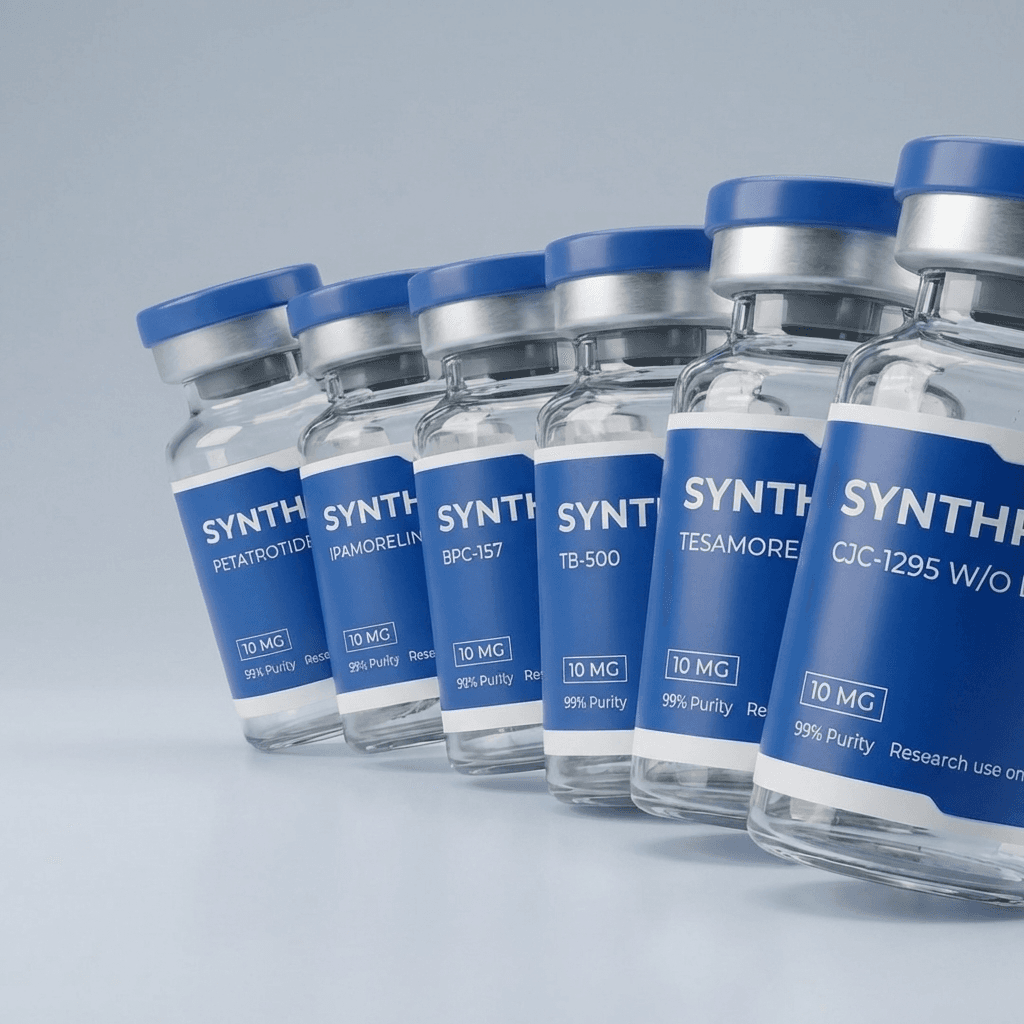
- GHRH analogs (CJC-1295, sermorelin, modified GRF 1-29): These mimic growth hormone-releasing hormone. CJC-1295 with DAC (drug affinity complex) binds albumin and has a long half-life of roughly 6 to 8 days, providing a sustained background of GHRH-like stimulation. CJC-1295 without DAC (modified GRF 1-29) clears much faster and produces a more pulsatile, short-acting signal.
- Ghrelin mimetics / GHRPs (ipamorelin, GHRP-2, GHRP-6): These activate GHS-R1a, the same receptor MK-677 targets, but as injectable peptides with short half-lives. Ipamorelin runs about 2 hours, GHRP-6 around 2.5 hours, and GHRP-2 closer to 15 to 30 minutes, peaking within an hour.
The two families are often combined because they are synergistic rather than merely additive: a GHRH analog raises the size of each GH pulse while a GHRP triggers the pulse, so stacking them (for example CJC-1295 plus ipamorelin) produces a larger GH release than either alone. Because the injectable GHRPs clear quickly, they better reproduce the natural pattern of brief GH pulses followed by troughs, which is the pattern the pituitary normally uses.
Ipamorelin is valued for selectivity. It releases GH at levels comparable to GHRP-6 but, unlike older secretagogues, does not meaningfully raise cortisol, prolactin, or aldosterone. GHRP-6 strongly stimulates appetite (a ghrelin effect), GHRP-2 stimulates it less, and ipamorelin barely at all.
Oral convenience vs injectable precision
The headline difference is practical. MK-677 is a single oral dose per day with no needles, no reconstitution of lyophilized powder, no refrigeration of mixed vials, and no injection-site care. For many people that convenience is decisive.
The trade-off is physiological. The body secretes GH in pulses, with low troughs in between, and that pattern matters for receptor signaling. MK-677's flat, continuous elevation does not replicate it, and the sustained IGF-1 signal is a likely reason MK-677 tends to drive more water retention and stronger appetite. Injectable GHRPs and short-acting GHRH analogs better preserve pulsatility, which is the main physiological argument in their favor.
- Choose oral (MK-677) if: you prioritize convenience, dislike injections, and accept stronger appetite and fluid retention.
- Choose injectable peptides if: you want a more pulse-like GH pattern, finer control over timing, and generally less water retention, and you are comfortable with subcutaneous injections.
There is also a storage and logistics dimension. MK-677 tablets are shelf-stable and travel easily, which matters for adherence over months. Injectable peptides usually ship as lyophilized powder that has to be reconstituted with bacteriostatic water and then kept refrigerated, with a limited window before the mixed solution degrades. Multiple daily injections also add friction that, in practice, lowers long-term compliance for many people. Convenience is not a trivial factor: the protocol you actually follow consistently tends to outperform the one that is theoretically more physiological but harder to sustain.
Side effects compared
MK-677. The most consistent issues are appetite, fluid, and glucose:
- Marked increase in appetite and caloric intake (the ghrelin-mimetic effect).
- Water retention and edema (swelling in the hands, feet, and face), with some users reporting several pounds of fluid weight. This is usually dose-dependent and reversible.
- Reduced insulin sensitivity and higher fasting glucose, which is the most clinically meaningful concern, especially for people with prediabetes or diabetes risk.
- Modest cortisol elevation and lethargy in some users.
Injectable secretagogues. Side effects depend on the specific peptide:
- Injection-site reactions (redness, itching, transient lumps).
- CJC-1295 can cause flushing, warmth, and transient drops in blood pressure shortly after dosing.
- GHRP-6 causes pronounced hunger; GHRP-2 less so; ipamorelin minimal.
- Water retention and numbness/tingling can occur but are typically milder than with MK-677 at comparable GH stimulation.
- As peptides, they carry a theoretical immunogenicity risk.
A risk both share: any agent that chronically raises IGF-1 has a theoretical concern around promoting growth of existing tumors, so these compounds are inappropriate for anyone with active or recent cancer.
Effect on GH and IGF-1
If the goal is a steady, day-long IGF-1 elevation (for example, supporting lean mass or sleep depth), MK-677's pharmacology delivers that with a single oral dose, and it reliably increases slow-wave and REM sleep in study subjects. If the goal is to amplify the body's own pulse pattern while minimizing constant IGF-1 exposure, a GHRH analog plus a GHRP is the more physiological route. Neither approach has been shown to reliably increase strength or athletic performance in controlled trials, and the lean-mass gains documented for MK-677 were modest and not matched by functional improvement. It is also worth noting that adult GH and IGF-1 levels decline naturally with age, so "restoring youthful levels" is a marketing frame rather than an established clinical goal; the body's pulsatile control of GH exists for a reason, and overriding it continuously is not proven to be benign over the long term.
Regulatory and legal status
None of these compounds is FDA-approved for muscle growth, fat loss, or anti-aging. MK-677 remains an investigational drug that never reached market approval; it is sold only as a research chemical or unapproved supplement and is banned by the World Anti-Doping Agency (WADA). Injectable secretagogues like ipamorelin and CJC-1295 are not FDA-approved either, and the FDA has restricted their use in compounding pharmacies. They are likewise prohibited in competitive sport. Products sold online are unregulated, so purity, dosing accuracy, and contamination are real concerns. If you are vetting a seller anyway, our guide to where to buy MK-677 covers what to check and what it should cost.
If you are researching GH secretagogues alongside metabolic peptides, it helps to understand how investigational agents are evaluated. Our explainers on what is retatrutide and its mechanism of action show how a drug moves through phase 3 trials, and is retatrutide safe covers how investigational status shapes safety expectations. For context on a related GLP-1 class drug, see retatrutide vs tirzepatide and retatrutide side effects. Note that retatrutide is investigational (in phase 3 trials, not FDA-approved) as of 2026; see when will retatrutide be available.
Who each option suits
- MK-677 fits people who want the simplest possible protocol, who specifically want appetite support or deeper sleep, and who do not have elevated blood sugar or insulin resistance.
- Injectable peptides fit people who want a pulse-mimicking signal, who want to avoid the appetite and fluid load of MK-677, and who are willing to manage subcutaneous injections and timing.
- Neither fits anyone with active cancer, uncontrolled diabetes, or who is subject to anti-doping testing, and neither is a substitute for prescribed recombinant GH where a genuine deficiency exists.
FAQ
Is MK-677 stronger than injectable peptides? Not in a simple sense. MK-677 produces a longer, flatter IGF-1 elevation from one daily dose, while a GHRH-plus-GHRP injectable stack can generate a larger single GH pulse. "Stronger" depends on whether you value sustained IGF-1 or pulse amplitude.
Does MK-677 cause more water retention than ipamorelin? Generally yes. The sustained IGF-1 elevation from MK-677 is associated with more fluid retention and edema than the short, pulsatile stimulation from ipamorelin, which is one of the most selective and side-effect-light GHRPs.
Can you take MK-677 and injectable peptides together? Some users do, but both act partly on the same ghrelin receptor (GHS-R1a), so combining MK-677 with a GHRP adds overlapping stimulation and side-effect risk without a clear evidence base. There is no controlled trial supporting the combination.
Why do injectables need to be taken more often than MK-677? Most GHRPs have half-lives measured in minutes to a couple of hours, so they are dosed one to three times daily to create repeated pulses. MK-677 keeps IGF-1 elevated for about 24 hours, so once daily is enough.
Are any of these FDA-approved? No. MK-677 and the injectable secretagogues are all unapproved for body composition or anti-aging use, and several are restricted in compounding and banned in competitive sport.
This article is for informational purposes only and is not medical advice; talk to a qualified clinician before using any growth hormone secretagogue or peptide.
References
- Nass et al., Annals of Internal Medicine (2008) — oral ghrelin mimetic (MK-677) in healthy older adults — 25 mg/day increased fat-free mass ~1.1 kg without improving strength, and reduced insulin sensitivity / raised fasting glucose.
- Operation Supplement Safety (DoD) — MK-677 (ibutamoren) — confirms MK-677 is an unapproved drug (not FDA-approved) and is on the WADA Prohibited List.