The amycretin peptide is Novo Nordisk's single-molecule GLP-1 and amylin receptor agonist, developed under the code NNC0487-0111, and its early trial figures are the reason it dominates obesity pipeline conversation. What sets the amycretin peptide apart is not just the size of the reported weight loss but that the same molecule is being developed in both a weekly injection and a daily tablet, which is a genuinely difficult thing to do with a peptide.
It is not on the market anywhere. Everything below is pipeline data from early-phase trials.
What the amycretin peptide is
Amycretin activates two receptors with one molecule: the GLP-1 receptor, familiar from semaglutide and its relatives, and the amylin receptor.
That combination is not new as an idea. CagriSema pairs semaglutide with cagrilintide, an amylin analogue, as two molecules in one injection. Amycretin attempts to collapse the same biology into a single peptide.
The engineering argument for doing so is practical. One molecule means one pharmacokinetic profile to characterise, one manufacturing process, and a much more tractable path to an oral formulation. Getting one peptide across the gut wall is hard. Getting two, at a fixed ratio, is considerably harder.
Why amylin is the interesting half
GLP-1 receptor agonists reduce hunger, slow gastric emptying and blunt what people describe as food noise. That pathway is well understood by now.
Amylin is a different signal. It is co-secreted with insulin by pancreatic beta cells and acts on satiety, meal size and post-meal glucose handling. Its effects overlap with GLP-1 but are not identical, which is the basis for expecting more than an additive result from hitting both.
There is a second reason for interest in amylin that gets less attention. Amylin analogues appear to preserve lean mass better than GLP-1 alone in some analyses, which matters because loss of muscle alongside fat is one of the substantive criticisms of the current generation of obesity drugs. Our amylin agonist guide covers the class.
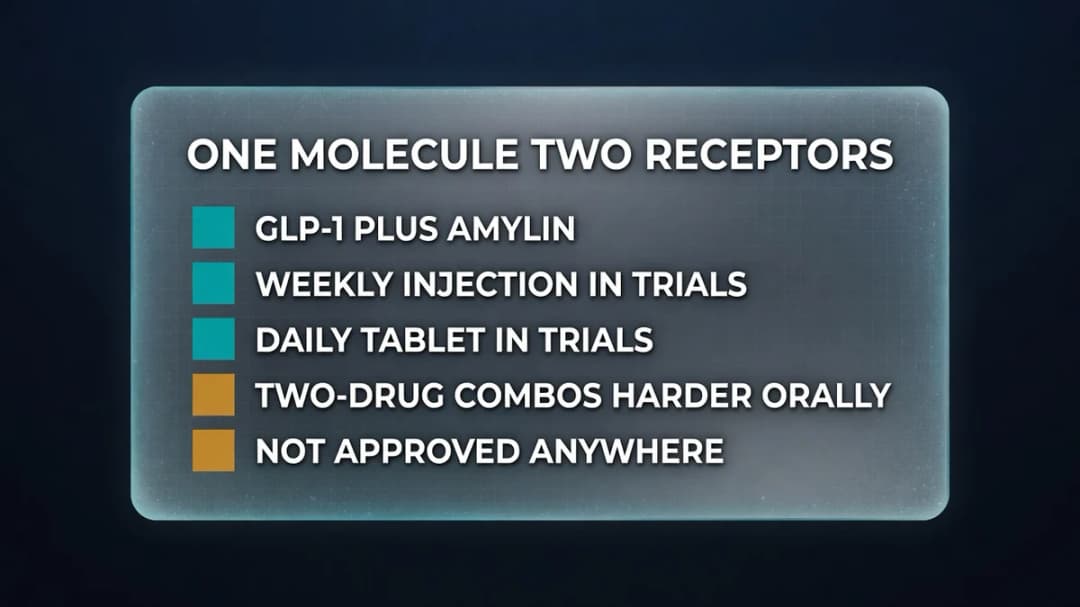
The reported numbers
These come from early-phase trials, and the caveats after the table matter as much as the figures in it.
| Study | Form | Reported result |
|---|---|---|
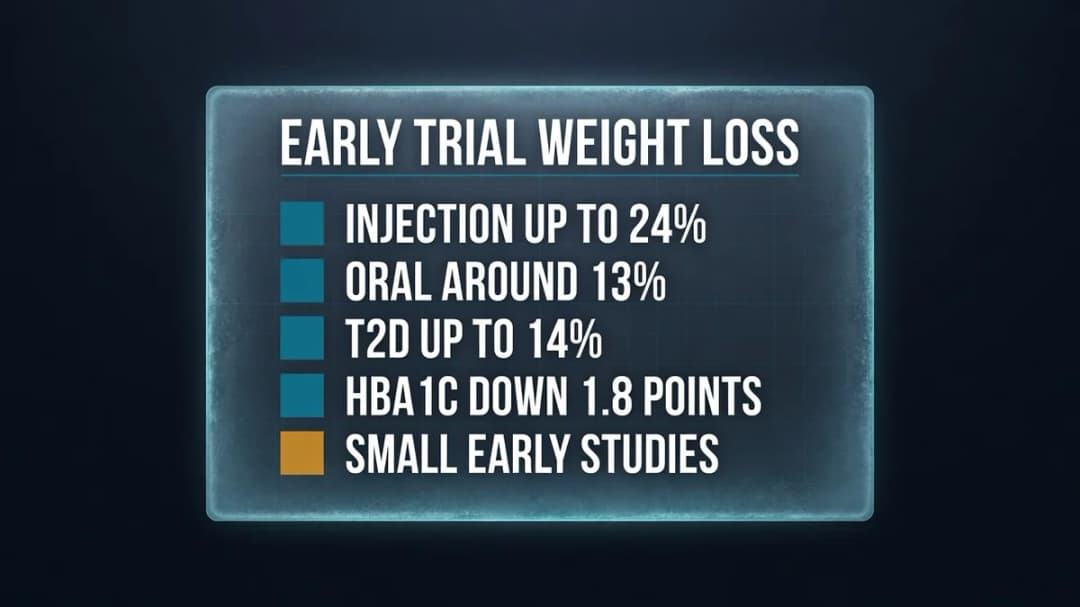
| Subcutaneous phase 1b/2a, around 125 participants, 36 weeks | Weekly injection | Estimated weight loss up to around 24% at the highest dose |
| First-in-human oral study, 12 weeks | Daily tablet | Around 13% weight loss at the highest regimen, against roughly 1% on placebo |
| Phase 2 in type 2 diabetes, around 450 participants, 36 weeks | Weekly injection | Reported weight loss up to around 14% with HbA1c reduction up to roughly 1.8 percentage points |
These are small, early studies. A 125-person phase 1b/2a trial is designed to establish safety and find a dose, not to measure efficacy reliably. Effect sizes from trials of that size routinely shrink when tested in thousands of people.
Some figures are estimated rather than observed. Trial reporting distinguishes between what happened to everyone enrolled and what would have happened had everyone stayed on treatment at the intended dose. The larger, more quotable number is usually the second kind.
Weight loss had not plateaued. In the subcutaneous study the curve was still descending at 36 weeks, which is genuinely notable and also means the endpoint was arbitrary rather than a ceiling.
Tolerability is the unanswered question. Reaching a high dose is straightforward in a small trial with careful titration and motivated participants. Gastrointestinal side effects are what determine whether a dose survives contact with the general population, and small early trials cannot tell you that.
The oral version
This is arguably the more important development. Oral semaglutide exists and works, but peptide tablets face a fundamental problem: the digestive system is designed to destroy peptides, so absorption is poor and variable, requiring absorption enhancers, fasting-state dosing and considerably more drug per dose.
If a daily oral tablet can deliver anything close to injection-level weight loss, it changes access rather than just convenience. Injections limit uptake through needle aversion, cold chain requirements and manufacturing capacity for pens. Tablets are easier on all three counts.
Around 13% weight loss over 12 weeks from an oral formulation is a strong early signal. Whether it holds at scale, and what the dosing conditions look like in practice, are open questions.
How it compares
| Amycretin | CagriSema | Retatrutide | |
|---|---|---|---|
| Design | One molecule, two receptors | Two molecules combined | One molecule, three receptors |
| Targets | GLP-1, amylin | GLP-1, amylin | GLP-1, GIP, glucagon |
| Developer | Novo Nordisk | Novo Nordisk | Eli Lilly |
| Forms | Injection and oral in development | Injection | Injection |
| Stage | Entering phase 3 | Phase 3 completed | Phase 3 |
Amycretin and CagriSema pursue the same biology by different routes, which is a sensible hedge for one company to run. Retatrutide takes a different approach entirely by adding glucagon receptor activity. See our CagriSema guide and retatrutide guide.
What to watch
Phase 3 results. Larger and longer trials are where effect sizes settle and where tolerability becomes visible. Early-phase numbers are a signal of promise rather than a prediction.
Discontinuation rates. How many people stop because of side effects is the figure that determines real-world usefulness, and it is systematically better in small early trials than in practice.
Whether the oral form keeps up. If oral amycretin lands meaningfully below the injection, it becomes a convenience option rather than a category shift.
Body composition. Whether the amylin component genuinely protects lean mass is one of the more consequential questions in this field and is measured far too rarely.
Timelines. Phase 3 obesity programmes typically run years, and approval, if it comes, sits well beyond that. Nobody is getting a prescription for this soon. Our new GLP-1 drugs page tracks the pipeline.
The realistic summary
Amycretin has produced some of the most striking early obesity numbers of any pipeline compound, in a molecule that also has a credible oral route. That combination is genuinely notable.
It is also a small number of small studies, and the history of obesity drug development is full of promising early results that moderated substantially at scale. The right posture is interest rather than expectation, and anyone currently making treatment decisions should be doing so on the basis of drugs that exist.
FAQ
What is amycretin?
A single peptide developed by Novo Nordisk that activates both the GLP-1 receptor and the amylin receptor. It is in development as a once-weekly injection and as a daily tablet, and is not approved or available anywhere.
How much weight loss does amycretin produce?
Early trials have reported up to roughly 24% over 36 weeks with the injection and around 13% over 12 weeks with the oral form. Both figures come from small early-phase studies, and effect sizes commonly shrink in larger trials.
Is amycretin the same as CagriSema?
No. CagriSema combines two separate molecules, semaglutide and cagrilintide, in one injection. Amycretin is a single molecule engineered to activate both receptor pathways, which makes an oral formulation far more feasible.
When will amycretin be available?
Phase 3 development is only beginning, and obesity programmes of that size run for years before submission. Approval, if it comes, is realistically several years away. Treat any earlier claim with suspicion.
Is there an oral version of amycretin?
Yes, in development. The first-in-human oral study reported around 13% weight loss over 12 weeks. Whether that holds at scale, and under what dosing conditions, remains to be established.
Can you buy amycretin now?
No. It is an investigational drug with no approval in any country. Anything sold under that name outside a clinical trial is not a verified product, and buying unapproved injectables from grey-market sources carries serious risks around identity, dose and sterility.