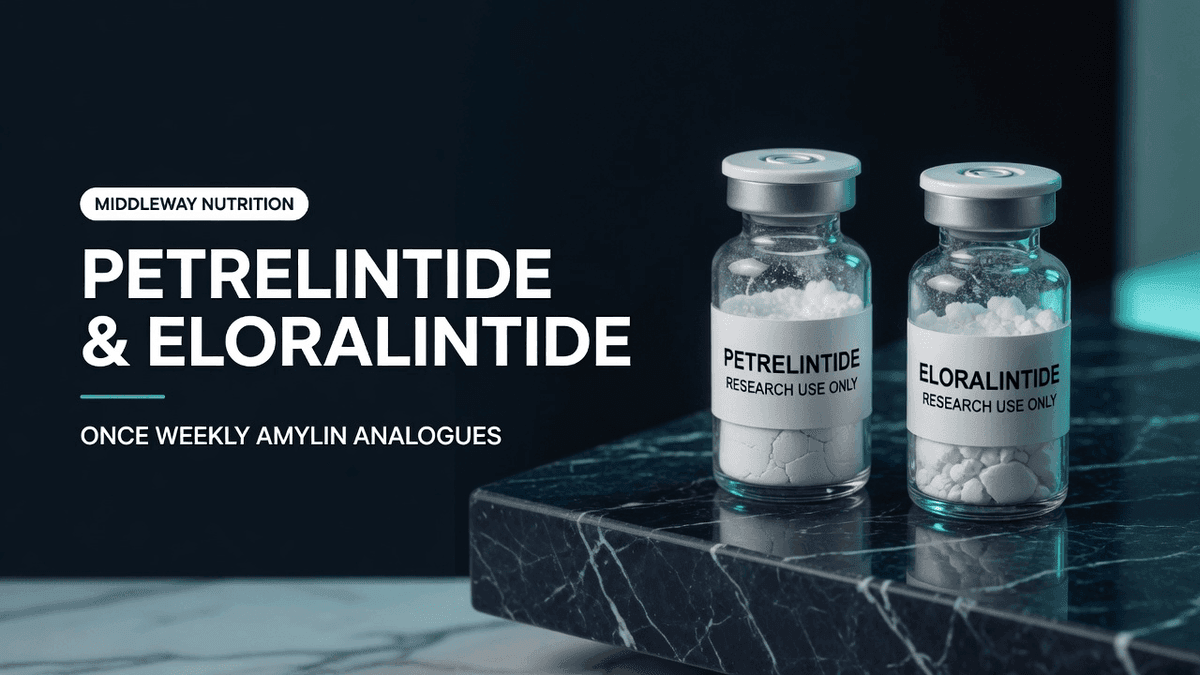
Petrelintide & eloralintide are once weekly amylin receptor agonists in clinical development, both aiming to deliver weight loss comparable to GLP-1 drugs with substantially less nausea and vomiting. Neither petrelintide & eloralintide is approved or purchasable anywhere, and both are being positioned as much for what they combine with as for what they do alone.
Petrelintide comes from Zealand Pharma, developed in partnership with Roche. Eloralintide comes from Eli Lilly, previously designated LY3841136.
Why Amylin Matters
Amylin is a 37 residue hormone released alongside insulin by pancreatic beta cells at mealtimes. Its receptors sit in the hindbrain, in the area postrema, and from there it slows the stomach, dampens appetite and contributes to feeling full.
Two features make it attractive as a drug target.
First, it reaches appetite through neural wiring that barely overlaps with the incretin route, so pairing an amylin drug with a GLP-1 drug adds rather than duplicates. Second, amylin has been characterised as restoring sensitivity to leptin, the signal that reports how much stored energy the body is carrying. Obesity involves resistance to that signal, so a compound that partly reopens the channel is mechanistically interesting in a way incretin drugs are not.
The concept was proven long ago. Pramlintide, an amylin analogue, has been used clinically alongside insulin for years and demonstrated that amylin agonism lowers how much people eat and what they weigh. Its problem was pharmacokinetic rather than pharmacological: it cleared too fast to be given less often than at every meal, which no one managing obesity will sustain. Petrelintide and eloralintide are attempts to solve that engineering problem.
Petrelintide & Eloralintide: What the Phase 2 Data Shows
| Petrelintide | Eloralintide | |
|---|---|---|
| Developer | Zealand Pharma with Roche | Eli Lilly |
| Class | Amylin analogue | Selective amylin receptor agonist |
| Dosing | Once weekly subcutaneous | Once weekly subcutaneous |
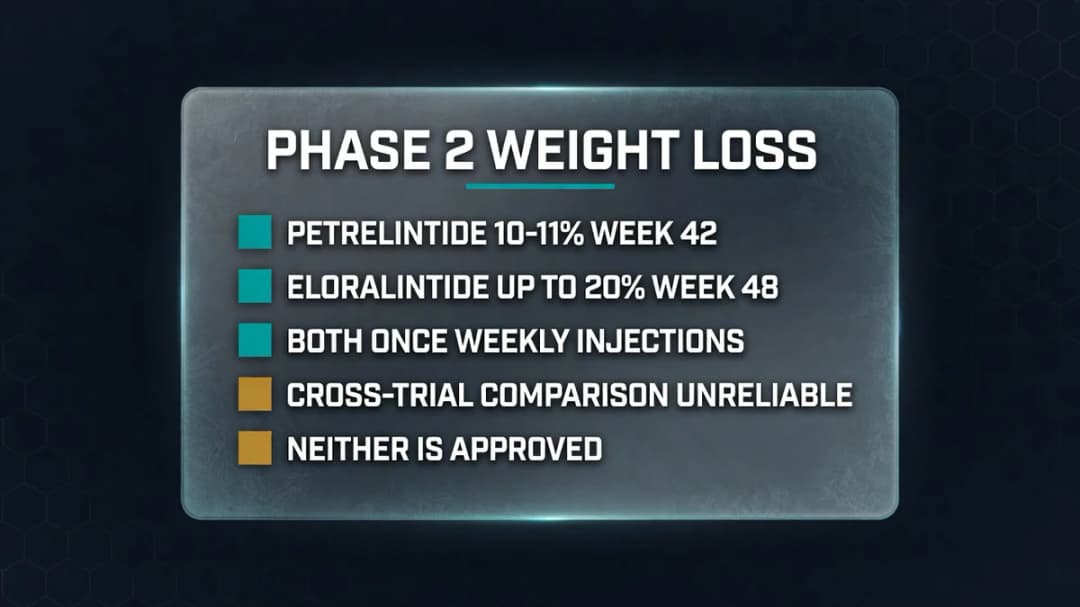
| Phase 2 weight loss | Around 10 to 11 percent at the top dose by week 42 | Up to around 20 percent at 48 weeks in the highest dose group |
| Tolerability claim | Notably low rates of vomiting at effective doses | Reported as well tolerated |
| Status | Phase 2 complete, further development ongoing | Phase 2 complete, further development ongoing |
Two cautions apply to reading that table. Phase 2 results routinely shrink in phase 3, across every therapeutic area, and cross trial comparisons are unreliable because populations, durations and background care differ.
The eloralintide figure is striking if it holds. Approaching 20 percent weight loss from a single mechanism with an amylin tolerability profile would be a significant result. Whether it survives a larger, longer trial is the question that matters and has not yet been answered.
The Tolerability Argument
This is the real proposition for the amylin class, more than the weight loss numbers.
Gastrointestinal side effects are the main reason people stop GLP-1 drugs. Nausea, vomiting and the misery of a titration week account for a substantial share of discontinuations, and discontinuation is the largest practical limit on real world effectiveness. A drug that produces 12 percent weight loss and is tolerated is worth more in practice than one producing 18 percent that a third of people abandon.
Amylin analogues appear to sit differently on that curve. Cagrilintide, the amylin analogue furthest along, still causes nausea, but the newer selective agonists are being designed to widen the gap between the satiety effect and the emesis effect, which share neighbouring circuitry in the brainstem.
Body composition is the secondary claim. Amylin analogues are reported to preserve lean mass relatively well. The comparisons are not head to head against GLP-1 drugs at matched weight loss, so this should be treated as a hypothesis rather than an established advantage.
Where They Fit in the Pipeline
Both are being developed substantially as combination partners rather than standalone products, which is a meaningful signal about how their developers expect them to be used.
The pattern across the field is now clear. Novo Nordisk pairs cagrilintide with semaglutide. Lilly is exploring amylin alongside its incretin portfolio. Zealand and Roche are pairing petrelintide with an incretin partner. The strategic bet is that amylin plus incretin is the next standard, with amylin contributing weight loss and tolerability while the incretin contributes glycaemic and cardiovascular effects.
For the class overview see our amylin agonist guide, and for the compound closest to market see the cagrilintide guide and CagriSema guide.
What This Means Practically
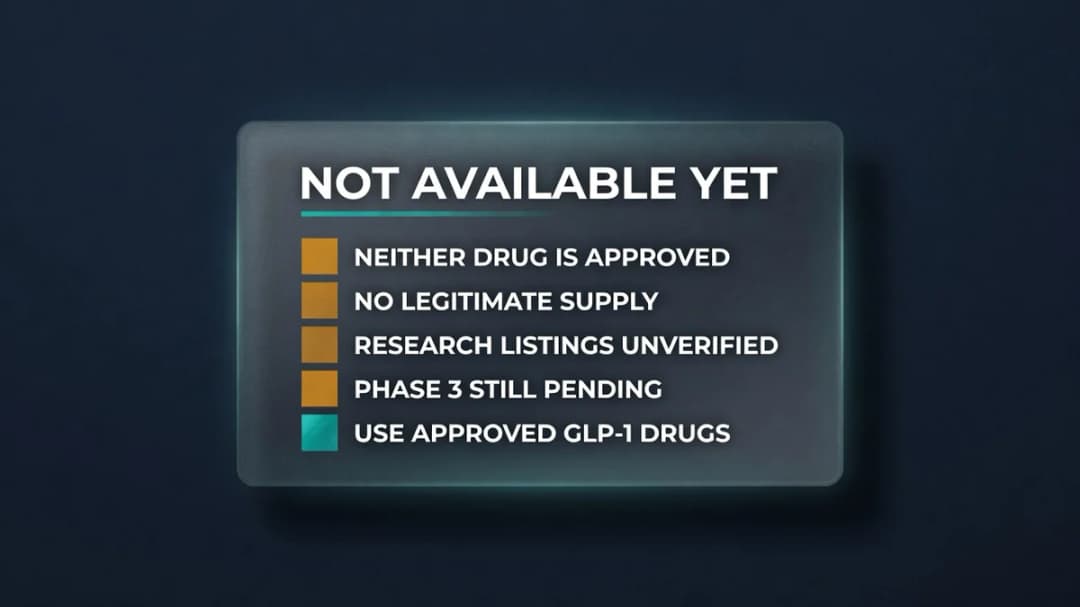
Nothing yet. Neither drug can be prescribed, and neither is available legitimately in any form.
Research suppliers do sell material labelled as these compounds. Buying a phase 2 molecule from an unregulated vendor means accepting unverifiable identity, no dosing guidance beyond what a trial protocol implied, and no safety monitoring, for a compound whose main selling point is a tolerability profile you cannot verify in yourself against a comparison group.
If weight management is the actual goal, the approved drugs are the sensible answer for now. See which GLP-1 is best for weight loss.
What to Watch For Next
Three things will determine whether either compound matters.
Whether the phase 2 weight loss figures hold in phase 3. Shrinkage between phases is the norm rather than the exception, and a drop from 20 percent to 14 percent would change the competitive picture entirely.
Whether the tolerability advantage survives a larger population. Small trials in selected participants routinely look gentler than large trials in a general one, and the tolerability claim is the whole proposition here.
Whether the combination data justifies the strategy. Both are being developed primarily as partners for incretin drugs, and the relevant number is not what either does alone but what each adds on top of an already effective agent, at what cost in side effects.
None of those questions will be answered quickly, and any timeline circulating before the phase 3 readouts is guesswork.
FAQ
What is the difference between petrelintide and eloralintide?
Both are once weekly amylin receptor agonists in clinical development, from different companies. Eloralintide reported larger phase 2 weight loss, and petrelintide reported particularly favourable tolerability. Cross trial comparison is unreliable, so neither claim should be taken as settling the comparison.
Are amylin drugs better than GLP-1 drugs?
Not on weight loss alone, on current evidence. The argument for them is tolerability and the possibility of better lean mass preservation, and the strategic use case is combination with an incretin rather than replacement of one.
When will petrelintide or eloralintide be available?
Both have completed phase 2. Phase 3 programmes, regulatory review and launch typically take several years from that point, and there is no announced availability date for either. Any specific date circulating online is speculation.
Can you buy petrelintide or eloralintide?
Not legitimately. Research suppliers list material under those names, but these are investigational compounds with no approval, no verified supply chain outside their sponsors, and no established dosing outside trial protocols.
How do amylin analogues differ from GLP-1 drugs mechanistically?
Amylin acts on receptors in the hindbrain area postrema and appears to restore some leptin sensitivity. GLP-1 agonists act on incretin receptors in the pancreas, gut and brain. Both reduce appetite, through largely separate circuits, which is why combining them adds up.