In the phentermine vs semaglutide comparison, semaglutide produces roughly two to three times as much weight loss and is approved for indefinite use, while phentermine is a cheap generic stimulant labelled for only a few weeks of treatment. At 2.4 mg weekly, semaglutide cut body weight by 14.9% over 68 weeks in its main trial. Phentermine on its own typically produces mid-single-digit losses over a few months, and it gets to about 8-10% only when it is paired with topiramate.
That gap doesn't settle the question alone. Phentermine costs a fraction of semaglutide, works within days and is a daily tablet. Semaglutide needs a weekly injection or daily pill, takes months to reach full dose, and brings mostly digestive rather than stimulant side effects. The right choice depends on heart health, budget, how much weight needs to come off and whether the goal is a short push or long-term treatment.
This page compares the two drugs directly. For the full background on semaglutide itself, see our semaglutide guide.
Phentermine vs Semaglutide at a Glance
| Phentermine | Semaglutide (Wegovy 2.4 mg) | |
|---|---|---|
| Drug class | Sympathomimetic amine (appetite suppressant) | GLP-1 receptor agonist |
| How it's taken | Oral tablet or capsule, once daily | Weekly injection; a daily Wegovy pill also exists |
| Licensed duration | Short-term ("a few weeks") | Long-term weight management |
| Controlled substance | Yes, Schedule IV in the US | No |
| Main trial result | 5.9% at 24 weeks (15 mg, early non-responders to diet) | 14.9% at 68 weeks (STEP 1) |
| With topiramate (Qsymia) | 7.8% (7.5/46 mg) and 9.8% (15/92 mg) at 56 weeks | Not applicable |
| Typical side effects | Dry mouth, insomnia, raised heart rate, jitteriness | Nausea, diarrhoea, vomiting, constipation |
| Minimum age | Not recommended at 16 or under | 12 and over (Wegovy) |
| Approximate cash price | Roughly $10-$20 a month for generic with a discount card | About $349 a month for Wegovy pens direct from the maker |
| Onset | Appetite drops within days | Builds over a 16-week dose escalation |
The trial numbers in that table are not directly comparable. They come from different populations, durations and study designs, which is covered in detail below.
How Phentermine and Semaglutide Work
The two drugs reduce appetite through completely different routes, and that difference explains almost everything else on this page: the side effects, the duration limits, the controlled-drug status and why stopping plays out differently.
Phentermine: a stimulant that dampens hunger
Phentermine is a sympathomimetic amine, chemically and pharmacologically related to amphetamine. It increases the release of noradrenaline (and to a lesser extent dopamine) in the brain, and part of the resulting "fight or flight" signalling is a reduced drive to eat. The same stimulant effect raises heart rate and blood pressure in some people, disrupts sleep and dries the mouth.
Because of its relationship to amphetamine, phentermine is a Schedule IV controlled substance in the US. The label says tolerance to its appetite-suppressing effect "usually develops within a few weeks" and tells prescribers not to push the dose higher when that happens, but to stop the drug instead.
Semaglutide: a gut hormone mimic
Semaglutide copies GLP-1, a hormone the gut releases after eating. It acts on receptors in the brain's appetite centres, slows the rate at which the stomach empties, and boosts insulin release when blood glucose is high. People describe it less as being wired and more as feeling full sooner and thinking about food less.
It isn't a stimulant and isn't a controlled substance. It has a half-life of about a week, which allows weekly dosing but also means it stays in the body for five to seven weeks after the last injection. It is sold as Wegovy for weight management and as Ozempic for type 2 diabetes. The two brands contain the same molecule at different dose ceilings. Our Wegovy guide covers the injection and pill forms.
Phentermine vs Semaglutide Weight Loss: What the Trials Show
No trial has put phentermine and semaglutide head-to-head. The only fair approach is to look at each against placebo and be clear about how the studies differ.
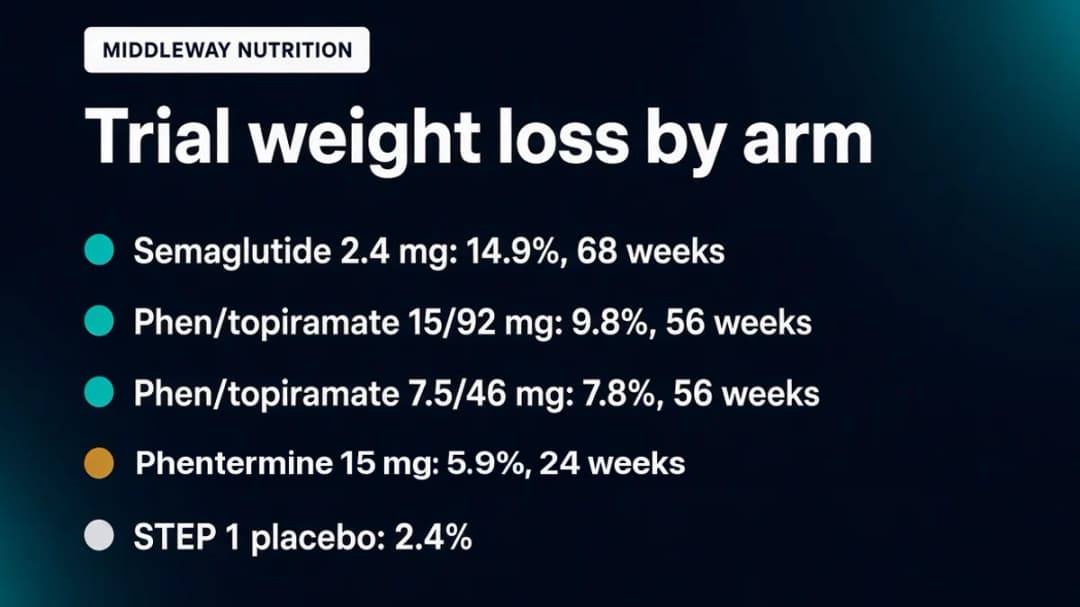
Semaglutide 2.4 mg: STEP 1
STEP 1 (Wilding and colleagues, New England Journal of Medicine, 2021) randomised 1,961 adults without diabetes, with a BMI of 30 or more (or 27 or more with a weight-related condition), to weekly semaglutide 2.4 mg or placebo for 68 weeks, alongside lifestyle support. PubMed 33567185
- Mean weight change: -14.9% with semaglutide vs -2.4% with placebo
- In kilograms: -15.3 kg vs -2.6 kg
- Lost at least 5%: 86.4% vs 31.5%
- Lost at least 10%: 69.1% vs 12.0%
- Lost at least 15%: 50.5% vs 4.9%
Those figures are the trial's primary analysis, which counts people whether or not they kept taking the drug. That's the most honest way to read them.
Phentermine on its own
Most phentermine trials are small, short and old. The best recent evidence is a 2025 randomised trial in Nature Medicine (Tronieri and colleagues). It enrolled adults who had lost less than 2% of their weight after four weeks of behavioural treatment and gave them phentermine 15 mg a day or placebo for 24 weeks. The phentermine group lost 5.9% of their weight vs 2.8% on placebo. PubMed 40055520
These were people already struggling to respond to diet, on a dose below the usual 37.5 mg, so it may understate the full-dose effect. Still, the size is a few points beyond placebo, not double digits.
The EQUATE trial (Aronne and colleagues, Obesity, 2013) ran for 28 weeks and tested phentermine alone against the phentermine-topiramate combination. The share of people losing at least 5% of their weight was 43.3% on phentermine 7.5 mg and 46.2% on phentermine 15 mg, against 15.5% on placebo and 66.0% on the top combination dose. PubMed 24136928
Phentermine plus topiramate (Qsymia): check the dose arm
Many comparison pages quote Qsymia figures as if they were phentermine figures, and some attach the wrong dose to the wrong number. CONQUER (Gadde and colleagues, Lancet, 2011) followed 2,487 adults for 56 weeks across three arms. PubMed 21481449
| CONQUER arm (56 weeks) | Weight change | Lost at least 5% | Lost at least 10% |
|---|---|---|---|
| Placebo | -1.4 kg (-1.2%) | 21% | 7% |
| Phentermine 7.5 mg + topiramate 46 mg | -8.1 kg (-7.8%) | 62% | 37% |
| Phentermine 15 mg + topiramate 92 mg | -10.2 kg (-9.8%) | 70% | 48% |
The 8.1 figure that circulates online is kilograms from the lower 7.5/46 mg dose, not a percentage and not the 15 mg dose. The top dose produced 9.8%. Either way, this is a two-drug combination, and topiramate brings its own side effects and a serious pregnancy risk.
Why the comparison is not like-for-like
The trials differ in length (68 weeks for STEP 1, 24 to 56 for the phentermine studies), population and dose. Even allowing for that, the gap is large: semaglutide reliably reaches double-digit percentage loss, and phentermine alone does not.
How Long Can You Take Phentermine or Semaglutide?
Phentermine: labelled for a few weeks
The phentermine label describes it as "a short-term (a few weeks) adjunct" to diet, exercise and behaviour change for adults with a BMI of 30 or more, or 27 or more with another risk factor. In practice most prescriptions run for about 12 weeks, reflecting concern about tolerance and stimulant misuse.
Longer use happens off-label. The best data on it is observational. An electronic health record study of 13,972 adults (Lewis and colleagues, Obesity, 2019) found that people who took phentermine continuously for more than 12 months had lost 7.4% more weight at 24 months than people who took it for three months or less. Heart disease or death was rare (0.3%, 41 events), and the risk did not differ significantly between groups. PubMed 30900410 This is reassuring for low-risk patients, but it is not a randomised trial and the people prescribed long courses were selected by their doctors.
Semaglutide: approved for long-term use
Wegovy is licensed to "reduce excess body weight and maintain weight reduction long term". It is also licensed to cut major cardiovascular events in adults with established heart disease and overweight or obesity. There is no built-in stopping point, and the evidence below on stopping suggests that for most people it works only as long as it is taken.
Side Effects: Phentermine vs Semaglutide
The side effects follow from the mechanisms. Phentermine's are stimulant effects; semaglutide's are mainly digestive.
Phentermine side effects
The label lists:
- Cardiovascular: palpitations, fast heart rate, raised blood pressure, ischaemic events, and rarely primary pulmonary hypertension or heart valve disease
- Nervous system: overstimulation, restlessness, insomnia, dizziness, tremor, headache, euphoria or low mood, and rarely psychosis
- Gut: dry mouth, unpleasant taste, diarrhoea or constipation
- Other: impotence or changes in libido, urticaria
Dry mouth and poor sleep are the complaints people notice most, and the label advises against late-evening doses for that reason. In CONQUER, dry mouth was reported by 2% on placebo, 13% on the 7.5/46 mg combination and 21% on the 15/92 mg combination.
Semaglutide side effects
In the Wegovy label, the most common adverse reactions with 2.4 mg against placebo were:
| Side effect | Wegovy 2.4 mg | Placebo |
|---|---|---|
| Nausea | 44% | 16% |
| Diarrhoea | 30% | 16% |
| Vomiting | 24% | 6% |
| Constipation | 24% | 11% |
| Abdominal pain | 20% | 10% |
| Headache | 14% | 10% |
| Fatigue | 11% | 5% |
Most of these peak during the dose increases and fade over time. In STEP 1, 4.5% of semaglutide users stopped because of gastrointestinal effects, against 0.8% on placebo. Less common but more serious risks include gallbladder disease, pancreatitis, kidney injury from dehydration and low blood sugar in people also taking insulin or sulfonylureas. Our page on semaglutide side effects covers timing and what helps.
Who Shouldn't Take Phentermine or Semaglutide
Phentermine is contraindicated with
- A history of heart disease, including coronary artery disease, stroke, arrhythmias, heart failure or uncontrolled high blood pressure
- Use of a monoamine oxidase inhibitor (MAOI) now or in the past 14 days
- An overactive thyroid
- Glaucoma
- Agitated states
- A history of drug misuse
- Pregnancy or breastfeeding
It is not recommended at 16 or under, and is capped at 15 mg a day in severe kidney impairment. That list rules out many people with the most to gain from weight loss, particularly those with heart disease.
Semaglutide is contraindicated with
- A personal or family history of medullary thyroid carcinoma, or multiple endocrine neoplasia type 2 (MEN 2). This follows from thyroid tumours seen in rodents, a risk that has not been confirmed in humans.
- A previous serious allergic reaction to semaglutide
It also calls for caution with a history of pancreatitis, gallbladder disease, diabetic eye disease or suicidal thoughts. It should be stopped at least 2 months before a planned pregnancy because it takes so long to clear the body. Unlike phentermine, it is licensed for people with established cardiovascular disease.
Phentermine vs Semaglutide Cost
This is where phentermine wins outright. The prices below are approximate US cash figures from pharmacy and manufacturer listings in 2026. They vary by pharmacy, change often and don't include the cost of the prescribing visit.
| Medication | Approximate monthly cash price |
|---|---|
| Generic phentermine 37.5 mg (30 tablets) | About $10-$20 with a discount card; roughly $15-$75 at retail |
| Generic phentermine-topiramate ER | From about $59 with a discount card |
| Brand Qsymia | About $98 through the maker's home-delivery programme |
| Wegovy pen, direct from Novo Nordisk | $349 ($199 for the first two fills for new patients) |
| Wegovy pill, lower doses | $149 |
| Ozempic pen, 0.25-1 mg | $349; the 2 mg pen is $499 |
| Wegovy list price | $1,349.02 |
Over a year, a generic phentermine prescription might cost a couple of hundred dollars at most. A year of Wegovy pens at the direct cash price comes to about $3,888 (two introductory fills at $199 and ten at $349), and much more at list price if you use neither insurance nor a manufacturer programme. For the full breakdown see Wegovy cost without insurance and Ozempic cost without insurance. The GLP-1 price comparison sets semaglutide against the other drugs in its class.
Can You Take Phentermine and Semaglutide Together?
Some obesity clinics do combine them, and there is no known direct pharmacokinetic interaction between the two. But the evidence behind the combination is thin, and no licence covers it.
What the evidence actually shows
- No randomised trial has tested phentermine plus semaglutide.
- The nearest trial used liraglutide, an older daily GLP-1 drug. Tronieri and colleagues (Metabolism, 2019) took 45 adults who had already lost 12.6% of their weight on liraglutide 3.0 mg over a year and randomised them to add phentermine 15 mg or placebo for 12 weeks. The phentermine group lost a further 1.6% vs 0.1%, which was not statistically significant (p = 0.073). The combination was well tolerated, and hunger scores fell more in the first eight weeks. The authors concluded it did not produce additional clinically meaningful weight loss. PubMed 30902750
- Published semaglutide data is limited to case reports. In one (Patel and colleagues, JCEM Case Reports, 2023), a 23-year-old man whose weight had stalled for a year on phentermine, topiramate and metformin reached a 32.5% total body weight reduction after semaglutide was added. PubMed 37908264 A single case shows what is possible. It says nothing about how often it happens or how safe it is.
The practical concerns
Both drugs can raise resting heart rate, so the combination stacks a stimulant on a drug that already nudges pulse up. Both suppress appetite, making it harder to eat enough protein and fluid during semaglutide's dose increases. It belongs under a prescriber who monitors blood pressure and heart rate and has a specific reason, usually a plateau on semaglutide alone, not as a way to speed up the first months.
What Happens When You Stop Phentermine or Semaglutide
Stopping semaglutide
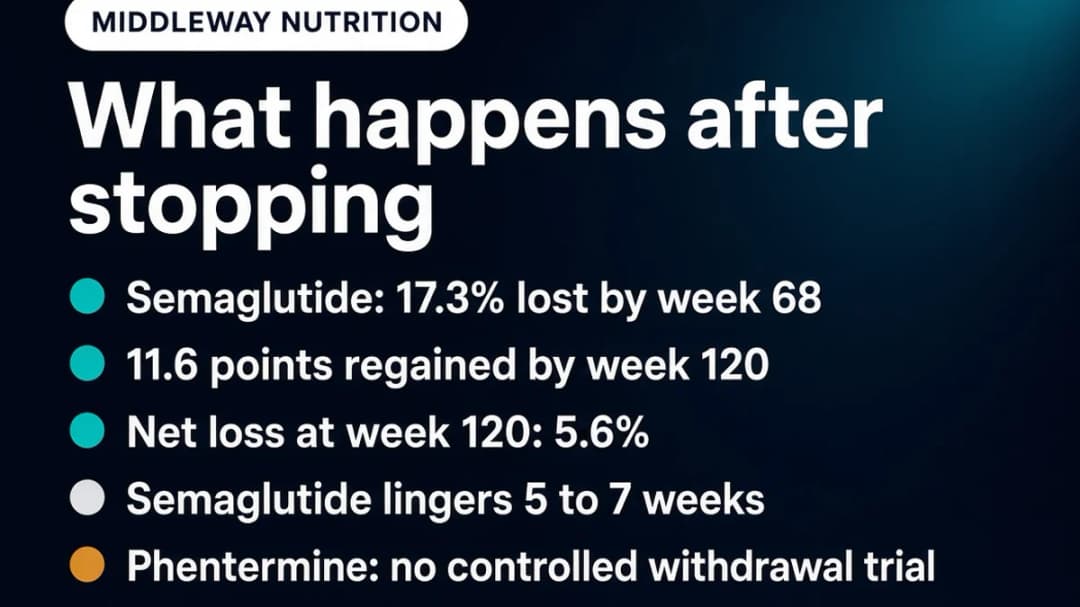
This has been measured properly. In the STEP 1 extension (Wilding and colleagues, Diabetes, Obesity and Metabolism, 2022), 327 participants were followed for a year after stopping treatment at week 68. The semaglutide group had lost 17.3% by week 68, then regained 11.6 percentage points by week 120, leaving a net loss of 5.6%. That is roughly two-thirds of the lost weight coming back within a year. Improvements in blood pressure, blood lipids and blood sugar also drifted back towards baseline. PubMed 35441470
Because semaglutide lingers in the body for five to seven weeks, appetite tends to return gradually rather than overnight. Our guide on stopping a GLP-1 without regaining weight covers what the trials say about tapering and maintenance.
Stopping phentermine
There is no controlled withdrawal trial for phentermine comparable to the STEP 1 extension, so the honest answer is that regain after stopping it hasn't been well quantified. What's known:
- It is short-acting, so the appetite effect wears off quickly once doses stop.
- Tolerance usually builds within a few weeks anyway, so for many people the appetite effect has faded before the prescription ends.
- The label warns that stopping abruptly after prolonged high-dose use can cause extreme fatigue and low mood. At normal doses over a standard course this is uncommon, but it is a reason not to stop suddenly after long or high-dose use without talking to the prescriber.
The principle that applies to semaglutide almost certainly applies here too. Obesity medications work while they are taken, and whatever habits are built during treatment carry most of the weight afterwards.
Which One Suits Whom
Phentermine tends to suit people who:
- Have a modest amount of weight to lose and want a short-term start alongside diet changes
- Can't afford semaglutide and don't have coverage for it
- Have no heart disease, normal blood pressure, and no history of anxiety, insomnia or stimulant misuse
- Would rather take a tablet than an injection
Semaglutide tends to suit people who:
- Need 10% or more weight loss, or have weight-related conditions such as type 2 diabetes, fatty liver or established heart disease
- Expect to need long-term treatment
- Have cardiovascular conditions that rule out a stimulant
- Can manage nausea during the escalation phase and can afford the ongoing cost
If phentermine alone isn't enough but semaglutide isn't possible, the phentermine-topiramate combination sits between the two, both in results and in price. For other drugs in semaglutide's class, see our overview of drugs similar to semaglutide.
This page is for information only and is not medical advice. Both drugs are prescription-only, and the choice between them should be made with a clinician who knows your medical history.
FAQ
Is semaglutide stronger than phentermine for weight loss?
Yes. In STEP 1, semaglutide 2.4 mg produced 14.9% weight loss over 68 weeks. Phentermine alone typically produces mid-single-digit losses, such as 5.9% at 24 weeks on 15 mg in a 2025 trial. Even phentermine combined with topiramate reached 9.8% at its top dose.
Which works faster, phentermine or semaglutide?
Phentermine suppresses appetite within days, while semaglutide starts at 0.25 mg and climbs over 16 weeks to 2.4 mg. Over a year, semaglutide ends up well ahead.
Can I switch from phentermine to semaglutide?
Yes, and it is a common sequence, especially when phentermine's short licence runs out or tolerance sets in. There's no dose conversion between them because they work in completely different ways. Semaglutide simply starts at its usual lowest dose. Your prescriber will decide whether to stop phentermine first.
Is phentermine safer than semaglutide?
Neither is simply safer. Phentermine's risks are stimulant-related: heart rate, blood pressure, insomnia and misuse potential. That's why it is off-limits for anyone with heart disease. Semaglutide's risks are mostly digestive, plus rarer gallbladder and pancreatic problems, and it has been shown to reduce cardiovascular events in people with established heart disease.
Why is phentermine only approved for short-term use?
The label limits it to "a few weeks" because tolerance to the appetite effect usually develops within that time, and because it is related to amphetamine and carries some misuse risk. Some clinicians prescribe it for longer off-label. A 2019 observational study of 13,972 adults found more weight loss and no rise in heart events with longer use in low-risk patients.
Do you regain weight after stopping phentermine or semaglutide?
For semaglutide, most people do: the STEP 1 extension found about two-thirds of lost weight returned within a year of stopping. Phentermine has no comparable withdrawal trial. Its effect ends quickly after the last dose, so the same pattern is likely unless habits carry the loss.
Is phentermine cheaper than Ozempic or Wegovy?
By a wide margin. Generic phentermine is roughly $10-$20 a month with a discount card, while Wegovy and Ozempic pens cost about $349 a month through Novo Nordisk's direct cash programme and far more at list price. Prices are approximate and change often.