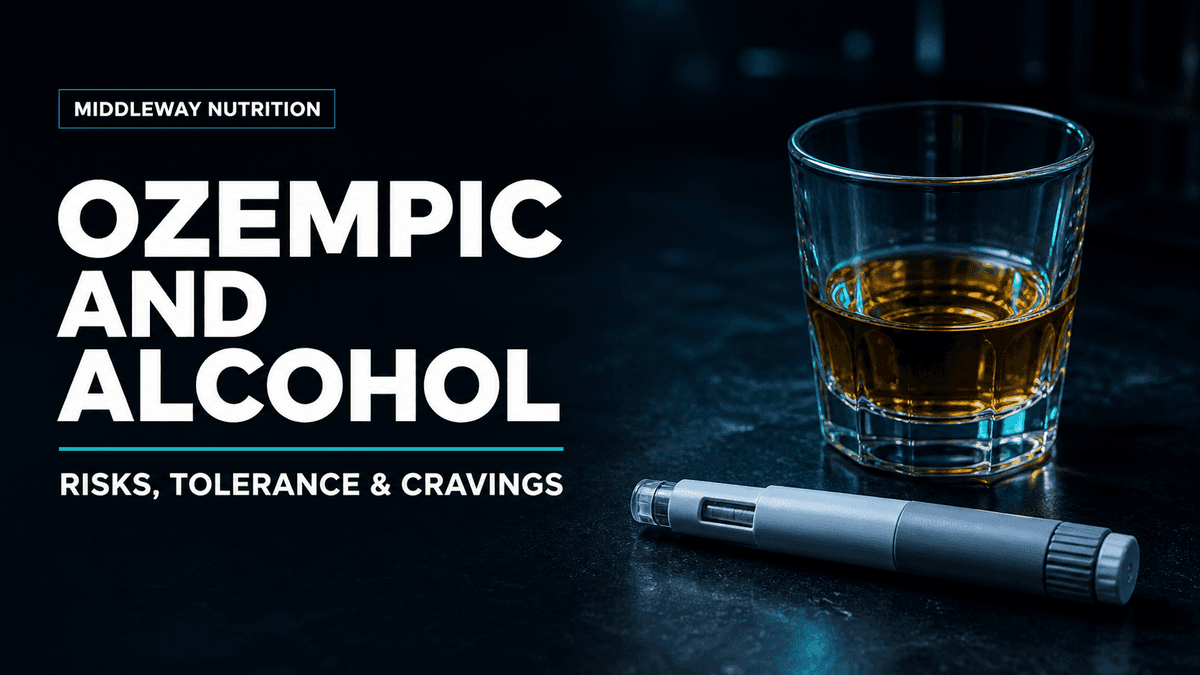
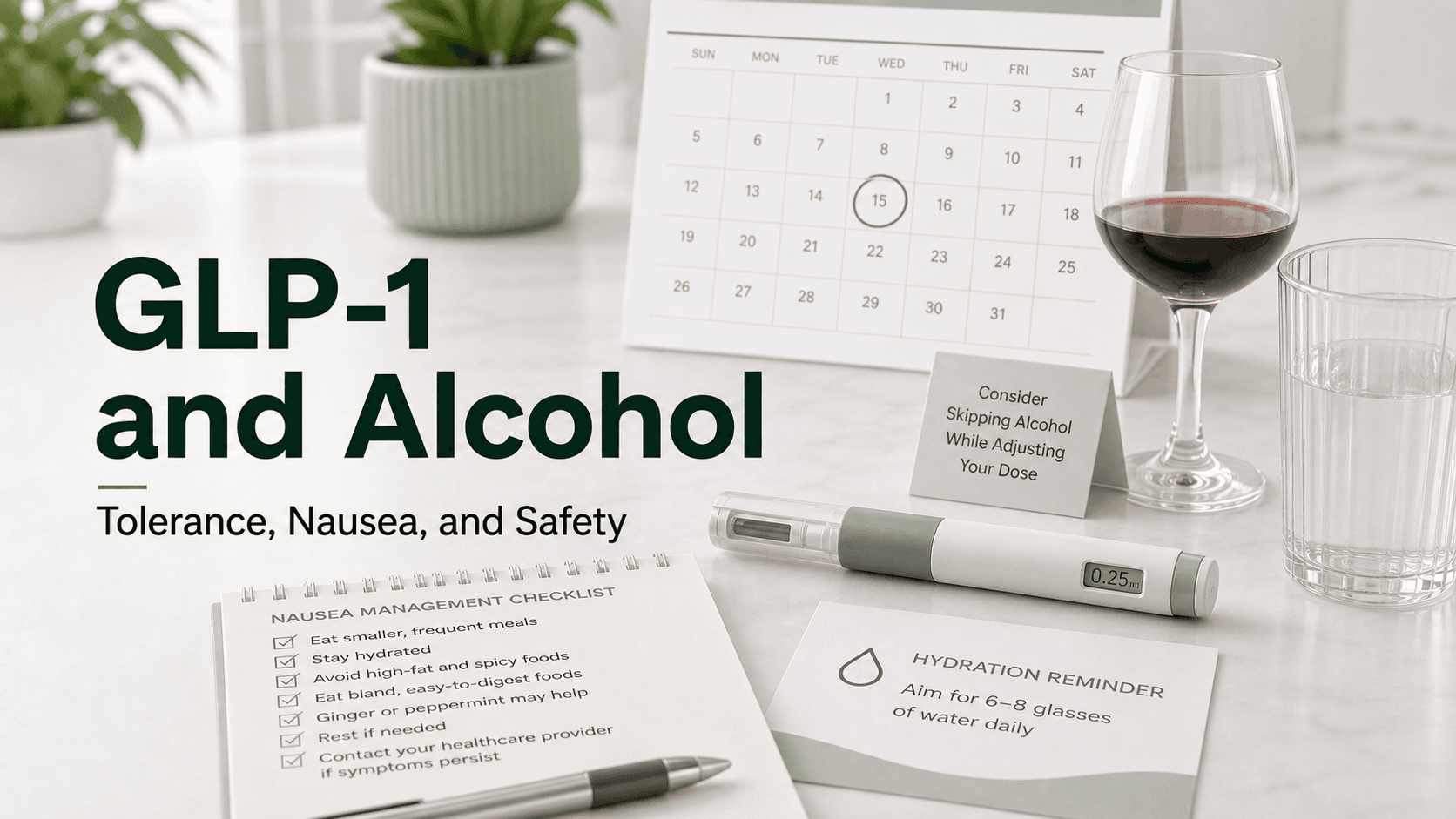
There is no warning on the Ozempic, Wegovy, Mounjaro, or Zepbound label that says "do not drink alcohol." The FDA label does not list a direct chemical interaction. But almost every patient who starts a GLP-1 notices alcohol changes — usually lower tolerance, worse nausea, faster hangovers, and for many, a quiet loss of interest in drinking entirely. The mechanisms behind this are well-understood; the practical advice from prescribers is fairly consistent across academic medical centers.
Direct answer: GLP-1 medications do not chemically interact with alcohol. But they slow gastric emptying, blunt appetite, and modulate brain reward circuits — all of which change how alcohol feels. Dr. Diana Thiara of UCSF Weight Management Clinic summarizes it: "There is no interaction between alcohol and semaglutide products like Ozempic, but your body's response to alcohol may be different while on the medication." Most prescribers recommend cutting intake to one drink/day or less, never drinking on an empty stomach, and waiting at least 24–48 hours after a dose increase. A randomized clinical trial in JAMA Psychiatry also found that semaglutide significantly reduced heavy drinking and alcohol craving over a 9-week period.
The Three Mechanisms Behind the Change
GLP-1 drugs do not metabolize alcohol differently or chemically interact with it. The change comes from three indirect effects:
1. Slowed Gastric Emptying
Native and prescription GLP-1 both slow how fast the stomach empties — delayed gastric emptying is a well-documented mechanism of these drugs. Alcohol that would normally clear in 30–60 minutes can sit there for hours. Joined.com and Health On both describe the practical result: the alcohol stays in the system longer, peaks more slowly, and lingers — making the same drink feel more intense over a longer window.
2. Reduced Food Buffering
Smaller meals mean less food in the stomach to slow absorption. Eating "lightly" before drinks used to be enough; on a GLP-1, "lightly" may mean almost nothing.
3. Brain Reward Modulation
GLP-1 receptors exist in the ventral tegmental area and nucleus accumbens — the brain's reward pathways. Activating them quiets craving signals not just for food but for alcohol, nicotine, and other rewarding stimuli. Dr. Marc-Andre Cornier, director of Endocrinology at the Medical University of South Carolina, describes what he hears from patients: "They're telling me they used to drink a glass of wine at night and now they don't feel like it anymore."
What the Drug Label Says
The FDA label for Ozempic, Wegovy, Mounjaro, and Zepbound contains no warning about alcohol. Dr. Christian Hendershot of USC Keck School of Medicine is direct: "There are no clear indications that GLP-1 medications increase the risks associated with alcohol consumption... potential interactions have not been studied comprehensively."
That is not the same as "drink as much as you want." It is closer to: "there is no chemical reaction, but there are real practical consequences."
What Patients Actually Notice
A composite of clinical observations and patient reports:
| Common change | Why it happens |
|---|---|
| Lower tolerance | Slower gastric emptying + smaller meals = alcohol absorbed over a longer window |
| Worse nausea | Alcohol irritates a GI tract already sensitized by GLP-1 — over 40% of Wegovy users report nausea at baseline |
| Acid reflux | GLP-1 + alcohol both relax the lower esophageal sphincter |
| Faster hangover | Dehydration from alcohol + GLP-1's blunted thirst signal |
| Less interest in drinking | GLP-1 receptor activation in brain reward areas |
| Longer-lasting buzz | Alcohol absorbed over more hours, stays detectable longer |
| More vomiting | Higher GI sensitivity + alcohol's gastritis effect |
The Hypoglycemia Risk
GLP-1s alone rarely cause hypoglycemia because their insulin-release effect is glucose-dependent. The risk profile changes when alcohol enters the picture, and rises sharply for patients also on:
- Insulin (both basal and rapid-acting)
- Sulfonylureas (glipizide, glyburide, glimepiride)
- Meglitinides (repaglinide, nateglinide)
Three mechanisms compound:
- Alcohol blocks the liver from releasing stored glucose (gluconeogenesis inhibition)
- GLP-1 medications enhance insulin response to carbs
- Skipping food (common while drinking) removes the glucose source
The dangerous twist: hypoglycemia symptoms (confusion, sweating, shakiness, slurred speech) overlap heavily with being drunk, so it is easy to miss. Patients on insulin or sulfonylureas should:
- Drink with food, never alone
- Check glucose before, during, and after
- Keep fast-acting carbs nearby
- Tell someone what to watch for
- Wear medical identification
Pancreatitis: The Less Obvious Risk
Heavy chronic alcohol use is the cause behind up to 70% of chronic pancreatitis cases. GLP-1 medications carry a rare but real association with acute pancreatitis. Combining the two in any sustained way is a risk most prescribers consider explicitly when a patient has:
- Prior episode of pancreatitis
- Gallstones
- Triglycerides over ~500 mg/dL
- History of heavy alcohol use
Sudden, severe abdominal pain radiating to the back, with vomiting, while drinking on a GLP-1 = ER, not a "sleep it off."
Safer Drinking Guidelines
The consensus advice from telehealth providers, weight-loss clinics, and academic endocrinology groups:
- Wait 24–48 hours after each dose increase before drinking. Nausea peaks during titration.
- Never drink on an empty stomach. Eat a protein-and-fat-containing meal first.
- Start with half of what you used to drink. Tolerance has changed.
- Give it 45–60 minutes before deciding to have another. Slower emptying means delayed effect.
- Alternate drinks with water. GLP-1s blunt thirst, so deliberate hydration matters.
- Cap at 1 drink/day for women, 2 for men — and most clinicians push lower.
- Set a number in advance and stop there. Disinhibited overdrinking is the most-cited problem in real-world reports.
Which Drinks Tend To Be Better Tolerated
| Easier on GLP-1 | Harder on GLP-1 |
|---|---|
| Dry wine (red or white), small pour | Sweet cocktails, frozen drinks |
| Clear spirits (vodka, gin, tequila) with soda water + lime | Cream-based liqueurs (Baileys, RumChata) |
| Light beer slowly | IPAs, heavy stouts |
| Spritzes (half wine, half soda) | Shots |
| Plain seltzer hard variants (low sugar) | Sugary mixers |
The pattern: dry, lower-volume, lower-sugar, lower-fat. Anything combining sugar + alcohol + carbonation tends to be the worst.
Weight Loss Impact
Alcohol contains 7 calories per gram — close to fat's 9 cal/g and much higher than protein or carbs (both 4 cal/g). Real impact on a GLP-1:
- Direct calorie load: ~150 calories per beer or glass of wine
- Disinhibited eating: late-night food choices on alcohol can erase a day's restraint
- Fat metabolism is paused while the liver processes alcohol
- Sleep quality drops, which blunts the next day's appetite control
- Hangover the next day = under-eating, then over-eating, then guilt
Weight loss on a GLP-1 does not require zero alcohol. It does require thinking of alcohol as a real cost on the calorie and behavioral ledger.
The Surprise Benefit: Lower Cravings
A 9-week randomized clinical trial reported that semaglutide significantly reduced alcohol cravings and heavy drinking days versus placebo. Real-world reports back this up — a substantial fraction of GLP-1 users drink less without intentionally trying. Phase 2/3 trials of semaglutide specifically for alcohol use disorder (AUD) are running, and early data suggest meaningful reductions in heavy drinking days.
If alcohol feels less rewarding on your GLP-1, that is biology, not just willpower.
When To Stop and Call a Clinician
- Severe abdominal pain after drinking (rule out pancreatitis)
- Repeated vomiting with no food retained
- Fainting or near-fainting
- Signs of hypoglycemia: confusion, sweating, shakiness — especially if you take insulin or a sulfonylurea
- Black or bloody stools or coffee-ground vomit
- Worsening jaundice (yellow eyes/skin)
What People Get Wrong About GLP-1 and Alcohol
- "There is no interaction, so I can drink normally." No chemical interaction does not mean the experience is the same. Tolerance changes.
- "My doctor didn't warn me, so it must be fine." Many physicians have not been formally trained on GLP-1 + alcohol because the data is recent. Ask explicitly.
- "Drinking will undo my weight loss." Calories matter, but the bigger acute risks are nausea, dehydration, and bad sleep.
- "I should stop my GLP-1 before a big event." Stopping disrupts months of titration. Better to skip the heavy drinking.
- "Wine is fine because it's not sugary." Wine still has 100–150 calories per glass and the same gastric-emptying problem.
Frequently Asked Questions
Can I drink alcohol on Ozempic or Wegovy? There is no FDA-label warning, but most clinicians recommend moderation: one drink or less per day, never on an empty stomach, and waiting 24–48 hours after a dose increase.
Can I drink on Mounjaro or Zepbound? Same answer. Tirzepatide slows gastric emptying like semaglutide and produces the same tolerance changes.
How long should I wait after my injection before drinking? Most clinicians suggest waiting at least 24–48 hours after a new dose or a dose increase, when nausea is highest.
Does GLP-1 lower alcohol tolerance? For most people, yes. Slower stomach emptying means alcohol enters the bloodstream more slowly but also leaves more slowly, and smaller meals mean less buffering.
Will drinking make me hypoglycemic? Hypoglycemia is rare on a GLP-1 alone. The risk rises significantly if you also take insulin or a sulfonylurea — and hypoglycemia symptoms can be mistaken for drunkenness.
Can GLP-1s help with alcohol use disorder? Early trials are promising. A 9-week randomized study showed semaglutide significantly reduced alcohol cravings, and Phase 2/3 AUD trials are underway.
Last reviewed: May 13, 2026
Sources
- Can You Drink Alcohol When Taking GLP-1 Drugs Like Ozempic? — WebMD
- Ozempic and Alcohol — MedShadow Foundation
- GLP-1 and Alcohol Tolerance — Health On
- Drinking Alcohol on GLP-1 Medications — Mochi Health
References
- Hendershot CS, et al. Once-Weekly Semaglutide in Adults With Alcohol Use Disorder: A Randomized Clinical Trial — JAMA Psychiatry, 2025
- Glucagon-Like Peptide-1 Receptor Agonists — StatPearls, NCBI Bookshelf (mechanism, delayed gastric emptying, GI effects)
- Emanuele NV, et al. Consequences of Alcohol Use in Diabetics — National Institutes of Health (PMC)