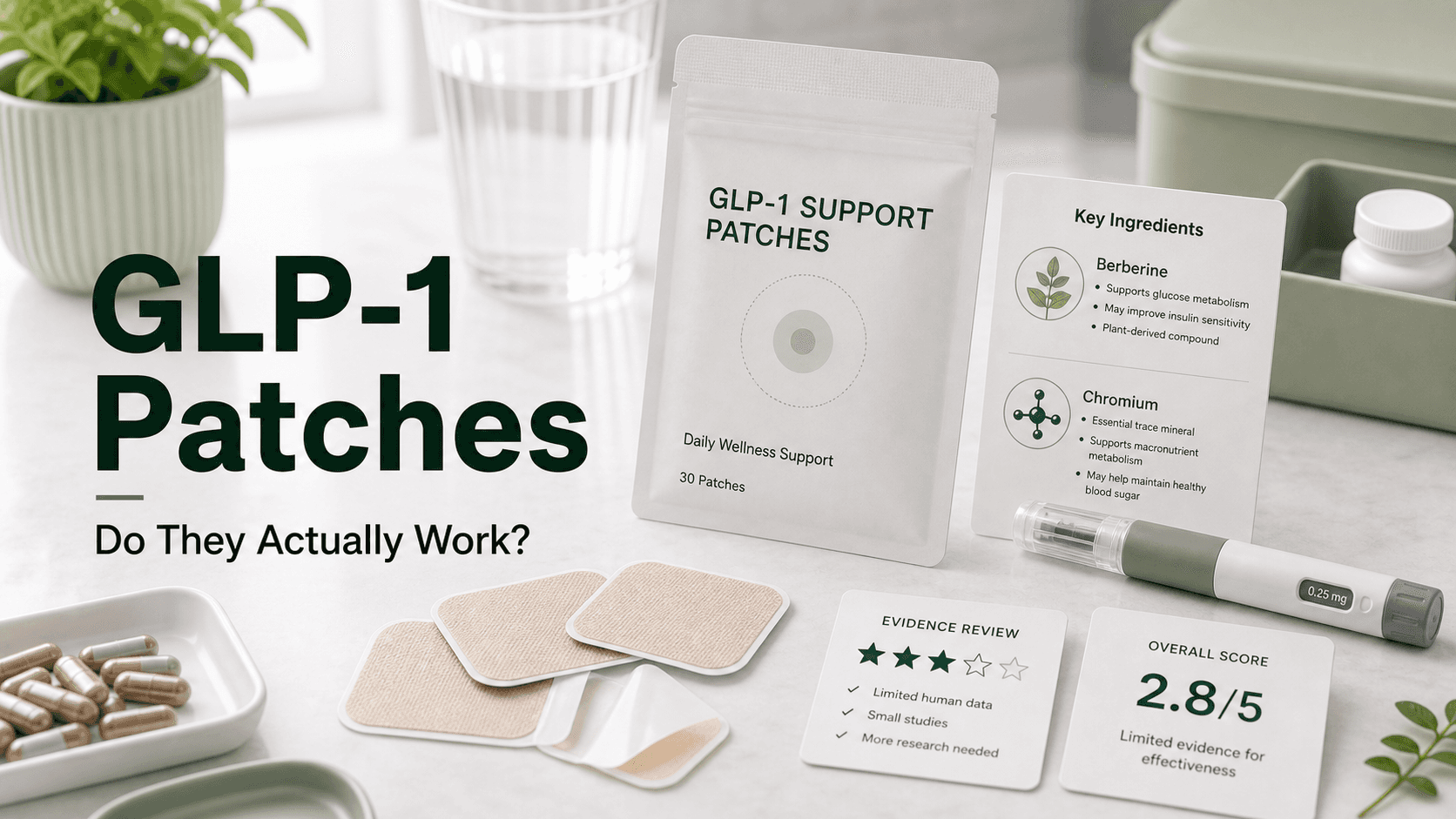
The TikTok ads are everywhere — a quick adhesive patch that promises to deliver "natural GLP-1" through your skin and shrink your appetite. The hardest numbers in this whole category come from the patches themselves: the two highest-volume brands, Kind Patches and Gentle Patches, sit at 1.8 and 2.1 stars on Amazon, with 80% of verified reviews at 1 or 2 stars. The biology and the customer experience point the same direction.
Direct answer: GLP-1 patches sold over-the-counter do not contain semaglutide, tirzepatide, or any FDA-approved GLP-1 receptor agonist. They are dietary supplements containing some mix of berberine, herbal extracts, B-vitamins, chromium, and amino acids. Semaglutide's molecular weight (~4,113 daltons) is roughly 8× the upper limit for passive transdermal absorption, so even if a real peptide were in the patch it could not cross the skin in a meaningful dose. No peer-reviewed human trials show that consumer GLP-1 patches activate GLP-1 receptors, lower A1C, or produce more than 1–3% weight loss. Compare that to 13.6%–20.2% for the prescription drugs.
What Is Actually In the Top-Selling Patches
Kind Patches GLP-1 (rebranded as "Berberine Patches" in 2025)
- Amazon rating: ~1.8 stars with ~80% of verified reviews at 1–2 stars
- Most common complaints: no appetite suppression, skin irritation, patches falling off
- Cost: $79 / 30 patches / month
Full ingredient list per patch:
| Ingredient | Amount per patch |
|---|---|
| Berberine extract | 8.75 mg |
| Pomegranate extract | 1.75 mg |
| Cinnamon extract | 2.75 mg |
| L-glutamine | 3.5 mg |
| Chromium | 35 mcg |
| B-vitamins (multiple) | trace |
For context: oral berberine for blood-sugar studies uses 500 mg, 2–3 times daily — about 100× the dose in a Kind Patch. And that is when berberine is swallowed and absorbed orally, not asked to cross intact skin.
Gentle Patch GLP-1
- Amazon rating: ~2.1 stars
- Cost: $89/month
- Ingredients: berberine + gymnema sylvestre marketed as "natural GLP-1 mimetics"
- Zero peer-reviewed studies on the product
Generic Amazon white-label patches
There are dozens of nearly identical products sold under different brand names with the same active ingredient profile: small doses of berberine + B-vitamins + an herbal blend + a transdermal carrier (often DMSO). Costs typically range $40–$90/month.
Why The Chemistry Cannot Work
This is the part the marketing skips. Transdermal absorption — moving a molecule through intact skin into the bloodstream — has hard biophysical rules:
- Molecular weight ceiling. Passive skin absorption favors molecules under about 500 daltons. Above that, the stratum corneum (outer dead-cell skin layer) is a near-impenetrable barrier without specialized engineering.
- Lipid solubility requirement. Skin lipids favor fat-soluble molecules. Peptides are large and water-soluble.
- Enzymatic degradation. Skin contains proteases that break down peptides on contact.
Semaglutide weighs ~4,113 daltons — roughly 8× over the 500-dalton threshold. Tirzepatide is even larger. There is no over-the-counter patch technology that overcomes those barriers with the doses involved.
This is why every real FDA-approved GLP-1 medication is either:
- An injection (Ozempic, Wegovy, Mounjoy, Zepbound)
- An oral pill with a specialized absorption enhancer like SNAC (Rybelsus, oral Wegovy)
- A non-peptide small molecule (Foundayo / orforglipron — small enough to absorb orally without an enhancer)
No FDA-approved transdermal GLP-1 exists.
What About the Mouse Study?
A 2025 study in male C57BL/6J mice (published in PMC) tested a custom transdermal semaglutide delivery system. Key details:
- Dose: 2 mg semaglutide per patch
- Patch size: 35 mm × 15 mm
- Application: 8 hours weekly, on shaved dorsal skin
- Duration: 7 weeks
Mouse weight-gain results:
| Group | Weekly weight gain |
|---|---|
| Vehicle control | 3.83 g/week |
| Semaglutide injection | 1.52 g/week |
| Transdermal patch | 1.15 g/week |
The transdermal arm actually outperformed the injection arm in this mouse model — which is why the study went viral on supplement-brand websites. What the supplement marketing leaves out:
- It was done in mice, not humans. Mouse skin is significantly more permeable than human skin.
- The mice had their skin shaved at each application — eliminating one of human skin's main barriers.
- The patch contained 2 mg of semaglutide, which is real peptide drug at therapeutic doses. No over-the-counter patch contains semaglutide.
- The formulation likely used specialized permeation enhancers (the published paper did not fully disclose them).
This is a proof-of-concept for a future engineered transdermal system, not evidence that any Amazon patch works.
What The FDA Says
The FDA has not approved a single transdermal GLP-1 medication for any condition. The agency's stance, quoted in regulatory analyses:
"If you can buy a product without a prescription, it is not an actual GLP-1 drug."
A 2026 Annals of Pharmacotherapy review specifically flagged the entire "natural transdermal GLP-1" category as violating the Dietary Supplement Health and Education Act (DSHEA), which requires that dietary supplements be ingested, not applied to skin. Patches that claim to deliver supplements through the skin are technically operating outside their legal framework — but enforcement has been slow.
Harvard's Dr. S. Bryn Austin, Professor in the Department of Social and Behavioral Sciences at Harvard T.H. Chan School of Public Health, summarizes the regulatory gap:
"The FDA cannot require rigorous pre-screening for safety and certainly not for effectiveness because by law, these supplements cannot claim to be treating or curing or preventing disease."
On the marketing:
"[Consumers seeing 'GLP-1' in product names] will think, 'Oh, it must work like Ozempic.'"
That confusion is precisely what the brands lean on.
The Real Side Effects (From Customer Reports)
Aggregated from public review data:
| Side effect | Rate |
|---|---|
| Skin rashes, itching, contact dermatitis | 35–50% of users |
| DMSO burns (from permeation enhancer in some patches) | ~15% |
| Allergic reactions | ~8% |
| Patches falling off | Very common |
| Failure to produce weight loss | Near-universal |
The skin issues are real because some patches use dimethyl sulfoxide (DMSO) as a permeation enhancer. DMSO can cause chemical burns and a strong garlic/sulfur breath odor in some users.
What Real GLP-1 Actually Produces
For honest comparison:
| Approach | Mean weight loss (~70 weeks) |
|---|---|
| GLP-1 patch (any brand) | No reliable data; reported 1–3% claims |
| Foundayo (orforglipron) pill | ~12% |
| Oral Wegovy (semaglutide pill) | ~13.6% |
| Wegovy injection | ~15% |
| Zepbound injection | ~21% |
The gap is 5–20× — not a "slight" difference.
Why Reviewers Still Sometimes Report Weight Loss
Patch reviews that claim weight loss usually capture one or more of:
- Calorie restriction. Most patches come with meal plans or "diet protocols."
- Placebo effect. Daily ritual of applying a patch reliably suppresses appetite in a subset of users.
- Self-selection bias. People paying $79/month for patches are already trying to lose weight.
- Caffeine/stimulants. Some patches include yerba mate or green tea extract.
None of this is a GLP-1 mechanism.
When A Patch Might Make Sense Anyway
There are honest use cases, none of which involve actual GLP-1 activation:
- A B-vitamin or chromium supplement that happens to come on a patch — fine, if you understand it is not GLP-1.
- A behavioral cue. Some people benefit from a daily ritual.
- Adjacent to a real medical weight-loss program that already includes a prescription — the patch is decorative.
It is not a substitute for a real GLP-1 medication.
What To Do Instead
If a real GLP-1 effect is the goal:
- Talk to a clinician about whether a prescription GLP-1 fits.
- Look at oral options — Foundayo (orforglipron), oral Wegovy, or Rybelsus — if needle-aversion is the barrier.
- Look at telehealth providers for branded or compounded GLP-1.
If finances are a real constraint and you want something at $25/month or less:
- Manufacturer savings cards for Wegovy, Zepbound, and Foundayo can drop the price below most patch subscriptions
- Berberine 500 mg orally, 2–3x daily — same active ingredient as in patches, taken at an actually-effective dose
- Soluble fiber + protein + meal-order behavior — costs nothing and amplifies your body's own GLP-1 release
What People Get Wrong About GLP-1 Patches
- "Natural means safer." Unregulated supplements have less oversight than prescriptions, not more.
- "It works through the skin like a nicotine patch." Nicotine is ~162 daltons. Semaglutide is ~4,113 daltons. Different chemistry, different rules.
- "Influencers tested it." Unblinded self-testing is not evidence.
- "It is FDA registered." FDA registration of a manufacturing facility is not FDA approval of a product.
- "There's a mouse study showing it works." The mouse study used 2 mg of real semaglutide and engineered permeation enhancers on shaved mouse skin — none of which apply to a $79 Amazon patch.
Frequently Asked Questions
Do GLP-1 patches actually contain semaglutide or tirzepatide? No. OTC patches sold without a prescription do not contain prescription GLP-1 receptor agonists.
Are GLP-1 patches FDA approved? No. The FDA has not approved any transdermal GLP-1 drug for any indication.
What ingredients are in Kind Patches and Gentle Patches? Kind Patches contain berberine 8.75 mg, pomegranate extract 1.75 mg, cinnamon extract 2.75 mg, L-glutamine 3.5 mg, chromium 35 mcg, and B-vitamins. Gentle Patches use berberine and gymnema sylvestre as the "natural GLP-1 mimetic" claim.
Why can't a patch deliver semaglutide? Semaglutide weighs ~4,113 daltons. Passive transdermal absorption is essentially limited to molecules under 500 daltons. The peptide is also water-soluble and gets degraded by skin proteases.
Has anyone studied GLP-1 patches in humans? No published peer-reviewed human trials show meaningful weight loss or A1C effect. The mouse study from 2025 used a custom-engineered formulation with 2 mg of real semaglutide, not the OTC patches you can buy.
Are GLP-1 patches safe? Most are unlikely to cause serious harm because the active ingredients probably are not absorbed in meaningful amounts. Skin irritation and DMSO burns are reported in 15–50% of users. The bigger risk is wasting money and delaying real treatment.
What does Kind Patches cost? About $79 for a 30-patch monthly supply. Gentle Patch is around $89/month.
Last reviewed: May 13, 2026