GLP-1 and Blindness: The NAION Evidence in 2026
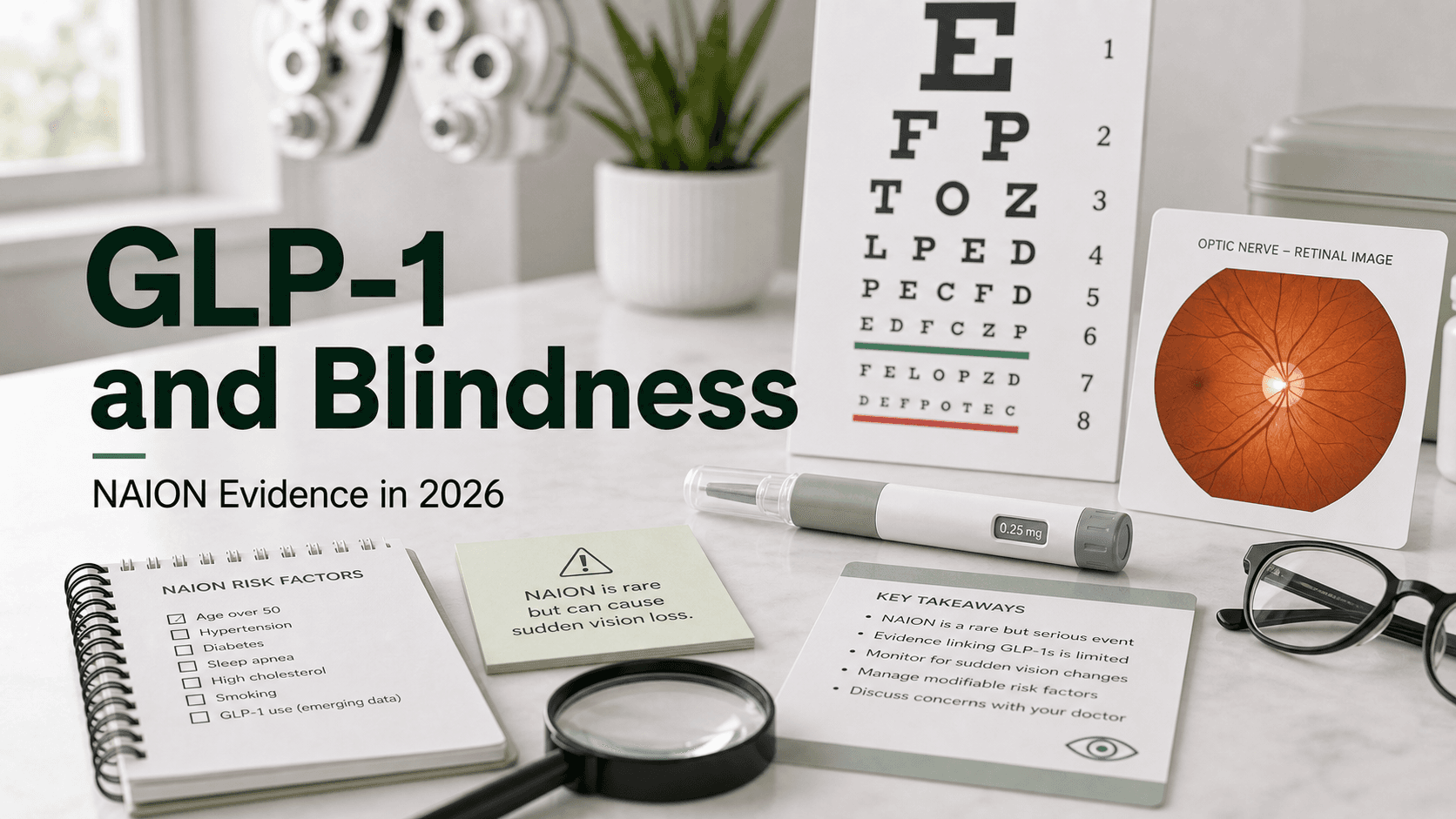
The "GLP-1 blindness" headlines all point at the same rare condition: non-arteritic anterior ischemic optic neuropathy (NAION) — sudden, painless vision loss in one eye from disrupted blood flow to the optic nerve. The science is less alarming than the headlines but less reassuring than the manufacturers' position. A 2024 JAMA Ophthalmology study found a 4–7× elevated risk on semaglutide. A 2026 TriNetX cohort study of 370,000 matched patients found no statistically significant NAION increase — and lower overall blindness rates on GLP-1s. Both studies are real. The honest answer requires reading both.
Direct answer: NAION is a rare condition estimated at roughly 1 in 10,000 patients taking semaglutide, per the American Optometric Association. The 2024 JAMA Ophthalmology paper showed a 4× elevated risk in diabetics and 7× in non-diabetic semaglutide users; the 2026 TriNetX cohort (n=370,132) found no statistically significant NAION increase (HR 1.26, 95% CI 0.94–1.70, P=0.12) — and a 24% relative reduction in overall blindness. Tirzepatide has not shown the same NAION signal in any analysis. The MDL-3163 lawsuits are still in expert discovery. Patients with small "crowded" optic discs, sleep apnea, or pre-existing optic neuropathy should discuss this explicitly before starting; everyone should know the red-flag symptoms.
What NAION Is
NAION is the sudden interruption of blood flow to the front portion of the optic nerve. Hallmarks:
- Sudden, painless vision loss in one eye, often noticed on waking
- Loss is usually partial (an arc, a half, or a wedge of the visual field)
- Affects ~10 people per 100,000 in the general population over age 50
- No effective treatment once it happens — damage is usually permanent
- About one-third of patients experience some vision improvement over time
Independent NAION risk factors:
- Small, "crowded" optic disc anatomy (lowest cup-to-disc ratio is the strongest predisposing factor)
- Sleep apnea
- Diabetes
- Low blood pressure overnight
- Hypertension, hyperlipidemia
- Sildenafil/tadalafil (Viagra/Cialis) use
What the 2024 JAMA Ophthalmology Study Found
The single most-cited paper, from Harvard / Mass Eye and Ear. In patients with type 2 diabetes:
- Semaglutide users had 4.28× higher NAION risk than those on other diabetes medications
- In overweight patients without diabetes (semaglutide for weight loss): 7.64× higher
It was a retrospective cohort — strong correlational evidence, not causal.
The 2026 TriNetX Cohort: Different Conclusion
A more recent peer-reviewed analysis used the TriNetX database (2015–2022) with 185,066 T2D patients on GLP-1 RAs vs 185,066 matched patients without GLP-1 prescriptions, two-year follow-up:
| Endpoint | GLP-1 vs non-GLP-1 | Hazard ratio (95% CI) | P-value |
|---|---|---|---|
| NAION | 96 (0.1%) vs 79 (<0.1%) | 1.26 (0.94–1.70) | 0.12 (not significant) |
| Any ischemic optic neuropathy | — | 1.10 (0.92–1.32) | 0.31 (not significant) |
| Incident diabetic retinopathy | 5,037 (2.7%) vs 4,938 (2.7%) | 1.07 (1.03–1.11) | 0.001 (small but significant) |
| Vitreous hemorrhage (pre-existing DR) | — | 0.74 (0.68–0.80) | <0.001 (favorable) |
| Blindness (all causes) | 2,313 (1.2%) vs 3,051 (1.6%) | 0.77 (0.73–0.82) | <0.001 — 24% reduction |
| Blindness in pre-existing DR | — | — | 30% reduction |
The headline: in the TriNetX cohort, GLP-1 users were no more likely to develop NAION than matched controls — and were significantly less likely to go blind overall. The small uptick in incident retinopathy (a known phenomenon during rapid glycemic improvement) is real but did not translate to more blindness.
Reconciling the Two Studies
How can both be true? Likely answers:
- Different populations. The JAMA study used Mass Eye and Ear patients; TriNetX is a much broader database with different baseline characteristics.
- NAION is rare. Even at 4× elevated risk, the absolute event count is small. Different statistical methods can produce different conclusions.
- Outcome definition. "NAION" requires specific diagnostic codes; coding precision varies.
- GLP-1s help most eyes. The clear glycemic and cardiovascular benefits likely prevent more blindness than they cause, even if NAION rate ticks up.
Both findings together suggest: rare absolute risk, real signal worth monitoring, overall vision benefit at the population level.
Tirzepatide: Different Pattern
Across multiple analyses, tirzepatide has not shown the same NAION signal. Some analyses specifically found no significant association between tirzepatide and NAION or diabetic retinopathy. Whether this is because of mechanism, dose, or simply less data remains unresolved.
What the AOA Recommends
The American Optometric Association's Evidence-based Optometry Committee has issued formal guidance:
- NAION risk on semaglutide: approximately 1 in 10,000 patients
- Epidemiologic risk increase: roughly 2-fold vs non-users
- Baseline exam: Comprehensive dilated eye exam within 12 months prior to starting therapy or within one month of initiation
- More frequent monitoring in patients with diabetes or macular degeneration
- Patient counseling on individualized risk
- Discontinue and consult the team if NAION develops
Dr. Andrew Morgenstern, director of AOA's clinical resources group, puts it this way:
"There is a low risk of serious side effects. But a low risk of a big number is a big risk."
The "big number" is the tens of millions of patients now on GLP-1 medications. Rare events become common in the aggregate.
Other Eye Issues Worth Knowing
NAION is not the only ophthalmic concern:
- Worsening diabetic retinopathy with rapid A1C reduction. SUSTAIN-6 and the TriNetX data both show a small uptick in incident retinopathy on semaglutide, likely tied to rapid glycemic change rather than direct toxicity.
- Age-related macular degeneration progression is in some emerging signals.
- Transient blurred vision at the start of treatment, usually from rapid blood sugar changes.
Regulatory and Legal Status
- June 2025: WHO Pharmacovigilance committee added NAION as a potential rare adverse event for semaglutide products
- December 15, 2025: US Judicial Panel on Multidistrict Litigation created MDL-3163 for GLP-1 NAION cases in the Eastern District of Pennsylvania, Judge Karen Marston
- May 2026: ~86 cases pending in MDL-3163; expert discovery underway; bellwether trial selection expected
- FDA labeling: Ozempic and Wegovy labels mention rare reports of vision changes; a formal warning is under review
Who Should Be Especially Careful
Talk with your prescriber and consider a pre-treatment eye exam if you have:
- Previous NAION in the other eye (10–25% per year recurrence)
- Pre-existing optic neuropathy or vision changes
- Small or "crowded" optic disc on prior eye exam
- Severe untreated sleep apnea
- Active diabetic retinopathy that has not been stabilized
What to Watch For While On a GLP-1
Call your prescriber and an ophthalmologist same-day if you experience:
- Sudden vision loss in one eye (often noticed on waking)
- A missing arc or wedge of vision
- A new dark spot that does not move when you blink
- Persistent flashes or floaters
- New color-vision impairment
Per Cleveland Clinic vitreoretinal surgeon Dr. Talcott: "You should be seen sooner, rather than later — within a few days." Same-day evaluation matters because some causes have a brief window for treatment.
How to Reduce Risk
There is no way to bring NAION risk to zero, but practical steps:
- Treat sleep apnea — major independent risk factor
- Manage blood pressure, especially avoiding overnight hypotension from over-aggressive medication
- Slow A1C reduction in long-standing diabetes — fast drops can flare retinopathy
- Annual dilated eye exam if diabetic (already standard)
- Don't stop a GLP-1 abruptly without medical guidance
What People Get Wrong About GLP-1 and Blindness
- "Ozempic causes blindness." The evidence supports a small absolute increase in NAION risk, not common or generalized blindness. The TriNetX cohort found GLP-1 users had less overall blindness.
- "All GLP-1s carry the same eye risk." Tirzepatide has not shown the same NAION signal.
- "The lawsuits prove it." The MDL is examining whether manufacturers should have warned earlier — not whether causation is proven.
- "I should switch off my GLP-1." For most patients, the cardiometabolic benefits outweigh the rare NAION risk. The vitreoretinal surgeon at Cleveland Clinic specifically stated: "The benefits of these drugs outweigh any potential risk, in terms of the eye."
Frequently Asked Questions
Can Ozempic cause blindness? A rare condition called NAION has been associated with semaglutide in some studies, but the evidence is mixed. Absolute risk is roughly 1 in 10,000 per AOA estimates.
Is Mounjaro safer for the eyes than Ozempic? Available data suggests tirzepatide has not shown the same NAION signal.
What are the symptoms of NAION? Sudden, painless vision loss in one eye, often noticed on waking. Usually partial — an arc or wedge of the visual field.
Is the risk reversible if I stop the drug? Stopping does not reverse NAION damage. About one-third of patients experience some natural improvement over time without specific treatment.
Should I get an eye exam before starting a GLP-1? The American Optometric Association recommends a baseline dilated exam within 12 months before or 1 month after starting therapy, especially in patients with diabetes or AMD.
Does the MDL-3163 lawsuit mean GLP-1s are unsafe? The MDL is examining whether manufacturers should have warned about NAION risk earlier. It does not establish that GLP-1s are unsafe for most patients.
Last reviewed: May 13, 2026