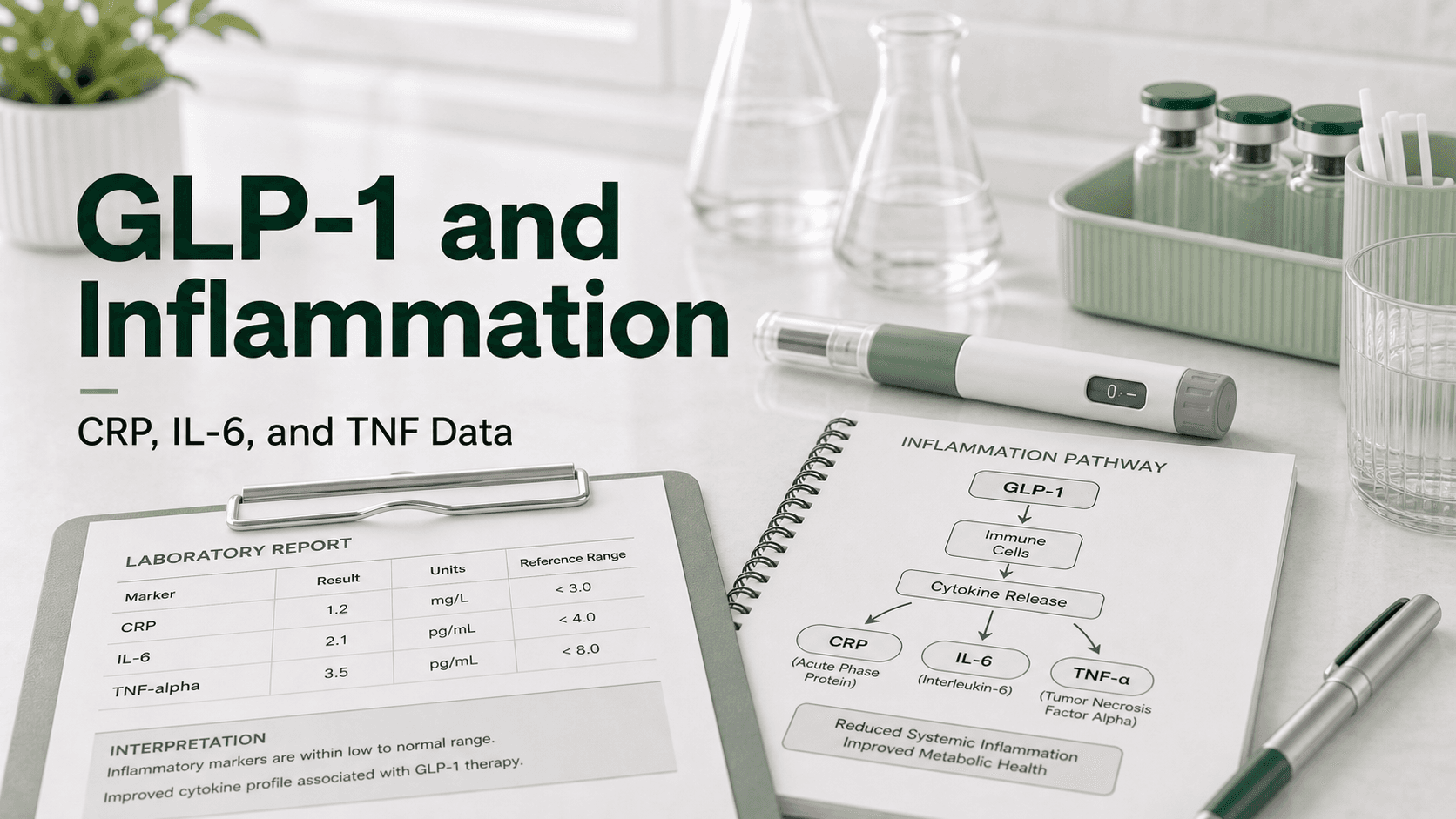
Inflammation has quietly become one of the most studied side benefits of GLP-1 receptor agonists. It is not on the label, and it is not why most people start the drug, but it shows up clearly in lab work and in the outcome trials that drive label expansions. The size of the effect is bigger than most people realize, and the mechanism is more interesting than "you lost weight, so your CRP went down."
Direct answer: Yes. GLP-1 receptor agonists consistently lower systemic inflammation. Semaglutide reduces high-sensitivity C-reactive protein (hsCRP) by roughly 20–30% in diabetes trials and 39–48% in the STEP obesity trials, with parallel reductions in IL-6 and TNF-α reported in the broader literature. Tirzepatide goes further — SURMOUNT-1 and SURMOUNT-2 post-hoc data show hsCRP reductions of 51–65% and IL-6 reductions of 16–31%. About half of the effect tracks weight loss; the other half appears to be a direct anti-inflammatory action via GLP-1 receptors on immune cells, vascular tissue, and the central nervous system. The effect is real, but it is not strong enough to replace dedicated anti-inflammatory drugs for autoimmune disease.
Why Inflammation Matters in Obesity
Adipose tissue is not an inert storage depot. As fat mass expands, adipocytes hypertrophy, become hypoxic, and start secreting pro-inflammatory cytokines — TNF-α, IL-6, MCP-1 — while macrophages infiltrate the tissue and shift toward an M1 (pro-inflammatory) phenotype. The result is a state called low-grade chronic systemic inflammation or "metaflammation."
You do not feel it. There is no fever, no swelling, no pain. But the cytokines and acute-phase proteins circulate continuously, and over years they:
- Promote endothelial dysfunction and atherosclerosis
- Drive insulin resistance in muscle and liver
- Push the liver toward steatohepatitis (MASH)
- Increase risk of certain cancers
- Worsen outcomes in respiratory infections like COVID-19
- Contribute to airway inflammation in asthma and to joint pain in osteoarthritis
CRP, IL-6, and TNF-α are the lab handles for this state. CRP — particularly high-sensitivity CRP (hsCRP) — is the cheapest and most widely used. Levels above 2 mg/L are generally considered high-risk for cardiovascular disease.
How GLP-1 Drugs Actually Reduce Inflammation
GLP-1 receptors are not only in the pancreas. They are expressed on monocytes, macrophages, T cells, vascular endothelial cells, hepatocytes, and brain neurons — including in the hypothalamus and brainstem. That distribution is the anatomical basis for the anti-inflammatory effect.
When activated, the receptor triggers a cAMP signal that:
- Inhibits NF-κB activation, the master transcription factor for pro-inflammatory genes — directly reducing TNF-α, IL-6, IL-1β, VCAM-1, and ICAM-1 expression
- Suppresses the NLRP3 inflammasome, lowering mature IL-1β and IL-18 release
- Shifts macrophages from M1 to M2 polarization, calming adipose and vascular tissue
- Reduces monocyte adhesion to the endothelium, slowing plaque formation
- Engages central GLP-1 receptors in the brainstem, which (via α1-adrenergic and δ-opioid signaling) suppress peripheral TLR-mediated inflammation — a neuro-immune pathway only recently mapped
A separate, larger contribution comes indirectly through weight loss: less adipose tissue, fewer infiltrating macrophages, less hypoxia, less circulating cytokine output.
The clinical translation: even patients who lose modest amounts of weight see CRP drop, and the percentage drop tends to exceed what you would expect from the weight loss alone.
The Lab Numbers — What Changes and By How Much
Semaglutide — Type 2 Diabetes Dose (Ozempic 0.5–2.0 mg)
The SUSTAIN and PIONEER analyses laid out the diabetes-dose picture:
| Trial | Comparator | hsCRP reduction |
|---|---|---|
| SUSTAIN 3 (week 56) | vs. exenatide ER | −25% |
| PIONEER 1 (week 26) | vs. placebo, 7 mg oral | −28% |
| PIONEER 1 (week 26) | vs. placebo, 14 mg oral | −24% |
| PIONEER 2 (week 52) | vs. empagliflozin, 14 mg oral | −30% |
A 20–30% reduction in hsCRP at clinically meaningful baselines is in the same range as statin therapy on inflammation — which is one reason cardiologists started paying attention.
Semaglutide — Obesity Dose (Wegovy 2.4 mg)
At the higher 2.4 mg dose used for weight management, the effect is bigger. The pooled STEP 1, 2, and 3 analyses (published in eClinicalMedicine, 2022) reported:
- CRP reductions of 39–48% at week 68 versus placebo
- Effect held regardless of baseline BMI, weight, or glycemic status
- Reductions correlated with weight loss, but a residual direct effect remained after statistical adjustment
A 2024 meta-analysis of 13 trials (26,131 patients) found semaglutide produced a standardized mean difference of −0.56 versus placebo and −0.45 versus active comparators — translating to roughly 44–55% lower CRP in semaglutide groups overall.
Tirzepatide — SURMOUNT-1 and SURMOUNT-2
The dual GIP/GLP-1 agonist appears to be a stronger anti-inflammatory than pure GLP-1 agonists, likely because the larger weight loss amplifies the indirect effect.
Post-hoc analyses of the SURMOUNT trials reported:
- SURMOUNT-1 (no T2D): hsCRP −51% to −65%, IL-6 −26% to −31% across the 5, 10, and 15 mg doses
- SURMOUNT-2 (with T2D): hsCRP −55% to −56%, IL-6 −16% to −23%
- A 2025 meta-analysis pooled the effect at hsCRP −33 and IL-6 −18 on a standardized scale
TNF-α
Reductions in TNF-α are reported less consistently because fewer trials measure it and assay variability is high. Mechanistic studies and smaller clinical trials show suppression of TNF-α in parallel with CRP and IL-6, particularly in patients with type 2 diabetes and obesity. Effect sizes range widely (roughly 10–25%) and depend heavily on baseline.
Conditions Where This Anti-Inflammatory Effect Probably Matters
Cardiovascular Disease and Atherosclerosis
The SELECT trial showed a 20% reduction in major adverse cardiovascular events with semaglutide 2.4 mg in adults with obesity and established CVD. Pre-specified mediation analyses showed that only a fraction of the benefit was explained by weight loss, blood pressure, or lipids — leaving a large residual attributed in part to inflammation. The CRP curves separate within weeks, well before any meaningful weight change.
In atherosclerosis specifically, GLP-1 agonists reduce vascular macrophage infiltration, lower VCAM-1/ICAM-1, stabilize plaques, and decrease matrix metalloproteinase-9 — all anti-inflammatory mechanisms with downstream cardiovascular consequences.
MASH and Liver Inflammation
The August 2025 FDA approval of semaglutide for MASH was driven by a trial where 63.9% of patients had liver inflammation improvement without worsening fibrosis versus 34.3% on placebo. Liver inflammation responds to both weight loss and the direct hepatic anti-inflammatory effect.
Asthma
A 2025 study of 60,000 patients showed GLP-1 users had better asthma symptom control, with no measurable change in spirometry. The pattern is consistent with reduced airway inflammation rather than improved airway mechanics. Mechanistic work in mice shows liraglutide reduces eosinophilic and NLRP3-driven airway inflammation.
COVID-19 Outcomes
In a 17,000-patient analysis during the pandemic, GLP-1 users had 19% lower COVID-19 mortality and fewer severe complications. The leading mechanistic explanation is dampening of the cytokine storm — IL-6 and IL-1β suppression in particular.
Inflammatory Bowel Disease
Retrospective cohorts of 3,700+ IBD patients on GLP-1s for diabetes show reduced hospitalization and surgery rates, with no signal of worsening IBD activity. But the review literature is clear: GLP-1s should not be used as primary or adjunctive therapy for IBD. There are no prospective randomized trials, and the effect on endoscopic mucosal healing is unstudied.
Rheumatoid Arthritis, Psoriasis, Lupus
There is no controlled trial evidence supporting GLP-1s as a treatment for classic autoimmune disease. Some weight-loss-mediated symptom improvement is plausible. Some direct anti-inflammatory contribution is plausible. Neither is established.
Comparison to Dedicated Anti-Inflammatories
This is the part most coverage skips. Yes, GLP-1s lower CRP and IL-6 substantially. But against the modern biologics that target inflammation directly, they are not in the same class:
- Statins (high-dose): CRP −20 to −40%. JUPITER showed cardiovascular benefit driven partly by CRP reduction.
- Canakinumab (anti-IL-1β antibody, CANTOS trial): IL-6 and CRP reductions in the −35 to −50% range, with a 15% MACE reduction.
- Tocilizumab (anti-IL-6 receptor, used in RA): designed to abolish IL-6 signaling; effective in RA where GLP-1s have no proven role.
- TNF inhibitors (adalimumab, infliximab, etanercept): standard of care in RA, IBD, psoriasis. GLP-1s are not a substitute.
- JAK inhibitors and IL-23 blockers: standard in psoriasis and IBD. GLP-1s are not a substitute.
GLP-1s should be thought of as broad, low-intensity anti-inflammatory agents that operate alongside their metabolic and weight effects — not as targeted immune modulators. They lower the inflammatory ceiling for an obese cardiometabolic patient; they do not turn off an autoimmune disease.
What People Get Wrong About GLP-1s and Inflammation
- "It just lowers CRP because you lost weight." Some of it does. But the CRP drop precedes meaningful weight change, holds up after statistical adjustment for weight, and appears in non-obese animal models. There is a direct effect.
- "GLP-1s can replace my biologic for rheumatoid arthritis or IBD." No. There is no prospective trial evidence supporting this. Stopping a TNF inhibitor or IL-23 blocker because you started a GLP-1 is unsafe.
- "My CRP went up — the drug isn't working." Acute infections, dental issues, and recent injuries spike CRP transiently. Trend the value over months, not single readings.
- "Tirzepatide does more for inflammation than semaglutide." It does drop hsCRP more in head-to-comparable cohorts, but most of that gap tracks the larger weight loss.
- "Anti-inflammatory benefit means I do not need to address lifestyle factors." Sleep, diet quality, alcohol, and smoking all push inflammation independently of GLP-1 action. The drug does not neutralize them.
- "Lowering CRP guarantees fewer heart attacks." It is a surrogate. SELECT showed outcome benefit; not every population will mirror that. The CRP drop is supportive evidence, not a personal guarantee.
Frequently Asked Questions
How much does a GLP-1 typically lower CRP? Semaglutide reduces hsCRP by roughly 20–30% at diabetes doses and 39–48% at the 2.4 mg obesity dose. Tirzepatide reduces it by 51–65% at obesity doses in SURMOUNT post-hoc analyses.
Is the anti-inflammatory effect from weight loss, or from the drug? Both. About half tracks weight loss; the other half appears to be a direct effect through GLP-1 receptors on immune cells, vascular endothelium, and central neurons.
Does GLP-1 lower IL-6 and TNF-α as well? Yes, though IL-6 is better documented (SURMOUNT-1 and -2 showed 16–31% reductions). TNF-α is measured less consistently but trends downward in mechanistic and smaller clinical studies.
Can a GLP-1 replace a biologic for rheumatoid arthritis or IBD? No. There are no prospective controlled trials supporting GLP-1s as primary or adjunctive therapy for autoimmune disease. They lower systemic inflammation broadly but do not target the disease-specific cytokines biologics neutralize.
How fast does CRP drop on a GLP-1? Measurable separation from placebo starts within 4–8 weeks. The full effect typically lands by 6–12 months and tracks with weight loss curves.
Should I check my CRP on a GLP-1? A baseline and a 6–12 month hsCRP is reasonable, especially in patients with cardiovascular risk factors. Treat single elevated values with caution — acute illness or injury distorts the value.
Will lower inflammation help my joint pain? Maybe. Knee osteoarthritis pain has been shown to drop on semaglutide. Some of that is mechanical (less weight) and some is anti-inflammatory. Autoimmune arthritis is different — see a rheumatologist before assuming the drug will help.
Last reviewed: May 13, 2026
Sources
- Effects of once-weekly semaglutide 2.4 mg on C-reactive protein in adults with overweight or obesity (STEP 1, 2, and 3) — eClinicalMedicine
- Anti-inflammatory effect of semaglutide: updated systematic review and meta-analysis — Frontiers in Cardiovascular Medicine
- Impact of semaglutide on high-sensitivity C-reactive protein: SUSTAIN and PIONEER analyses — Cardiovascular Diabetology / PMC
- Glucagon-like peptide-1: a multi-faceted anti-inflammatory agent — PMC
- GLP-1 Agonists in Cardiovascular Diseases: Mechanisms, Clinical Evidence, and Emerging Therapies — PMC
- Anti-inflammatory effects of tirzepatide: a systematic review and meta-analysis — Reviews in Endocrine and Metabolic Disorders
- Inflammatory biomarkers in tirzepatide-treated patients: post-hoc analysis from SURMOUNT-1 and SURMOUNT-2 — Circulation
- GLP-1 receptor agonists in inflammatory bowel disease: mechanisms, clinical implications, and therapeutic potential — Journal of Crohn's and Colitis
- Central GLP-1 receptor activation inhibits TLR agonist-induced inflammation — Cell Metabolism