The "before and after" you see in marketing is almost always the top decile of responders on top doses. Real-world data tells a different story: a real-world cohort of 2,405 patients on older GLP-1s at glycemic-control doses lost only 2.2% of body weight at 72 weeks — far below the 15% from STEP trials of high-dose semaglutide. The gap matters because expectations set during the first weeks shape whether someone stays on the drug long enough to see the real curve.
For more first-hand accounts, browse our roundup of GLP-1 reviews from real users.
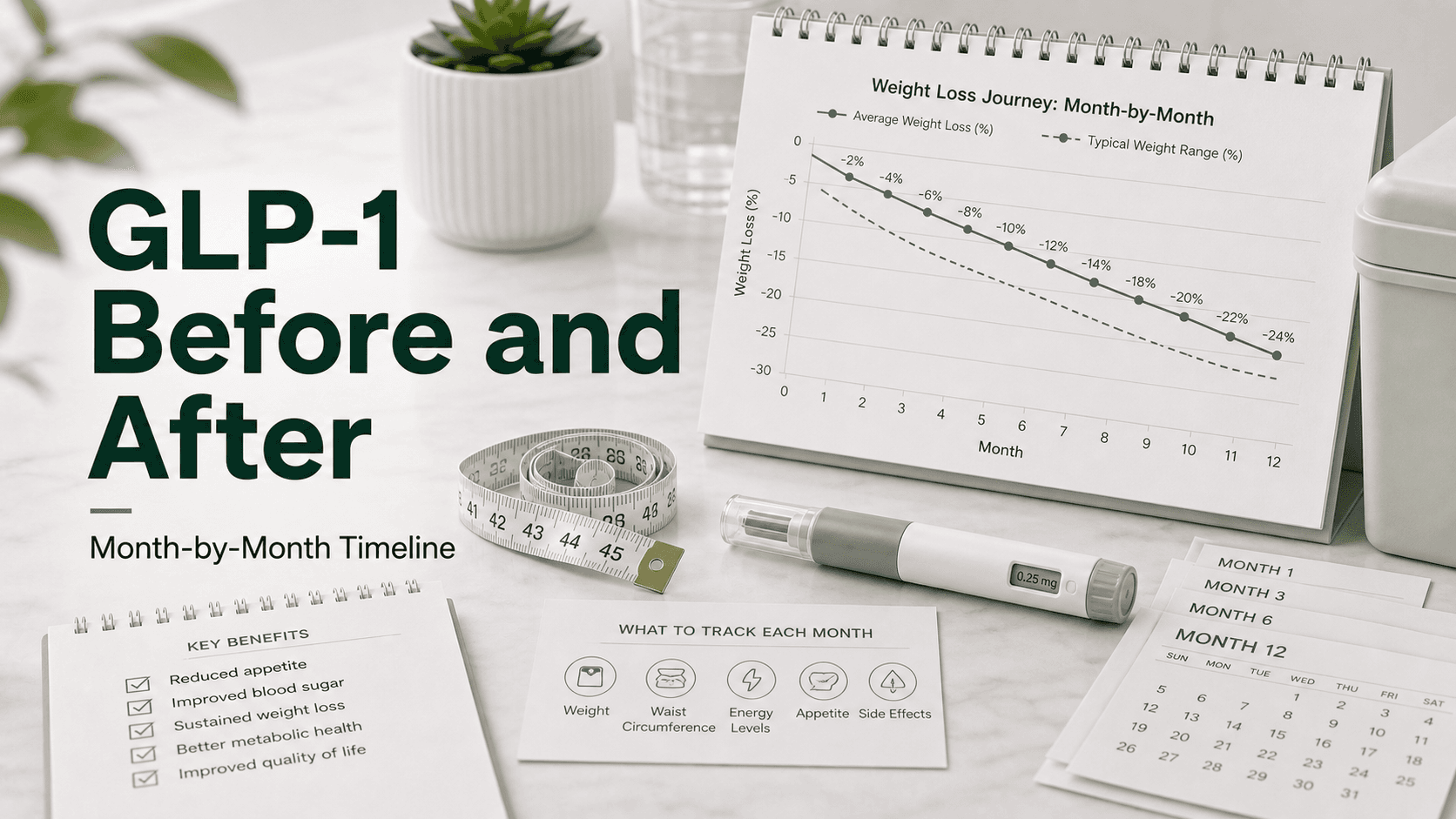
Direct answer: Trial-level data shows a predictable arc on high-dose GLP-1s: 2–5% in month 1, 8–11% by month 6, 14–22% by month 12, plateau by month 18. Tirzepatide produces about 5–7 percentage points more weight loss than semaglutide at top doses. Real-world results land lower because of dose adherence, lower-dose prescribing, and missed doses. Body composition changes (waist, fat mass, A1C, BP, sleep) often outpace what the scale shows in months 7–12.
The Average Trial Curve
Based on STEP, SURMOUNT, and head-to-head data, the typical patient on a high-dose GLP-1 for obesity follows this curve:
| Time on GLP-1 | Semaglutide 2.4 mg | Tirzepatide 15 mg | Approx lb on 200-lb starting weight |
|---|---|---|---|
| Weeks 1–2 | 0.5–1% (1–2 lb) | 0.5–1% (1–2 lb) | Mostly water |
| Month 1 | 2–5% | 2–5% | 4–10 lb |
| Month 2 | 4–7% | 5–8% | 8–16 lb |
| Month 3 | 5–8% (5.9% in pooled real-world data) | 7–10% | 10–20 lb |
| Months 4–6 | 10–14% (10.9% real-world) | 12–17% | 20–34 lb |
| Months 7–9 | 12–14% | 15–18% | 24–36 lb |
| Months 10–12 | 14–15% (15% STEP target) | 18–20% | 28–40 lb |
| Months 13–18 | 15–17% | 20–22.5% (21% SURMOUNT) | 30–45 lb |
Retatrutide trials (not yet approved) point higher: ~24% at 48 weeks at 12 mg.
Before and After by Drug: What the Registration Trials Measured
Every "before and after" has a drug, a dose and a clock attached to it. Here is what each agent produced in its own pivotal trial, with the arithmetic run against the same 200-lb starting weight used above.
| Drug and dose | Trial | Length | Mean weight change | On a 200-lb start |
|---|---|---|---|---|
| Liraglutide 3.0 mg daily (Saxenda) | SCALE Obesity and Prediabetes | 56 weeks | -8.4 kg vs -2.8 kg on placebo (mean baseline 106.2 kg, roughly -7.9%) | ~16 lb |
| Semaglutide 2.4 mg weekly (Wegovy) | STEP 1 | 68 weeks | -14.9% vs -2.4% on placebo | ~30 lb |
| Tirzepatide 5 mg weekly (Zepbound) | SURMOUNT-1 | 72 weeks | -15.0% vs -3.1% on placebo | ~30 lb |
| Tirzepatide 10 mg weekly | SURMOUNT-1 | 72 weeks | -19.5% | ~39 lb |
| Tirzepatide 15 mg weekly | SURMOUNT-1 | 72 weeks | -20.9% | ~42 lb |
| Tirzepatide vs semaglutide, max tolerated dose | SURMOUNT-5 (head-to-head) | 72 weeks | -20.2% vs -13.7% | ~40 lb vs ~27 lb |
| Retatrutide 8 mg weekly (investigational) | Phase 2 | 48 weeks | -22.8% vs -2.1% on placebo | ~46 lb |
| Retatrutide 12 mg weekly (investigational) | Phase 2 | 48 weeks | -24.2% | ~48 lb |
Three things to read carefully before you use this table as a benchmark.
The SURMOUNT-1 figures are the treatment-regimen estimand. That counts everyone randomized, including people who stopped the drug early, which is the number closest to what an actual clinic sees. The higher figures quoted elsewhere, like 22.5%, come from the efficacy estimand, which counts only participants who stayed on treatment.
SURMOUNT-5 is the only head-to-head trial of the two drugs in obesity. Cross-trial math between STEP and SURMOUNT is an estimate with different populations behind it. The head-to-head trial, run open-label over 72 weeks in adults with obesity and without type 2 diabetes, landed at 20.2% for tirzepatide against 13.7% for semaglutide, a 6.5-percentage-point gap. Tirzepatide also produced the larger waist reduction.
Responder spread is wider than the mean suggests. In the retatrutide phase 2, at 48 weeks on the 12 mg dose, 100% of participants lost at least 5% of body weight, 93% lost at least 10% and 83% lost at least 15%, against 27%, 9% and 2% on placebo. Retatrutide is not approved and these are phase 2 numbers in 338 people, so treat them as a ceiling estimate rather than a forecast. On the approved drugs, the same principle holds in the other direction: a mean of 15% contains people at 25% and people at 5%.
What Real-World Numbers Look Like
A 2,405-patient cohort study of patients on liraglutide (52%), dulaglutide (40%), and other older GLP-1s — at glycemic-control doses, not high obesity doses:
| Time point | Mean weight loss | % achieving ≥5% loss | % achieving ≥10% loss |
|---|---|---|---|
| 8 weeks | 1.1% | 11.2% | n/a |
| 72 weeks | 2.2% (~6 lb on 238-lb baseline) | 33.3% | 10.5% |
Why so much lower than trials?
- These patients were on lower-dose, older drugs for diabetes, not high-dose weight-loss formulations
- Real-world dose escalation is slower and often stops short of the target
- Adherence drops over time
- Half don't take the medication consistently
The headline lesson: trial numbers are the best case at top doses with full adherence. Real-world numbers are 30–60% of the trial result.
Month By Month: What Actually Happens
Month 1: Adjustment
Most of the early loss is water as glycogen drops. The medication is in titration; the dose has not reached therapeutic levels for weight loss.
- 2–5 lb loss
- Food noise quiets noticeably — often the biggest "wow" moment
- Mild nausea, especially the first 3–4 days after each dose
- Energy can dip if calories drop too fast
Don't compare your month 1 to anyone else's; the dose has not been titrated up yet.
Months 2–3: Momentum
This is when most people see meaningful changes. Dose has reached the first real therapeutic level.
- 1–2 lb per week typical
- Clothes start fitting differently before the scale moves dramatically
- Cravings continue dropping
- Small plateau around week 8 is common — usually resolves with the next dose increase
- Real-world cohort data: 5.9% mean loss at 3 months
Months 4–6: The Visible Phase
The "before vs now" photos start to look meaningfully different.
- 4–8 lb/month
- Real-world cohort: 10.9% at 6 months
- Body composition shifts — fat mass drops, lean mass mostly preserved (especially if eating ≥1.2 g/kg protein and resistance training)
- Major plateau common around months 4–5 — usually short
- Some patients reach maintenance dose during this phase
Months 7–12: The Long Tail
The curve flattens. Many people get frustrated here.
- 0.5–1 lb/week is normal
- Trial outcome at 12 months: ~15% on semaglutide, ~21% on tirzepatide
- Smaller scale changes, bigger body composition changes
- Resistance training matters most here for preserving lean mass
- Plateaus of 4–6 weeks are common and usually break on their own
Months 13–18: Flattening Out
Most people on a stable dose are within a few pounds of their maximum response.
- Semaglutide 2.4 mg: 15–17%
- Tirzepatide 15 mg: 20–22.5%
- Retatrutide 12 mg (trials): ~24%
After this point, more weight loss usually requires a dose increase, a switch to a more potent agent, or structured training.
What Changes Besides the Scale
The before-and-after photo captures only one dimension. The fuller list of measurable changes after 6–12 months:
| Measure | Typical change |
|---|---|
| Waist circumference | -4 to -8 inches |
| Body fat % | -5 to -10 percentage points |
| A1C (if diabetic) | -1 to -2 percentage points |
| Blood pressure | -10 to -15 mmHg systolic |
| Triglycerides | -20 to -30% |
| LDL cholesterol | -5 to -10% |
| HDL cholesterol | +5 to +10% |
| Resting heart rate | -3 to -5 bpm |
| Sleep apnea events (AHI) | Often 25+/hour reduction |
| Knee/hip pain | Often reduced |
| ALT/AST (liver) | Often normalized |
Individual Variation: Why Some Lose Faster
Trials show wide spreads around the mean. At 12 months on semaglutide 2.4 mg, the 90th percentile loses ~25%; the 10th percentile loses ~5%. Drivers of the spread:
- Age: younger (<45) responds faster
- Starting BMI: higher BMI tends to lose more absolute weight but similar percent
- Sex: women lose slightly slower on average
- Dose adherence: missing doses or staying on low doses caps response
- Protein intake: higher protein preserves muscle and resting metabolic rate
- Sleep: poor sleep measurably blunts response
- Strength training: preserves lean mass, prevents metabolic adaptation
- Thyroid status: untreated hypothyroidism slows response
- Other meds: sulfonylureas, certain antidepressants can blunt loss
- Genetics: real effect, small magnitude
Realistic Photo Comparisons
Before-and-after photos used in marketing are usually from people in the top decile. A more honest comparison:
- 3 months: Mild change. Face usually slimmer first. Pants fit differently.
- 6 months: Visible difference to people who haven't seen you for a while.
- 12 months: Clearly different person in clothes. Body fat distribution has shifted.
- 18 months: Stable. Skin has had time to adapt.
How to Document Your Own Before and After
Most people take one enthusiastic photo in month 1, nothing in months 2 through 5, then try to compare a bathroom mirror shot against a different room, different light and a different time of day. The comparison is worthless and it usually reads as less progress than actually happened.
A protocol that survives 12 months:
- Same three angles every time: front, side, back. Arms relaxed at your sides, not flexed, not sucked in.
- Same room, same light, same time of day. Morning, after the bathroom, before eating. Overhead light casts shadows that fake definition, so use the same one every time rather than the best one.
- Same clothing. Fitted shorts, or swimwear, or the same pair of jeans that will visibly change fit. Baggy clothes hide the result you are documenting.
- Mark the floor. A piece of tape where you stand and where the phone sits, at the same height. Distance changes apparent size more than a month of progress does.
- Shoot every 4 weeks, not every day. Weekly photos show noise. Monthly photos show the curve.
Photos alone will mislead you in months 7 through 12, when the scale flattens while body composition keeps moving. Pair them with numbers:
| Cadence | What to record |
|---|---|
| Weekly | Weight on the same scale, same morning, same conditions. Use the 7-day average, not the daily reading. Injection date, dose and site. Any missed dose. |
| Every 4 weeks | Photos in all three angles. Waist at the navel, narrowest waist, hips at the widest point, chest, upper arm, mid-thigh. Measure at the same time of day, tape flat and level, breathing out normally. |
| Every 4 weeks | Protein grams on a typical day, resistance training sessions per week, average sleep. These are the three inputs that most change what the photos look like at the same weight. |
| Every 3 to 6 months | Blood pressure, resting heart rate, lipids, A1C if relevant, ALT and AST. A DEXA scan if you want lean mass measured rather than estimated. |
The measurement that matters most is the waist. It moves during plateaus, it tracks visceral fat, and it costs nothing to check. A month where the scale is flat and the waist drops an inch is a good month misread as a stall.
Real Patient Stories (Composite)
From published patient profiles:
- Pepper Schwartz (not diabetic) lost ~30 lb on Ozempic with improved BP and cholesterol
- Gina Schweppe (overweight + pre-diabetes + hyperthyroidism) lost ~35 lb in 3 months on a GLP-1 with diet and exercise
- Jamel Corona lost ~60 lb on Wegovy with food discipline and regular activity
These are real outcomes, not marketing — but they are the upper end of typical, not the median.
When To Worry
The arc above is the average. Reasons to talk to a prescriber:
- No weight loss after 12 weeks at the therapeutic dose
- Rapid weight loss of >2% per week sustained for more than 4 weeks
- Persistent symptoms that don't resolve between doses
- Unintended weight loss beyond your goal
- Plateau lasting more than 12 weeks — sometimes the answer is a dose increase, switch, or paired strength program
- Significant lean mass loss on DEXA — usually a sign protein and training need work
What People Get Wrong About Before-and-Afters
- "It stopped working after 6 months." It is supposed to slow down. The curve is not linear.
- "My friend lost 30 lb in 3 months on Wegovy — why am I not?" Top-decile responses are not the median.
- "The picture is what counts." Body composition matters more than scale weight.
- "After I stop, the weight will stay off." Most regain 1/3 to 2/3 of the loss within a year of stopping unless transition strategies are in place.
- "Real-world results match the trials." They usually don't, mostly because dose, adherence, and lifestyle differ from trial conditions.
Frequently Asked Questions
How much weight will I lose in the first month on GLP-1? Average is 2–5 lb in month 1. Most of that is glycogen and water; real fat loss accelerates in months 2–3.
What is the typical 6-month result? Trial data: 10–14% of starting body weight. Real-world data: closer to 5–8% depending on the drug, dose, and adherence.
What is the average 1-year weight loss on Wegovy? About 15% in STEP trials. Real-world cohorts show 3–8% at standard doses with imperfect adherence.
Is tirzepatide before-and-after better than semaglutide? On average yes — tirzepatide produces about 5–7 percentage points more weight loss at 72 weeks (~21% vs ~15%). The one head-to-head trial, SURMOUNT-5, measured it directly at 72 weeks: -20.2% on tirzepatide versus -13.7% on semaglutide, both at maximum tolerated dose.
Why has my weight loss stalled? Plateaus of 4–6 weeks are normal. Sleep, protein, dose level, alcohol, and stress are the usual culprits. Persistent plateaus often resolve with a dose adjustment or change in training.
Will I keep the weight off after stopping? Without structured transition (slow taper, strength training, food rules), about 1/3 to 2/3 of the loss returns within 12 months.
Last reviewed: May 13, 2026
Sources
- Real-world weight loss effectiveness of GLP-1 agonists among patients with T2D — PMC
- GLP-1 Weight Loss Results: Month by Month Timeline — glp-1.com
- Semaglutide Before and After with Photo Examples — Medica Depot
- Once-Weekly Semaglutide in Adults with Overweight or Obesity (STEP 1, NEJM 2021; -14.9% at 68 weeks) — PubMed
- Tirzepatide Once Weekly for the Treatment of Obesity (SURMOUNT-1, NEJM 2022; -15.0%, -19.5%, -20.9% at 72 weeks) — PubMed
- Tirzepatide as Compared with Semaglutide for the Treatment of Obesity (SURMOUNT-5, NEJM 2025; -20.2% vs -13.7% at 72 weeks) — PubMed
- A Randomized, Controlled Trial of 3.0 mg of Liraglutide in Weight Management (SCALE, NEJM 2015; -8.4 kg at 56 weeks) — PubMed
- Triple-Hormone-Receptor Agonist Retatrutide for Obesity, A Phase 2 Trial (NEJM 2023; -24.2% at 48 weeks on 12 mg) — PubMed