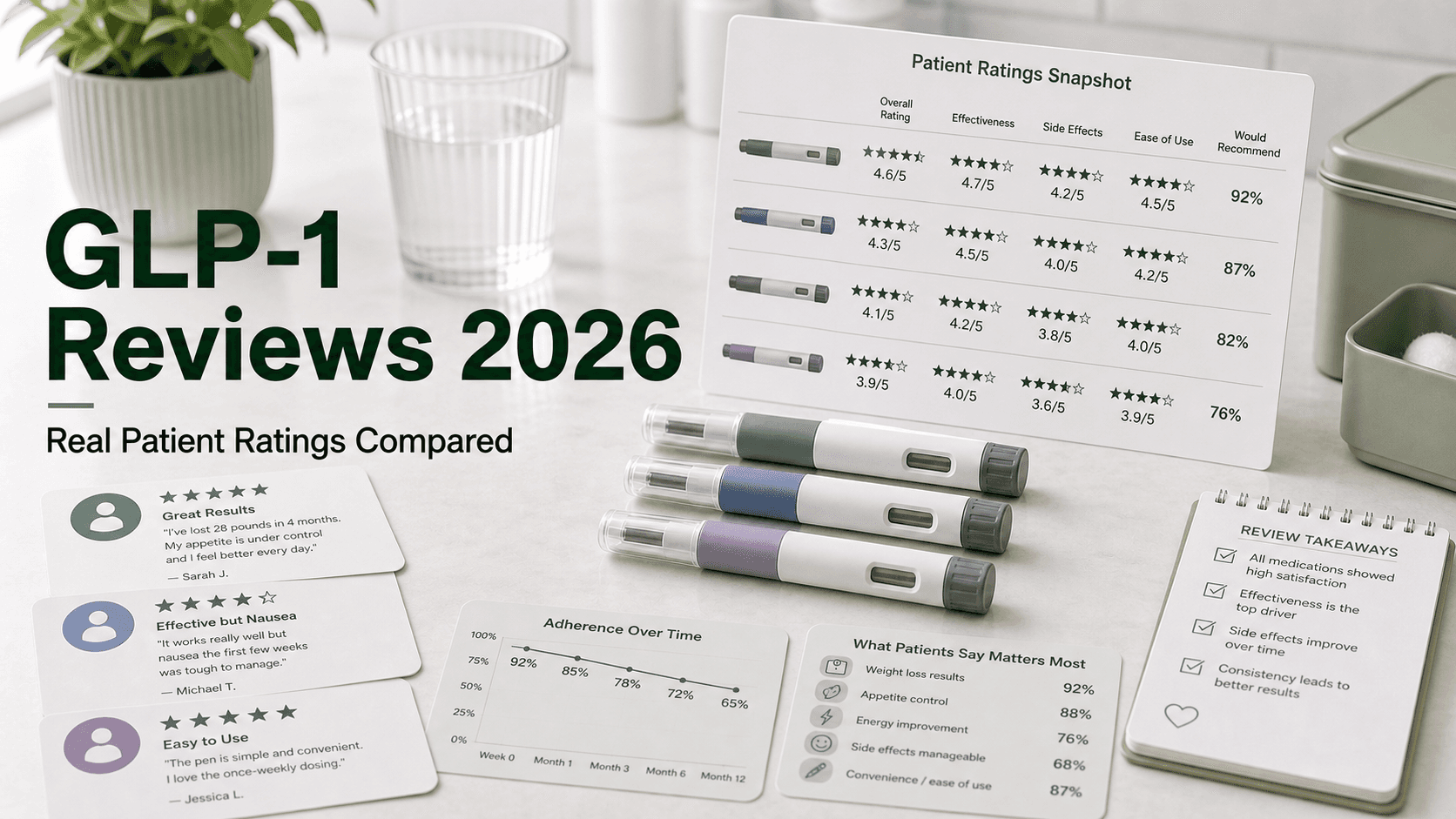
If you read only the clinical trial summaries, GLP-1 medications look close to miraculous: 15% body weight reduction with semaglutide, 20%+ with tirzepatide, durable cardiometabolic benefits. If you read only the comment sections on Drugs.com and WebMD, you get a different picture: thousands of five-star reviews next to one-star horror stories about gastroparesis, hair loss, hospital trips for dehydration, and bills that doubled after a job change. The reality lives between those two views, and it is mostly captured by one number that doesn't show up in either: at 12 months, fewer than 1 in 4 patients without diabetes are still filling their GLP-1 prescription.
Direct answer: Across the largest patient-review databases as of May 2026, Zepbound (tirzepatide) has the highest aggregate rating at 8.7/10 on Drugs.com (653 reviews, 80% positive, 3% negative) and 4.2/5 on WebMD (83% positive effect). Mounjaro (tirzepatide) sits at 8.4/10 on Drugs.com (1,860 reviews, 77% positive). Wegovy (semaglutide) rates 7.4/10 on Drugs.com (628 reviews, 64% positive, 17% negative) and 3.8/5 on WebMD. Ozempic (semaglutide) is the lowest of the big four at 6.7/10 on Drugs.com (1,692 reviews, 52% positive, 22% negative). The pattern is consistent across platforms: tirzepatide drugs out-rate semaglutide drugs, and weight-loss-indicated brands (Zepbound, Wegovy) out-rate diabetes-indicated brands of the same molecule (Mounjaro, Ozempic) — partly because expectations differ. Despite the high ratings, real-world discontinuation runs 46–65% within 12 months, with cost and side effects the top two reasons.
Aggregated GLP-1 Ratings (May 2026)
| Drug | Drugs.com rating | Reviews | % positive | % negative | WebMD rating |
|---|---|---|---|---|---|
| Zepbound (tirzepatide) | 8.7/10 | 653 | 80% | 3% | 4.2/5 |
| Mounjaro (tirzepatide) | 8.4/10 | 1,860 | 77% | 6% | 4.1/5 |
| Wegovy (semaglutide) | 7.4/10 | 628 | 64% | 17% | 3.8/5 |
| Ozempic (semaglutide) | 6.7/10 | 1,692 | 52% | 22% | 3.6/5 |
A few patterns to note before reading any individual review:
- Review sites self-select. People who quit early, had no side effects, or are too sick to write anything are underrepresented. People with extreme experiences (very positive or very negative) post more.
- Tirzepatide brands rate higher than semaglutide brands. This tracks the head-to-head trial data: tirzepatide produces more weight loss and slightly milder GI side effects for most users.
- Brand splits matter. The same molecule rates differently depending on the indication and the price point. Wegovy reviewers expect weight loss; Ozempic reviewers are often diabetic and rate by A1c and side effects.
What Patients Consistently Love
Across thousands of reviews, the same themes repeat. None of them are weight loss alone.
Food noise quieting. The phrase shows up in nearly every Zepbound and Wegovy review thread. One reviewer told Scientific American, "All of a sudden it was like some part of my brain that was always there just went quiet... If I had lost almost no weight, just to have my brain working the way it's working, I would stay on this medication forever." A composite Zepbound review reads: "The 'food noise' that always seemed to be in my head is gone. Just gone." For many patients this is the headline benefit, not the scale.
Weight loss without conscious restriction. Reviewers commonly describe eating less without trying — half a sandwich, a few bites of dinner, full for hours. WebMD Wegovy reviews include posts like, "Lost a total of 66 lbs... I'm back to the way I was when my husband and I started dating," and Zepbound reviews like, "I've lost 50 lbs since August!! I'm currently taking 10 mg on my second week."
Reduced alcohol craving. A recurring theme across both Reddit and WebMD: people who drank nightly cut to once or twice a week without effort. The clinical literature now supports this — GLP-1 receptors in reward pathways appear to dampen alcohol cue reactivity.
Less bingeing and grazing. Patients with binge eating disorder histories frequently say the urge to binge is "gone" rather than resisted. This shows up in 5-star reviews more than any side-effect tolerance comment.
Lab improvements. Lower A1c, lower triglycerides, lower LDL, lower blood pressure, normalized liver enzymes. Diabetic Ozempic reviewers cite A1c drops from 9+ to under 7 within six months. For many older patients these markers matter more than pounds.
Less joint pain and better mobility. Often understated. Reviewers in their 50s and 60s frequently describe knees and hips feeling normal again 20–30 pounds in.
What Patients Consistently Hate
The negative reviews are not random. They cluster around the same complaints.
Nausea and GI side effects during titration. Roughly 60% of users mention some GI symptom in early weeks. WebMD Wegovy: "The side effects were so vicious and constant... ended up in hospital, with dehydration, low blood pressure." Ozempic: "I have constant diarrhea many times throughout the day. Need to be right close to a bathroom." Sulfur burps, reflux, constipation, and diarrhea are the four most common written complaints.
Cost and insurance friction. Mentioned in nearly every 1-star review where the patient otherwise praises the drug. Self-pay prices remain around $499/month for Wegovy and $549 for Zepbound after savings cards; without commercial insurance the math frequently breaks down by month 4.
Plateau frustration. Reviewers commonly hit a stall at month 4–6 and read it as treatment failure. "Been taking for 4 months, only lost 10 pounds. have had bad side effects, headache, bloating, gas." Some plateaus reflect dose-titration timing; others reflect that the patient has hit a new metabolic setpoint.
Rebound weight after stopping. STEP-1 extension data showed two-thirds of weight regained within a year of stopping semaglutide. Reviewers describe the same: "Lost 60 lbs, came off because of cost, gained 45 back in 8 months."
"Ozempic face" and loose skin. Volume loss in the face, neck, and arms shows up repeatedly in 3-star reviews — drug worked, but the cosmetic outcome was unwelcome.
Hair loss. A subset of reviewers — disproportionately women losing more than 15% body weight — report thinning. "I lost my hair, literally... losing my hair and my plateau has not changed." Most cases are telogen effluvium tied to rapid loss, not the drug itself, but the experience reads identically to the patient.
Fatigue, mood changes, anhedonia. Less common but cited. Some patients describe a flat affect and reduced interest in previously enjoyable activities — sometimes called "Ozempic personality" in 2026 commentary.
Gastroparesis fears. A small but vocal minority report delayed gastric emptying symptoms persisting after discontinuation. "It has caused me to have gastroparesis after only 6 weeks of usage and this is a life-long chronic illness." Causality is debated; the symptom set is real.
Why Discontinuation Is So High Despite High Ratings
A JAMA Network Open analysis of 125,474 GLP-1 patients found 53.6% discontinued within 12 months overall — 46.5% of patients with type 2 diabetes and 64.8% without diabetes. NPR coverage in April 2026 cited the now-widely-quoted figure that fewer than 1 in 4 patients without diabetes stay on a GLP-1 past the first year.
The reasons cluster:
| Reason for stopping | Notes |
|---|---|
| Cost / insurance lapse | Top driver in obesity-only group. A formulary change or job switch frequently ends a course. |
| Side effects | Most often GI in the first 12 weeks; gastroparesis-like symptoms later. |
| Reached goal weight | Many patients still see treatment as a "course" rather than chronic therapy. |
| Plateau frustration | Misread as failure when it is usually a setpoint shift. |
| Medical reasons | Surgery, pregnancy, new diagnosis (pancreatitis, severe reflux). |
| Shortage / access | Compounded availability tightening through 2025–2026 pushed some off. |
A counter-data point: of those who discontinue, 36–47% reinitiate within a year, and 46–57% reinitiate within two years. The pattern is not "tried and gave up" — it is "cycled off and back on."
Drug-by-Drug Review Patterns
Zepbound (tirzepatide for obesity). Highest aggregate rating of any GLP-1 brand. Reviewers describe smoother titration than semaglutide, faster food-noise reduction, and average loss in the 18–22% body-weight range. Complaints concentrate on cost ($549 self-pay), Lilly Direct supply hiccups in late 2025, and a small subset reporting fatigue and hair shedding. Best-reviewed for people who want maximum efficacy and can manage out-of-pocket.
Mounjaro (tirzepatide for diabetes). Same molecule as Zepbound, scored marginally lower because diabetic reviewers rate by A1c outcomes and frequently report side effects that obesity patients tolerate for weight loss. 77% positive on Drugs.com is still elite.
Wegovy (semaglutide for obesity). Mid-tier among the big four. Reviewers report strong weight loss but more variable side-effect profiles than tirzepatide users. The cardiovascular indication (SELECT trial) earns frequent mentions in 2025–2026 reviews from older patients. Oral Wegovy launched in 2025 broadened the user base; pill reviewers cite easier adherence but more nausea.
Ozempic (semaglutide for diabetes). The most reviewed and the most polarized — 22% explicitly negative on Drugs.com. The off-label weight-loss wave brought in users with expectations Ozempic wasn't designed for, and many of those leave 1- and 2-star reviews. Among on-label diabetic users the rating is meaningfully higher.
Saxenda and Victoza (liraglutide). Older daily-injection GLP-1s. Lower ratings (typically 5–6/10 on Drugs.com) than weekly options, mostly because the daily shot is a compliance burden and the weight-loss effect is modest.
Rybelsus (oral semaglutide). Mid-tier ratings, with adherence praised over efficacy. Many reviewers note slower weight loss than injectables.
Composite Real-User Quotes
These are anonymized composites of patterns that appear across review sites; they are not single sourced quotes.
- "I came for weight loss and stayed for the silence. I didn't realize how loud food had been in my head until it wasn't." — typical Zepbound 5-star reviewer
- "Worked great for nine months. Lost my insurance coverage in February, couldn't afford $549 a month, and now I've regained 22 pounds. Looking at compounded but worried about quality." — typical Wegovy 3-star
- "My A1c went from 9.2 to 6.4 in five months. I dropped 31 pounds without trying. I don't understand the negative reviews." — typical Ozempic 5-star
- "Constant nausea, sulfur burps, lost 8 pounds in 14 weeks at 0.5mg. Stopping." — typical Ozempic 2-star
- "Side effects were rough for three weeks then disappeared. Down 40 lbs at month 7. Wish I'd started years ago." — typical Mounjaro 5-star
Realistic Expectations from the Review Aggregate
Patterns worth internalizing before starting:
- Expect a 60–80% chance of meaningful GI side effects in the first 8 weeks. Most resolve. Some don't.
- Expect a plateau somewhere between month 4 and month 8 — usually at 12–18% loss for semaglutide, 18–22% for tirzepatide. Dose, diet, and patience break most plateaus.
- Expect rebound if you stop without a maintenance plan. Two-thirds of weight loss returns within 12 months for most users.
- Expect cost volatility. Coverage changes, savings cards expire, and compounded options shift quarterly. Build a 6-month financial buffer before starting.
- Expect the food noise change to feel bigger than the scale change in months 1–2. The scale catches up.
- Do not expect a quick on/off course. Reviews from people who treated it as a 6-month diet drug skew negative. Reviews from people who reframed it as chronic therapy skew positive.
What People Get Wrong About GLP-1 Reviews
- "Drugs.com ratings tell the whole story." They tell the story of people motivated enough to write a review. Adherence data tells the rest.
- "A high rating means low side effects." It doesn't. Zepbound reviewers report GI side effects at similar rates to Wegovy — they just rate the outcome higher because the weight loss is greater.
- "Negative reviews mean the drug doesn't work." Many 1-star reviews come from patients who stopped before the therapeutic dose. Most clinical benefit shows up at 2.4 mg semaglutide or 10–15 mg tirzepatide.
- "If I quit, I failed." Discontinuation is the norm, not the exception. The question is whether you discontinued with a plan (maintenance protocol, lifestyle scaffolding, monitoring) or just stopped.
- "Ozempic and Wegovy are the same." Same molecule, different titration ceilings (2.0 mg vs 2.4 mg) and different labels. Reviewers compare them as if interchangeable; they aren't quite.
- "Compounded is cheaper and just as good." Reviews of compounded providers in 2026 are mixed; quality varies, regulatory status tightened through 2025, and side-effect reports skew higher.
Frequently Asked Questions
Which GLP-1 has the best patient reviews? Zepbound, at 8.7/10 on Drugs.com (80% positive) and 4.2/5 on WebMD. Mounjaro is a close second at 8.4/10. Both are tirzepatide.
Why are Wegovy and Ozempic reviews lower? Semaglutide produces less weight loss than tirzepatide and slightly more GI side effects in most head-to-head comparisons. Ozempic reviews are further dragged down by off-label users whose expectations were set by Wegovy data.
What percentage of GLP-1 patients stay on past 12 months? About 35–53% overall. For patients without diabetes, fewer than 1 in 4 remain on therapy at one year, per Almandoz et al. and JAMA Network Open analyses.
What do patients complain about most? In order: cost, GI side effects (nausea, constipation, sulfur burps), plateaus, rebound after stopping, and cosmetic changes (Ozempic face, hair shedding).
What do patients praise most? Reduced food noise, weight loss without conscious restriction, lab improvements, reduced alcohol craving, less joint pain.
Are positive reviews trustworthy? Aggregates are more trustworthy than individual reviews. A drug with 80% positive across 600+ reviews tells you more than any single 5-star story. But review sites underrepresent people who quit early and over-represent extreme experiences.
Do negative reviews mean the drug is dangerous? No. The safety signal from trials and real-world studies is consistent. Negative reviews mostly describe tolerability and expectations gaps, not adverse events.
Should I trust review sites over my doctor? No. Use them to set expectations and to surface questions for your prescriber. Reviews flag patterns; your clinical history determines whether those patterns apply to you.
Last reviewed: May 13, 2026
Sources
- Zepbound Reviews & Ratings — Drugs.com
- Wegovy Reviews & Ratings — Drugs.com
- Ozempic Reviews & Ratings — Drugs.com
- Mounjaro Reviews & Ratings — Drugs.com
- Zepbound (tirzepatide) Reviews by Patients — WebMD
- Wegovy (semaglutide) Reviews by Patients — WebMD
- Ozempic (semaglutide) Reviews by Patients — WebMD
- Discontinuation and Reinitiation of Dual-Labeled GLP-1 Receptor Agonists — JAMA Network Open
- Quit a GLP-1? Plan to start again? — NPR, April 2026
- Patient Perceptions of Ozempic for Weight Loss: Mixed Methods Analysis — Journal of Medical Internet Research
- Why Do So Many Patients Stop Taking GLP-1 Medications Within A Year? — Northwestern Medicine
- Ozempic Quiets Food Noise in the Brain — Scientific American