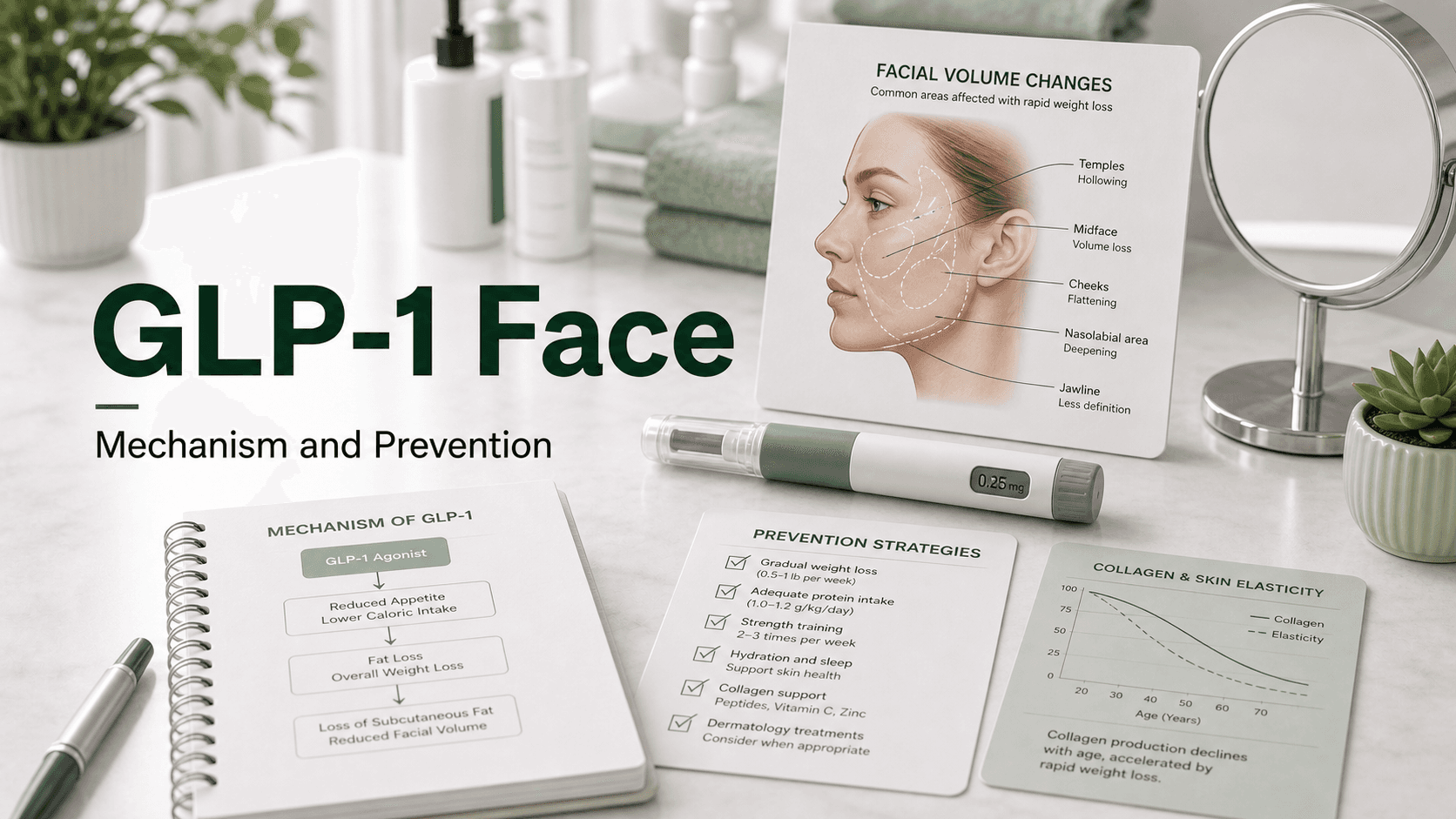
Dermatologist Dr. Paul Jarrod Frank coined the term "Ozempic face" in 2022 to describe the hollow cheeks, sunken temples, and loose skin around the jawline that show up after months on a GLP-1. For a long time the assumption was: it is just rapid weight loss, same as bariatric surgery face. New research suggests something more specific — GLP-1 receptors on adipose-derived stem cells directly affect collagen synthesis, oxidative stress, and dermal fat, which may explain why the face seems to age faster than the rest of the body on these drugs.
Direct answer: "Ozempic face" or "GLP-1 face" describes the gaunt, sunken, and aged appearance that can follow rapid weight loss on a GLP-1. The main driver is loss of subcutaneous and dermal white adipose tissue (DWAT) combined with reduced collagen and elastin. A 2025 review of laboratory work proposes a second layer: GLP-1 receptors on adipose-derived stem cells (ADSCs) reduce their cytokine output, triggering oxidative damage to fibroblasts and matrix metalloproteinase-1 activity that breaks down collagen. That part is mechanism, not measured human outcome. It typically becomes visible after losing 15–20 lb or 10–20% of body weight over 2–6 months. Slower titration, adequate protein, strength training, sleep, and sun protection reduce severity. Once it appears: dermal fillers, biostimulatory injectables (Sculptra), microneedling/RF (Sofwave), fat grafting, or surgical facelift.
What Is Actually Happening
The mechanism is more layered than "you lost weight too fast." Three things are happening at once:
1. Loss of Subcutaneous Facial Fat
Rapid weight loss shrinks the fat that cushions the cheeks, temples, and under-eyes. The cheeks hollow, temples sink, jawline shows more bone. Mechanical, predictable.
2. Loss of Dermal White Adipose Tissue (DWAT)
Distinct from the subcutaneous fat layer, DWAT is the thin layer of fat within the skin itself. GLP-1 drugs appear to deplete it disproportionately. Less DWAT = less skin volume and faster wrinkling.
3. Direct GLP-1 Effects on Skin Cells
This is the new piece, and the least settled one. GLP-1 receptors have been reported on adipose-derived stem cells (ADSCs) in the skin — although whether fat tissue carries functional GLP-1 receptors at all is disputed in the incretin literature. Where the receptors are present, activation is proposed to:
- Reduces ADSC production of protective cytokines, triggering oxidative damage to fibroblasts (the cells that make collagen and elastin)
- Decreases estrogen production from ADSCs, which normally stimulates fibroblast collagen synthesis
- Increases matrix metalloproteinase-1 activity, which breaks down existing collagen
- Increases reactive oxygen species (ROS) production in ADSCs, damaging cell membranes and signaling
If those cell-level findings hold in living skin, the combined effect would be faster collagen and elastin loss than weight loss alone would cause — the proposed reason "Ozempic face" is said to look different from "post-diet" face. No human study has tested that comparison directly.
What Is Established and What Is Not
"Ozempic face" is a media term, not a diagnosis. It is not in the Ozempic prescribing information — the words "face" and "facial" do not appear anywhere in the label, and the only skin-related postmarketing entry is alopecia. There is no agreed definition of how much volume loss counts, and no trial has used facial appearance as an endpoint. A 2026 letter in Aesthetic Surgery Journal Open Forum framed the open question in its title: construct, consequence, or clinical entity?
Sorting the claims by what actually backs them:
| Claim | What supports it |
|---|---|
| Rapid, large weight loss empties facial fat compartments and leaves loose skin | Established, and not specific to GLP-1s — the same thing happens after bariatric surgery or any comparable loss |
| People on GLP-1s are seeking facial rejuvenation in growing numbers | Descriptive. A 2025 systematic review found 23 plastic-surgery papers on the topic plus rising searches for "face filler" alongside "Ozempic face" |
| GLP-1 receptor activation ages skin directly through ADSCs, MMP-1 and oxidative stress | Hypothesis. It comes from a 2025 narrative review of cell and animal work whose own authors write that studies of direct skin effects are limited and that it is unclear whether every patient on a GLP-1 develops the look |
| Facial change is worse on a GLP-1 than on the same weight loss achieved by diet | Untested. No controlled comparison has been published |
| Face-specific prevention protocols | Extrapolated. The 2026 anatomy-driven prevention algorithm in Aesthetic Plastic Surgery is labeled by its own journal as Level of Evidence V and describes itself as hypothesis-generating |
None of that makes the effect imaginary. Volume loss in the midface after 40 lb is visible in a mirror. It means the honest version is: the weight loss is doing the work, the drug-specific skin mechanism is plausible and unproven, and prevention advice is borrowed from what preserves lean tissue generally.
Does the GIP Half of Tirzepatide Change This?
Tirzepatide (Mounjaro, Zepbound) is a dual GIP/GLP-1 receptor agonist, so "do GLP-1/GIP drugs affect facial aging differently, and why" splits into two questions: how much weight comes off, and what the two receptors do in fat.
The part that is measured: weight. SURMOUNT-5 randomized 751 adults with obesity and without type 2 diabetes to the maximum tolerated dose of tirzepatide or semaglutide for 72 weeks. Weight change was -20.2% with tirzepatide versus -13.7% with semaglutide, and waist circumference fell 18.4 cm versus 13.0 cm. Total loss and rate of loss are the established drivers of facial hollowing, so on averages alone a dual agonist takes more volume off the face over the same stretch of time. That is the difference you can actually predict.
The part that is argued about: receptors. GIP receptors are found in adipose tissue. Whether the GLP-1 receptor is expressed in fat is contested — incretin physiology reviews report that the GIP receptor is present in whole adipose tissue while the GLP-1 receptor is not, which sits awkwardly next to a skin-aging model built on GLP-1 receptors sitting on dermal ADSCs. GIP's documented roles in fat include lipid uptake and disposal, lipolysis, adipose blood flow and free fatty acid re-esterification. What any of that does to a cheek has not been studied.
What nobody has measured. No trial of either drug has reported a facial endpoint, and the 2025 review of GLP-1s and skin aging does not discuss GIP or dual agonists at all. Anyone claiming tirzepatide is gentler or harsher on the face than semaglutide for receptor reasons is guessing. The size and speed of the weight change is the honest answer to "why."
Who Gets It Worst
| Risk factor | Why it matters |
|---|---|
| Age 40+ | Lower baseline collagen, slower remodeling |
| Faster weight loss rate | Less time for skin to adapt |
| Larger total weight loss | More volume change |
| Female sex | Slightly thinner skin, less retentive sub-Q fat |
| Sun damage / smoking history | Reduced elastin reserve |
| Lower starting body fat | Less to lose before face shows it |
| Low protein intake | Collagen synthesis impaired |
| Sleep deprivation | Skin remodeling occurs largely in deep sleep |
| Higher GLP-1 dose | Faster weight loss, more direct cell effect |
When It Appears
Most people start seeing changes around the 15–20 lb mark, which on a GLP-1 typically lands at month 3–4. The change accelerates between months 4 and 9, when weight loss is at peak rate.
After weight stabilizes (month 12+), the face often "settles" over the following 6–12 months as collagen partially rebuilds.
Per Cleveland Clinic endocrinologist Dr. Vinni Makin:
"The faster your weight loss, the more likely that your face will show signs of the weight loss."
How To Reduce It Before It Starts
1. Slow Down the Rate of Loss
The single biggest variable. Losing 1–1.5 lb/week is much easier on the face than 3 lb/week.
- Don't push past the lowest tolerated dose to chase faster results
- Skip a titration step if losing too fast
- Stay at a maintenance dose once you reach your target weight
2. Eat Enough Protein
Adequate protein supports skin and lean-mass preservation:
- Target 1.2–1.6 g/kg of body weight per day (about 0.55–0.73 g/lb)
- For a 180-lb person: ~100–130 g protein/day
- Prioritize meals over shakes when possible
3. Strength Train
- Preserves lean body mass, so weight loss is mostly fat
- Improves circulation and nighttime growth-hormone pulses that drive skin remodeling
- 2–3× per week minimum
4. Sleep 7–9 Hours
Skin remodeling occurs primarily during slow-wave sleep. Cutting sleep cuts collagen turnover. One of the simplest, most-overlooked steps.
5. Stay Hydrated
GLP-1s blunt thirst signals. Dehydration exaggerates facial hollowness. Aim for ~half your body weight (in lb) in ounces of fluid daily.
6. Sun Protection
Loss of skin support is permanent if structural proteins are already sun-damaged. Daily SPF 30+ protects what's left.
7. Don't Overshoot Your Target
Set a stopping weight and back off the dose when you reach it. The medication keeps suppressing appetite past your goal weight if you let it.
What Helps When It Already Happened
Cosmetic dermatology and plastic surgery options, in order of invasiveness:
| Treatment | What it does | Typical duration |
|---|---|---|
| Topical retinoids + peptides | Modest collagen remodeling | Months of daily use |
| Microneedling + radiofrequency (e.g., Morpheus8) | Stimulates collagen | 6–12 months per series |
| Sofwave (ultrasound) | Collagen stimulation | 6–12 months |
| Hyaluronic acid fillers (Juvéderm, Restylane) | Replaces lost volume | 9–18 months |
| Sculptra (poly-L-lactic acid) | Triggers collagen growth | 2+ years |
| Platelet-rich plasma (PRP) | Growth factors for skin | Adjunct to other procedures |
| Botox | Wrinkles, not volume | 3–4 months |
| Fat grafting | Transplants patient's own fat | Long-lasting (some resorption) |
| Threads (PDO/PLLA) | Mechanical lift + collagen | 6–12 months |
| Facelift / neck lift | Surgical excess-skin removal | Years to decades |
| Blepharoplasty | Excess eyelid skin | Long-term |
| Lip lift | Restores upper lip shape | Long-term |
Most patients start with sub-surgical options (fillers, microneedling) and reserve surgical lifts for severe laxity after weight has stabilized for 6–12 months.
Doesn't Some of It Come Back?
Yes, partially. Once weight is stable:
- Subcutaneous fat can partially return over 6–12 months as the body recalibrates
- Skin remodeling continues for 12–24 months
- Late-onset improvement is common, especially in younger patients with better skin reserve
This is part of why most cosmetic surgeons recommend waiting 6–12 months after weight stabilizes before pursuing a definitive procedure.
What People Get Wrong
- "GLP-1 melts facial fat selectively." Partly true — direct GLP-1 effects on dermal adipose tissue and stem cells amplify the rapid weight-loss effect.
- "Only Ozempic does this." All rapid weight loss does, but GLP-1s appear to add a direct cellular component.
- "Eating more will fix it." Eating more raises overall fat percentage, but the face isn't the first place fat returns. Better to slow the loss in the first place.
- "I should stop the medication." Often the better move is to titrate down to a maintenance dose, not stop entirely (which risks rebound weight gain).
Frequently Asked Questions
Is Ozempic face permanent? Not entirely. Skin and subcutaneous fat partially recover over 6–12 months after weight stabilizes, especially in younger patients.
At what weight loss does it appear? Most people notice it around 15–20 lb or 10–20% of starting weight. Faster losses make it appear earlier.
Can I prevent it? You can reduce severity by slowing the rate of loss, eating enough protein (1.2–1.6 g/kg/day), strength training 2–3× weekly, sleeping enough, and using daily SPF.
Will fillers fix it? They restore lost volume effectively. Best done after weight has stabilized for at least 6 months.
Do face exercises help GLP-1 face? There is one real study and it was not done on GLP-1 patients. A 2018 JAMA Dermatology pilot put 27 women aged 40 to 65 through 30 minutes of daily facial exercise for 8 weeks, then 3 to 4 sessions a week for 12 more; 16 finished. Blinded dermatologist raters scored upper and lower cheek fullness as improved (P = .003 for both) and dropped their age estimates from 50.8 to 48.1 years. It was single-arm, self-selected, with 11 dropouts and no control group. Facial exercise trains the muscle under the fat pad — it does not put fat back. Reasonable as a free, low-risk addition to protein, training and a slower titration. Not a substitute for volume.
Does Mounjaro cause it less than Ozempic? Not pharmacologically — both class effects apply — but tirzepatide tends to produce faster and larger weight loss, which can make facial changes more pronounced.
Should I stop the GLP-1? Usually not. Lowering to a maintenance dose or adjusting protein, training, and pace is more effective than stopping.
Who coined the term "Ozempic face"? Dermatologist Dr. Paul Jarrod Frank, in 2022, to describe the rapid facial changes he was seeing in patients on these medications.
Last reviewed: May 13, 2026
Sources
- "Ozempic Face": What It Is and How to Avoid It — Cleveland Clinic
- How Plastic Surgery Can Address Ozempic Face — American Society of Plastic Surgeons
- What is "Ozempic Face"? — Medical News Today
- GLP-1 RA and Possible Skin Aging — PMC
- Association of Facial Exercise With the Appearance of Aging — JAMA Dermatology
- Tirzepatide as Compared with Semaglutide for the Treatment of Obesity (SURMOUNT-5) — New England Journal of Medicine
- The interplay of glucose-dependent insulinotropic polypeptide in adipose tissue — Journal of Endocrinology
- Beyond the pancreas: contrasting cardiometabolic actions of GIP and GLP1 — Nature Reviews Endocrinology
- "Ozempic Face" in Plastic Surgery: A Systematic Review — Aesthetic Surgery Journal Open Forum
- Response by Sharp to "Ozempic Face": Construct, Consequence, or Clinical Entity? — Aesthetic Surgery Journal Open Forum
- Preventing GLP-1-Associated Facial Aging: An Anatomy-Driven Risk Stratification Model — Aesthetic Plastic Surgery
- Ozempic Prescribing Information — DailyMed