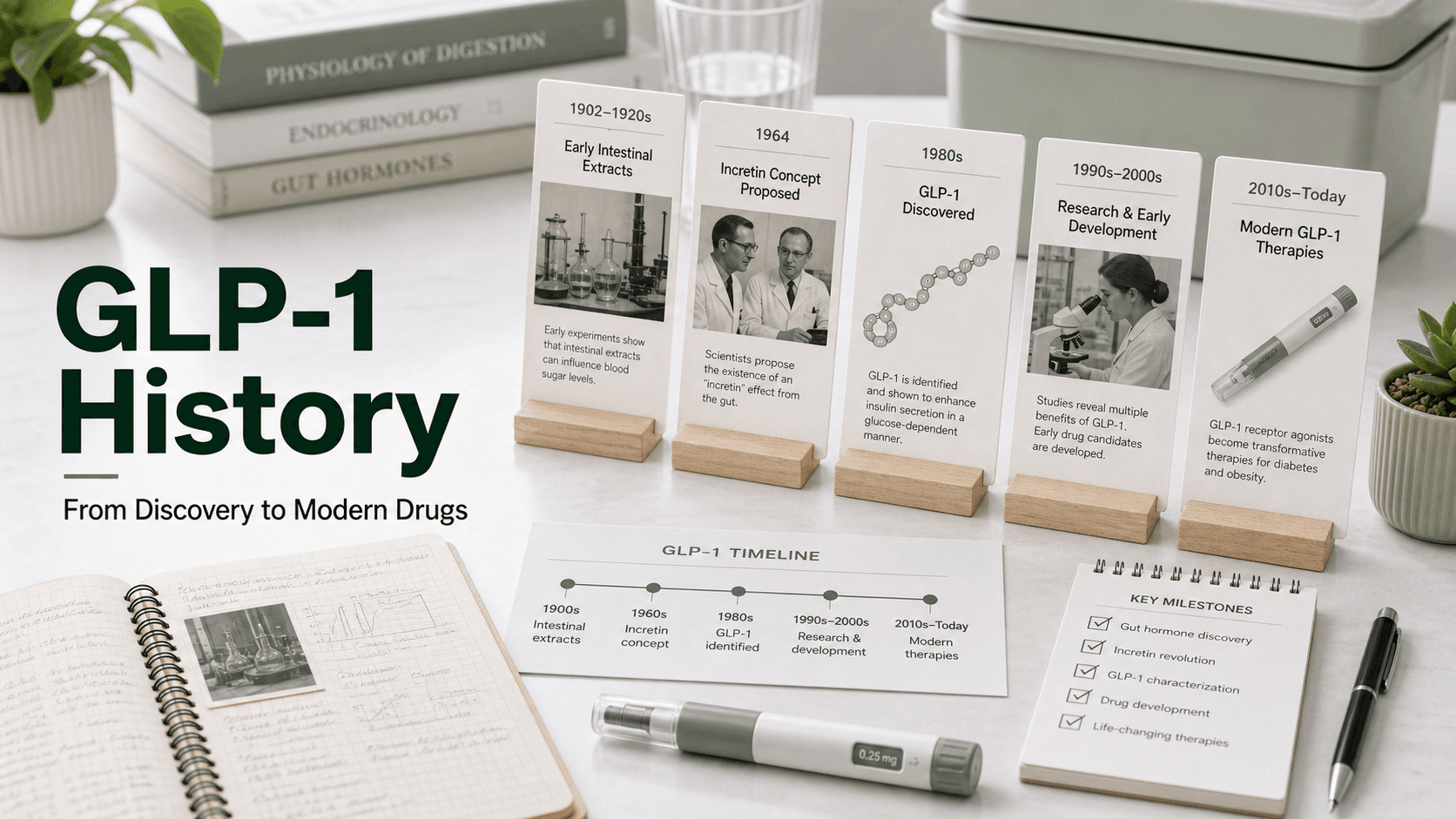
The simplest version of the question — "when did GLP-1 come out?" — actually has two answers, separated by almost two decades. GLP-1 the hormone was identified by molecular biologists in the mid-1980s. GLP-1 the drug class arrived in 2005, when the US Food and Drug Administration approved a synthetic copy of a peptide originally found in the venom of a desert lizard. Everything that came after — Victoza, Trulicity, Ozempic, Wegovy, Mounjaro, Zepbound, and the new oral pills launching in 2026 — sits on top of those two foundational discoveries.
Direct answer: GLP-1 was first isolated as a biologically active hormone in 1986 by groups led by Joel Habener (with Svetlana Mojsov) at Massachusetts General Hospital and Jens Juul Holst in Copenhagen. The first GLP-1 receptor agonist drug, exenatide (Byetta), was FDA-approved on April 28, 2005. The full timeline runs from secretin in 1902 (the discovery that founded gut endocrinology) through the incretin concept in 1932, GLP-1 isolation in 1986–87, the Gila monster venom peptide discovered by John Eng in the early 1990s, Byetta in 2005, Victoza in 2010, Trulicity in 2014, Ozempic in 2017, Rybelsus in 2019, Wegovy in 2021, Mounjaro in 2022, Zepbound in 2023, Zepbound for sleep apnea in 2024, semaglutide for chronic kidney disease in 2025, and oral orforglipron (Foundayo) in April 2026.
1902: Secretin and the Birth of Hormone Science
The story does not start with GLP-1. It starts with a different gut hormone — and arguably with the entire concept of hormones.
On January 16, 1902, two University College London physiologists, William Bayliss and Ernest Starling, ran the now-famous experiment in which they showed that acid arriving in the small intestine triggered a chemical messenger to travel through the blood and stimulate the pancreas. They named that messenger secretin. Three years later, in his 1905 Croonian Lecture, Starling coined the term hormone (from the Greek for "I arouse to activity") to describe this class of bloodborne signals.
That single experiment opened the door to every gut hormone discovery that followed — including the recognition, decades later, that the gut also releases factors that talk to the pancreas about glucose.
1932: The Incretin Concept
The idea that the gut sends an insulin-stimulating signal to the pancreas after meals had been floating around since the late 19th century. In 1932, Belgian physiologist Jean La Barre gave it a name — incrétine — a contraction of "intestinal secretion of insulin." For decades, this remained an idea in search of a molecule.
That changed in 1970, when the first true incretin, glucose-dependent insulinotropic polypeptide (GIP), was identified. GIP was clearly an incretin, but it was not enough on its own to explain the postprandial insulin response observed in healthy humans. There had to be at least one more.
1982–1983: Cloning Proglucagon
The molecular era began when Joel Habener's lab at Massachusetts General Hospital isolated cDNA encoding proglucagon — first from anglerfish pancreatic islets in 1982, then in mammals. Around the same time, Graeme Bell at the University of Chicago sequenced the mammalian proglucagon gene.
The surprise: proglucagon was not just the precursor to glucagon. The same gene also encoded two additional, previously unknown peptide sequences — which Bell named glucagon-like peptide 1 (GLP-1) and glucagon-like peptide 2 (GLP-2).
GLP-1 was a peptide sequence on paper. Nobody yet knew what, if anything, it actually did.
1986–1987: GLP-1 Is Isolated and Shown to Stimulate Insulin
The bioactive identity of GLP-1 was nailed down in 1986–87 by two groups working in parallel.
In Boston, Svetlana Mojsov, a chemist in Habener's department, used chemical synthesis and immunoassays to identify the truncated, biologically active form — GLP-1(7-37) — in the rat intestine. Working with Habener, Mojsov, and Gordon Weir at the Joslin Diabetes Center, the team showed in a 1987 Journal of Clinical Investigation paper that very small amounts of pure GLP-1(7-37) caused isolated rat pancreases to release insulin in a glucose-dependent way.
In Copenhagen, Jens Juul Holst independently demonstrated that proglucagon is processed differently in the gut than in the pancreas, releasing GLP-1 from intestinal L-cells. Holst's group went on to map out the physiological effects — insulin release, glucagon suppression, slowed gastric emptying, appetite suppression — that define the hormone today.
A third key figure, Daniel Drucker, then a postdoctoral fellow in Habener's lab and now at the University of Toronto, did the foundational receptor and cell-biology work that confirmed GLP-1 as a real hormone with therapeutic potential. Habener, Mojsov, and Lotte Bjerre Knudsen (the Novo Nordisk chemist behind liraglutide and semaglutide) shared the 2024 Lasker–DeBakey Clinical Medical Research Award for this collective body of work.
Early 1990s: A Lizard in the Bronx VA
There was one stubborn problem with native GLP-1 as a drug: it gets chewed up by the enzyme DPP-4 within about two minutes of release. To turn GLP-1 into medicine, someone needed a version that resisted that degradation.
Nobody set out to find one in lizard saliva.
In the early 1990s, Dr. John Eng, an endocrinologist at the Bronx VA Medical Center in New York, was studying venoms after reading older work suggesting some animal toxins caused pancreatic effects. He ordered dried venom of the Gila monster (Heloderma suspectum) — a slow, heavy desert lizard from the American Southwest known for eating only a few times a year while keeping stable blood sugar. Working with colleague Jean-Pierre Raufman, Eng isolated a 39-amino-acid peptide he named exendin-4.
Exendin-4 turned out to bind the human GLP-1 receptor — and crucially, it resisted DPP-4 cleavage, giving it a half-life of hours instead of minutes. Eng patented the discovery in his own name (the VA initially passed) and in October 1996 licensed it to a small biotech, Amylin Pharmaceuticals, which developed it into the drug exenatide.
2005: Byetta Is Approved — the First GLP-1 Drug
On April 28, 2005, the FDA approved exenatide (Byetta) — twice-daily subcutaneous injection — for type 2 diabetes. It was the first GLP-1 receptor agonist ever marketed anywhere in the world.
Byetta was a modest commercial success at first. Twice-daily injections were a hard sell, weight loss was meaningful but not dramatic, and nausea drove early dropout. But the proof of concept was overwhelming: a hormone-mimetic drug could lower A1c, reduce appetite, and produce gentle weight loss without causing hypoglycemia.
Every GLP-1 medication that followed was an attempt to take that mechanism and make it more potent, longer-acting, easier to dose, or available in a pill.
Byetta did not survive the era it started. At AstraZeneca's request, the FDA withdrew approval of the Byetta application — and of both extended-release exenatide products, Bydureon and Bydureon BCise — effective September 3, 2025, after the company told the agency the products were no longer marketed. That is a commercial exit under 21 CFR 314.150(c), not a safety withdrawal; pharmacies were allowed to dispense remaining inventory until it ran out or expired. The first GLP-1 drug is now history in the literal sense: 2005 to 2025, start to finish.
2010: Victoza — Once-Daily Liraglutide
In January 2010, the FDA approved liraglutide (Victoza), developed by Lotte Bjerre Knudsen and her team at Novo Nordisk. Liraglutide added a fatty acid chain to the GLP-1 peptide so it would reversibly bind albumin in the blood, dramatically extending its half-life and enabling once-daily dosing. It also produced more weight loss than Byetta, and pivotal trials would later (in 2016) show cardiovascular benefit in high-risk patients with type 2 diabetes.
A higher-dose version of liraglutide, Saxenda, was approved in December 2014 as the first GLP-1 specifically indicated for chronic weight management.
2012–2016: Weekly Dosing and Crowded Field
- January 2012: Bydureon (exenatide extended-release) — the first once-weekly GLP-1, microsphere formulation.
- April 2014: Tanzeum (albiglutide) — once-weekly; later voluntarily withdrawn from the market in 2018 for commercial reasons.
- September 2014: Trulicity (dulaglutide) by Eli Lilly — once-weekly, easy auto-injector. A major commercial success that proved patients would adopt weekly GLP-1s.
- July 2016: Adlyxin (lixisenatide) — daily; later discontinued in the US.
By the middle of the 2010s, the GLP-1 class was firmly established for type 2 diabetes, with a steady drumbeat of cardiovascular outcome trials showing protective effects beyond glucose lowering.
2017: Ozempic Arrives
On December 5, 2017, the FDA approved semaglutide (Ozempic) for type 2 diabetes — once-weekly subcutaneous, also developed by Novo Nordisk. Semaglutide's molecular design pushed the albumin-binding trick further, giving it a half-life around 7 days.
Ozempic produced larger A1c reductions and more weight loss than any prior GLP-1, and its convenience format — a familiar pen, weekly injection — combined with strong cardiovascular trial data (SUSTAIN-6) to make it the dominant prescription in the class within a few years.
2019: Rybelsus — the First Oral GLP-1
On September 20, 2019, the FDA approved Rybelsus, an oral tablet form of semaglutide co-formulated with the absorption enhancer SNAC. It was the first oral GLP-1 receptor agonist of any kind. Rybelsus was indicated for type 2 diabetes only, with strict dosing rules (empty stomach, small amount of water, wait 30 minutes), and modest weight effects compared with injectable semaglutide.
2021: Wegovy and the Obesity Pivot
On June 4, 2021, the FDA approved Wegovy — semaglutide at the higher dose of 2.4 mg weekly — for chronic weight management in adults with obesity or overweight with at least one weight-related comorbidity. The pivotal STEP-1 trial showed mean weight loss of about 15 percent over 68 weeks, a magnitude previously achievable only with bariatric surgery.
Wegovy is the launch point most patients associate with the modern "GLP-1 era." Demand outran supply for years. Compounding pharmacies entered the market. The cultural conversation around semaglutide as a weight-loss drug began here.
2022: Mounjaro and the Twincretin Era
On May 13, 2022, the FDA approved tirzepatide (Mounjaro) by Eli Lilly for type 2 diabetes — the first dual GIP/GLP-1 receptor agonist. By engaging both incretin receptors, tirzepatide produced larger A1c reductions and more weight loss than semaglutide head-to-head in the SURPASS-2 trial. It became the fastest-growing diabetes drug launch in US history.
2023: Zepbound — Tirzepatide for Obesity
On November 8, 2023, the FDA approved Zepbound, the same molecule as Mounjaro, marketed at obesity doses (5, 10, and 15 mg) for chronic weight management. SURMOUNT-1 showed mean weight loss of about 20.9 percent at the top dose over 72 weeks — the largest weight reduction ever recorded for a non-surgical therapy at the time.
2024–2025: New Indications, Beyond Diabetes and Obesity
The GLP-1 class kept widening the diseases it could legitimately treat:
- March 2024: Wegovy received an expanded indication to reduce major adverse cardiovascular events in adults with established cardiovascular disease and obesity, on the strength of the SELECT trial.
- December 20, 2024: Zepbound became the first medication ever approved for moderate-to-severe obstructive sleep apnea in adults with obesity, based on the SURMOUNT-OSA trial.
- January 28, 2025: Ozempic added a new indication to reduce the risk of worsening chronic kidney disease and cardiovascular death in adults with type 2 diabetes and CKD, based on the FLOW trial (24 percent relative risk reduction).
- 2025: Semaglutide development for MASH (metabolic dysfunction-associated steatohepatitis) advanced into late-stage liver-disease territory, with positive ESSENCE Phase 3 data.
- December 22, 2025: Wegovy pill (oral semaglutide 25 mg) was approved as the first oral GLP-1 for weight management, based on the OASIS-4 trial (mean weight loss ~16.6 percent).
2026: Foundayo and the Small-Molecule Future
On April 1, 2026, the FDA approved Foundayo (orforglipron) — Eli Lilly's once-daily oral pill — for chronic weight management. Unlike Rybelsus and oral Wegovy, which are peptide-based and require empty-stomach dosing, orforglipron is a non-peptide, small-molecule GLP-1 receptor agonist. It can be taken with or without food. It is the first GLP-1 medicine in history that does not require either an injection or specialized peptide-handling.
Foundayo signals a likely structural shift in the GLP-1 market: cheaper to manufacture at scale, easier to ship and store, and far easier for patients to use long-term.
What Is Next After 2026
Two late-stage programs dominate the near-term pipeline:
- Retatrutide (Eli Lilly): a triple agonist at the GLP-1, GIP, and glucagon receptors. Phase 2 data showed mean weight loss of about 24 percent at 48 weeks at the top dose. As of mid-2026 it remains in Phase 3 trials; FDA submission is expected in late 2026 with possible approval in 2027. It is sometimes nicknamed "GLP-3" in marketing, although no GLP-3 receptor exists in human biology.
- CagriSema (Novo Nordisk): a fixed-dose combination of semaglutide and cagrilintide, a long-acting amylin analog. FDA application was filed and a decision is expected in the second half of 2026, with a likely launch in 2027.
Further out, oral peptide GLP-1s, monthly injectables, and combination therapies pairing GLP-1 with myostatin inhibitors or fibroblast growth factor analogs are all in clinical development.
How Long Have GLP-1s Been Around?
The honest answer depends on which GLP-1 the question means, and the three answers are decades apart:
- The hormone: about 40 years. GLP-1 was shown to be a real, insulin-releasing hormone in 1986–87.
- The drug class: 21 years. The first GLP-1 receptor agonist, Byetta, was approved on April 28, 2005.
- The weight-loss phenomenon most people actually mean: 5 years. Wegovy was approved on June 4, 2021.
Individual medicines have far shorter track records than the class does. Approval dates below are the original FDA approval on record in Drugs@FDA, not the launch or marketing date:
| Drug (molecule) | FDA approval | Time on the US market as of 2026 |
|---|---|---|
| Byetta (exenatide) | April 28, 2005 | 20 years; approval withdrawn September 3, 2025 |
| Victoza (liraglutide) | January 25, 2010 | 16 years |
| Bydureon (exenatide extended-release) | January 27, 2012 | 13 years; approval withdrawn September 3, 2025 |
| Tanzeum (albiglutide) | April 15, 2014 | Discontinued |
| Trulicity (dulaglutide) | September 18, 2014 | 11 years |
| Saxenda (liraglutide 3 mg) | December 23, 2014 | 11 years |
| Ozempic (semaglutide) | December 5, 2017 | 8 years |
| Rybelsus (oral semaglutide) | September 20, 2019 | 6 years |
| Wegovy (semaglutide 2.4 mg) | June 4, 2021 | 5 years |
| Mounjaro (tirzepatide) | May 13, 2022 | 4 years |
| Zepbound (tirzepatide for obesity) | November 8, 2023 | 2 years |
| Foundayo (orforglipron) | April 1, 2026 | Under a year |
That spread matters when someone asks how much real-world experience sits behind a prescription. Exenatide accumulated roughly two decades of use before it left the market. Liraglutide has 16 years, semaglutide 8, tirzepatide 4 as Mounjaro. Orforglipron has months. Longer time on the market means more postmarketing reports and more outcome trials have accrued, not that a newer drug is unsafe — it means the newer ones are still being watched. Patient-side experience is a different lens, and we collect it in our roundup of GLP-1 reviews.
What People Get Wrong About GLP-1 History
- "GLP-1 came out with Ozempic in 2017." Ozempic is the most famous GLP-1, but the class began with Byetta in 2005 — 12 years earlier.
- "Novo Nordisk invented GLP-1." Novo Nordisk developed semaglutide and liraglutide and most of the obesity science, but the foundational hormone work was led by US academic labs (Habener, Mojsov, Drucker, Bell) and Holst's group in Denmark. The first GLP-1 drug, exenatide, was developed by Amylin Pharmaceuticals from John Eng's VA work.
- "GLP-1s were designed as weight-loss drugs." They were designed as diabetes drugs. The weight loss was a tolerability finding that turned into a therapeutic indication a decade later.
- "Tirzepatide is a GLP-1." It is a dual GIP/GLP-1 receptor agonist. It activates GLP-1, but it is technically a different class — a "twincretin."
- "Exenatide is Gila monster venom." Exenatide is a synthetic copy of exendin-4, one peptide isolated from Gila monster saliva. The drug contains no animal-derived material.
Frequently Asked Questions
When did GLP-1 come out as a drug? The first GLP-1 receptor agonist, exenatide (Byetta), was approved by the FDA on April 28, 2005.
Who discovered GLP-1? GLP-1 was identified in 1986 by two groups working in parallel: Joel Habener and Svetlana Mojsov at Massachusetts General Hospital, and Jens Juul Holst at the University of Copenhagen. The 1987 JCI paper from the Boston group first showed GLP-1(7-37) stimulated insulin release. Daniel Drucker contributed key receptor and cell biology work.
Where does the Gila monster fit in? Dr. John Eng at the Bronx VA isolated a peptide called exendin-4 from Gila monster (Heloderma suspectum) venom in the early 1990s. Exendin-4 binds the human GLP-1 receptor and resists DPP-4 cleavage. A synthetic version became exenatide (Byetta), the first GLP-1 drug, in 2005.
When did Ozempic come out? The FDA approved Ozempic (semaglutide) for type 2 diabetes on December 5, 2017.
When did Wegovy come out? The FDA approved Wegovy (semaglutide 2.4 mg) for chronic weight management on June 4, 2021. The oral Wegovy pill (semaglutide 25 mg) was approved on December 22, 2025.
When did Mounjaro and Zepbound come out? Mounjaro (tirzepatide) was approved for type 2 diabetes on May 13, 2022. Zepbound (the same molecule for obesity) was approved on November 8, 2023.
What is the newest GLP-1? Foundayo (orforglipron), approved on April 1, 2026, is the first non-peptide, small-molecule oral GLP-1 for weight management. Retatrutide and CagriSema are next in line.
How long have GLP-1s been around? Twenty-one years as a drug class: the first GLP-1 receptor agonist, Byetta, was approved on April 28, 2005. About 40 years as a hormone, since the 1986–87 work that showed GLP-1(7-37) releases insulin. Five years as the weight-loss phenomenon, dating from Wegovy's approval on June 4, 2021.
When did Byetta come out? The FDA approved Byetta (exenatide) on April 28, 2005, making it the first GLP-1 receptor agonist sold anywhere. It was a twice-daily injection for type 2 diabetes. It is no longer available in the US: the FDA withdrew approval of Byetta, Bydureon, and Bydureon BCise effective September 3, 2025, after AstraZeneca told the agency the products were no longer marketed and asked for the applications to be withdrawn. That was a business decision, not a safety action.
Is GLP-1 a hormone or a drug? Both. GLP-1 is a natural human hormone released by intestinal L-cells after meals. GLP-1 receptor agonists are synthetic drugs designed to mimic or extend its action.
Last reviewed: May 13, 2026
Sources
- The Origin and Understanding of the Incretin Concept — Frontiers in Endocrinology
- Ernest Starling and the discovery of secretin — PubMed
- Discovery, characterization, and clinical development of the glucagon-like peptides — PMC
- Joel Habener, Svetlana Mojsov, and Lotte Bjerre Knudsen awarded Lasker prize for pioneering work on GLP-1 — JCI
- Diabetes drug from Gila monster venom — VA Research
- Dr. John Eng to receive Golden Goose Award — EurekAlert
- History of GLP-1 Approvals in the U.S. — Alliance Clinical Network
- GLP-1 FDA Approvals Timeline (2005–2026) — The RX Index
- History of glucagon-like peptide-1 receptor agonists — ScienceDirect
- FDA Approves First Medication for Obstructive Sleep Apnea — FDA
- FDA approves Ozempic as the only GLP-1 RA to reduce risk of worsening kidney disease — Novo Nordisk
- FDA Approves Oral Semaglutide as First GLP-1 Pill for Weight Loss — AJMC
- Foundayo (orforglipron) FDA Approval History — Drugs.com
- What to know about retatrutide — Eli Lilly
- Drugs@FDA: Byetta (exenatide), NDA 021773 — FDA
- Withdrawal of Approval of 39 New Drug Applications (includes Byetta, Bydureon, Bydureon BCise) — Federal Register, August 4, 2025