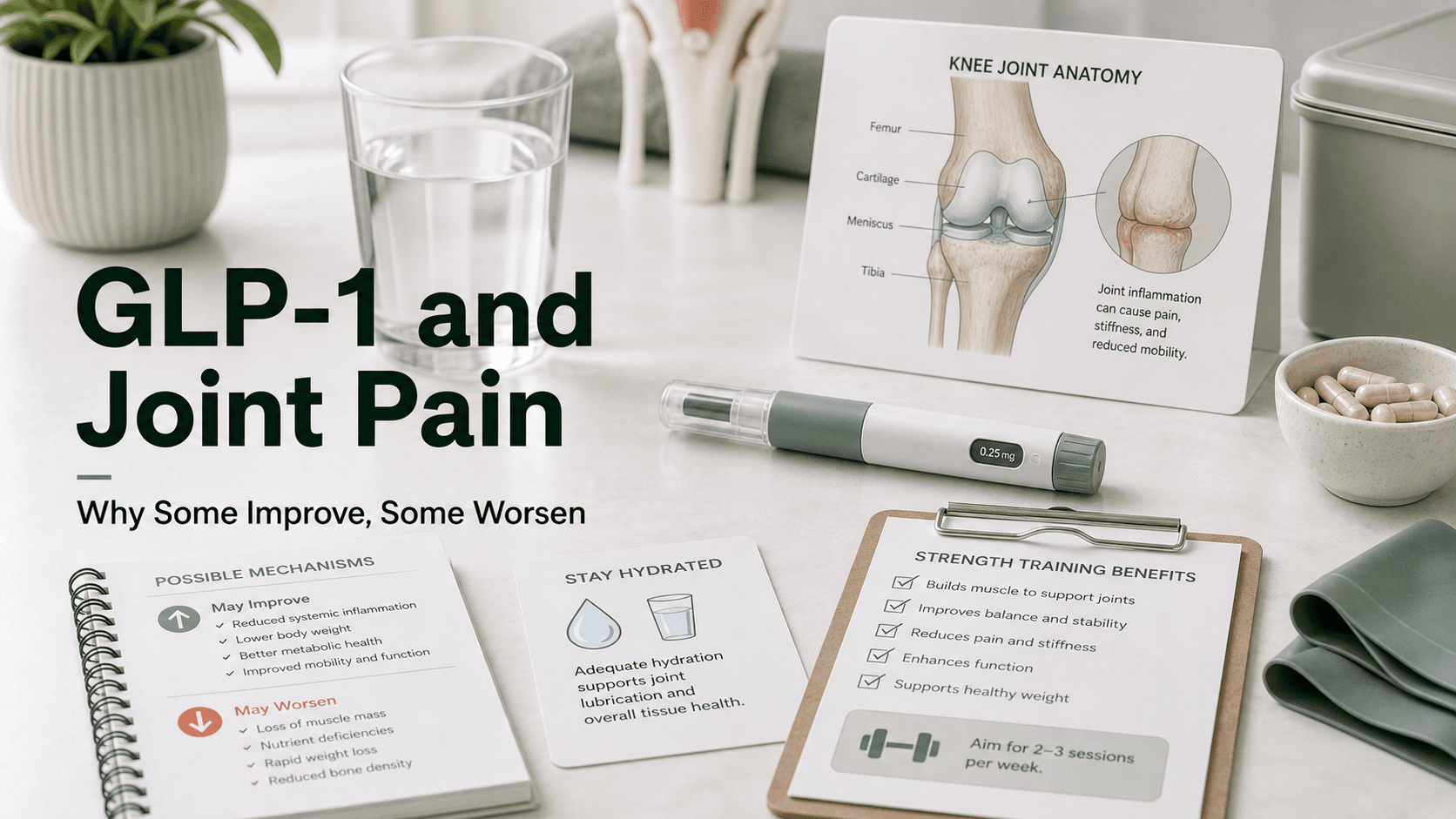
Joint pain on a GLP-1 is a two-way street. The headline trial — STEP-9, published in NEJM in October 2024 — showed semaglutide 2.4 mg cut knee osteoarthritis pain by roughly 42 points on a 100-point WOMAC scale over 68 weeks, versus 27.5 points on placebo. That is one of the largest pain reductions ever recorded in a pharmacologic OA trial. At the same time, a smaller subset of patients report new joint pain that wasn't there before they started the drug — usually traceable to muscle loss, dehydration, a gout flare, or post-loss biomechanics that haven't recalibrated yet. Both stories are real.
Direct answer: Joint pain on a GLP-1 is usually better, not worse. Every pound of body weight lost takes about 4 pounds of pressure off the knee during walking, so the average person with knee or hip pain feels meaningful relief by the time they hit 10–15 lb down. STEP-9 confirmed this and added a likely anti-inflammatory component beyond pure mechanics. A minority — roughly 4–5% of trial participants — report new arthralgia, almost always linked to rapid loss of lean mass (which can be 25–40% of total weight lost), dehydration, uric acid mobilization triggering gout, or under-eating. Management is the same set of levers regardless of direction: protein, resistance training, hydration, slow titration, and treating gout flares early.
What STEP-9 Actually Showed
STEP-9 was a 68-week, double-blind, placebo-controlled trial at 61 sites in 11 countries. The protocol enrolled 407 adults with obesity (mean BMI 40.3) and clinically and radiologically confirmed moderate knee osteoarthritis with at least moderate pain at baseline. They were randomized 2:1 to weekly semaglutide 2.4 mg or placebo, both arms receiving counseling on physical activity and a reduced-calorie diet.
The numbers at week 68:
| Outcome | Semaglutide 2.4 mg | Placebo |
|---|---|---|
| Body weight change | −13.7% | −3.2% |
| WOMAC pain (0–100 scale) | −41.7 points | −27.5 points |
| SF-36 physical function | +12.0 points | +6.5 points |
| 6-minute walk distance vs. placebo | +42 meters | — |
| Discontinuation for adverse events | 6.7% | 3.0% |
The 14-point between-group difference in WOMAC pain (P<0.001) is clinically substantial — comparable to or greater than the effect of intra-articular corticosteroid injection at the same time point. The placebo arm also improved meaningfully (the diet/activity counseling worked), but semaglutide doubled the effect.
The Mechanical Argument: Every Pound Counts Four Times
Orthopedic surgeons frequently quote a 4-to-1 multiplier: for every 1 lb of body weight lost, the knee joint experiences about 4 lb less compressive force during normal walking. The multiplier comes from gait biomechanics — the knee absorbs ground reaction force scaled by lever-arm geometry, so each pound at the center of mass translates to several pounds across the tibiofemoral and patellofemoral joints.
That means a 30-lb weight loss — typical at the maintenance dose of semaglutide 2.4 mg or tirzepatide 10–15 mg — removes roughly 120 lb of per-step knee load. Walk a few thousand steps a day and the cumulative offload is enormous. The hip experiences a similar (slightly smaller) multiplier; the spine and ankle benefit at roughly 2- to 3-to-1.
Older studies before GLP-1s, like the Framingham and IDEA trials, already showed that a 10% body weight reduction in obese knee OA patients produces around a 50% reduction in pain and disability. STEP-9 replicated and extended that finding using a drug — not surgery, not a diet program — to drive the loss.
The Anti-Inflammatory Argument
The STEP-9 effect appears larger than weight loss alone can explain. Investigators and editorialists have pointed to direct anti-inflammatory effects of GLP-1 receptor activation. Multiple lines of preclinical evidence support this:
- GLP-1 receptors have been identified by immunohistochemistry on human chondrocytes and synovial membrane.
- Activation downregulates NF-κB phosphorylation in chondrocytes, reducing IL-1β, IL-6, and TNF-α expression.
- It downregulates MMP-3, MMP-13, and ADAMTS-4/5 — the proteases that chew through type II collagen and aggrecan in OA cartilage.
- In rat models, liraglutide protected chondrocytes from IL-1β– and thapsigargin-induced apoptosis.
Human cartilage data is still limited, but the signal is consistent: GLP-1 agonism appears to be chondroprotective, not just weight-reducing. STEP-9 wasn't powered or designed to separate the two mechanisms, but the magnitude of pain reduction suggests both are at play.
Why a Minority Get New Joint Pain
In STEP trial pooled data, arthralgia occurred in roughly 4–5% of semaglutide-treated patients vs. 2–3% on placebo — a small but real excess. The pharmacology of semaglutide itself doesn't obviously explain new joint pain; the mechanisms are downstream of rapid weight loss and metabolic shifts.
1. Muscle Loss (the Big One)
GLP-1s shrink fat and lean mass together. Body composition studies show lean body mass can account for up to 40% of total weight lost on semaglutide and around 25% on tirzepatide. Lean mass includes muscle, but also water, connective tissue, and organ glycogen — so the muscle-specific loss is smaller than that 40% figure suggests. Still, in older adults, sedentary people, or anyone losing weight fast on a low-protein diet, the muscle loss is real and the muscles that stabilize the knee and hip — quads, glutes, calves — get thinner.
Less quadriceps mass means less anterior knee stability, more patellofemoral compression, and more anterior knee pain on stairs. Less glute strength means a Trendelenburg-style gait that loads the hip and lateral knee. The joint surfaces haven't changed — but the muscular brace around them has weakened.
2. Gout Flares from Urate Mobilization
Rapid weight loss mobilizes purines from adipose tissue and transiently raises serum uric acid. In people with a history of gout or asymptomatic hyperuricemia, this can trigger a flare — most commonly in the great toe, but also in the knee, ankle, or wrist. Risk is highest in the first 3–6 months of treatment, when weight loss velocity peaks.
3. Dehydration
GLP-1s blunt thirst signaling and slow gastric emptying. Nausea, vomiting, or diarrhea during dose escalation makes it worse. Dehydration concentrates synovial fluid, reduces cartilage glycosaminoglycan hydration, and is a well-known driver of cramping and aching joints.
4. New or Resumed Activity
People who were sedentary for years often start walking, hiking, or going to the gym once they lose 20–30 lb and feel better. That's good — but underconditioned tendons and ligaments respond with patellar tendinopathy, Achilles tendinopathy, plantar fasciitis, and trochanteric bursitis when load ramps faster than tissue tolerance. This is "good problem" joint pain.
5. Under-Eating and Micronutrient Gaps
At 1,000–1,300 kcal/day — common on a GLP-1 — it is easy to miss magnesium, potassium, vitamin D, and omega-3 intake. All four are linked to musculoskeletal comfort. Low magnesium specifically presents as diffuse muscle and joint achiness.
Management: Both Directions
The same playbook helps people who are already improving and people who are getting worse.
Protein, Higher Than You Think
Target 1.2–1.6 g/kg of body weight per day (0.55–0.73 g/lb). For a 200-lb person, that's 110–145 g/day. This is the single biggest lever for preserving the muscle that protects joints. Whole-food sources beat shakes when appetite allows.
Resistance Training 2–3× Weekly
Non-negotiable. Even 20–30 minutes of compound movements (squat, hinge, push, pull, carry) preserves muscle and strengthens the muscular brace around hips and knees. One observational dataset of tirzepatide users found 40% less joint discomfort in consistent strength trainers vs. sedentary peers.
Slow the Rate of Loss If Symptoms Appear
If joint pain shows up at month 2–3 alongside fast weight loss, slow down. Stay at the current dose instead of escalating. Aim for 1–1.5 lb per week rather than 3.
Hydrate
Half your body weight in pounds, in ounces of fluid daily. Electrolytes (sodium, potassium, magnesium) matter, especially in the first months.
Treat Gout Flares Early
If joint pain is sudden, hot, red, and asymmetric — especially in a single joint — check serum uric acid and consider colchicine, an NSAID, or a short prednisone course with your prescriber. Long-term urate-lowering therapy (allopurinol) is reasonable if hyperuricemia persists.
Topical NSAIDs Beat Oral Ones During GLP-1
Oral NSAIDs irritate a stomach that is already slow-emptying and prone to nausea. Topical diclofenac (Voltaren gel) gives 70–80% of the relief at the joint with a fraction of the GI risk.
When to Call a Clinician
- Joint swelling, redness, warmth, or fever in a single joint
- Morning stiffness lasting more than 30 minutes (suggests inflammatory arthritis, not OA)
- Pain that worsens despite slower titration and protein/resistance work
- Sudden severe pain with inability to bear weight
- Numbness, tingling, or weakness alongside joint pain
A case report from 2013 described GLP-1-induced polyarthritis in a patient on liraglutide that resolved within a week of stopping the drug — exceedingly rare, but documented. Persistent inflammatory joint symptoms deserve workup, not dismissal.
What People Get Wrong
- "GLP-1 causes joint pain." For the average patient, it does the opposite. STEP-9 is the definitive trial-level evidence.
- "If my joints hurt I should stop the drug." Almost always wrong. The first move is more protein, more resistance training, hydration, and a slower titration — not discontinuation.
- "Muscle loss is unavoidable on a GLP-1." It isn't. Studies that emphasize adequate protein and resistance training show lean mass preservation similar to non-pharmacologic weight loss.
- "Knee pain that gets better with weight loss will come back if I stop the drug." True only if weight comes back. Maintenance dosing preserves the joint benefit.
- "Tirzepatide is harder on joints than semaglutide." No mechanistic reason to expect this. Tirzepatide produces faster weight loss, which can outpace muscle adaptation if protein/training are low.
Frequently Asked Questions
Does Ozempic cause knee pain? Usually the opposite. STEP-9 (NEJM, 2024) showed semaglutide 2.4 mg cut WOMAC knee pain by 41.7 points vs. 27.5 on placebo over 68 weeks. A minority (~4–5%) develop new arthralgia, typically from muscle loss or gout.
How fast does knee pain improve on a GLP-1? Most people notice less pain by the time they've lost 10–15 lb, often weeks 8–12 on semaglutide or tirzepatide. The full effect builds out to 6–9 months as weight stabilizes.
Why do my joints hurt more on Wegovy than before? Most likely muscle loss, dehydration, gout from urate mobilization, or new-activity overuse. Add protein (1.2–1.6 g/kg/day), strength train 2–3× weekly, hydrate, and consider checking serum uric acid.
Will my joint pain come back if I stop the GLP-1? Only if your weight comes back. The mechanical benefit is tied to body weight, not the drug. A maintenance dose holds the weight — and the joint benefit — in place.
Is the STEP-9 effect just weight loss? Mostly, but not entirely. The pain reduction in STEP-9 was larger than weight loss alone typically produces, and preclinical data show direct anti-inflammatory and chondroprotective effects of GLP-1 receptor activation in cartilage.
Should I take ibuprofen for joint pain on a GLP-1? Topical NSAIDs (diclofenac gel) are preferred. Oral NSAIDs work but stress a stomach already slowed by the drug — GI side effects and ulcer risk are higher.
What about tirzepatide for joint pain? No published phase 3 trial yet matches STEP-9 for tirzepatide, but the SURMOUNT data show comparable or greater weight loss, so the mechanical benefit should be at least as large. A dedicated OA trial is anticipated.
Last reviewed: May 13, 2026
Sources
- Once-Weekly Semaglutide in Persons with Obesity and Knee Osteoarthritis — NEJM (STEP-9)
- Semaglutide in persons with obesity and knee osteoarthritis — PubMed abstract
- STEP-9 results press release — PR Newswire / Novo Nordisk
- New study suggests weight loss drugs like Ozempic could help with knee pain — University of Sydney
- Ozempic, Wegovy May Help Reduce Knee Pain — Healthline
- Ozempic for Joint Pain: Benefits, Risks, and Orthopedic Considerations — Rothman Orthopaedics
- Targeting the GLP-1/GLP-1R axis to treat osteoarthritis — PMC
- The Effects of GLP-1 Agonists on Musculoskeletal Health — PMC
- GLP-1 Side Effects: Joint Pain Causes and Management — Bolt Pharmacy
- Managing Joint Pain During GLP-1 Weight Loss — Klarity Health