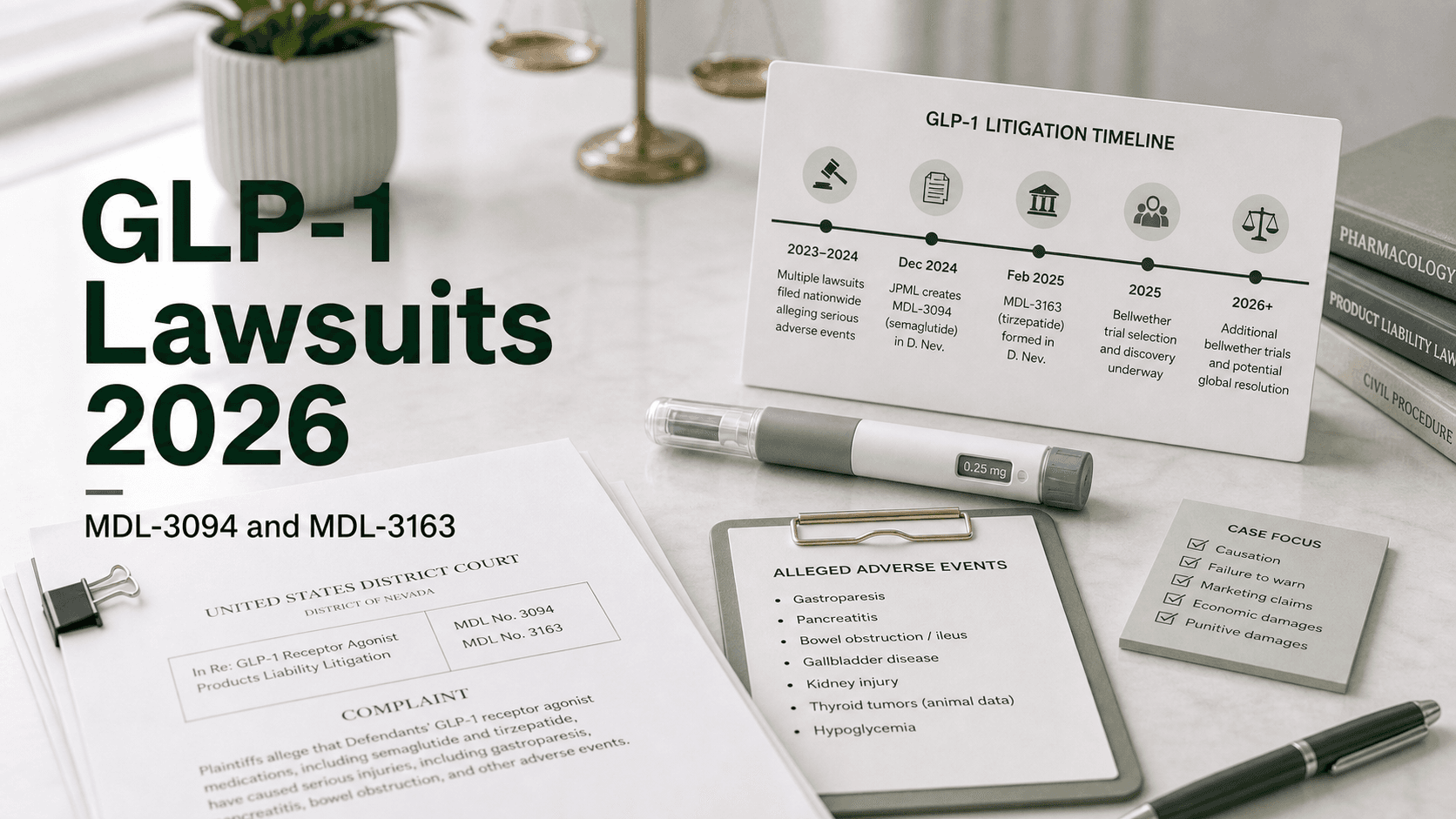
GLP-1 medications generated over $50 billion in 2025 sales — and a parallel wave of product liability lawsuits. As of May 2026, more than 3,600 cases are pending across two federal multidistrict litigations, both consolidated in the Eastern District of Pennsylvania before Judge Karen Spencer Marston. Aggregate liability has been speculated at $2 billion or more. No global settlement has been announced. This is an educational overview; nothing here is legal advice.
Direct answer: Two MDLs are active in 2026: MDL-3094 for gastroparesis and other GI injuries (~3,546 cases as of April 16, 2026, growing by ~200 cases/month) and MDL-3163 for non-arteritic anterior ischemic optic neuropathy and vision loss (~73 cases as of April 2026). Both are before Judge Karen Spencer Marston in the Eastern District of Pennsylvania. Plaintiffs allege failure to warn, design defect, negligence, and breach of warranty. Speculative individual payout ranges: $50,000–$500,000 for gastroparesis claims, $500,000–$1 million+ for NAION. Aggregate liability projections range up to $2 billion. No settlements have been announced; bellwether trials are expected to begin shaping resolution timelines over the next 12–24 months.
The Two Federal MDLs
MDL-3094 — Gastroparesis and GI Injuries
- Caption: In re: Glucagon-Like Peptide-1 Receptor Agonists (GLP-1 RAs) Products Liability Litigation
- Court: US District Court, Eastern District of Pennsylvania
- Judge: Karen Spencer Marston
- Created: February 2024
- Pending cases (April 2026): ~3,546, growing ~200/month
- Recent growth: 486 new plaintiffs joined in Aug–Sept 2025 alone
Primary claims:
- Gastroparesis (chronic, disabling delayed gastric emptying)
- Ileus (impaired bowel function)
- Intestinal obstruction / pseudo-obstruction
- Pancreatitis
- Gallbladder disease
- Acute kidney injury
- Wernicke's encephalopathy (added to claims as evidence emerged)
- Pulmonary aspiration during surgery
- Malnutrition requiring hospitalization
- A growing number of wrongful death cases
Defendants include Novo Nordisk (Ozempic, Wegovy, Rybelsus, Saxenda, Victoza) and Eli Lilly (Mounjaro, Zepbound, Trulicity).
MDL-3163 — NAION Vision Loss
- Caption: In re: Glucagon-Like Peptide-1 Receptor Agonists (GLP-1 RAs) Non-Arteritic Anterior Ischemic Optic Neuropathy Products Liability Litigation
- Court: Same — EDPA, Judge Marston
- Created: December 19, 2025
- Pending cases (April 2026): ~73 (grew to ~86 by May 2026)
- First status conference: January 2026
Newer and smaller. Primary claim: NAION, a rare condition causing sudden, painless, usually permanent vision loss in one eye. The 2024 JAMA Ophthalmology paper from Harvard / Mass Eye and Ear — showing semaglutide users had a "fourfold greater risk" for NAION — is the central piece of evidence.
The MDL specifically targets semaglutide products (Ozempic, Wegovy, Rybelsus). Tirzepatide has not shown the same NAION signal in available data and is not the primary defendant in this MDL.
Litigation Timeline
| Date | Event |
|---|---|
| August 2023 | First gastroparesis lawsuit filed |
| September 2023 | FDA added ileus warnings to GLP-1 labels |
| February 2024 | MDL-3094 created and centralized in EDPA |
| June 2024 | Judge Marston assigned |
| July 2024 | First JAMA Ophthalmology NAION study published |
| November 2024 | Master complaint filed in MDL-3094 |
| June 2025 | WHO pharmacovigilance warning re: semaglutide and NAION |
| August 2025 | Judge denied most dismissal motions; key claims proceed |
| December 19, 2025 | MDL-3163 created for NAION cases |
| January 2026 | First status conference for NAION cases; case management order in MDL-3094 |
| April 16, 2026 | 3,546 cases in MDL-3094; 73 cases in MDL-3163 |
| Mid-2026 | Bellwether trial selection expected |
| 2027+ | First bellwether jury trials likely |
There are also two Multicounty Litigations (MCLs) pending in New Jersey state court running parallel to the federal MDLs.
What "Bellwether" Means
Bellwether trials are a small group of representative cases that go to trial first, giving both sides a read on jury responses, damages, and the strength of evidence. The results inform whether the broader MDL settles or proceeds case by case.
For Ozempic-style mass torts:
- A verdict favoring plaintiffs often triggers global settlement talks
- A verdict favoring defendants can collapse the MDL or significantly reduce filings
- Mixed results extend litigation for years
Speculative Settlement Estimates
These are estimates by litigation analysts, not announced settlements. No GLP-1 lawsuit has reached settlement as of May 2026.
| Claim type | Speculative individual payout range |
|---|---|
| Mild gastroparesis, resolved | $50,000–$150,000 |
| Severe gastroparesis | $250,000–$500,000+ |
| NAION (single-eye blindness) | $500,000–$1,000,000+ |
| Bilateral NAION / bilateral blindness | Significantly higher |
| Wrongful death | Variable, often $1M+ |
Aggregate liability projection: $2 billion+ across all current cases.
Who Typically Qualifies to File
Eligibility varies by firm and case type, but common features:
Gastroparesis MDL (MDL-3094):
- Prescribed and took a GLP-1 (Ozempic, Wegovy, Mounjaro, Zepbound, Trulicity, Saxenda, Rybelsus, Victoza, Bydureon, Byetta)
- Diagnosis of gastroparesis (typically requires gastric emptying study, breath test, or wireless motility capsule), bowel obstruction, ileus, pancreatitis, or related GI injury
- Severe vomiting lasting 4+ weeks for stomach claims
- No prior gastric surgery that would explain symptoms
- Treatment after starting the GLP-1
- Within statute of limitations (varies by state, typically 2–4 years from discovery)
NAION MDL (MDL-3163):
- Prescribed a semaglutide product (Ozempic, Wegovy, Rybelsus)
- Diagnosis of NAION confirmed by an ophthalmologist
- Vision loss after starting the medication
- Within statute of limitations
What Plaintiffs Allege
The core legal theories:
- Failure to warn — the manufacturer knew or should have known about the risk and did not adequately warn patients and prescribers
- Design defect — the drug as designed posed unreasonable risk
- Negligence — failure to exercise reasonable care in marketing and testing
- Negligent marketing — promotional materials downplayed or omitted risk
- Breach of warranty — express or implied safety claims were broken
- Fraud and consumer protection violations — alleging misrepresentation
The master complaint (November 2024) alleges defendants "downplayed known gastrointestinal risks." In August 2025, Judge Marston largely denied dismissal motions, allowing the key claims to proceed.
What the Manufacturers Say
Novo Nordisk and Eli Lilly uniformly maintain:
- GLP-1 labeling already covers the relevant risks
- Many of the alleged injuries occur at similar rates in obese and diabetic populations regardless of treatment
- Correlation in observational data does not establish causation
- Patients knew or should have known about side effects from prescribing information
Absolute vs Relative Risk Context
For context on the magnitudes being litigated:
| Injury | Reported relative risk on GLP-1 | Approximate absolute increase |
|---|---|---|
| Gastroparesis | ~3–4× vs comparators | ~1–2 additional cases per 1,000 patient-years |
| NAION (semaglutide) | ~4–7× in JAMA cohort; not significant in TriNetX cohort | ~10–60 per 100,000 patient-years |
| Pancreatitis | ~1.5–2× | Small absolute increase |
| Gallbladder disease | ~1.5–2× | Small absolute increase |
The relative numbers sound alarming. The absolute numbers are real but smaller than the relative multiples suggest.
What This Means For Patients
If you are currently on a GLP-1 and considering action:
- Talk to a doctor first. Do not stop a GLP-1 abruptly because of a lawsuit ad on TV — sudden discontinuation has its own risks.
- Document injuries with a clinician. Symptoms without a formal diagnosis usually do not qualify.
- Be cautious of mass-tort marketing. Many lead-generation firms collect names and sell them to law firms; not all of those firms have litigation experience.
- Statutes of limitations vary by state — typically 2–4 years from discovery of injury.
- Most plaintiffs sign contingency agreements where the firm is paid only if money is recovered.
- No legal advice here. Consult a licensed attorney in your state.
What People Get Wrong
- "There is already a settlement." As of May 2026, no global settlements have been announced.
- "All GLP-1s are in the same MDL." Two separate MDLs — one for GI injuries, one for NAION — and they cover slightly different defendant lists.
- "You can sue just for side effects." Common side effects do not generally qualify. The litigation focuses on serious, documented diagnoses.
- "The lawsuit proves the drug is dangerous." Lawsuits are allegations, not verdicts. Causation is still being litigated.
Frequently Asked Questions
How many Ozempic lawsuits are there? About 3,546 cases in MDL-3094 (gastroparesis and GI injuries) and 73–86 in MDL-3163 (NAION vision loss) as of April–May 2026.
Where is the GLP-1 MDL? US District Court, Eastern District of Pennsylvania, before Judge Karen Spencer Marston.
Has there been a settlement? No global settlement has been announced. Bellwether trials are expected to shape resolution timelines over 2026–2027.
Can I sue if I took Mounjaro or Zepbound, not Ozempic? Eli Lilly is named in MDL-3094 for tirzepatide products. The NAION MDL focuses on semaglutide.
What injuries qualify for a GLP-1 lawsuit? Gastroparesis (with diagnostic test), bowel obstruction, ileus, pancreatitis, gallbladder disease, kidney damage, NAION blindness, Wernicke's encephalopathy, pulmonary aspiration during surgery, and severe malnutrition.
Do I need a lawyer to file? Practically yes — mass-tort product-liability cases are complex. Most plaintiffs retain a firm with MDL experience on contingency.
How much could a GLP-1 lawsuit be worth? Speculative ranges: $50,000–$500,000 for gastroparesis cases, $500,000–$1 million+ for NAION. None of these are confirmed; no settlements have been finalized.
Last reviewed: May 13, 2026
Sources
- Ozempic Lawsuit May 2026 Update — Drugwatch
- Ozempic NAION & Gastroparesis Lawsuit — Lawsuit Information Center
- Ozempic GLP-1 Lawsuit & Gastroparesis — Seeger Weiss
- Current GLP-1 Litigation Status 2026 — Defective Drug Site
- Ozempic Lawsuit 2026 MDL Updates — Spencer Law
References
- Risk of Nonarteritic Anterior Ischemic Optic Neuropathy in Patients Prescribed Semaglutide — JAMA Ophthalmology (PubMed)
- OZEMPIC (semaglutide) prescribing information, ileus warning added 2023 — FDA
- Popular prescription weight loss drugs linked to uncommon blinding condition (NAION) — Mass General Brigham / Mass Eye and Ear