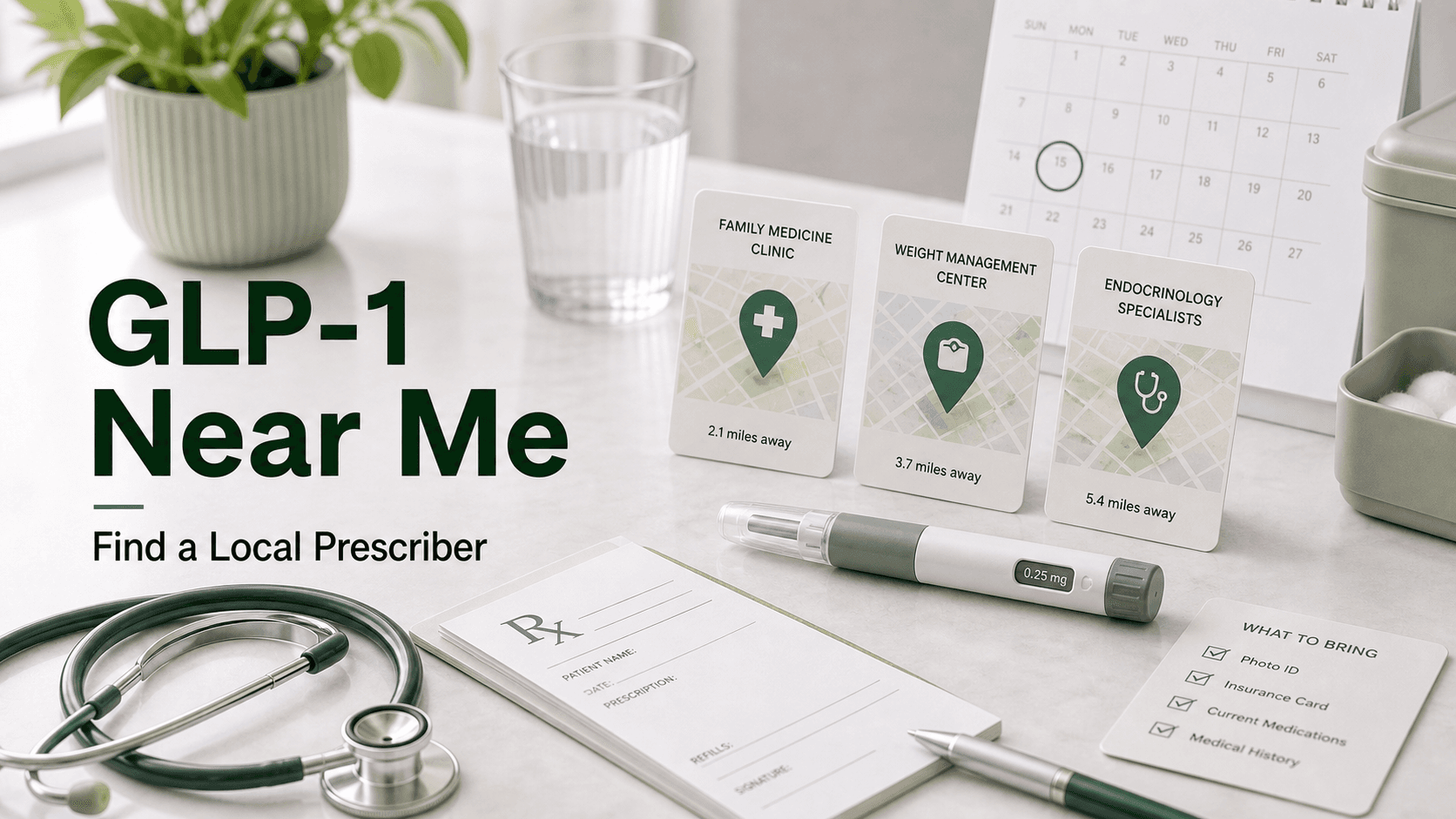
Most people typing "GLP-1 near me" into Google are not looking for a telehealth signup page. They want a real human, in their zip code, who can write a prescription, run baseline labs, and stay involved long enough to make the medication actually work. That option exists — and it is usually cheaper, safer, and better-integrated with insurance than the telehealth alternatives — but you have to know which door to knock on.
Many people also search for a GLP-1 diet program near me to pair with treatment.
Direct answer: In 2026 there are four practical local paths to a GLP-1 prescription. (1) Your primary care doctor is the cheapest if you have insurance, since the visit is billed normally and a prior authorization for Wegovy or Zepbound can drop your monthly cost to a Tier-4 copay (often $25–$300). (2) Obesity medicine clinics like Medi-Weightloss (136 US locations) charge a program fee on top of medication but deliver weekly visits, body-composition tracking, and dietitian support. (3) Retail clinics are the fastest option: a CVS MinuteClinic visit is $69 initial / $59 follow-up cash, with no membership; Walgreens Weight Management runs $49 per visit via video. (4) Med spas are the most variable — some are excellent, many are not, and only Ohio currently licenses them. To search by zip code for board-certified obesity specialists, use the Obesity Medicine Association directory and filter for ABOM Diplomates (60+ hours of obesity-specific training).
The Four Local Options at a Glance
| Provider type | Typical visit cost | What's included | Best for |
|---|---|---|---|
| Primary care doctor (PCP) | $0–$50 with insurance; $150–$300 self-pay | Labs, prior auth, refills, continuity of care | Insurance-covered patients, complex medical history |
| Obesity medicine clinic | $200–$500/month program fee + medication | Weekly visits, dietitian, body comp, side-effect management | Patients wanting specialist focus and structure |
| Retail clinic (MinuteClinic, Walgreens) | $49–$69 per visit | Eligibility check, prescription, simple follow-up | Healthy adults who want fast, low-friction access |
| Med spa | Highly variable; often $250–$500/month all-in | Usually compounded sema/tirz, sometimes a nurse visit | Limited — only with a licensed prescriber and named pharmacy |
Option 1: Your Primary Care Doctor
This is the option most people skip and most often regret skipping. Any licensed clinician can prescribe Wegovy, Zepbound, oral Wegovy, or Saxenda — including primary care physicians, nurse practitioners, and physician assistants. There is no special license required.
Why it's usually the right starting point:
- Insurance billing is native. A standard office visit runs through your plan; you pay only your copay or deductible amount.
- Prior authorizations are easier. Insurers approve PA requests from established physicians faster than from telehealth platforms they have not credentialed.
- Continuity of care. Your PCP already knows your A1C, kidney function, thyroid history, medications, and pregnancy plans — all directly relevant to GLP-1 safety.
- No membership fee. Telehealth services typically add $99–$149/month on top of the medication.
The honest caveat: A 2024–2025 physician survey cited by HealthCentral found that 64% of primary care doctors said they prescribed GLP-1s, but only 25% could correctly state the BMI eligibility criteria, and half cited time and training as obstacles. Translation: ask your PCP directly whether they manage GLP-1s routinely. If they hesitate, ask for a referral to an obesity medicine colleague or endocrinologist.
Yale Medicine's Dr. Avlin Imaeda summarized the trade-off cleanly: "We can offer support around diet, exercise, and side-effect management that primary care may not always have time to address."
Option 2: Dedicated Weight-Loss and Obesity Medicine Clinics
These are clinics whose entire practice is medical weight loss. The largest national network is Medi-Weightloss with 136 US locations; many regional groups exist (Scottsdale Weight Loss Center, Nuviva in Florida, Be Your Kind in Minnesota, etc.). Some hospital systems — Ohio State Wexner Medical Center, Yale, Mayo — also run multidisciplinary weight management programs.
What you typically get:
- An initial 60–90 minute evaluation with labs (A1C, lipid panel, kidney function, liver enzymes, thyroid)
- Weekly or biweekly in-person visits during titration
- Body composition measurement (InBody or DEXA)
- A dedicated dietitian or nutrition coach
- Side-effect troubleshooting in real time
- Access to both branded (Wegovy, Zepbound, Saxenda) and, where state law allows, named-pharmacy compounded options
The trade-off is price. Most clinics charge a program fee outside of insurance — commonly $200–$500/month — plus the medication cost. The pitch is that face-to-face accountability produces better outcomes; Medi-Weightloss reports an average loss of 29 pounds in 13 weeks for its patient population.
How to find one in your zip code: the Obesity Medicine Association maintains a searchable directory at obesitymedicine.org/about/find-a-provider/. Filter for two credentials when available:
- ABOM Diplomate — physician who completed at least 60 hours of obesity-specific education and passed the American Board of Obesity Medicine exam
- Fellow of OMA (FOMA) — physician, NP, or PA with at least 75 hours of advanced obesity-medicine training
The Obesity Action Coalition's parallel directory also lists dietitians and bariatric surgeons.
Option 3: Retail Pharmacy Clinics
The fastest local option. Both CVS MinuteClinic and Walgreens Weight Management now run formal weight-management programs that can prescribe FDA-approved GLP-1s. They are not designed for complex medical cases — but for a healthy adult with a qualifying BMI, the cost and convenience are hard to beat.
CVS MinuteClinic
| Detail | What it is |
|---|---|
| Initial visit (self-pay) | $69 |
| Follow-up coaching visit (self-pay) | $59 |
| Membership / subscription fee | None |
| Medications offered | Wegovy and Zepbound (FDA-approved only; no compounded) |
| Insurance | Accepted by most major plans; FSA/HSA eligible |
| Availability | Nationwide, except GLP-1 prescribing is excluded in Massachusetts and Missouri |
| Format | Walk-in or virtual |
Visits review medical history, diet, activity, and behavioral factors; prescriptions fill at CVS Pharmacy, LillyDirect, or your pharmacy of choice. Dr. David Fairchild, CMO of CVS Retail Health, framed the program around continuity: "Ongoing support from providers to create and follow a healthier lifestyle is an important part of MinuteClinic's weight-loss program."
Independent reviews note the program is medically credible but slow — labs are provider-discretionary, and insurance navigation can take weeks.
Walgreens Weight Management
| Detail | What it is |
|---|---|
| Visit cost | $49 flat per visit |
| Subscription | None |
| Format | Video visit only (not in-person) |
| Medications offered | Wegovy injection and oral Wegovy via Novo Nordisk self-pay program |
| Self-pay medication cost | Oral Wegovy from $149/month; Wegovy injection intro $199 for first two fills, then $349/month |
| Eligibility | Self-pay adults ages 18–64 |
| Support hours | Chat/video follow-up 7 a.m.–11 p.m. CT, seven days a week |
| Availability | Currently 28 states (as of early 2026) |
Walgreens launched the program in February 2026 explicitly for self-pay patients — the company cited that fewer than 1 in 4 employers cover GLP-1s for obesity. The pay-per-visit model avoids the $149/month membership wall that Hims and Ro now charge.
Option 4: Med Spas — Proceed Carefully
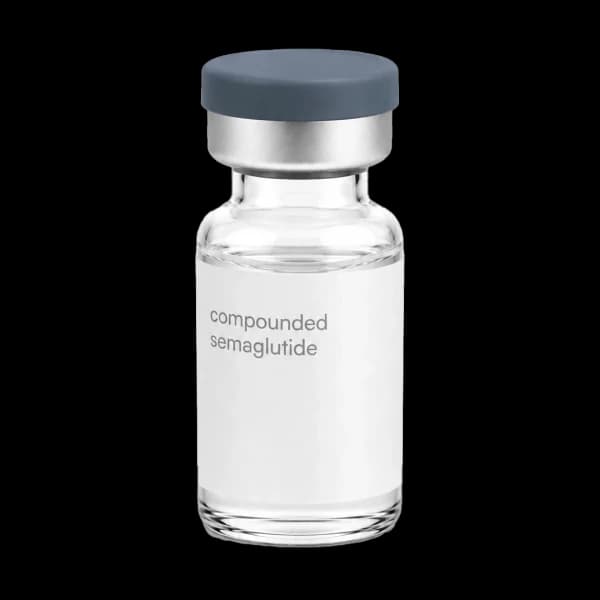
Med spas are by far the most variable category. Some are run by board-certified physicians with named compounding-pharmacy partnerships and proper baseline labs. Others are aesthetic businesses that added "semaglutide" to a pricing menu because the margins are good. The U.S. regulatory floor for med spas is alarmingly low: Ohio is the only state that requires med spas to be licensed by a state pharmacy board. Everywhere else, oversight is minimal.
Real safety data. The Partnership for Safe Medicine and Safe.Pharmacy have catalogued 455+ adverse-event reports tied to compounded semaglutide and 320+ tied to compounded tirzepatide, plus widespread issues with multidose dosing errors and counterfeit supply. Some compounded products have been found to contain semaglutide sodium or semaglutide acetate — salt forms that are not the same active ingredient as the FDA-approved drug.
The 2026 legal reality. The FDA has formally ended the semaglutide and tirzepatide shortages. Small 503A compounding pharmacies must stop producing GLP-1s; larger 503B outsourcing facilities have wind-down deadlines. Novo Nordisk has stated publicly that it does not supply weight-loss clinics or med spas with Wegovy. If a med spa is dispensing branded Wegovy, ask hard questions.
How to vet a med spa in 10 minutes
Ask, before booking:
- Who is the prescribing clinician, and what is their state license number? A medical director who is rarely on-site is a red flag.
- What compounding pharmacy do you use, and are they NABP-accredited? Use the NABP Safe Site search tool to verify.
- Do you order baseline labs (A1C, kidney/liver, lipid panel, TSH)? Standard of care says yes.
- What is your protocol for nausea, dehydration, or severe side effects after hours? "Call 911" is not a protocol.
- What is your refund policy if I stop tolerating the medication?
- Do you require a follow-up visit before each dose escalation?
- Are you billing insurance, or is this strictly cash? Cash-only with no superbill option is a downstream tax-deductibility loss.
Hard red flags — walk out:
- No licensed prescriber listed by name
- No mention of which pharmacy compounds the drug
- "Research-use only" labels or vials marked "not for human use"
- Group injection events or party pricing
- Prices that look much lower than every other clinic in your area
- Pressure to buy multi-month packages up front
What to Ask on Your First Visit (Any Provider)
Whether you sit down with a PCP, an obesity specialist, or a MinuteClinic provider, the conversation should cover:
- Your BMI and whether you meet the 30, or 27 with a comorbidity threshold for GLP-1s
- Personal or family history of medullary thyroid carcinoma, MEN2, pancreatitis, severe GI disease, gallbladder issues, or pregnancy/breastfeeding plans
- Baseline A1C, kidney function (eGFR), liver enzymes, lipid panel, TSH — and a plan to recheck
- Current medications, especially insulin, sulfonylureas, or oral contraceptives (GLP-1s can affect absorption)
- Whether your provider will submit a prior authorization to your insurance, and the expected turnaround
- A dose-escalation schedule — Yale's Dr. Imaeda notes the fastest reasonable cadence is one dose step per month
- A plan for what happens when you stop. Dr. John Morton at Yale frames it bluntly: "It might take a year to lose the weight, but only four months to gain it back."
The Insurance Reality in 2026
The biggest cost lever in finding a local GLP-1 provider is whether your visit and medication actually go through insurance.
- Commercial insurance: Wegovy is on most major formularies in 2026, usually on Tier 4 specialty with prior authorization. Even covered, you may pay $200–$300/month out of pocket. Zepbound coverage is expanding through 2026 but still inconsistent.
- Medicare: Starting July 1, 2026, the Medicare GLP-1 Bridge demonstration covers Wegovy and the Zepbound KwikPen for eligible Part D members at a $50/month copay. This is a temporary program running through December 31, 2027. Important catch: the $50 copay does not count toward your Part D deductible or the $2,100 annual out-of-pocket cap.
- Medicaid: Coverage varies by state and is generally narrower than commercial.
- Employer plans: Fewer than 25% of employer plans cover GLP-1s for weight loss (vs much higher rates for diabetes indications).
A local primary care doctor or obesity medicine clinic will run a benefits check and submit the PA. A med spa typically will not.
When Telehealth Actually Makes Sense
Local-first is the right default, but telehealth has a few legitimate use cases:
- You live more than 60 minutes from any obesity medicine clinic and your PCP refuses to prescribe.
- You have already done baseline labs with a local doctor and just need refill management.
- You travel constantly and need asynchronous messaging.
For everyone else, the cost stack of a telehealth platform — typically a $99–$149/month membership plus the medication price — usually exceeds what a local PCP visit and a Tier-4 copay would cost.
What People Get Wrong About Finding a Local GLP-1 Provider
- "My PCP won't prescribe GLP-1s, so I have to go online." Not always. Ask directly; if no, ask for a referral to an obesity medicine colleague within the same health system. The referral is usually faster than starting from scratch on a telehealth platform.
- "Med spas are basically the same as a doctor's office." They are not. Regulation, prescriber presence, lab work, and emergency protocols vary wildly. Only Ohio formally licenses med spas through a pharmacy board.
- "Compounded semaglutide at a local clinic is the cheap option." As of 2026, FDA-approved drugs at MinuteClinic or through a PCP with insurance often beat compounded med-spa pricing — and the shortage that made compounding legal has ended.
- "MinuteClinic doesn't really do GLP-1s." They do, in most states. Massachusetts and Missouri are the exceptions.
- "Insurance never covers Wegovy." Most commercial plans cover it with prior authorization in 2026. The real friction is the PA, not coverage existing.
Frequently Asked Questions
Can my regular doctor prescribe GLP-1 medications? Yes. Any licensed physician, nurse practitioner, or PA can prescribe Wegovy, Zepbound, Saxenda, or oral Wegovy. No special certification is required. Experience with obesity medicine improves outcomes but is not a legal prerequisite.
How do I find a board-certified obesity medicine doctor near me? Use the Obesity Medicine Association provider directory at obesitymedicine.org and filter for "ABOM Diplomate" — physicians who have passed the American Board of Obesity Medicine exam after at least 60 hours of obesity-specific training.
Does CVS MinuteClinic prescribe GLP-1s? Yes, in most states. The exceptions are Massachusetts and Missouri, where MinuteClinic does not prescribe GLP-1s. Self-pay pricing is $69 for the initial visit and $59 per follow-up; insurance is accepted.
How much does Walgreens Weight Management cost? $49 per visit via video, with no monthly subscription. Medications are billed separately — oral Wegovy starts at $149/month via Novo Nordisk's self-pay program; Wegovy injection runs $199 for the first two fills and $349/month after.
Are med spa GLP-1 injections safe? Quality varies widely. Look for a named, on-site licensed prescriber, an NABP-accredited compounding pharmacy, baseline lab work, and a clear after-hours protocol. Walk away from cash-only operations with no pharmacy disclosed and no labs ordered.
What's the cheapest way to get GLP-1 medication locally? For most people: a primary care visit + insurance prior authorization for Wegovy or Zepbound. Tier-4 specialty copays typically run $25–$300/month, often less than the $149+ telehealth membership + drug stack.
Does Medicare cover GLP-1 for weight loss in 2026? Yes, starting July 1, 2026, the Medicare GLP-1 Bridge covers Wegovy and the Zepbound KwikPen at a $50/month copay through December 31, 2027. The copay does not apply to the Part D deductible or the $2,100 out-of-pocket cap.
Do I need labs before starting a GLP-1? Standard of care says yes — A1C, kidney function, liver enzymes, lipid panel, and TSH at minimum. Most PCPs and obesity medicine clinics will order them. Many retail clinics will only order labs when clinically indicated, and most telehealth platforms do not order them at all.
Last reviewed: May 13, 2026
Sources
- MinuteClinic Weight Loss Program — CVS
- MinuteClinic Weight-Loss Program Expansion — CVS Health News
- CVS MinuteClinic Weight Loss Review — Nutrition and Nourishment Collective
- Walgreens Weight Management $49 Pay-Per-Visit — HIT Consultant
- Walgreens Weight Management Program Overview — Walgreens
- Find an Obesity Doctor Near You — Obesity Medicine Association
- GLP-1 Medications for Weight Loss: How to Get Started — Yale Medicine
- GLP-1 Treatments — Medi-Weightloss
- Who Can Prescribe Anti-Obesity Drugs — HealthCentral
- Staying Safe from Fake GLP-1s and Rogue Med Spas — Safe.Pharmacy
- Medicare GLP-1 Bridge — CMS
- What to Know About the BALANCE Model for GLP-1s in Medicare — KFF