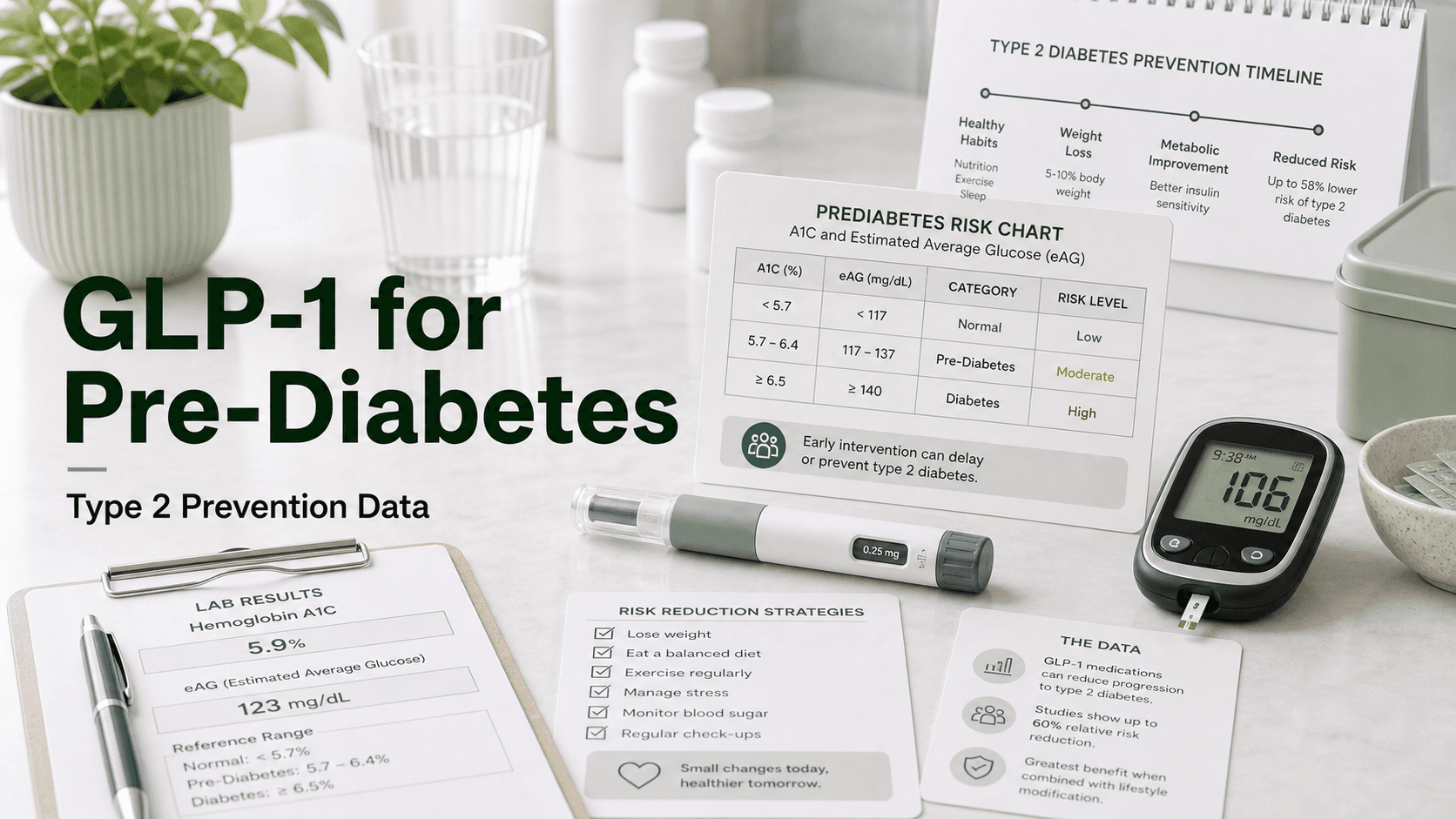
Prediabetes is the in-between zone — blood sugar too high to be normal, too low to be type 2 diabetes — and it is reversible. The conventional drug for it is metformin, which in the landmark DPP trial reduced 3-year progression to type 2 diabetes by 31%. GLP-1s do far better in their own trials. They are not FDA approved for prediabetes, but the trial data for an off-label use is now among the strongest in metabolic medicine.
Direct answer: In SURMOUNT-1 (3 years, 1,032 adults with obesity and prediabetes), tirzepatide cut progression to type 2 diabetes by 94% vs placebo — only 1.3% of treated patients developed T2D vs 13.3% on placebo. In the STEP program (68 weeks), 80–84% of semaglutide-treated prediabetic participants reverted to normoglycemia vs 37–48% on placebo, with A1C drops of about 0.3 percentage points beyond placebo. Compare to the DPP trial, where metformin reduced 3-year progression by 31% and intensive lifestyle by 58%. No GLP-1 is FDA approved specifically for prediabetes — it is used off-label, typically under a weight-loss or diabetes-prevention rationale, and insurance coverage usually requires BMI ≥30 or BMI ≥27 with a comorbidity.
What Prediabetes Is
Prediabetes is defined by laboratory values that sit between normal and diabetic. The American Diabetes Association recognizes three diagnostic criteria — any one meets the definition:
| Test | Normal | Prediabetes | Type 2 Diabetes |
|---|---|---|---|
| Hemoglobin A1C | <5.7% | 5.7–6.4% | ≥6.5% |
| Fasting plasma glucose | <100 mg/dL | 100–125 mg/dL | ≥126 mg/dL |
| 2-hour OGTT | <140 mg/dL | 140–199 mg/dL | ≥200 mg/dL |
About 1 in 3 American adults has prediabetes. Without intervention, roughly 5–10% of people with prediabetes progress to type 2 diabetes each year, and the majority will reach T2D within a decade. Higher A1C at diagnosis, higher BMI, and family history all accelerate progression.
The condition is silent — no symptoms, no obvious physical findings. Most people learn they have it from a routine blood draw.
Why Prediabetes Is Treatable
Insulin resistance and beta-cell stress are the engines of prediabetes, and both are partially reversible. Even modest weight loss (5–7% of body weight) restores insulin sensitivity, lowers fasting glucose, and gives beta cells a recovery window. The DPP trial proved this 25 years ago.
What changed in the last 5 years is the size of the lever. With lifestyle alone, achieving 7% weight loss and keeping it off is rare in the real world. With GLP-1 medications, average weight loss is 15–20% — and the metabolic improvements scale with it.
STEP Program: Semaglutide in Prediabetic Subgroups
The STEP trials studied semaglutide 2.4 mg weekly (the Wegovy dose) in adults with overweight or obesity. Across STEP 1, 3, and 4, a large subgroup had prediabetes at baseline, and the results were consistent.
Reversion to Normoglycemia at 68 Weeks
| Trial | Semaglutide | Placebo |
|---|---|---|
| STEP 1 | 84.1% | 47.8% |
| STEP 3 | 89.5% | 55.0% |
| STEP 4 | 89.8% | 70.4% |
In other words, roughly 8 to 9 out of 10 prediabetic participants on semaglutide returned to a normal A1C and fasting glucose by the end of the trial, vs roughly half on placebo.
Glycemic Markers
Beyond the binary reversion endpoint, semaglutide produced consistent quantitative improvements vs placebo:
- HbA1C: −0.29 to −0.35 percentage points difference vs placebo
- Fasting plasma glucose: −8 to −9 mg/dL difference vs placebo
- HOMA-IR (insulin resistance): −28% to −30% difference vs placebo
STEP 10: Built Specifically for Prediabetes
STEP 10 enrolled adults with both obesity (BMI ≥30) and prediabetes — 52 weeks of semaglutide 2.4 mg vs placebo, then 28 weeks off treatment. Weight loss reached −13.9% vs −2.7% on placebo. 80% of semaglutide participants reverted to normoglycemia by the end of treatment vs 37% on placebo.
SELECT: Long-Term Cardiovascular Trial
The SELECT trial (semaglutide 2.4 mg in adults with overweight/obesity and established cardiovascular disease but no diabetes) found that semaglutide significantly reduced progression to diabetes and increased regression to normoglycemia across the prediabetic subgroup over more than 3 years — confirming the STEP findings in a larger, longer setting.
SURMOUNT-1: Tirzepatide Over 3 Years
The SURMOUNT-1 trial enrolled 2,539 adults with obesity. Of those, 1,032 had prediabetes at baseline and were followed for 176 weeks (3+ years) with tirzepatide 5 mg, 10 mg, or 15 mg weekly, or placebo.
Headline Results in the Prediabetic Subgroup
| Endpoint | Tirzepatide (pooled) | Placebo |
|---|---|---|
| Progressed to type 2 diabetes | 1.3% | 13.3% |
| Reached normal A1C at week 176 | >90% | 59% |
| Weight loss (5 mg / 10 mg / 15 mg) | −12.3% / −18.7% / −19.7% | −1.3% |
A 94% relative reduction in 3-year progression to type 2 diabetes is the largest pharmacological effect on diabetes prevention ever reported. For perspective, in DPP the same outcome was 31% with metformin and 58% with intensive lifestyle — over a shorter follow-up.
Off-Treatment Rebound
After tirzepatide was stopped at week 176, some weight regain and A1C rise occurred over the 17-week off-treatment period. This matches every other obesity drug trial: stopping treatment removes most of the benefit. The implication is that GLP-1 therapy for prediabetes is likely a chronic treatment, not a 12-month course.
How GLP-1s Beat Metformin Head-to-Head
Metformin has been the prescribed prediabetes drug since DPP. It is cheap, generic, and tolerated by most patients. But it is not as potent.
In a 2024 nationwide cohort study of 1,778 drug-naive patients with prediabetes or diabetes, GLP-1 vs metformin produced:
- Greater HbA1C reduction: −2.59 mmol/mol additional drop in the prediabetic subgroup
- Lower add-on glucose-lowering treatment within 1 year (RR 0.27, meaning ~73% lower)
- Higher nonadherence with GLP-1 in prediabetics (RR 1.60) — likely cost and injection-related
In trial settings:
| Drug | T2D progression reduction over ~3 years |
|---|---|
| Metformin (DPP) | 31% |
| Intensive lifestyle (DPP) | 58% |
| Semaglutide (STEP/SELECT pooled) | ~60%+ |
| Tirzepatide (SURMOUNT-1, 176 wk) | 94% |
The trials are not perfectly comparable — different populations, different eras, different protocols — but the effect-size gap is large enough to be clinically meaningful. Metformin is a reasonable first step. GLP-1 is the more powerful option.
Off-Label Use: What the FDA Has and Hasn't Approved
No GLP-1 medication is FDA approved with prediabetes as its labeled indication. The approvals are:
- Ozempic, Mounjaro, Rybelsus, Trulicity, Victoza: type 2 diabetes
- Wegovy, Zepbound, Saxenda: chronic weight management
- Wegovy: cardiovascular risk reduction in adults with overweight/obesity and CVD
- Zepbound: moderate-to-severe obstructive sleep apnea with obesity
A patient with prediabetes alone does not automatically qualify for a GLP-1 on label. Prescribing for prediabetes is off-label — legal and common, but it has to be justified through one of the approved indications, usually obesity or overweight with a comorbidity.
Who Qualifies in Practice
In real-world prescribing, qualification for GLP-1 therapy when prediabetes is the chief concern typically depends on weight criteria:
- BMI ≥30 (obesity) — qualifies for Wegovy or Zepbound
- BMI ≥27 with a comorbidity — qualifies for Wegovy or Zepbound; prediabetes itself often counts as the comorbidity in clinical decision-making but not always in insurance criteria
- BMI <27 — generally cannot get a GLP-1 prescribed under standard insurance pathways, even with prediabetes
If a patient meets neither weight threshold but has aggressive prediabetes (rising A1C, family history, polycystic ovary syndrome, history of gestational diabetes), some clinicians prescribe a GLP-1 off-label cash-pay. Compounded options have become harder to access since FDA action in 2025–2026 against bulk compounding of semaglutide and tirzepatide.
Insurance Coverage Reality
This is where the gap between trial data and the pharmacy counter is widest.
- Commercial plans rarely cover Wegovy or Zepbound for prediabetes alone. They cover for obesity (BMI ≥30) or BMI ≥27 with an approved comorbidity (often hypertension, dyslipidemia, sleep apnea, or established T2D — prediabetes is sometimes included, sometimes not).
- Prior authorization is the rule. Most plans require documented BMI, prior weight-loss attempts, sometimes a 3–6 month lifestyle program first, and step therapy through phentermine or older agents.
- Medicare Part D historically excluded coverage of obesity drugs entirely. A time-limited Medicare GLP-1 Bridge program is set to provide access between July 2026 and December 2027 for eligible beneficiaries.
- Medicaid varies state by state.
- Cash-pay: Wegovy and Zepbound list prices are ~$1,000–$1,350/month. Manufacturer programs (LillyDirect, NovoCare) have brought self-pay prices to roughly $350–$650/month depending on dose and product.
Many patients with prediabetes who would benefit clinically simply cannot get coverage and choose not to pay out of pocket.
Lifestyle Alternatives — Still the Foundation
The DPP showed that intensive lifestyle intervention reduced 3-year progression by 58%. The core elements are unchanged:
- Weight loss of 5–7% of body weight — the threshold for measurable insulin sensitivity improvement
- 150 minutes/week of moderate-intensity physical activity
- Calorie reduction of ~500–750 kcal/day with emphasis on fiber, lean protein, and lower glycemic load
- Sleep ≥7 hours/night — short sleep worsens insulin resistance
- Limiting alcohol and ultra-processed foods
For motivated patients without a weight problem severe enough for medication, lifestyle alone is genuinely effective. For patients who have tried lifestyle without success, a GLP-1 makes lifestyle easier — appetite drops, food noise quiets, and the weight loss target becomes reachable.
What People Get Wrong
- "My A1C is 5.8 — that's basically normal." No — 5.7% is the prediabetes threshold. 5.8% means active glucose dysregulation and a real progression risk.
- "GLP-1s are approved for prediabetes." They are not. They are approved for obesity and for type 2 diabetes; prediabetes use is off-label.
- "If I get back to a normal A1C, I can stop the GLP-1." Possibly — but rebound is common. Most clinicians treat prediabetes regression with a GLP-1 as the beginning of long-term metabolic management, not a cure.
- "Metformin is just as good." In head-to-head and indirect comparisons, GLP-1s produce larger A1C reductions, larger weight loss, and a much larger reduction in progression to T2D.
- "Insurance will cover it because prediabetes is serious." Usually not. Coverage almost always requires meeting the obesity or overweight-with-comorbidity criteria, not the prediabetes label itself.
Frequently Asked Questions
Is any GLP-1 FDA approved for prediabetes? No. None of the GLP-1 or dual-agonist medications is approved with prediabetes as the labeled indication. Use for prediabetes is off-label.
By how much do GLP-1s reduce the risk of progressing to type 2 diabetes? In SURMOUNT-1 over 3 years, tirzepatide reduced progression by 94% (1.3% on tirzepatide vs 13.3% on placebo). Semaglutide trials show a more than 60% reduction over comparable timeframes.
How does that compare to metformin? In the DPP trial, metformin reduced 3-year progression by 31% and intensive lifestyle by 58%. GLP-1s exceed both in trial data.
What A1C defines prediabetes? A1C between 5.7% and 6.4%. Fasting plasma glucose 100–125 mg/dL or a 2-hour OGTT of 140–199 mg/dL also meet criteria.
Will insurance pay for a GLP-1 if I have prediabetes? Usually only if you also meet obesity criteria (BMI ≥30) or BMI ≥27 with another approved comorbidity. Prediabetes alone is rarely sufficient.
Can lifestyle alone reverse prediabetes? Yes — the DPP showed 58% reduction in progression with intensive lifestyle. For many people, a 5–7% weight loss with exercise restores normal glucose. GLP-1s are not the only path; they are the most powerful one.
If my A1C goes back to normal on a GLP-1, can I stop? Most patients who stop see partial regain in weight and A1C. Clinicians increasingly view prediabetes-driven GLP-1 therapy as long-term.
What's the difference between semaglutide and tirzepatide for prediabetes? Tirzepatide produces larger weight loss (~18–20% vs ~13–15% at top doses) and the largest trial-reported reduction in T2D progression (94% in SURMOUNT-1). Both work; tirzepatide is, on current data, more potent.
Last reviewed: May 13, 2026
Sources
- Tirzepatide for Obesity Treatment and Diabetes Prevention — NEJM (SURMOUNT-1 176-week)
- Tirzepatide reduced risk of developing type 2 diabetes by 94% — Eli Lilly investor release
- Tirzepatide Shows Powerful Diabetes-Prevention Effect — Weill Cornell Newsroom
- Changes in Glucose Metabolism in Prediabetes Participants in the STEP Program — Diabetes Care
- Once-weekly semaglutide 2.4 mg in obesity and prediabetes (STEP 10) — The Lancet
- Effect of Semaglutide on Regression and Progression of Glycemia in SELECT — Diabetes Care
- GLP-1 receptor agonists vs metformin in drug-naive prediabetes: cohort study — Journal of Diabetes
- 2. Diagnosis and Classification of Diabetes — ADA Standards of Care 2026
- Prediabetes — Diagnosis and Treatment, Mayo Clinic
- Medicare GLP-1 Bridge — CMS