GLP-1 and Pregnancy: Washout Timing, Breastfeeding, and Unintended Exposure
Pregnancy is the one condition where every FDA-approved GLP-1 receptor agonist — semaglutide (Ozempic, Wegovy, Rybelsus), tirzepatide (Mounjaro, Zepbound), liraglutide (Saxenda, Victoza), and dulaglutide (Trulicity) — is meant to come off. Strictly speaking it is not listed in section 4 of any of those labels, where the contraindications are limited to medullary thyroid carcinoma history and hypersensitivity; the instruction to stop lives in section 8.1 instead. Animal reproductive toxicity data and the long half-life of weekly drugs mean that the timing of stopping matters as much as the decision to stop. The good news is that the small but growing human dataset on unintended first-trimester exposure has been reassuring rather than alarming.
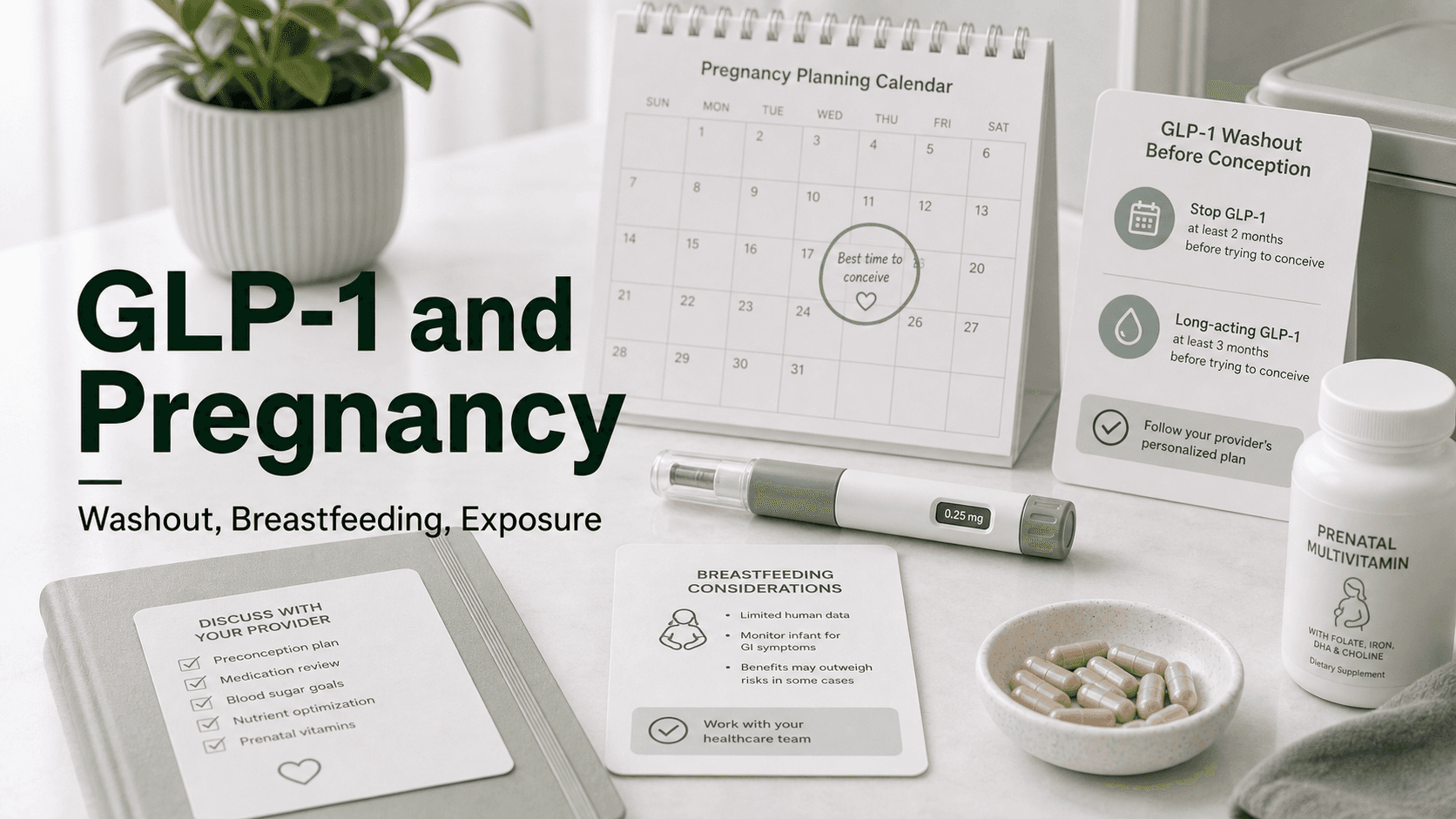
Direct answer: Stop a weekly GLP-1 (semaglutide, tirzepatide, dulaglutide) at least 2 months before trying to conceive. Semaglutide has a half-life of about 1 week and is present in the circulation for about 5 to 7 weeks after the final dose according to the current label; tirzepatide's half-life is ~5 days, with full clearance around 25–35 days. Liraglutide (daily) clears in about 3 days. If pregnancy occurs unexpectedly while on a GLP-1, discontinue immediately and tell your obstetrician — but inadvertent first-trimester exposure is not, on current evidence, considered grounds for termination or extra fetal monitoring. Breastfeeding with injectable semaglutide is now considered probably low-risk by LactMed; oral semaglutide (Rybelsus) is contraindicated during lactation because of the SNAC absorption enhancer.
Why GLP-1s Are Contraindicated in Pregnancy
Three threads run through the manufacturer labels, FDA guidance, ACOG commentary, and UKTIS/MotherToBaby monographs.
1. Animal reproductive toxicity. In rat and rabbit studies, semaglutide caused embryofetal mortality, structural malformations, and growth alterations at exposures below or at human therapeutic levels. Tirzepatide showed similar signals. The findings are confounded by significant maternal weight loss and reduced food intake — but the FDA classifies these drugs accordingly and the labels reflect it.
2. Maternal weight loss itself. Pregnancy is not a time for active weight reduction. Caloric restriction during organogenesis (the first ~10 weeks) is associated with low birth weight and other outcomes that overlap with what GLP-1 medications cause incidentally.
3. The SNAC problem in oral semaglutide. Rybelsus uses salcaprozate sodium (SNAC) as an absorption enhancer. SNAC has its own animal toxicity signals and crosses biological membranes more readily than the peptide itself. This is why oral semaglutide carries a stricter lactation restriction than the injectable forms. The pre-conception rule is identical across both.
Planning Ahead: The 2-Month Rule
The manufacturer labels for Ozempic, Wegovy, and Rybelsus recommend stopping at least 2 months before attempting pregnancy. ACOG and most reproductive endocrinologists echo this. The math:
| Drug | Half-life | Approx. time to clear | Recommended stop |
|---|---|---|---|
| Semaglutide (weekly) | ~1 week | ~5–7 weeks | 8 weeks before conception |
| Tirzepatide (weekly) | ~5–6 days | ~25–35 days | 4–8 weeks before conception |
| Liraglutide (daily) | ~13 hours | ~3 days | ~1 week before conception |
| Dulaglutide (weekly) | ~5 days | ~25–35 days | 4–8 weeks before conception |
| Oral semaglutide (Rybelsus, Ozempic tablets, Wegovy tablets) | ~1 week | ~5–7 weeks | 8 weeks before conception |
The 2-month figure is the conservative, easy-to-remember version that covers the whole class. Some OB specialists prefer 3 months if you have been on high doses for a long time, to account for tissue redistribution.
Practical issues during the washout:
- Some weight regain is normal. Plan for it. Continued protein intake, resistance training, and a structured plate keep regain modest.
- Hunger and food noise often return within 2–3 weeks.
- A1C may drift up in T2D patients. Coordinate with your endocrinologist on bridging therapy (metformin is pregnancy-compatible and often used).
- Cycles may shift. Weight loss can have already restored ovulation; expect potentially faster conception than you'd predict.
What the FDA Prescribing Information Actually Says
The 2-month rule is not in every label. It is in the semaglutide labels, and treating it as a class-wide instruction is the most common misreading in this topic. Here is what each current US prescribing information says in section 8.1 (Pregnancy) and section 8.3 (Females and Males of Reproductive Potential).
| Drug (brand) | Section 8.1 instruction | Pre-conception window in 8.3 |
|---|---|---|
| Semaglutide injection (Ozempic) | Use during pregnancy only if the potential benefit justifies the potential risk to the fetus | Discontinue at least 2 months before a planned pregnancy due to the long washout period for semaglutide |
| Semaglutide injection and tablets (Wegovy) | For weight reduction or CV risk reduction, discontinue when pregnancy is recognized; for MASH, only if benefit justifies risk | Discontinue at least 2 months before a planned pregnancy because of the long half-life of semaglutide |
| Oral semaglutide (Rybelsus, Ozempic tablets) | Risk summary only, no standalone stop instruction | Discontinue at least 2 months before a planned pregnancy due to the long washout period |
| Tirzepatide (Zepbound) | Weight loss offers no benefit to a pregnant patient and may cause fetal harm; discontinue when a pregnancy is recognized | None. Section 8.3 covers contraception only |
| Tirzepatide (Mounjaro) | Use during pregnancy only if the potential benefit justifies the potential risk to the fetus | None. Section 8.3 covers contraception only |
| Liraglutide (Saxenda) | Weight loss offers no benefit to a pregnant patient; discontinue when a pregnancy is recognized | No section 8.3 |
| Liraglutide (Victoza) | Use during pregnancy only if the potential benefit justifies the potential risk to the fetus | No section 8.3 |
| Dulaglutide (Trulicity) | Use during pregnancy only if the potential benefit justifies the potential risk to the fetus | No section 8.3 |
Three things follow from that table.
Only semaglutide carries a labeled pre-conception window. Every semaglutide product, injectable and oral, instructs prescribers to stop at least 2 months before a planned pregnancy. No tirzepatide, liraglutide or dulaglutide label names a number at all.
For tirzepatide, the 2-month figure is clinical convention rather than a label instruction. It is extrapolated from a roughly 5 to 6 day elimination half-life, which clears the drug considerably faster than semaglutide's ~1 week. The only timing instruction Zepbound gives is to discontinue when a pregnancy is recognized, and Mounjaro's 8.1 does not even go that far, framing it as a benefit-versus-risk judgment for a patient with diabetes. Applying the semaglutide rule across the class is a deliberately conservative choice, not a labeled requirement — which also means a tirzepatide patient who stopped 5 weeks rather than 8 weeks before conceiving has not violated the prescribing information.
The contraception instruction is broader than most summaries make it. Both tirzepatide labels tell patients using oral hormonal contraceptives to switch to a non-oral method, or add a barrier method, for 4 weeks after starting the drug and for 4 weeks after each dose escalation. A standard titration involves several escalations, so the window keeps reopening. No semaglutide label carries an equivalent contraception instruction.
Both manufacturers also print their registry contacts in section 8.1. Novo Nordisk's semaglutide pregnancy registry is reachable at 1-877-390-2760 or wegovypregnancyregistry.com; Eli Lilly's tirzepatide registry at 1-800-LillyRx (1-800-545-5979).
If Pregnancy Happens Unexpectedly
The fastest-growing reason people end up on GLP-1s during conception is that the drugs themselves restore fertility — particularly in women with PCOS, insulin resistance, or weight-related anovulation. "Ozempic babies" is a real and rising phenomenon.
If you discover you are pregnant while on a GLP-1:
- Stop the medication immediately. No taper required.
- Contact your prescriber and obstetrician the same week. They will document exposure dates and dose.
- Do not panic. Inadvertent first-trimester exposure to GLP-1 medications, on current data, is not grounds for termination or extra fetal monitoring beyond standard prenatal care.
- Take folic acid (400–800 mcg daily) immediately if not already.
- Consider enrolling in a pregnancy registry (Novo Nordisk and Eli Lilly both maintain them).
UKTIS, the UK Teratology Information Service, explicitly states that "inadvertent exposure to GLP-1 RAs at any stage in pregnancy would not usually be regarded as medical grounds for termination of pregnancy or any additional fetal monitoring."
What the Human Data Actually Show
Animal data drove the contraindication, but human data is what counts for risk counseling after an unintended exposure. The 2024–2026 evidence base:
- Multicentre Teratology Information Service cohort (n=168 GLP-1-exposed first-trimester pregnancies). Major birth defect rate 2.6%, versus 2.3% in a diabetes reference group and 3.9% in an overweight/obese reference group — no increased risk.
- Large registry analysis of 104,422 singleton pregnancies (32 semaglutide-exposed in first trimester). Major malformation rate 9.4% on semaglutide versus 13.9% on insulin and 7.7% in unexposed. No statistically increased risk versus insulin or unexposed comparators.
- Type 2 diabetes registry of ~50,000 pregnancies found no significant fetal development problems among those on a GLP-1 at conception versus those not.
- Systematic review and meta-analysis (JACC Advances, 2026) of GLP-1 exposure in pregnancy: no increased risk of major congenital anomalies compared with insulin-only therapy.
The recurring caveat: sample sizes are still modest, and these data justify reassurance after accidental exposure — not deliberate continuation. Authors of every major review explicitly state the recommendation against use during pregnancy has not changed.
Breastfeeding: Injection vs Oral Is a Critical Distinction
This is where labels, LactMed, and clinical practice have evolved fastest.
Injectable semaglutide (Ozempic, Wegovy). A study of 8 nursing mothers found semaglutide was undetectable in breast milk (<1.7 mcg/L) at therapeutic doses. Infants studied (ages 4–23 months) had normal growth and development. The molecule is large (~4,100 Da) — well above the ~500 Da threshold where drugs typically transfer easily into milk — and any trace amount would be poorly absorbed by an infant's gut.
Injectable tirzepatide (Mounjaro, Zepbound). Even less data, but the same biology: a 4,800 Da protein that does not cross meaningfully into milk. InfantRisk Center reported tirzepatide was undetectable or barely detectable in milk at doses up to 5 mg, with no infant adverse effects. The Mounjaro and Zepbound labels now carry their own lactation data: after a single 5 mg subcutaneous dose in 11 healthy lactating women, tirzepatide was undetectable in 164 of 171 milk samples, and the cumulative amount across the remaining 7 came to less than 0.02% of the maternal dose.
Oral semaglutide (Rybelsus, Ozempic tablets, Wegovy tablets). Different story, and the brand list is longer than it used to be — oral semaglutide is now sold under three names, all of them SNAC-containing. In clinical lactation studies semaglutide itself came back below the limit of quantification in human milk, but SNAC and its metabolites are present in milk, and the enzymes that clear SNAC are less active in infants than in adults, so it can accumulate. The labels reach the conclusion directly: because non-SNAC semaglutide products exist that can be used during lactation, breastfeeding is not recommended during treatment with the tablets. LactMed agrees. Injectable semaglutide is the preferred option for any breastfeeding patient where a GLP-1 is being considered.
The real-world concern with breastfeeding on any GLP-1 is not direct drug transfer — it is maternal undernutrition. GLP-1s can reduce caloric intake by 30–40%. Lactation requires ~500 extra calories per day above baseline (~2,250–2,500 daily for most women). Insufficient maternal intake risks:
- Reduced milk supply
- Nutrient deficiencies in milk
- Maternal fatigue, dehydration, and dizziness
- Slowed infant weight gain
If a GLP-1 is being used postpartum during nursing — usually only after specialist input — best practice is to wait until the baby is at least 6 months old (ideally 7–12 months, with solid foods established), track calories deliberately rather than rely on hunger cues, prioritize protein (90–120 g/day), supplement with a prenatal vitamin, and monitor the infant's growth curve closely.
Fertility Benefits Before Pregnancy
For many women, the right framing isn't "GLP-1s harm fertility" — it is "GLP-1s can restore fertility, then need to be stopped before conception." Key points:
- PCOS, anovulation, and insulin resistance are the dominant causes of weight-related infertility. GLP-1s improve all three.
- 5–10% body weight loss is enough to restore regular ovulation in many women.
- Improved insulin sensitivity reduces hyperandrogenism, can normalize cycle length, and lowers miscarriage risk in subsequent pregnancies.
- Use reliable contraception while on a GLP-1 if you are not trying to conceive — fertility may rebound faster than you expect, and oral contraceptive absorption can be reduced for 4 weeks after starting tirzepatide and for 4 weeks after every dose increase.
- Plan the transition off the drug 8 weeks before the conception window so the body has cleared the medication before fertilization.
Post-Pregnancy Restart Timing
After delivery, when can you restart?
| Scenario | Earliest restart |
|---|---|
| Formula feeding only | Once your obstetrician clears you postpartum (typically 4–6 weeks) and you have no contraindications |
| Exclusive breastfeeding | Generally not recommended; wait until weaning |
| Combination feeding | Specialist discussion; injectable preferred over oral if used |
| Considering another pregnancy soon | Coordinate timing — stop 2 months before next conception window |
Postpartum weight loss can be slow and emotionally loaded. Many patients consider a GLP-1 to address persistent post-pregnancy weight. The class is highly effective; the timing requires intention. When that time comes, our guide to where to buy semaglutide walks through each route.
What About Pregnancy After Stopping?
A common worry: "If I was on a GLP-1, can the next pregnancy still be healthy?"
Current data say yes. Beyond the washout period, there is no evidence that prior GLP-1 use affects subsequent pregnancy outcomes. The drug is fully cleared, and any weight loss preserved generally improves pregnancy outcomes (lower gestational diabetes, preeclampsia, and macrosomia rates).
Recent observational data also suggest that women who discontinue GLP-1s before conception have pregnancy outcomes similar to women who were never exposed — once the washout has been completed.
Unintended Exposure Data: A Closer Look
Because so many people now end up briefly exposed in early pregnancy, this is worth detail.
- Timing of exposure matters less than absolute exposure. The first-trimester window (weeks 5–10) is the critical organogenesis period. Exposures confined to weeks 1–4, before implantation completes, are essentially pre-organogenesis.
- Stopping at positive test is the standard, evidence-supported approach. Pregnancy tests typically positive 4–5 weeks after the last menstrual period — exposure beyond this point is generally truncated quickly.
- No specific extra ultrasounds, amniocentesis, or genetic testing is recommended solely because of GLP-1 exposure.
- Pregnancy registries (Novo Nordisk's Wegovy/Ozempic registry, Eli Lilly's tirzepatide registry) are gathering long-term outcome data. Enrolment is voluntary and recommended.
- Neonatal hypoglycemia is one theoretical late-pregnancy concern if exposure persists near delivery — relevant only in patients who continue against advice, not in those who stop in the first trimester.
What People Get Wrong
- "GLP-1s cause infertility." They usually do the opposite. Most fertility issues on a GLP-1 are about needing to stop before conception, not about the drug suppressing fertility.
- "One week off is enough before trying to conceive." No. Semaglutide and tirzepatide are weekly drugs precisely because they linger; 5–8 weeks of clearance is the right number.
- "My pregnancy is ruined if I got exposed in early weeks." Current data are reassuring. No major signal for birth defects in modest first-trimester exposures.
- "I can keep using it if I just lower the dose." No. Discontinuation is the recommendation across the entire dose range.
- "Breastfeeding always rules out a GLP-1." Injectable semaglutide is now considered probably compatible with breastfeeding, with caveats around maternal nutrition. Oral semaglutide is the formulation that is firmly avoided.
- "I should switch to oral semaglutide when nursing because it is safer." The opposite. SNAC in Rybelsus is the reason it is more restricted in lactation than the injection.
- "If I am on birth control I do not need to worry about timing." Tirzepatide reduces oral contraceptive absorption for 4 weeks after initiation and for 4 weeks after each dose increase, so the window recurs through the whole titration — a non-oral method or a backup barrier method is what the label advises. Even more importantly: fertility can rebound rapidly once weight drops.
Frequently Asked Questions
How long before pregnancy should I stop a GLP-1? At least 2 months for semaglutide, tirzepatide, and dulaglutide. About 1 week for daily liraglutide. Some specialists prefer 3 months if you have been on high doses long term.
When should I stop semaglutide or tirzepatide if I want to conceive? Semaglutide is the straightforward one. Every semaglutide label — Ozempic, Wegovy, Rybelsus and Ozempic tablets — instructs stopping at least 2 months before a planned pregnancy, because the drug stays in circulation for about 5 to 7 weeks after the final dose. Tirzepatide has no labeled pre-conception window; Mounjaro and Zepbound only address stopping once a pregnancy is recognized. With a 5 to 6 day half-life it clears in roughly 25 to 35 days, and most reproductive specialists still apply the same 2-month buffer so that one rule covers the whole class. Daily liraglutide is the exception where about a week is genuinely enough.
Does the tirzepatide label say to stop 2 months before pregnancy? No. Neither the Zepbound nor the Mounjaro prescribing information contains a pre-conception discontinuation window. Zepbound section 8.1 says to discontinue when a pregnancy is recognized; Mounjaro says it should be used during pregnancy only if the potential benefit justifies the potential risk. The 2-month figure comes from the semaglutide labels and is applied to tirzepatide as a conservative convention. Section 8.3 of both tirzepatide labels covers contraception only: move off oral hormonal contraceptives or add a barrier method for 4 weeks after starting and 4 weeks after each dose increase.
What is the half-life of semaglutide? About 1 week. The current label states that semaglutide is present in the circulation for about 5 to 7 weeks after the last dose, injectable or oral. The 2-month rule builds a buffer on top of that.
I just found out I am pregnant and I am on a GLP-1. What now? Stop the medication today. Contact your obstetrician and prescriber this week. Take folic acid. Do not panic — current data are reassuring for short, early-pregnancy exposures.
Will my baby have birth defects from accidental first-trimester exposure? Current human data, including a multicentre study of 168 exposed pregnancies and a registry study covering more than 100,000 pregnancies, show no increased rate of major birth defects versus comparison groups. Sample sizes are still modest, but the signal is reassuring.
Can I breastfeed on a GLP-1? Injectable semaglutide and tirzepatide appear to transfer minimally into breast milk and current evidence shows no infant harm. The main concern is maternal caloric intake. Oral semaglutide (Rybelsus) is contraindicated during breastfeeding because of the SNAC absorption enhancer.
Will GLP-1 use before pregnancy affect my baby later? No evidence to suggest so, provided you complete the recommended washout before conception.
Can a GLP-1 help me get pregnant? Indirectly, yes. Weight loss of 5–10% and improved insulin sensitivity restore ovulation in many women with PCOS or weight-related anovulation. But the drug itself must be stopped before conception.
When can I restart a GLP-1 after delivery? If you are not breastfeeding, typically after your 4–6 week postpartum visit. If you are breastfeeding, most guidance is to wait until weaning, although injectable semaglutide is increasingly considered case-by-case with specialist input.
Last reviewed: May 13, 2026
Sources
- Semaglutide — MotherToBaby Fact Sheet
- Semaglutide — LactMed (Drugs and Lactation Database), NCBI
- Use of GLP-1 Receptor Agonists in Pregnancy — UKTIS
- Use of GLP1 Receptor Agonists in Early Pregnancy and Reproductive Safety: Multicentre Observational Cohort — PMC
- Pregnancy Outcomes After Semaglutide Exposure — PMC/NIH
- GLP-1 Receptor Agonist Exposure During Pregnancy: Systematic Review and Meta-Analysis — JACC Advances
- Tirzepatide and Breastfeeding — InfantRisk Center
- Can Ozempic Affect Fertility? A Guide to GLP-1 Medications and Pregnancy — University of Utah Health
- Semaglutide, Fertility, and Pregnancy — Mochi Health
- Subcutaneous Semaglutide during Breastfeeding: Infant Safety Regarding Drug Transfer into Human Milk — PMC
- Ozempic (semaglutide injection) Prescribing Information — DailyMed
- Wegovy (semaglutide injection and tablets) Prescribing Information — DailyMed
- Rybelsus and Ozempic tablets (oral semaglutide) Prescribing Information — DailyMed
- Mounjaro (tirzepatide) Prescribing Information — DailyMed
- Zepbound (tirzepatide) Prescribing Information — DailyMed
- Saxenda (liraglutide) Prescribing Information — DailyMed
- Victoza (liraglutide) Prescribing Information — DailyMed
- Trulicity (dulaglutide) Prescribing Information — DailyMed