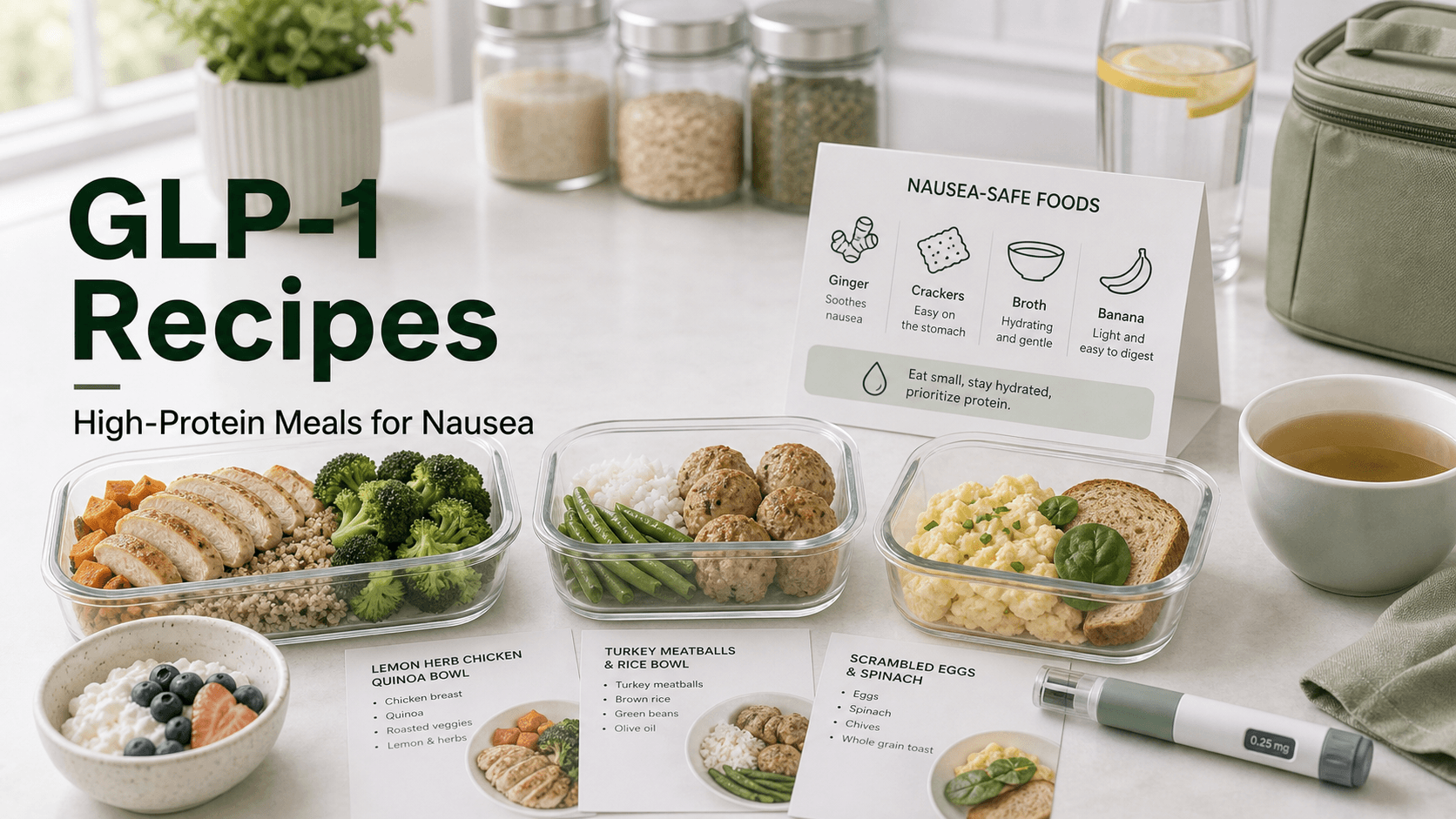
Most "GLP-1 recipe" articles online drop you onto a wall of stock photos with no measurements, no macros, and no cooking time. That is useless when your stomach is half its old size and you have 90 seconds of appetite to work with. This page is the opposite: fifteen real recipes with weighed ingredients, protein grams, and gentle cooking methods that match the way semaglutide and tirzepatide actually change your appetite.
Direct answer: GLP-1 recipes should land 20–30 g of protein per main meal, 80–100 g per day total (or roughly 1.2–1.6 g protein per kilogram of body weight), 5–10 g of fiber per meal, and under 15 g of fat per portion because high-fat dishes slow gastric emptying even further and trigger nausea. Aim for 300–450 calories per meal if you are losing weight and 400–550 if you are maintaining. Cooking methods should stay gentle — baked, poached, simmered, sheet-pan, air-fried — and avoid deep-frying, heavy cream sauces, large amounts of butter, and very spicy preparations. The fifteen recipes below cover breakfasts (egg cups, cottage cheese bowls, Greek yogurt parfaits), lunches (tuna white-bean salad, chicken soup, Greek bowls), dinners (baked cod, sheet-pan chicken, salmon bowls, turkey chili, tofu stir-fry), and snacks, all built to be tolerable on a shrunken GLP-1 appetite.
How GLP-1 Recipes Are Different
Three changes drive every recipe below:
- Appetite is smaller. A typical pre-GLP-1 dinner was 700–900 kcal. On semaglutide or tirzepatide, the same person often stops at 350–450 kcal. Recipes must concentrate protein in less volume.
- Gastric emptying is slower. Fat already takes 4–6 hours to leave the stomach in a healthy adult. On a GLP-1, that window stretches. High-fat meals are the #1 reported trigger for nausea, sulfur burps, and reflux. Recipes below cap added fat to 1–2 tablespoons of olive oil per serving.
- Fiber tolerance varies week to week. During titration, raw cruciferous veg and beans can cause bloating; once stable, fiber is essential to counter constipation. Recipes flag swaps for sensitive weeks.
The macro target most clinicians anchor to is 1.2–1.6 g protein per kg of body weight during weight loss, ramped up from the general 0.8 g/kg baseline because GLP-1s drive faster loss and risk muscle wasting. A 75-kg adult lands around 90–120 g of protein per day, split across 3–4 eating occasions.
Breakfast Recipes (4)
Cottage Cheese Egg Cups (Make 12)
Batch-prep on Sunday, eat 2–3 per breakfast all week.
- 8 large eggs
- 1 cup 2% cottage cheese
- 1/2 cup shredded sharp cheddar (reduced-fat)
- 1 cup chopped baby spinach
- 1/2 cup diced bell pepper
- 1/4 tsp salt, 1/4 tsp black pepper
Blend eggs, cottage cheese, cheddar, salt, and pepper until smooth. Stir in spinach and bell pepper. Divide into 12 greased muffin cups. Bake at 350 F for 20–22 minutes until centers are firm. Cool, refrigerate up to 5 days.
Per 3 muffins: 27 g protein, 220 kcal, 1 g fiber, 11 g fat, 15 min prep + 22 min bake.
Cottage Cheese & Berry Bowl
The fastest 25 g of protein you can plate.
- 3/4 cup 2% cottage cheese
- 1/2 cup mixed berries (fresh or thawed frozen)
- 1 tbsp ground flaxseed
- 1 tsp honey or maple syrup
- 6 chopped walnuts
Spoon cottage cheese into a bowl. Top with berries, flaxseed, drizzle of honey, walnuts. Done.
Per bowl: 26 g protein, 280 kcal, 5 g fiber, 9 g fat, 3 min prep.
Greek Yogurt Protein Parfait
- 1 cup nonfat plain Greek yogurt
- 1 scoop (20 g) whey or pea protein, stirred in
- 1/3 cup raspberries
- 2 tbsp low-sugar granola
- 1 tbsp chia seeds
Stir protein powder into yogurt with 2 tbsp cold water until smooth. Layer in a glass with berries, granola, and chia.
Per parfait: 34 g protein, 320 kcal, 8 g fiber, 6 g fat, 4 min prep.
Smoked Salmon Avocado Toast
For mornings when sweet flavors trigger nausea.
- 1 slice whole-grain sourdough, toasted
- 1/4 ripe avocado, mashed
- 2 oz cold-smoked salmon
- 1 tbsp whipped cream cheese
- Capers, dill, lemon zest, fresh pepper
Spread cream cheese on toast, then avocado. Lay salmon on top. Garnish with capers, dill, lemon zest, and pepper.
Per slice: 22 g protein, 310 kcal, 4 g fiber, 14 g fat, 5 min prep.
Lunch Recipes (4)
Tuna White-Bean Lemon Salad
Pantry recipe, no cooking, travels well.
- 1 can (5 oz) tuna in water, drained
- 1/2 cup canned cannellini beans, rinsed
- 1/4 cup diced celery
- 2 tbsp diced red onion
- 1 tbsp olive oil
- 1 tbsp fresh lemon juice
- 1/2 tsp Dijon mustard
- Fresh parsley, salt, pepper
Whisk olive oil, lemon, Dijon, salt, and pepper in a bowl. Fold in tuna, beans, celery, onion, parsley. Serve over arugula or in a whole-grain wrap halved.
Per serving: 32 g protein, 360 kcal, 7 g fiber, 12 g fat, 7 min prep.
Slow-Cooker Chicken & Vegetable Soup
Gentle on a nauseated stomach. Freezes in 1-cup portions.
- 1.5 lb skinless chicken breast
- 6 cups low-sodium chicken broth
- 1 cup diced carrots
- 1 cup diced celery
- 1 small yellow onion, diced
- 2 cloves garlic, minced
- 1 cup baby spinach
- 1 tsp dried thyme, bay leaf, salt, pepper
Combine everything except spinach in a slow cooker. Cook on low 6 hours. Remove chicken, shred, return to pot. Stir in spinach for 2 minutes. Season.
Per 1.5-cup bowl (6 servings): 28 g protein, 220 kcal, 3 g fiber, 4 g fat, 10 min prep + 6 hr cook.
Greek Chicken Quinoa Bowl
- 4 oz grilled or rotisserie chicken breast, sliced
- 1/2 cup cooked quinoa
- 1/4 cup diced cucumber
- 1/4 cup halved cherry tomatoes
- 2 tbsp diced red onion
- 1 oz crumbled feta
- 4 kalamata olives
- 1 tbsp olive oil + 1 tsp red wine vinegar + oregano
Layer quinoa in a bowl. Top with chicken, vegetables, feta, olives. Whisk dressing, drizzle.
Per bowl: 35 g protein, 440 kcal, 5 g fiber, 18 g fat (mostly mono), 10 min prep with pre-cooked quinoa.
Lentil & Roasted Veg Lunch Jar
Plant-forward, very gut-friendly once GI side effects settle.
- 1/2 cup cooked green lentils
- 1/2 cup roasted zucchini and bell pepper
- 1 cup baby kale
- 2 tbsp crumbled feta (or 1/4 cup chickpeas for dairy-free)
- 1 tbsp olive oil + 1 tsp balsamic + Dijon
Layer dressing at the bottom of a jar, then lentils, roasted veg, feta, kale. Refrigerate up to 3 days. Shake before eating.
Per jar: 20 g protein, 380 kcal, 11 g fiber, 16 g fat, 8 min prep with pre-cooked lentils.
Dinner Recipes (5)
Baked Lemon-Herb Cod
Gentlest dinner protein on this list. Cod has almost no fat.
- 6 oz cod loin
- 1 tsp olive oil
- 1/2 tsp lemon zest + 1 tbsp lemon juice
- 1/4 tsp garlic powder, dill, salt, pepper
- 1 cup asparagus spears
- 1/3 cup cooked brown rice
Place cod and asparagus on a parchment-lined sheet pan. Rub cod with oil, lemon, garlic, dill, salt, pepper. Bake at 400 F for 12–14 minutes until cod flakes. Serve over rice with extra lemon.
Per plate: 36 g protein, 360 kcal, 4 g fiber, 6 g fat, 5 min prep + 14 min bake.
Sheet-Pan Chicken & Brussels Sprouts
One pan, one knife, one cleanup.
- 2 chicken breasts (5 oz each), cubed
- 2 cups Brussels sprouts, halved
- 1 cup baby potatoes, halved
- 1.5 tbsp olive oil
- 1 tsp smoked paprika, garlic powder, salt, pepper
- Lemon wedges
Toss everything in oil and seasoning on a sheet pan. Roast at 425 F for 22–25 minutes, stirring once. Squeeze lemon at the table.
Per serving (2): 38 g protein, 410 kcal, 6 g fiber, 12 g fat, 10 min prep + 25 min bake.
Teriyaki Salmon Bowl
- 5 oz salmon fillet
- 1 tbsp low-sodium soy sauce
- 1 tsp rice vinegar
- 1 tsp honey
- 1/2 cup cooked brown rice
- 1 cup steamed broccoli florets
- 1/4 cup shelled edamame
- 1 tsp sesame seeds, scallions
Whisk soy, vinegar, honey. Brush over salmon. Bake skin-down at 400 F for 11–13 minutes. Plate rice, top with salmon, broccoli, edamame, sesame, scallion.
Per bowl: 38 g protein, 470 kcal, 6 g fiber, 15 g fat, 8 min prep + 13 min bake.
Stovetop Turkey & Bean Chili
Freezer-friendly. Halve the portion if early in dose titration.
- 1 lb 93% lean ground turkey
- 1 small onion, diced
- 2 cloves garlic, minced
- 1 can (15 oz) black beans, drained
- 1 can (15 oz) fire-roasted tomatoes
- 1 cup low-sodium chicken broth
- 2 tbsp tomato paste
- 1 tbsp chili powder, 1 tsp cumin, 1/2 tsp smoked paprika, salt
Brown turkey in a dry pot, 6 minutes. Add onion and garlic, cook 3 minutes. Stir in everything else. Simmer 25 minutes uncovered. Top each bowl with 1 tbsp Greek yogurt.
Per 1.5-cup bowl (6 servings): 26 g protein, 280 kcal, 8 g fiber, 6 g fat, 10 min prep + 30 min simmer.
Tofu & Vegetable Stir-Fry
Lower in fat than most stir-fries because we pan-sear, not deep-fry, the tofu.
- 7 oz extra-firm tofu, cubed and patted dry
- 1 tsp cornstarch
- 1 tbsp avocado oil
- 1 cup broccoli florets
- 1/2 cup snap peas
- 1/2 red bell pepper, sliced
- 2 cloves garlic, 1 tsp grated ginger
- 1.5 tbsp low-sodium soy sauce + 1 tsp sesame oil + 1 tsp rice vinegar
- 1/2 cup cooked jasmine rice
Toss tofu in cornstarch. Sear 6–7 minutes in oil until golden; set aside. Stir-fry vegetables 4 minutes. Add garlic, ginger, sauce; return tofu. Toss 1 minute. Serve over rice.
Per plate: 24 g protein, 410 kcal, 7 g fiber, 16 g fat, 10 min prep + 12 min cook.
Snack Recipes (2)
Cinnamon Cottage Cheese with Apple
- 1/2 cup 2% cottage cheese
- 1/2 small apple, diced
- 1 tsp almond butter
- Pinch cinnamon
Mix and eat.
Per snack: 15 g protein, 180 kcal, 3 g fiber, 5 g fat, 2 min prep.
Turkey & Hummus Roll-Ups
Salty/savory snack for afternoons when sweet stuff is unbearable.
- 3 slices low-sodium deli turkey (about 3 oz)
- 2 tbsp hummus
- 1/2 red bell pepper, sliced into sticks
- 1 string cheese (optional)
Spread hummus on each turkey slice. Wrap around bell pepper sticks.
Per snack: 24 g protein, 220 kcal, 4 g fiber, 8 g fat, 3 min prep.
Sample 100 g Protein Day
A realistic eating plan using recipes above:
| Meal | Recipe | Protein |
|---|---|---|
| 7:30 AM Breakfast | Greek Yogurt Protein Parfait | 34 g |
| 11:00 AM Snack | Cinnamon Cottage Cheese with Apple | 15 g |
| 1:00 PM Lunch | Tuna White-Bean Lemon Salad | 32 g |
| 4:00 PM Snack | Turkey & Hummus Roll-Ups (half portion) | 12 g |
| 7:00 PM Dinner | Baked Lemon-Herb Cod | 36 g |
| Total | 129 g | |
| Calories | ~1,470 kcal |
If appetite is very small, swap the parfait for 3 cottage cheese egg cups (27 g) and skip one snack — you still land near 95 g.
Exact-Grams Day: Chicken, Eggs, Oats, and Banana
The day above is built from recipes. This one is built from a kitchen scale and eight plain ingredients, for people who want exact grams rather than a menu. Every figure comes from USDA FoodData Central SR Legacy entries, calculated for the weight shown, using cooked weight wherever the food is eaten cooked.
| Time | Weigh this | Protein | Calories | Fat |
|---|---|---|---|---|
| 7:30 AM | 60 g dry oats + 170 g plain lowfat Greek yogurt + 60 g banana (half a medium) | 28 g | 411 | 8 g |
| 10:30 AM | 2 large eggs, hard-boiled (100 g) + 58 g banana (the other half) | 13 g | 207 | 11 g |
| 1:00 PM | 85 g cooked chicken breast + 125 g cooked brown rice + 90 g broccoli + 7 g olive oil | 32 g | 387 | 12 g |
| 6:30 PM | 100 g cooked chicken breast + 125 g cooked brown rice + 150 g broccoli + 7 g olive oil | 39 g | 432 | 12 g |
| Day total | one banana, two eggs, 185 g chicken, 60 g oats, 250 g rice | 112 g | 1,436 | 42 g |
The reference numbers, so you can rebuild the day at your own portion sizes:
| Food, per 100 g | Protein | Calories | Fat | Fiber |
|---|---|---|---|---|
| Oats, dry | 16.9 g | 389 | 6.9 g | 10.6 g |
| Chicken breast, meat only, roasted | 31.0 g | 165 | 3.6 g | 0 g |
| Egg, whole, hard-boiled | 12.6 g | 155 | 10.6 g | 0 g |
| Greek yogurt, plain, lowfat | 10.0 g | 73 | 1.9 g | 0 g |
| Brown rice, long-grain, cooked | 2.7 g | 123 | 1.0 g | 1.6 g |
| Broccoli, raw | 2.8 g | 34 | 0.4 g | 2.6 g |
| Banana, raw | 1.1 g | 89 | 0.3 g | 2.6 g |
| Olive oil | 0 g | 884 | 100 g | 0 g |
Four things that day gets right:
- 112 g of protein is 1.5 g per kg for a 75-kg adult, inside the 1.2–1.6 g/kg band this page anchors to.
- No meal exceeds 15 g of fat, which is the single biggest lever on nausea.
- Fiber lands near 20 g from the oats, rice, broccoli, and banana, which keeps constipation in check without a supplement.
- One banana covers two eating occasions. A medium banana is about 118 g; splitting it stops a single fruit from crowding out protein at breakfast.
If 1,436 calories is too low because you are maintaining rather than losing, add 100 g of cooked brown rice and 10 g of olive oil across the day. That lands you near 1,650 calories with the protein unchanged.
Hydration: Is 4 Liters a Day Right?
Four liters is the number that circulates in GLP-1 groups, and it is above the reference intake for both sexes. The Institute of Medicine set the Adequate Intake for total water — drinking water, every other beverage, and the water inside food — at 3.7 L/day for men and 2.7 L/day for women aged 19 to 30. In the survey data behind those numbers, beverages supplied 3.0 L (about 13 cups) for men and 2.2 L (about 9 cups) for women, roughly 81% of total intake, with food providing the other 19%.
What that means in practice on a GLP-1:
- Target 2.2–3.0 L of fluid a day, not 4. You are already getting close to a fifth of your water from food, and the meals above are heavy in yogurt, broccoli, rice, and fruit.
- Drink between meals, not with them. A full glass alongside a meal takes up room in a stomach that is already emptying slowly, and the protein is what you cannot afford to skip.
- 250 mL an hour across ten waking hours is 2.5 L and is easier to hit than three large bottles.
- Go higher only when you are losing fluid — vomiting, diarrhea, heavy training, hot weather. Then electrolytes matter as much as volume, because forcing plain water on a small appetite means very little sodium is coming in with it.
- Fluid restrictions override all of this. Kidney disease, heart failure, and some blood pressure regimens come with a number from your clinician. That number wins.
Foods and Recipes to Limit on a GLP-1
These dishes are common nausea triggers. Limit, modify, or avoid during titration and the 24 hours after each dose.
- Deep-fried anything — fish and chips, fried chicken, tempura. The fat load slows gastric emptying further.
- Heavy cream sauces — alfredo, vodka sauce, carbonara, cream-of-mushroom casseroles.
- Buttery pastries and croissants — high fat in low volume hits hard.
- Large steaks (>6 oz) — dense protein in one sitting frequently causes a "meat sticking" sensation.
- Spicy curries and chili oil dishes — capsaicin worsens reflux on slowed digestion.
- Carbonated beverages — sodas and seltzer cause bloating and burps.
- Raw cruciferous salads in volume — kale, raw broccoli, cabbage. Cook them, or eat smaller amounts.
- Ultra-sweet desserts — high-sugar foods are the most reported nausea trigger after high-fat meals.
- Alcohol with meals — relaxes the lower esophageal sphincter and worsens reflux.
What People Get Wrong About GLP-1 Recipes
- "Low-calorie automatically means GLP-1-friendly." A 90-calorie keto fat bomb made of cream cheese and coconut oil is more likely to trigger nausea than a 400-calorie cod-and-rice plate. Fat density matters more than total calories.
- "Smoothies are the safest meal." Liquid calories empty the stomach faster — which can leave you hungry by mid-morning and undermine protein totals. Smoothies are useful, not a default.
- "Skip carbs entirely." Brown rice, oats, quinoa, and beans provide fiber that prevents constipation, the most common GLP-1 side effect. Cutting them often makes side effects worse.
- "Just eat plain chicken breast forever." Monotony kills adherence. The recipes above intentionally rotate flavor profiles.
- "Protein shakes replace meals." Two scoops of whey is 50 g of protein in 20 seconds — your slowed gut absorbs only a fraction. Spread protein across 3–4 eating occasions for better muscle preservation.
Frequently Asked Questions
How much protein do I need per meal on a GLP-1? Aim for 20–30 g per main meal and 10–15 g per snack. Daily target is roughly 1.2–1.6 g per kilogram of body weight — about 80–100 g for most adults.
What is the easiest high-protein breakfast on a GLP-1? A 3/4 cup cottage cheese bowl with berries and ground flaxseed — 26 g of protein in 3 minutes with no cooking.
Are smoothies a good GLP-1 meal? They can be, but liquid calories leave the stomach faster than solids, so you may get hungry sooner. Use smoothies as a snack or as breakfast when appetite is very low; pair with a solid protein later in the day.
Can I eat carbs on a GLP-1? Yes — whole grains, beans, oats, and fruit help with constipation and energy. The bigger pitfalls are added sugar, fried starches, and oversized portions.
Why does fried food make me nauseous on semaglutide? GLP-1s slow gastric emptying. High-fat meals already empty slowly; deep-fried food can sit in the stomach for hours, causing reflux, sulfur burps, and nausea.
Are cruciferous vegetables (broccoli, kale, cabbage) okay? Cooked, yes — they are nutrient-dense. Raw and in large servings, they often trigger bloating during early titration. Steam or roast them and start with smaller portions.
Is dairy okay on a GLP-1? Most low- and full-fat dairy is fine for most users. Lactose-sensitive individuals may need lactose-free milk or Greek yogurt. Heavy cream and butter-heavy dishes are common triggers.
How many liters of water should I drink on a GLP-1? Between 2.2 and 3.0 liters of fluid a day covers most adults. That is the beverage share of the intake used to set the Adequate Intake for total water — 2.7 L/day for women and 3.7 L/day for men, food included. The 4-liter target you see in GLP-1 groups is above that for both sexes, and forcing it down on a shrunken appetite mostly displaces protein. Sip roughly 250 mL an hour between meals, and drink more only when you are vomiting, losing fluid to diarrhea, training hard, or in the heat.
Can a meal plan run on just chicken, eggs, oats, and banana? Yes. The weighed day above reaches 112 g of protein and about 1,436 calories from those four foods plus Greek yogurt, brown rice, broccoli, and olive oil, with every meal under 15 g of fat. Rotate fish, tofu, or turkey in a couple of times a week so you are not eating the same four things for months.
Should I batch cook? Yes. Cottage cheese egg cups, slow-cooker chicken soup, turkey chili, and grain bowls all freeze or refrigerate well — useful because appetite swings make daily cooking less appealing.
Last reviewed: May 13, 2026
Sources
- GLP-1 Friendly Meal Plan: 7-Day High-Protein Menu — Clean Eatz Kitchen
- 25 High-Protein GLP-1 Recipes — Clean Eating Kitchen
- 9 GLP-1 Meal Ideas — Healthecooks
- Food as Medicine: Meal Ideas While on a GLP-1 Drug — Healthy For Life Meals
- Protein Balance for GLP-1s Sample Meal Plan — Mayo Clinic Diet
- 13 High-Protein Foods To Eat When Taking GLP-1 Weight-Loss Drugs — TODAY
- GLP-1 Breakfast Ideas: 10 High-Protein Meals — Daily Harvest
- 7 High-Protein Meals for Semaglutide Users — Daily Harvest
- 12 Simple High-Protein GLP-1 Meal Ideas — Smartest Recipes
- 30 High-Protein Meals for GLP-1 Under 10 Minutes — Zappy Health
- The Definitive Guide to Tirzepatide Nausea — Skinny RX
- What Foods Help Reduce GI Side Effects of Tirzepatide — Yorktown Health
- GLP-1 Chicken Parm Cottage Cheese Bowl Recipe — Liz's Healthy Table
References
- Changes in lean body mass with GLP-1-based therapies and mitigation strategies — PubMed
- GLP-1 receptor agonists and delayed gastric emptying — NIH/PMC
- Impact of Semaglutide on fat mass, lean mass and muscle function (SEMALEAN) — NIH/PMC
- FoodData Central — USDA Agricultural Research Service
- Dietary Reference Intakes for Water, Potassium, Sodium, Chloride, and Sulfate — National Academies Press