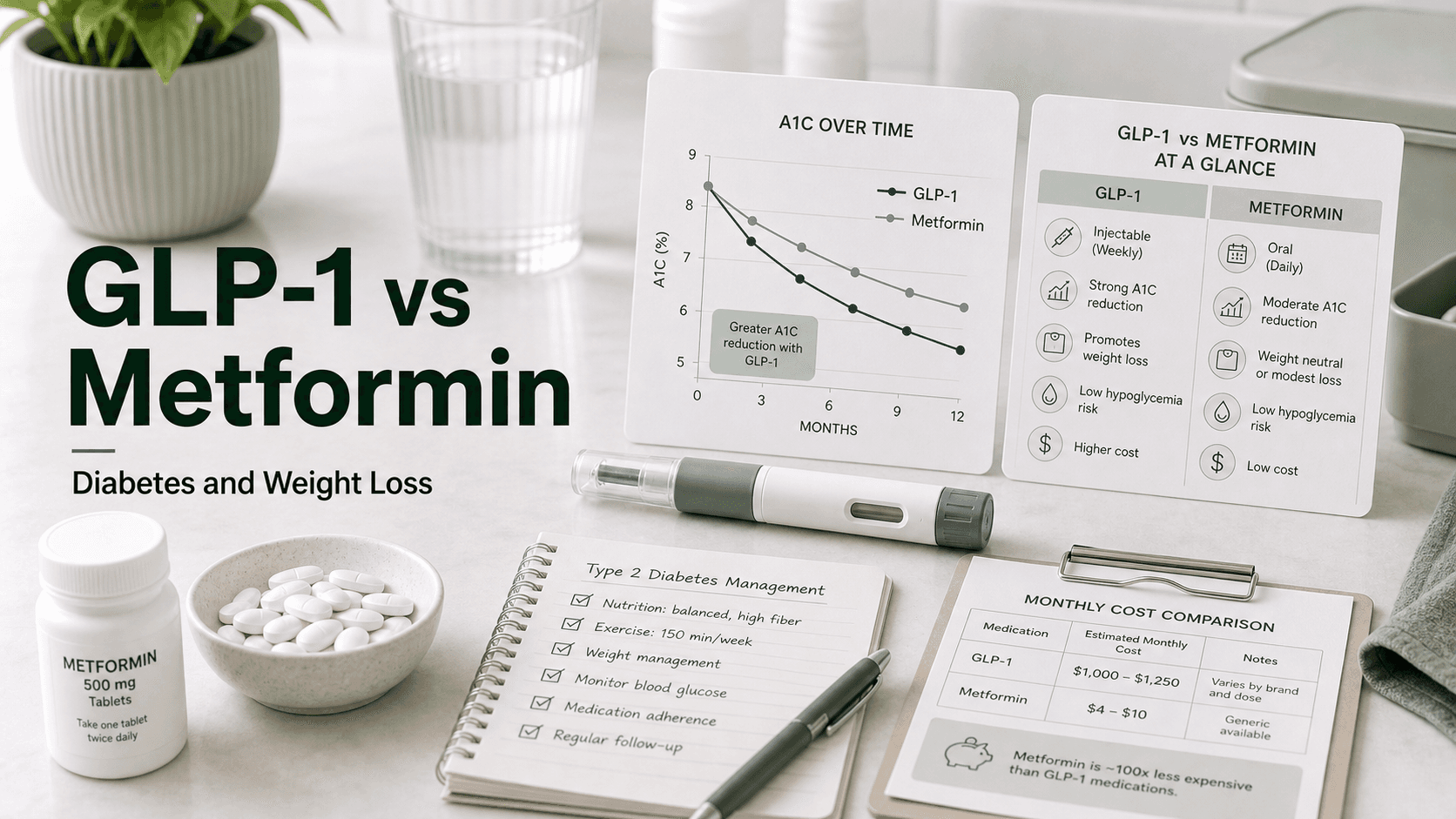
Metformin has been the default first pill for type 2 diabetes since Glucophage was approved in March 1995. It is dirt cheap, well understood, and works. GLP-1 receptor agonists are newer, drop A1C harder, and produce dramatically more weight loss — but at the manufacturers' own cash prices they cost 100 to 200 times as much per month, and most still rely on weekly injections. The honest answer is that this is rarely a true either/or decision: most patients end up taking both, because they treat type 2 diabetes through completely different mechanisms.
Direct answer: Metformin lowers blood sugar by reducing how much glucose the liver pumps out and by making muscle and fat tissue more sensitive to insulin. How much A1C it removes depends almost entirely on where you start: in the two randomized trials that tested it as monotherapy, metformin dropped HbA1c 0.51 percentage points from a 7.6% baseline over 52 weeks (AWARD-3) and 1.48 points from an 8.5% baseline over 26 weeks (DURATION-4), alongside about 2 kg (4-5 lb) of weight loss. Pharmacies acquire generic metformin for pennies — about $1.70 a month at 2,000 mg/day of the immediate-release tablet (CMS NADAC, August 2026). GLP-1 receptor agonists (semaglutide, tirzepatide, liraglutide) mimic an incretin hormone, triggering glucose-dependent insulin release, slowing gastric emptying, and quieting appetite. They produce 1.6 to 2.3 points of A1C reduction, depending on dose, baseline and whether they are added to metformin, and, in obesity trials that enrolled people without diabetes, 15-21% weight loss — for $149-499 per month at manufacturer cash prices, or as little as $25 with commercial coverage. The 2026 ADA Standards of Care still call metformin effective, safe and inexpensive, but now state that for people with diabetes and overweight or obesity "the preferred pharmacotherapy should be a glucagon-like peptide 1 receptor agonist or dual glucose-dependent insulinotropic polypeptide and glucagon-like peptide 1 receptor agonist with greater weight loss efficacy (i.e., semaglutide or tirzepatide)" (Recommendation 8.18, grade A) — which describes most of them.
Is Metformin a GLP-1?
No. Metformin is not a GLP-1, not a GLP-1 receptor agonist, and not an incretin drug of any kind. It is a biguanide — a small molecule, molecular weight 165.63 as the hydrochloride salt, first approved in the US in 1995. Its FDA label describes the mechanism as decreasing hepatic glucose production, decreasing intestinal absorption of glucose, and improving insulin sensitivity, with insulin secretion left unchanged.
GLP-1 receptor agonists (GLP-1 RA, also written GLP-1RA) are a structurally different kind of drug: molecules that bind and switch on the GLP-1 receptor itself. Most are engineered peptides — the Trulicity label states that the GLP-1 analog portion of dulaglutide "is 90% homologous to native human GLP-1 (7-37)", grafted onto an antibody Fc fragment to make a 63 kDa fusion protein. That is no longer the whole class: orforglipron, approved as Foundayo on 1 April 2026 for chronic weight management, is a once-daily small-molecule GLP-1 receptor agonist taken as a tablet.
| Metformin | GLP-1 receptor agonist | |
|---|---|---|
| Drug class | Biguanide | Incretin mimetic (GLP-1 receptor agonist) |
| Molecule | Small molecule, MW 165.63 | Engineered peptide for most; orforglipron is a small molecule |
| Binds the GLP-1 receptor? | No | Yes — that is the entire mechanism |
| Delivery | Daily pill | Weekly or daily shot; semaglutide and orforglipron also come as daily tablets |
| Examples | Generic metformin IR and ER, originally Glucophage | Ozempic, Wegovy, Trulicity, Victoza, Saxenda, Foundayo; Mounjaro and Zepbound add GIP. Rybelsus is being discontinued and replaced by Ozempic tablets |
| FDA-approved for weight management | No | Yes for Wegovy (injection and tablets), Saxenda, Zepbound and Foundayo |
Where the confusion comes from is real biology, not marketing. Metformin does nudge your own GLP-1 upward. In people with type 2 diabetes, metformin raises plasma intact GLP-1, mostly by stimulating secretion from gut L-cells, with a smaller contribution from reduced soluble DPP-4 activity. That is an indirect, modest, downstream effect on a hormone you already make. A GLP-1 RA does something categorically different: it replaces that hormone with an engineered version that survives DPP-4 and keeps the receptor switched on for days.
So the short answer to "what is the difference between GLP-1 and metformin": different drug class, different molecule, different target, usually a different delivery route, and — at the high end of GLP-1 dosing — a much larger weight effect. That last gap is estimated across separate trials, not measured in one, and the size of it is covered further down. They are also routinely prescribed together.
GLP-1 and Metformin Side By Side
| Metformin | GLP-1 RA (semaglutide) | Dual GIP/GLP-1 (tirzepatide) | |
|---|---|---|---|
| Drug class | Biguanide | Incretin mimetic | Dual incretin mimetic |
| FDA approval | 1995 (US) | 2017 (Ozempic) | 2022 (Mounjaro) |
| Form | Oral pill | Weekly injection (or daily pill) | Weekly injection |
| Typical dose | 500-2,000 mg/day | 0.25-2.4 mg/week (7.2 mg for Wegovy HD) | 2.5-15 mg/week |
| A1C reduction at top dose | -0.5 to -1.5%, depending on baseline | -1.6% as monotherapy; -2.2% at 2 mg on background metformin | -1.7% as monotherapy; -2.3% added to metformin |
| Weight loss | 2-2.2 kg in monotherapy trials | ~15% at 68 weeks (STEP-1, adults without diabetes) | ~21% at 72 weeks (SURMOUNT-1, adults without diabetes) |
| Cost (manufacturer cash, US) | ~$2-4/month generic | $149-499/month | $299-499/month |
| Hypoglycemia risk alone | Very low | Very low | Very low |
| Cardiovascular benefit | Reduces CV events and death (ADA 2026) | Proven vs placebo (SUSTAIN-6, SELECT) | Noninferior to dulaglutide (SURPASS-CVOT, 2025); no placebo-controlled CV trial |
| FDA-approved for weight loss | No (off-label) | Yes (Wegovy) | Yes (Zepbound) |
| First-line in ADA 2026? | Yes (effective, safe, inexpensive) | Preferred if overweight/obesity is present | Preferred if overweight/obesity is present |
Two rows need reading carefully. The A1C row compares numbers from trials with different baselines and different background therapy — that is not the same as a head-to-head result, and the section below unpacks it. The last row reflects a real shift: the ADA no longer mandates a metformin-first sequence. The 2026 Standards describe metformin as the medication that "historically has been the first-line treatment for type 2 diabetes" and reserve it for patients who "do not have additional considerations informing choice of therapy beyond need for glucose lowering."
How Metformin Actually Works
Metformin is the only widely used biguanide, and despite 60+ years in clinical use, its full mechanism is still being mapped. The accepted mechanism has three layers:
- Suppresses hepatic glucose production. The liver normally drips glucose into the bloodstream between meals and overnight. In type 2 diabetes, this drip is excessive. Metformin reduces it, lowering fasting blood sugar significantly.
- Improves insulin sensitivity in muscle and fat. Metformin makes existing insulin work better, partly through activating AMP-activated protein kinase (AMPK).
- Slows intestinal glucose absorption and modestly increases gut GLP-1 release — which is why some of metformin's benefit overlaps with the GLP-1 drugs.
It does not stimulate insulin secretion — the label states that "insulin secretion remains unchanged" — which is why metformin alone almost never causes hypoglycemia. Blood sugar can only go as low as the body's own counter-regulatory hormones allow.
How GLP-1 Receptor Agonists Actually Work
GLP-1 (glucagon-like peptide-1) is an incretin hormone secreted by gut L-cells in response to food. Native GLP-1 is destroyed by the enzyme DPP-4 within minutes, which is why it took protein engineering to turn it into a usable drug. GLP-1 RAs are modified peptides (or, in orforglipron's case, a small molecule) that resist DPP-4 and act for hours to days.
Activating the GLP-1 receptor:
- Triggers glucose-dependent insulin release from the pancreas — only when blood sugar is high
- Slows gastric emptying so meals enter the bloodstream gradually
- Suppresses glucagon so the liver does not dump glucose
- Quiets food noise — intrusive thoughts about food driven by the hypothalamus
- Reduces caloric intake. In two small crossover studies measuring what people actually ate, ad libitum energy intake fell 24% on semaglutide 1 mg and 35% on semaglutide 2.4 mg versus placebo
- May protect heart and kidney tissue (SUSTAIN-6, SELECT, FLOW outcome trials; kidney protection is now in the Ozempic label)
Tirzepatide adds a second receptor — GIP. The idea that GIP agonism blunts nausea comes from animal work, and it did not show up in the one trial that pitted the two drugs against each other: in SURPASS-2, nausea occurred in 17-22% of tirzepatide patients versus 18% on semaglutide 1 mg. What tirzepatide clearly did do in that trial is lower A1C further (-2.3% vs -1.9%) and roughly double weight loss (-11.2 kg vs -5.7 kg). See our GLP-1 and GIP deep dive for the receptor-level pharmacology.
A1C Reduction: GLP-1 Wins, But Not By As Much As You'd Think
The spread is real but smaller than the marketing implies — and it shrinks further once you match trials on baseline A1C, because every diabetes drug removes more A1C from a higher starting point. Compare the metformin rows below: the same drug at essentially the same dose produced nearly three times more A1C reduction in the trial that started at 8.5%.
| Drug | A1C reduction at max dose | Baseline A1C | Trial reference |
|---|---|---|---|
| Metformin 1,500-2,000 mg | -0.51% at 52 weeks | 7.6% | AWARD-3, monotherapy |
| Metformin 2,000 mg | -1.48% at 26 weeks | 8.5% | DURATION-4, monotherapy |
| Liraglutide 1.8 mg | -1.1% at 52 weeks | 8.2% | Victoza label, monotherapy vs glimepiride |
| Semaglutide 1 mg | -1.6% at 30 weeks | 8.1% | Ozempic label, monotherapy vs placebo |
| Semaglutide 2 mg | -2.2% at 40 weeks | 8.9% | SUSTAIN FORTE, added to metformin |
| Tirzepatide 15 mg | -1.7% at 40 weeks | 7.9% | Mounjaro label (SURPASS-1), monotherapy |
| Tirzepatide 15 mg | -2.3% at 40 weeks | 8.3% | SURPASS-2, added to metformin |
Only the first two rows come from trials that had a metformin arm; the rest had no metformin comparator at all. Read down the monotherapy rows at comparable baselines and the gap between metformin and the strongest incretin drugs narrows to well under a full point of A1C — far from the two-point spread you get by setting a metformin trial that started at 7.6% against an add-on tirzepatide trial that started at 8.3%.
A Danish nationwide cohort study of drug-naive patients (1,778 per matched group) found GLP-1 RA first-line therapy produced a 2.59 mmol/mol greater A1C drop in people with prediabetes and 3.79 mmol/mol in people with diabetes, and a 33% lower risk of needing add-on therapy at 1 year among the diabetes group (relative risk 0.67, 95% CI 0.37-0.98). This is observational: patients were not randomized, so prescribing choices rather than the drugs themselves may explain part of the difference.
The numbers are honest but the bigger truth is that for many newly diagnosed patients, metformin alone can bring A1C below 7% if started early. The case for a GLP-1 over metformin gets stronger as starting A1C climbs and as BMI climbs.
What Head-to-Head Trials Actually Found
Every table above pools results from separate trials run in different patients at different baselines. That is how nearly all "GLP-1 vs metformin" numbers online are built, and it inflates the gap. Only two large randomized trials have put a GLP-1 RA directly against metformin as monotherapy, in the same patients, at the same starting point. Both are worth reading, because the head-to-head results are far more modest than the cross-trial ones. (Trials report the test as HbA1c; US labs and this article call the same measurement A1C.)
AWARD-3: dulaglutide (Trulicity) vs metformin, 52 weeks
AWARD-3 randomized 807 adults with early type 2 diabetes — mean HbA1c 7.60%, mean BMI 33.3 kg/m², mean weight 92.3 kg, mean diabetes duration 2.6 years — to once-weekly dulaglutide or metformin tablets titrated to 2,000 mg/day (at least 1,500 mg/day) over 52 double-blind weeks.
| Outcome (AWARD-3) | Dulaglutide 1.5 mg/week | Dulaglutide 0.75 mg/week | Metformin 1,500-2,000 mg/day |
|---|---|---|---|
| HbA1c change, 26 weeks (primary) | -0.78% | -0.71% | -0.56% |
| HbA1c change, 52 weeks | -0.70% | -0.55% | -0.51% |
| Reached HbA1c <7.0% at 52 weeks | 60.0% | 53.2% | 48.3% |
| Reached HbA1c ≤6.5% at 52 weeks | 42.3% | 34.7% | 28.3% |
| Weight change, 26 weeks | -2.29 kg | -1.36 kg | -2.22 kg |
| Weight change, 52 weeks | -1.93 kg | -1.09 kg | -2.20 kg |
| BMI change, 52 weeks | -0.73 kg/m² | -0.42 kg/m² | -0.83 kg/m² |
| Nausea over 52 weeks | 19.7% | 11.5% | 16.0% |
| Diarrhea over 52 weeks | 11.5% | 9.6% | 14.6% |
Dulaglutide 1.5 mg beat metformin on HbA1c, and the margin at the 26-week primary endpoint was 0.22 percentage points. It did not beat metformin on weight: metformin was numerically ahead at one year on both kilograms and BMI. No severe hypoglycemia occurred in any arm. Note that AWARD-3 tested dulaglutide at 1.5 mg; the Trulicity label now allows escalation to 4.5 mg weekly, above anything this trial measured. Figures above are from the published paper and the posted trial results.
DURATION-4: exenatide once weekly vs metformin, 26 weeks
DURATION-4 randomized 820 drug-naive patients with a higher baseline HbA1c of 8.5% and mean weight of 87.0 kg to exenatide once weekly 2.0 mg (n = 248), metformin 2,000 mg/day (n = 246), pioglitazone 45 mg/day (n = 163), or sitagliptin 100 mg/day (n = 163).
| Outcome (DURATION-4, 26 weeks) | Exenatide once weekly 2 mg | Metformin 2,000 mg/day |
|---|---|---|
| HbA1c change | -1.53% | -1.48% (P = 0.62) |
| Weight change | -2.0 kg | -2.0 kg (P = 0.89) |
Exenatide once weekly was non-inferior to metformin on HbA1c and identical on weight. Its most common adverse events were nausea (11.3%) and diarrhea (10.9%); metformin's were diarrhea (12.6%) and headache (12.2%). Minor confirmed hypoglycemia was rare in both arms and no major hypoglycemia occurred.
Why this does not settle the weight-loss question
Both trials used first-generation weekly GLP-1 RAs. Randomized head-to-head, the glycemic gap over metformin is 0 to about 0.25 percentage points of HbA1c and the weight gap is roughly zero.
The dramatic 15-21% figures belong to semaglutide 2.4 mg and tirzepatide, which are much more potent than dulaglutide 1.5 mg or exenatide — and neither has been randomized against metformin monotherapy in any published trial. STEP-1 and SURMOUNT-1 were placebo-controlled and enrolled adults without diabetes. The SURPASS trials used placebo (SURPASS-1 and -5), insulin degludec, insulin glargine or semaglutide 1 mg as comparators, and in most of them metformin was running in the background of both arms. So both sets of numbers are real, but the semaglutide-or-tirzepatide-versus-metformin comparison is a cross-trial estimate, not a head-to-head result, and the tables in this article should be read that way.
Weight Loss: This Is Where the Gap Is Enormous
Metformin produces modest, real weight loss. In the Diabetes Prevention Program, adults with prediabetes taking 850 mg twice daily lost an average of 2.1 kg (about 4.6 lb) over 2.8 years, against 0.1 kg on placebo. The two head-to-head diabetes trials above put it at 2.0-2.2 kg. The mechanism appears to involve mild appetite suppression and gut microbiome shifts, not just glucose control.
GLP-1 drugs are in a completely different category:
| Drug | Average weight loss at top dose | Trial |
|---|---|---|
| Metformin 1,700 mg | -2.1 kg (~4.6 lb, ~2%) over 2.8 years | Diabetes Prevention Program, adults with prediabetes |
| Liraglutide 3 mg (Saxenda) | -8.0% (8.4 kg) at 56 weeks | SCALE Obesity and Prediabetes; -6.0% in the type 2 diabetes trial |
| Semaglutide 2.4 mg (Wegovy) | -14.9% at 68 weeks | STEP-1, adults without diabetes |
| Tirzepatide 15 mg (Zepbound) | -20.9% at 72 weeks | SURMOUNT-1, adults without diabetes |
Read across trials, that is roughly a 7-10x weight-loss advantage for high-dose GLP-1 drugs — with two caveats: no trial has ever randomized those doses against metformin, and both obesity trials excluded people with type 2 diabetes, so the figures do not transfer directly to the population this comparison is about. For a 220 lb patient, the arithmetic works out to about 5 lb on metformin versus 33-46 lb on semaglutide or tirzepatide.
Metformin's weight-loss reputation is solid but oversold. It is a metabolic helper, not a weight-loss drug. The ADA puts the same point plainly: metformin is "associated with weight loss, although the magnitude of weight loss is much smaller (<5% body weight loss)."
What the 2026 ADA Standards Actually Say
The 2026 ADA Standards of Care set out a clear hierarchy for type 2 diabetes pharmacotherapy:
- Metformin remains endorsed as effective, safe, inexpensive and widely available, and the Standards credit it with reducing "risks of microvascular complications, cardiovascular events, and death." It is the default when nothing else about the patient dictates a different class.
- For people with diabetes and overweight or obesity, "the preferred pharmacotherapy should be a glucagon-like peptide 1 receptor agonist or dual glucose-dependent insulinotropic polypeptide and glucagon-like peptide 1 receptor agonist with greater weight loss efficacy (i.e., semaglutide or tirzepatide)" (Recommendation 8.18, grade A).
- For patients with established atherosclerotic cardiovascular disease, heart failure, or chronic kidney disease, an SGLT2 inhibitor or GLP-1 RA with demonstrated benefit is recommended — explicitly "irrespective of A1C" (Recommendations 9.7 to 9.11).
- When metformin alone is insufficient, the Standards state that "addition of GLP-1 RAs or the dual GIP and GLP-1 RA to metformin usually results in 1% to ≥2% lowering of A1C."
- Recommendation 9.18 says do not combine a GLP-1 RA with a DPP-4 inhibitor: concurrent use "is not recommended due to lack of additional glucose lowering beyond that of a GLP-1-based therapy."
The net: metformin is no longer the required first step, but it remains the most cost-effective default when nothing else dictates a different choice.
Side Effect Profiles: Both Hit the Gut, Differently
Both classes are dominated by GI side effects. The timing and texture differ. The rates below come from each drug's own label, which means they are not head-to-head comparisons — the metformin and semaglutide numbers were collected in different trials with different placebo rates.
| Side effect | Metformin | Semaglutide |
|---|---|---|
| Nausea | 26% on immediate-release, 7% on extended-release (label counts nausea and vomiting together) | 16-20% on Ozempic, 44% on Wegovy 2.4 mg |
| Diarrhea | 53% on immediate-release, 10% on extended-release | 8.5% on Ozempic, 30% on Wegovy 2.4 mg |
| Vomiting | Counted with nausea on the label | 5-9% on Ozempic, 24% on Wegovy 2.4 mg |
| Bloating, gas | Flatulence 12% on immediate-release | Flatulence 6%, eructation 7% on Wegovy |
| Hypoglycemia (alone) | Does not stimulate insulin secretion; rare without a sulfonylurea or insulin | 0% severe as monotherapy in the Ozempic label |
| Vitamin B12 deficiency | ~7% drop to subnormal B12 in 29-week trials; after 13 years of use, 7.4% frankly low and 20.3% low or borderline-low (DPPOS) | None |
| Lactic acidosis | Boxed warning; pooled trial and cohort data found no cases in 70,490 patient-years, upper bound 4.3 per 100,000 patient-years (Cochrane) | None |
| Pancreatitis signal | None | Label warning: acute pancreatitis "has been observed in patients treated with GLP-1 receptor agonists, including WEGOVY"; no incidence rate is given |
| Gallbladder issues | None | "Associated with an increased occurrence of cholelithiasis and cholecystitis"; cholelithiasis reached 4% vs 0% on placebo in the adolescent trial, and the label notes rates were higher in adolescents than adults |
| Thyroid C-cell concern | None | Boxed warning — "in rodents, semaglutide causes dose-dependent and treatment-duration-dependent thyroid C-cell tumors"; human relevance undetermined |
Metformin's diarrhea is often the deal-breaker, and the extended-release label reports far lower GI rates than the immediate-release one, though the two were measured in separate trials rather than against each other. GLP-1 nausea typically improves after the first 4-8 weeks at each dose if titration is slow.
Cost: This Is the Real Decision Driver for Many Patients
This is where the comparison stops being subtle. Manufacturer cash prices for the GLP-1 drugs changed substantially through 2025 and 2026, so the figures below are the prices the manufacturers themselves published as of August 2026, not list prices. If a GLP-1 is where you are heading, our guide to where to buy semaglutide ranks each route by what you actually pay.
| Drug | Manufacturer or acquisition price | With commercial insurance | Cash / self-pay |
|---|---|---|---|
| Metformin IR generic | $0.014 per 500 mg tablet (NADAC, 19 Aug 2026) — about $1.70/month at 2,000 mg/day | Generic tier | Retail cash price is that acquisition cost plus the pharmacy's dispensing fee |
| Metformin ER generic | $0.029 per 500 mg tablet (NADAC, 19 Aug 2026) — about $3.45/month at 2,000 mg/day | Generic tier | Retail cash price is that acquisition cost plus the pharmacy's dispensing fee |
| Ozempic (semaglutide) | — | As little as $25/month with the savings card | $199/month intro, then $349; $499 for the 2 mg pen; from $149 for Ozempic tablets |
| Wegovy (semaglutide 2.4) | — | As little as $25/month | $199/month intro, then $349; $399 for the 7.2 mg HD pen; $149-299 for Wegovy tablets |
| Mounjaro (tirzepatide) | — | $25 with the savings card | As low as $499/month through the card if insurance excludes it |
| Zepbound (tirzepatide) | — | Starting at $25 with the savings card | $299/month at 2.5 mg, $399 at 5 mg, $449 at 7.5-15 mg via LillyDirect |
| Compounded semaglutide or tirzepatide | Not an FDA-approved product | Not covered | Neither drug is on FDA's shortage list, and the shortage exemption that allowed pharmacies to compound copies no longer applies |
Medicare patients have their own route: both manufacturers run a GLP-1 Bridge program capping eligible Part D patients at $50 a month.
A year of generic metformin costs $21 (immediate-release) to $42 (extended-release) at pharmacy acquisition cost. A year of Wegovy at the manufacturer's standard $349 cash price is about $4,200. That is still a 100- to 200-fold spread, and it explains why many patients start metformin and only escalate to a GLP-1 when insurance covers it or when the clinical case is strong enough to justify out-of-pocket spend.
On compounding: FDA's compounding guidance states that compounders "may prepare compounded versions of a drug on FDA's drug shortages list if the compounded drug meets certain conditions detailed in federal law," and that compounded drugs "are not FDA-approved," meaning FDA "does not verify the safety, effectiveness or quality" before marketing. With the semaglutide and tirzepatide shortages resolved, that pathway is closed for routine copies of either drug. What is still legal to buy, and from whom, is covered in our guide to tirzepatide for sale.
Drug Interactions Worth Knowing
Per the metformin label:
Metformin:
- Iodinated contrast dye — hold metformin around imaging studies; risk of lactic acidosis if kidney function drops.
- Heavy alcohol — alcohol "potentiates the effect of metformin on lactate metabolism."
- Carbonic anhydrase inhibitors (topiramate, zonisamide, acetazolamide, dichlorphenamide) — additive acidosis risk.
- Cimetidine, ranolazine, vandetanib, dolutegravir — reduce metformin clearance and raise exposure.
GLP-1 RAs:
- Sulfonylureas and insulin — hypoglycemia risk goes up; the labels advise considering a dose reduction of the insulin secretagogue or insulin when starting.
- Oral medications — semaglutide delays gastric emptying and "has the potential to impact the absorption of concomitantly administered oral medications." In practice the label reports that injected semaglutide 1 mg did not affect absorption of oral drugs tested, while the semaglutide tablet raised levothyroxine exposure by 33%. Monitor rather than assume.
- DPP-4 inhibitors — no added benefit, do not combine.
Crucially, metformin and GLP-1 RAs have no meaningful interactions with each other and are very commonly used together.
Combination Therapy Is the Norm, Not the Exception
This is the part the "vs" framing hides. In real clinical practice, most patients prescribed a GLP-1 are already on metformin and stay on it. The mechanisms complement rather than overlap:
- Metformin addresses hepatic glucose output and insulin sensitivity — supply side.
- GLP-1 addresses post-meal insulin release, gastric emptying, and appetite — demand side.
Combination data:
- Adding a GLP-1 RA or dual GIP/GLP-1 RA to metformin "usually results in 1% to ≥2% lowering of A1C," per the 2026 ADA Standards. In SURPASS-2, tirzepatide 15 mg added to metformin cut HbA1c 2.3 points from a baseline of 8.3%.
- No trial has isolated the weight effect of adding metformin on top of a GLP-1, but metformin contributes about 2 kg of its own in monotherapy trials, so the combination should not lose ground versus the GLP-1 alone.
- A retrospective analysis of the TriNetX database found that patients on both metformin and a GLP-1 RA had a 39% lower incidence of adiposity-related cancers (HR 0.61) and 67% lower all-cause mortality (HR 0.33) than a propensity-matched group taking a DPP-4 inhibitor; metformin alone (HR 0.96) and a GLP-1 RA alone (HR 0.86) showed smaller reductions against the same comparator. This is observational data, not a randomized trial, and the comparator is DPP-4 inhibitor users rather than untreated patients.
- GI side effects can stack — most clinicians slow GLP-1 titration in patients on full-dose metformin.
The ADA 2026 algorithm assumes combination therapy from the start for many patients, not sequential monotherapy.
Who Is Best Suited for Each
Metformin first makes sense when:
- A1C is mildly elevated (7.0-8.0%) and BMI is normal or near-normal
- Cost is a primary concern and a GLP-1 cannot be afforded or covered
- The patient prefers oral medication and has no GI red flags
- Kidney function is adequate — the label says do not use metformin below an eGFR of 30 mL/min/1.73 m², and does not recommend initiating it between 30 and 45
- There is no current cardiovascular or kidney disease driving a specific drug class choice
A GLP-1 RA first (or added early) makes sense when:
- A1C is high (>8.5%) at diagnosis
- BMI is ≥27 and weight loss is a therapeutic goal
- Established ASCVD, heart failure with reduced ejection fraction, or CKD
- The patient has tried metformin and hit GI intolerance or insufficient response
- Cost coverage is in place via insurance, manufacturer savings, or direct cash programs
Tirzepatide specifically moves to first-line consideration when weight loss is the dominant clinical priority. Expect roughly 1.7 points of A1C reduction as monotherapy from a baseline near 8%, and about 2.3 points when it is added to metformin at a baseline of 8.3%.
Switching from Metformin to a GLP-1
In practice, "switching" is rarely all-or-nothing. The typical pattern:
- Continue metformin during GLP-1 initiation. The combination is the goal, not the stepping stone.
- Start the GLP-1 at the lowest dose (semaglutide 0.25 mg/week or tirzepatide 2.5 mg/week) for at least 4 weeks before any increase.
- Monitor A1C at 3 months. The ADA recommends reevaluating the medication plan every 3-6 months. If at target, stay there. If not, escalate the GLP-1 rather than the metformin.
- Reassess metformin only if GI side effects are unmanageable, kidney function drops, or A1C is at or below 6.5% on the combination and de-escalation is reasonable.
- Do not stop metformin without a plan. Metformin's glycemic effect disappears when it is withdrawn; the ADA advises against clinical inertia in either direction, and any de-escalation should be paired with follow-up A1C testing rather than assumed to be safe.
If cost or tolerability forces a choice between the two long-term, the question becomes whether weight loss or glycemic-mechanism breadth matters more. For many patients with T2D plus obesity, the GLP-1 wins both fights.
What People Get Wrong About GLP-1 vs Metformin
- "Metformin is obsolete now that we have Ozempic." Not true. Metformin remains endorsed in the 2026 ADA Standards, costs almost nothing, and adds independent benefit to a GLP-1.
- "GLP-1s only work for weight loss." Semaglutide and tirzepatide are FDA approved for type 2 diabetes; weight loss is a side effect of the same mechanism.
- "You can replace metformin with berberine." Berberine has weak comparative data and is not FDA approved. Metformin is still cheaper and far better studied.
- "You can't take both at the same time." You almost always can, and most patients do. There is no pharmacokinetic interaction.
- "GLP-1s cure diabetes." They control it. In the STEP-1 off-treatment extension, participants who had lost 17.3% of body weight on semaglutide 2.4 mg regained 11.6 percentage points of it — two-thirds — in the year after stopping, and cardiometabolic improvements reverted toward baseline.
- "Metformin causes hypoglycemia." Alone, no. Combined with insulin or sulfonylureas, yes.
- "All GLP-1s are equally strong as metformin." Liraglutide 1.8 mg cut HbA1c 1.1 points from an 8.2% baseline as monotherapy — in the same range as metformin from a similar baseline. Semaglutide and tirzepatide are stronger.
Frequently Asked Questions
Is metformin or a GLP-1 better for type 2 diabetes? For pure A1C reduction, GLP-1 RAs (especially tirzepatide) win at the high end of dosing. For cost, simplicity, and decades of safety data, metformin wins. The 2026 ADA position is that both are appropriate first-line options depending on the patient, with a GLP-1 RA or dual GIP/GLP-1 RA preferred when overweight or obesity is in the picture.
Can you take metformin and Ozempic together? Yes. This is one of the most common combinations in type 2 diabetes management. They work through different mechanisms and have no clinically significant interaction. GI side effects can be additive.
Will I lose more weight on metformin or semaglutide? Semaglutide, by a wide margin — but the comparison is assembled from separate trials, not a head-to-head. Semaglutide 2.4 mg produced 14.9% weight loss over 68 weeks in adults without diabetes, while metformin produces roughly 2% in its own trials. No trial has randomized semaglutide 2.4 mg against metformin.
Is metformin first-line in 2026? Metformin remains a recommended option and the ADA still calls it effective, safe and inexpensive, but the 2026 Standards prefer a GLP-1 RA or tirzepatide when weight management is a goal, and call for an SGLT2 inhibitor or GLP-1 RA irrespective of A1C when ASCVD, heart failure, or CKD is present.
Why is metformin so much cheaper than a GLP-1? Metformin lost patent protection decades ago and is a simple small molecule — pharmacies acquire a 500 mg tablet for about 1.4 cents. Most GLP-1 RAs are engineered peptides that require injection-grade manufacturing and are still under patent. That is changing at the edges: orforglipron, approved in April 2026, is a small-molecule oral GLP-1 RA, though it is still a patented brand-name drug.
Can a GLP-1 replace metformin? Clinically, yes — many patients eventually use a GLP-1 as monotherapy when metformin is poorly tolerated, and both AWARD-3 and DURATION-4 tested exactly that design. But the 2026 ADA guidance and observational data both favor keeping metformin on board unless there is a reason to drop it.
Which one has fewer side effects? Both hit the gut, and which one is worse depends on the dose. Immediate-release metformin causes far more diarrhea (53% in its label trial, against 8.5% on Ozempic and 30% on Wegovy 2.4 mg). GLP-1s cause more nausea and vomiting at weight-management doses (44% and 24% on Wegovy 2.4 mg, against 26% nausea-or-vomiting on immediate-release metformin), especially during titration; at diabetes doses the gap narrows. Long-term, both are generally well tolerated by patients who get through the first 8-12 weeks.
Does metformin work for weight loss without diabetes? Modestly. In the Diabetes Prevention Program, adults with prediabetes on 850 mg twice daily lost an average of 2.1 kg (4.6 lb) over 2.8 years versus 0.1 kg on placebo — real but small. It is sometimes used off-label for PCOS and prediabetes.
Is metformin a GLP-1 medication? No. Metformin is a biguanide that lowers hepatic glucose output and improves insulin sensitivity. GLP-1 medications activate the GLP-1 receptor. Different class, different molecule, different target — and metformin is a pill, while most GLP-1 RAs are a weekly shot.
Does metformin raise your own GLP-1 levels? Yes, modestly. In type 2 diabetes, metformin increases plasma intact GLP-1, mainly by stimulating secretion from gut L-cells, with a smaller contribution from reduced soluble DPP-4 activity. That is a nudge to a hormone you already make, not receptor activation, and it does not make metformin a GLP-1 drug.
How does Trulicity 1.5 mg compare with slow-release metformin? AWARD-3 tested effectively that matchup for 52 weeks. Dulaglutide 1.5 mg once weekly cut HbA1c 0.70% versus 0.51% for metformin titrated to 2,000 mg/day, while metformin edged it on weight (-2.20 kg vs -1.93 kg). The trial used standard metformin tablets rather than the extended-release form, but slow-release metformin delivers essentially the same 24-hour drug exposure as immediate-release at the same daily dose — the FDA label's steady-state AUC is 26,811 vs 27,371 ng·hr/mL — so extended-release is a tolerability formulation, not a stronger one. Net: about 0.2 percentage points more HbA1c reduction, one injection a week instead of a daily pill, no generic option, and a brand-name price set against the roughly $3.45 a month that pharmacies pay for generic metformin ER.
Which GLP-1 drugs have actually been compared with metformin head-to-head? Dulaglutide (AWARD-3) and exenatide once weekly (DURATION-4), both as monotherapy in early type 2 diabetes. Semaglutide 2.4 mg and tirzepatide have not been. Any claim that they produce "5x the weight loss of metformin" is a comparison across separate trials.
Last reviewed: May 13, 2026
Sources
- 9. Pharmacologic Approaches to Glycemic Treatment: Standards of Care in Diabetes 2026 — ADA
- 8. Obesity and Weight Management for the Prevention and Treatment of Diabetes: Standards of Care in Diabetes 2026 — ADA
- Pharmacologic Approaches to Glycemic Treatment: Standards of Care in Diabetes 2025 — ADA
- Comparing GLP-1 receptor agonists versus metformin in drug-naive patients: A nationwide cohort study — Journal of Diabetes
- GLP-1 receptor agonists versus metformin nationwide cohort study — PMC
- 8 Major Differences Between Ozempic and Metformin — GoodRx
- How do Ozempic and Metformin compare for diabetes? — Drugs.com
- Metformin vs. semaglutide: A detailed comparison for weight loss and diabetes — NiceRx
- Efficacy and safety of semaglutide combined with metformin in T2DM with overweight or obesity — PMC
- Diabetes Medications as Monotherapy or Metformin-Based Combination Therapy — Annals of Internal Medicine
- Synergistic associations of metformin and GLP-1 receptor agonist use with adiposity-related cancer incidence — Diabetes, Obesity and Metabolism
- Metformin vs. GLP-1 Receptor Agonists: Which Diabetes Medication Is Right for You? — HealthCentral
- Ozempic vs. metformin: Differences, similarities, and which one is better — SingleCare
- Efficacy and safety of dulaglutide monotherapy versus metformin in type 2 diabetes in a randomized controlled trial (AWARD-3) — Diabetes Care
- AWARD-3 posted results, NCT01126580 — ClinicalTrials.gov
- Efficacy and safety of exenatide once weekly versus metformin, pioglitazone, and sitagliptin as monotherapy in drug-naive patients with type 2 diabetes (DURATION-4) — Diabetes Care
- Mechanism of increase in plasma intact GLP-1 by metformin in type 2 diabetes — Diabetes Research and Clinical Practice
- Tirzepatide versus semaglutide once weekly in patients with type 2 diabetes (SURPASS-2) — NEJM
- Cardiovascular outcomes with tirzepatide versus dulaglutide in type 2 diabetes (SURPASS-CVOT) — NEJM
- Efficacy and safety of once-weekly semaglutide 2.0 mg versus 1.0 mg (SUSTAIN FORTE) — The Lancet Diabetes & Endocrinology
- Once-weekly semaglutide in adults with overweight or obesity (STEP 1) — NEJM
- Weight regain and cardiometabolic effects after withdrawal of semaglutide: the STEP 1 trial extension — Diabetes, Obesity and Metabolism
- Tirzepatide once weekly for the treatment of obesity (SURMOUNT-1) — NEJM
- A randomized, controlled trial of 3.0 mg of liraglutide in weight management (SCALE Obesity and Prediabetes) — NEJM
- Efficacy of liraglutide for weight loss among patients with type 2 diabetes (SCALE Diabetes) — JAMA
- Reduction in the incidence of type 2 diabetes with lifestyle intervention or metformin (Diabetes Prevention Program) — NEJM
- Long-term metformin use and vitamin B12 deficiency in the Diabetes Prevention Program Outcomes Study — Journal of Clinical Endocrinology & Metabolism
- Risk of fatal and nonfatal lactic acidosis with metformin use in type 2 diabetes mellitus — Cochrane Database of Systematic Reviews
- Effects of once-weekly semaglutide on appetite, energy intake and control of eating — Diabetes, Obesity and Metabolism
- Effect of semaglutide 2.4 mg on energy intake, appetite and gastric emptying in adults with obesity — Diabetes, Obesity and Metabolism
- Metformin hydrochloride tablets, full prescribing information — DailyMed
- Metformin hydrochloride extended-release tablets, full prescribing information — DailyMed
- Trulicity (dulaglutide) injection, full prescribing information — DailyMed
- Ozempic (semaglutide) injection, full prescribing information — DailyMed
- Wegovy (semaglutide) injection and tablets, full prescribing information — DailyMed
- Mounjaro (tirzepatide) injection, full prescribing information — DailyMed
- Victoza (liraglutide) injection, full prescribing information — DailyMed
- Foundayo (orforglipron) tablets, full prescribing information — DailyMed
- Drugs@FDA: Glucophage (metformin) NDA 020357 approval history — FDA
- National Average Drug Acquisition Cost (NADAC) — CMS / Medicaid.gov
- NovoCare Pharmacy self-pay pricing for Ozempic and Wegovy — Novo Nordisk
- Wegovy savings offer — Novo Nordisk
- Zepbound coverage and savings — Eli Lilly
- Mounjaro savings and resources — Eli Lilly
- Compounding and the FDA: Questions and Answers — FDA
- FDA Drug Shortages database — FDA