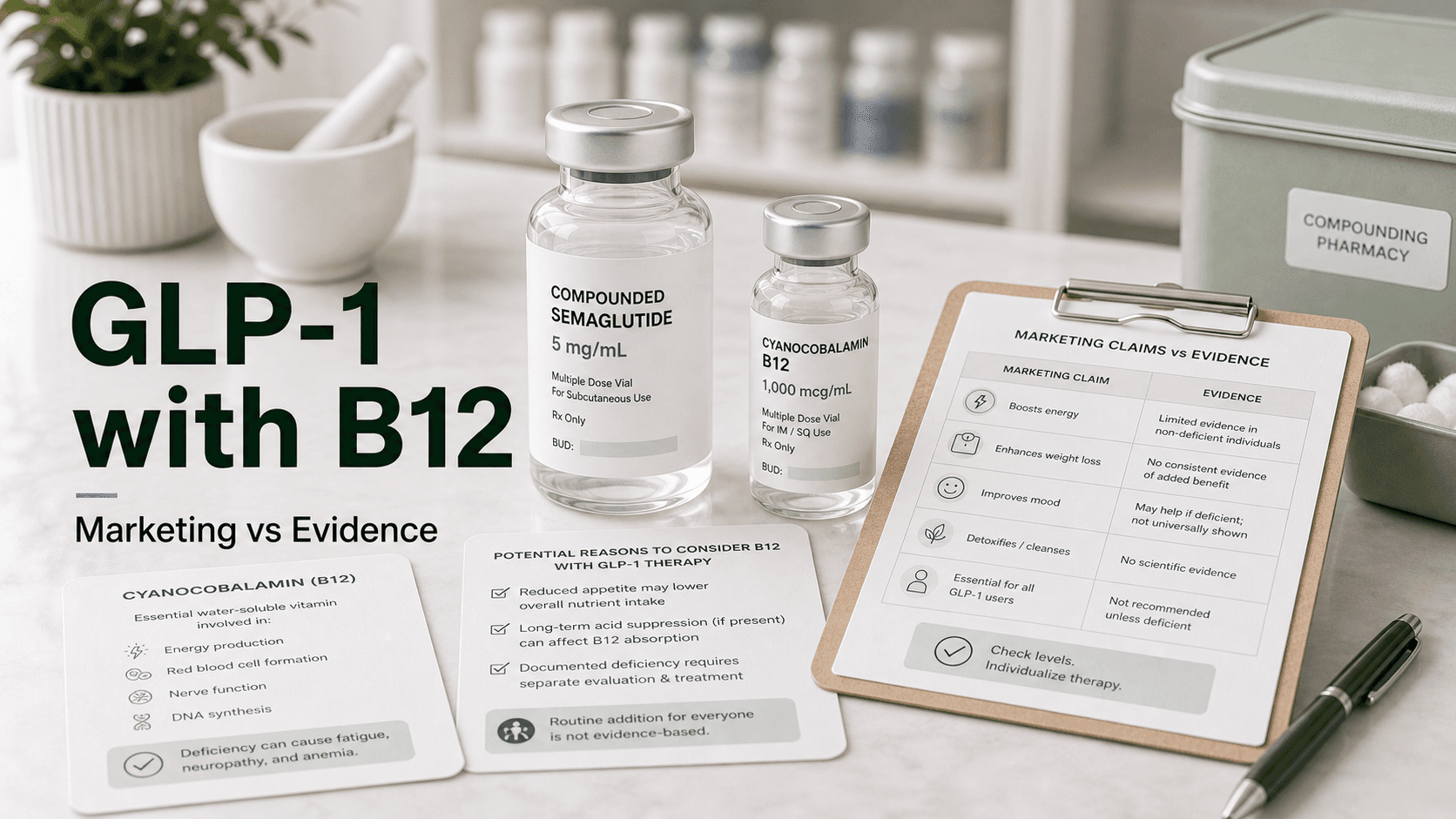
GLP-1 with B12: What the Combination Actually Does
From 2023 to 2025, almost every compounding pharmacy in the US was selling "semaglutide with B12" or "tirzepatide with B12" as a flagship product. The vials had a pale pink tint from added cyanocobalamin, the websites promised more energy and fewer side effects, and the price matched a plain compounded GLP-1. The pitch sold itself. The pharmacology did not match the pitch.
Direct answer: Adding vitamin B12 to compounded GLP-1 is primarily a marketing differentiator, not an evidence-backed weight loss boost. There are no controlled trials showing that B12 increases weight loss when mixed with semaglutide or tirzepatide. B12 only helps energy and metabolism if you are actually deficient — and most people on a GLP-1 are not. The typical compounded dose is 1000 mcg of methylcobalamin or cyanocobalamin per weekly injection, which is far more than the 2.4 mcg daily requirement. The deficiency risk on GLP-1s is real but uncommon, and it usually comes from eating less food, not from a direct drug interaction. If your B12 is normal, a $10 standalone tablet would do the same job — or no job at all — for a fraction of the cost.
Why Compounding Pharmacies Started Adding B12
The trend took off in 2023 and 2024 when 503A and 503B compounders were filling the semaglutide and tirzepatide shortage. Every pharmacy was selling roughly the same active ingredient at roughly the same price, so they needed a differentiator. B12 was the easy pick:
- It is cheap (a few cents per dose at wholesale)
- It is water-soluble with a very wide safety margin
- The pink color makes the vial look distinct
- It gives the marketing team a story about "energy" and "metabolism"
- B12 deficiency is a real, well-known concept the public already understands
The rationale offered to patients usually combined three claims: (1) GLP-1 drugs slow gastric emptying, which could reduce B12 absorption from food; (2) the energy support would offset GLP-1 fatigue; and (3) B12 helps cellular metabolism during weight loss. Each of those claims has a kernel of biological truth and a much smaller kernel of clinical evidence.
Does B12 Boost GLP-1 Weight Loss?
No. There are no head-to-head trials of compounded semaglutide-plus-B12 versus plain semaglutide. The 15.2% weight loss number that gets quoted in compounded-B12 marketing is the STEP-1 result for branded semaglutide alone, with no B12 added. B12 is being borrowed for credibility.
The mechanism does not work either. Semaglutide produces weight loss through GLP-1 receptor activation in the brainstem and hypothalamus — that pathway has nothing to do with B12. Tirzepatide adds GIP receptor activation, again unrelated to cobalamin. B12 supports red blood cell production, nerve myelination, and one-carbon metabolism. None of those pathways change how much weight you lose on a GLP-1.
| Question | Answer |
|---|---|
| Does B12 increase weight loss on semaglutide? | No controlled evidence |
| Does B12 reduce nausea on GLP-1? | No controlled evidence (theory only) |
| Does B12 reduce GLP-1 fatigue if you are not deficient? | No |
| Does B12 help if you are actually deficient? | Yes, regardless of GLP-1 |
| Is B12 in compounded GLP-1 a marketing differentiator? | Mostly yes |
B12 Deficiency Risk on GLP-1: Real but Uncommon
There is a plausible mechanism for B12 trouble on a GLP-1. Dietary B12 has to detach from food protein with the help of stomach acid, then bind to intrinsic factor produced by the gastric parietal cells, then get absorbed in the terminal ileum. GLP-1 drugs slow gastric emptying and modestly reduce acid production, so the front end of that chain could be affected.
In practice, the bigger factor is just eating less. People on Wegovy or Zepbound often cut intake by 30 to 40 percent. If that intake skews toward chicken breast, salad, and protein shakes — and away from red meat, eggs, dairy, and shellfish — B12 input drops. Add metformin (which independently impairs B12 absorption) or a proton pump inhibitor and the risk compounds.
Documented deficiency rates from GLP-1 monotherapy are low. The clearest signal comes from older liraglutide data showing roughly 10 to 15 percent of long-term users drifting into low-normal B12. That is a population where monitoring makes sense, not a population where prophylactic injectable B12 is mandatory.
Higher-risk groups on a GLP-1:
- Vegetarians and vegans (already low dietary B12)
- Adults over 60 (lower stomach acid baseline)
- People on metformin long-term
- People on PPIs or H2 blockers
- Post-bariatric patients
- Anyone with prior pernicious anemia or ileal disease
For everyone else, the practical move is a serum B12 (and ideally methylmalonic acid) at baseline and again at 6 to 12 months. If those numbers are normal, you do not need extra B12 in your vial.
Deficiency Symptoms Worth Watching
B12 deficiency can be subtle and is often blamed on the GLP-1 when it would have happened anyway. The signal cluster:
- Persistent fatigue that does not respond to sleep
- Tingling or numbness in hands or feet (peripheral neuropathy)
- Glossitis (smooth, sore, red tongue)
- Pale skin, shortness of breath on stairs (megaloblastic anemia)
- Memory fog, mood changes, irritability
- Balance problems in advanced cases
Most GLP-1 fatigue is not B12 deficiency. It is calorie restriction, dehydration, low sodium, or low protein intake. If you are eating 1100 calories a day and feel tired, the answer is usually more food and more electrolytes, not more cobalamin.
Cyanocobalamin vs Methylcobalamin
Both forms are used in compounded GLP-1 products, and the choice matters less than the marketing suggests.
| Form | Notes | Typical dose in compounds |
|---|---|---|
| Cyanocobalamin | Cheapest, most shelf-stable, FDA-monograph injectable form. The body cleaves off the cyanide group (a trivial amount) and converts to active forms | 1000 mcg per weekly dose |
| Methylcobalamin | Already in an active coenzyme form. Slightly better retention in some studies. More expensive | 1000 mcg per weekly dose |
| Hydroxocobalamin | Used in some European and prescription IM B12 products. Longest plasma half-life | Less common in GLP-1 compounds |
| Adenosylcobalamin | Other active coenzyme form. Rare in compounded injectables | Rare |
The NIH Office of Dietary Supplements has stated there is no good evidence absorption rates differ meaningfully between forms in healthy adults. For correcting deficiency, either works. Cyanocobalamin is the form you will see in most pharmacy compounds because it survives mixing and storage best.
Dosing in Compounded GLP-1 Products
The most common formulation is roughly 1000 mcg of B12 per weekly subcutaneous dose, sometimes expressed as 0.5 mg/mL at 2 mL fill volumes, or as a fixed 1 mg addition per vial. That is hundreds of times the 2.4 mcg daily oral RDA, but because B12 is water-soluble with a very wide safety margin, the excess simply gets excreted in urine. There is no meaningful toxicity ceiling for B12 in healthy adults.
Some pharmacies push higher doses (2500 to 5000 mcg) and frame it as a "loading" protocol. There is no clinical justification for that in someone with normal B12. For documented deficiency, the standard medical protocol is 1000 mcg IM every other day for one to two weeks, then weekly, then monthly — a regimen designed by hematologists, not by compounding marketing teams.
Semaglutide/Cyanocobalamin: What Is Actually in the Vial
"Semaglutide/Cyanocobalamin Injection" is the name most pharmacies print on the label. The same product gets sold as semaglutide with B12, sema/B12, or semaglutide/methylcobalamin when the compounder uses the methyl form. The name tells you the two ingredients. It does not tell you how much of the second one reaches you.
Empower Pharmacy, one of the larger US compounders, lists the product in two strengths — 1 mg/0.5 mg per mL and 5 mg/0.5 mg per mL of semaglutide/cyanocobalamin — as a ready-to-use refrigerated solution in 1 mL and 2.5 mL vials. Read the second number. The B12 is fixed at 0.5 mg per mL, which is 500 mcg per mL. You are not injecting a milliliter. You are injecting whatever volume delivers your semaglutide dose, and the B12 rides along in that same proportion.
Here is the arithmetic, assuming a ready-to-use solution (nothing to reconstitute, no diluent added) drawn into a U-100 insulin syringe where 1 mL = 100 units:
| Vial strength (semaglutide / B12) | Semaglutide dose | Volume drawn | Units on a U-100 syringe | Cyanocobalamin delivered |
|---|---|---|---|---|
| 1 mg / 0.5 mg per mL | 0.25 mg | 0.25 mL | 25 | 125 mcg |
| 1 mg / 0.5 mg per mL | 0.5 mg | 0.5 mL | 50 | 250 mcg |
| 5 mg / 0.5 mg per mL | 1 mg | 0.2 mL | 20 | 100 mcg |
| 5 mg / 0.5 mg per mL | 1.7 mg | 0.34 mL | 34 | 170 mcg |
| 5 mg / 0.5 mg per mL | 2.4 mg | 0.48 mL | 48 | 240 mcg |
Two things fall out of that table. First, the delivered dose is set by concentration times volume, not by the headline on the website. A pharmacy advertising "1000 mcg of B12" is describing either the total sitting in the vial or a far more concentrated formulation — not what this product gives you at a 0.25 mg starting dose, which is 125 mcg, about 18 mcg a day averaged across the week. Second, the relationship runs backwards on the concentrated vial: switching from the 1 mg/mL vial to the 5 mg/mL vial cuts your injection volume by five, so your weekly B12 falls while your semaglutide dose climbs.
None of that is a safety problem. B12 is water-soluble, injected B12 skips the intrinsic-factor bottleneck entirely, and the excess leaves in urine. It is a truth-in-labeling problem. Nobody can tell you your B12 dose from the product name — ask the pharmacy for the mcg per mL and multiply it by your injection volume. Empower's own product page states the obvious caveat that sits underneath all of this: compounded medications "are not FDA-approved medications, and FDA does not review compounded medications for safety or efficacy."
What Injectable B12 Is Actually Approved to Treat
The FDA-approved cyanocobalamin injection label — the monograph behind essentially every vitamin B-12 shot given in a US clinic — is narrow and specific. Cyanocobalamin injection is indicated for B12 deficiency due to malabsorption: pernicious anemia, gastrointestinal pathology or surgery including total or partial gastrectomy, gluten enteropathy or sprue, small bowel bacterial overgrowth, fish tapeworm, malignancy of the pancreas or bowel, and folic acid deficiency. Weight loss is not on that list. Neither is energy, metabolism, or GLP-1 support.
Four details from that label rarely make it onto a compounding pharmacy's product page:
- The labeled dose is 100 mcg, not 1000 mcg. For pernicious anemia the label specifies 100 mcg daily by intramuscular or deep subcutaneous injection for 6 to 7 days, then the same amount on alternate days for seven doses, then every 3 to 4 days for another 2 to 3 weeks, then 100 mcg monthly for life. US clinics default to 1000 mcg largely because the commercial vial is supplied at 1000 mcg/mL and the surplus is harmless — but the regimen the FDA actually approved is an order of magnitude smaller.
- Oral is the label's own fallback. Where requirements run above normal, the label says they "can usually be met with oral supplementation," and for patients with normal intestinal absorption it states that chronic treatment "should be with an oral B12 preparation."
- Never intravenous. In the label's words, "use of this product intravenously will result in almost all of the vitamin being lost in the urine."
- It is not a zero-risk ingredient. Sensitivity to cobalt or vitamin B12 is a contraindication, and the label warns that "anaphylactic shock and death have been reported after parenteral vitamin B12 administration." Multi-dose vials contain benzyl alcohol as a preservative.
The label also names the drugs that genuinely block B12 absorption — colchicine, para-aminosalicylic acid, and heavy alcohol intake for longer than two weeks. GLP-1s are not among them. Running the comparison from the other direction, semaglutide's prescribing information lists exactly two drug interactions: insulin or insulin secretagogues, and the delayed gastric emptying that can affect oral medications. On that second point the label reports that in clinical pharmacology trials, semaglutide 1 mg once weekly "did not affect the absorption of orally administered medications."
That finding covers the drugs tested, not the protein-bound B12 in a steak, which does need stomach acid to be released. But the crystalline B12 in a supplement tablet is not protein-bound — it behaves like a drug, not like food. The central argument for injecting B12 alongside your GLP-1 is that the GLP-1 blocks the oral route. The manufacturer's own pharmacology does not support it.
Standalone B12 vs Compounded Combo
If you decide you want B12, the standalone route is far cheaper and gives you control over dose, form, and frequency.
| Option | Cost per month | Pros | Cons |
|---|---|---|---|
| Compounded GLP-1 with B12 | Same as plain compounded GLP-1 ($150-$400) | One injection, no extra step | No dose flexibility, B12 amount fixed, B12 piggybacks on GLP-1 weekly cadence |
| Oral B12 1000 mcg daily | $5-$10 | Cheapest, easiest, fine for most people | Slightly slower correction in true deficiency |
| Sublingual B12 1000-2500 mcg | $10-$15 | Bypasses some gastric issues | Mostly absorbed via gut anyway |
| IM B12 1000 mcg monthly (clinic) | $20-$40 per shot | Reliable for documented deficiency | Requires clinic visit |
| Self-injected B12 1000 mcg | $10-$20 | Cheap, flexible | Another needle |
The 2024 Annals of Internal Medicine consensus on B12 repletion: high-dose oral B12 (1000-2000 mcg daily) is equivalent to intramuscular injection for almost all causes of deficiency, including pernicious anemia, because passive diffusion can absorb enough B12 at those doses without intrinsic factor. That single finding makes the "we have to inject it because GLP-1 blocks oral absorption" argument very weak.
Who Actually Benefits from B12 Supplementation on a GLP-1
A short, honest list:
- People with measured low B12 (serum < 200 pg/mL, or 200-300 with elevated MMA)
- Strict vegans and long-term vegetarians with no B12-fortified foods
- Adults over 60 with reduced stomach acid
- People on metformin for 4+ years
- People on long-term PPIs
- Post-bariatric surgery patients
- People with documented pernicious anemia or ileal resection
If none of those apply, B12 in your compounded vial is doing very little.
The Status of Compounded GLP-1 with B12 in 2026
The FDA's resolution of the semaglutide and tirzepatide shortages in 2025 changed the legal landscape. 503A pharmacies can still compound for individual patients with documented medical need (allergy to a branded ingredient, dose unavailable in branded form), but mass-market sales of compounded semaglutide and tirzepatide are not permitted as of the post-shortage rulings. Some telehealth brands have pivoted to "personalized" formulations that include B12, peptides like cyanocobalamin plus glycine, or low-dose naltrexone to argue clinical necessity for the compound. That argument is being contested in court.
The practical effect: if you are still being offered compounded semaglutide-plus-B12 in 2026, ask the prescriber to document the specific medical reason a branded GLP-1 cannot meet your needs. "It is cheaper" is not a valid basis under federal compounding law. If price is the driver, our guide to semaglutide cash prices without insurance covers the legal routes.
What People Get Wrong About GLP-1 with B12
- "The pink color means it is stronger." It means cyanocobalamin was added. Pure semaglutide is colorless.
- "B12 will boost my weight loss." No trial supports this.
- "B12 prevents GLP-1 nausea." Theoretical only. There is no evidence B12 changes nausea.
- "GLP-1s cause B12 deficiency in everyone." They do not. Deficiency is uncommon and usually multifactorial.
- "Injected B12 is the only way to absorb it on a GLP-1." High-dose oral B12 works for almost everyone, even with reduced intrinsic factor.
- "My fatigue is from low B12." Usually it is from undereating. Check the calorie and protein numbers first.
- "Compounded with B12 is the same as branded plus a B12 shot." Branded Wegovy and Zepbound are FDA-approved at known doses; compounded versions are not.
Frequently Asked Questions
Does adding B12 to semaglutide help you lose more weight? No controlled trial has shown a weight loss benefit from adding B12. Semaglutide alone produces about 15% weight loss in STEP-1 — B12 does not change that.
Why is my compounded semaglutide pink? The pink tint comes from added cyanocobalamin (vitamin B12). Pure semaglutide solution is clear.
How much B12 is in compounded GLP-1? Most pharmacies use 1000 mcg per weekly injection (sometimes labeled 0.5 mg/mL at 2 mL fill). Some go higher; there is no clinical justification for that in someone with normal B12.
Is methylcobalamin better than cyanocobalamin? Not meaningfully. Both correct deficiency. Cyanocobalamin is cheaper and more stable, which is why most pharmacies use it.
Should I get my B12 checked before starting a GLP-1? Yes if you are vegetarian, over 60, on metformin or a PPI, or have any deficiency symptoms. A baseline serum B12 (plus MMA if borderline) is cheap and informative.
Can I take oral B12 while on a GLP-1? Yes. A standard 1000 mcg daily oral tablet is sufficient for almost everyone, even with reduced intrinsic factor, because high-dose oral B12 is absorbed by passive diffusion.
Is compounded GLP-1 with B12 legal in 2026? Mass-market sales of compounded semaglutide and tirzepatide are restricted now that the shortages are resolved. Individual compounding with a documented clinical reason is still permitted; "added B12" alone is generally not considered sufficient justification.
Does B12 reduce semaglutide nausea? There is no clinical evidence that it does. Nausea management still relies on slow titration, smaller meals, hydration, and (when needed) ondansetron.
Do GLP-1s cause B12 deficiency? Not directly, and not in most people. The plausible mechanism — slower gastric emptying, slightly less acid, so less B12 released from food protein — is real but small. The bigger driver is eating 30 to 40 percent less food, especially if the food you dropped was meat, eggs, dairy, or shellfish. Risk stacks when metformin or a PPI is already in the picture. The answer is a serum B12 (plus methylmalonic acid if the result is borderline) at baseline and again at 6 to 12 months, not a vitamin added to your vial on the assumption that you will need it.
Can I get a separate B12 injection while I am on a GLP-1? Nothing in the semaglutide or tirzepatide labels prohibits it — their listed drug interactions are insulin and insulin secretagogues, and oral medications affected by delayed gastric emptying, not vitamins. Cyanocobalamin injection is given intramuscularly or by deep subcutaneous injection, so it is a separate shot on its own schedule and does not need to be timed to your GLP-1 day. The real question is whether you need one at all. If your serum B12 is normal, a weekly shot is treating a number that is not there, and if you are already on a semaglutide/cyanocobalamin combination product you are getting B12 twice.
Is semaglutide with methylcobalamin different from semaglutide with cyanocobalamin? In the vial, yes: methylcobalamin is already an active coenzyme form, cyanocobalamin is the stable synthetic form the body converts after injection. Clinically the difference is small enough that no outcome hangs on it — both correct deficiency. Cyanocobalamin is the form the FDA-approved injectable monograph covers and the form most pharmacies use because it is cheaper and more shelf-stable in a mixed solution. Methylcobalamin is usually priced as the premium option. Neither one adds weight loss.
Will B12 or glycine in a compounded GLP-1 help my blood pressure? No. Neither ingredient is a blood pressure treatment, and the FDA-approved cyanocobalamin injection label carries no cardiovascular indication at all. The hypothesis people reach for is homocysteine: B12 and folate lower it, and homocysteine tracks with vascular disease. That hypothesis has been tested directly. In the NORVIT trial (NEJM, 2006), 3,749 patients who had just had a heart attack were randomized to folic acid plus B12, with or without B6, or placebo. Homocysteine dropped 27 percent. The primary endpoint — recurrent myocardial infarction, stroke, or sudden cardiac death — did not move (RR 1.08, 95% CI 0.93–1.25), and the combined B-vitamin arm trended toward harm. Blood pressure does improve for many people on a GLP-1, but that comes from the drug and the weight loss, not from the vitamin in the syringe. Glycine is an amino acid used in injectable formulations, not an antihypertensive; treat it as part of the vehicle until someone shows you a trial.
Last reviewed: May 13, 2026
Sources
- Should You Take Semaglutide with Vitamin B12? — Healthline
- Compounded semaglutide with B12: Benefits and risks — SingleCare
- Everything You Need to Know About Compounded Semaglutide with B12 — Wellcore
- Semaglutide / Cyanocobalamin Injection — Empower Pharmacy
- Semaglutide with B12: Boost energy and enhance weight loss — NiceRx
- Semaglutide + B12 Dosage Chart for Weight Loss — NiceRx
- How Semaglutide Affects B12 Levels — BMI Doctors
- Vitamin B12 Fact Sheet for Health Professionals — NIH Office of Dietary Supplements
- Compounded Semaglutide with B12: Weight Loss & Benefits — IvyRx
- Cyanocobalamin Injection, USP — FDA Prescribing Information (DailyMed)
- Wegovy (semaglutide) — FDA Prescribing Information (DailyMed)
- Homocysteine Lowering and Cardiovascular Events After Acute Myocardial Infarction (NORVIT) — NEJM via PubMed