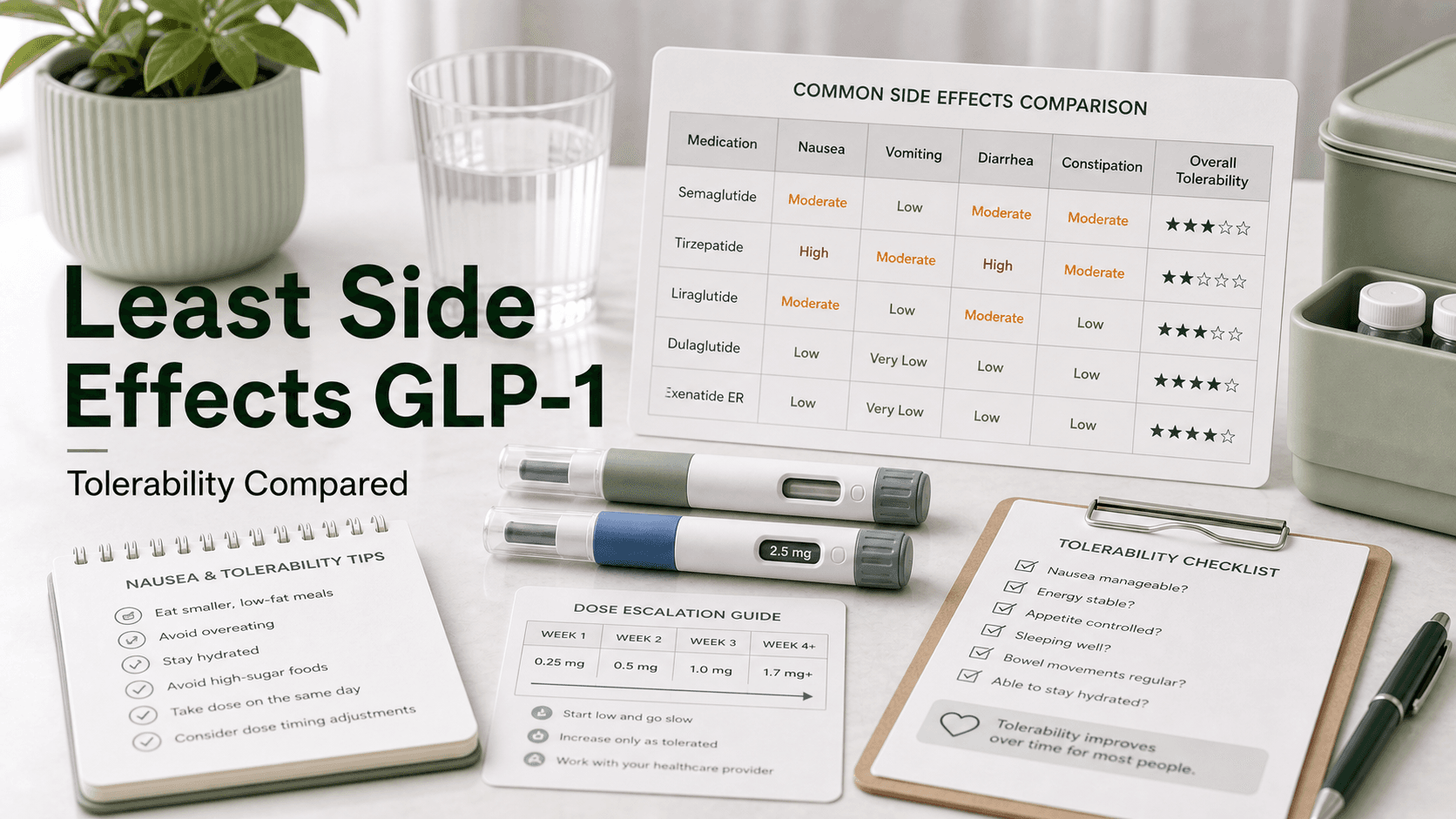
If two GLP-1 drugs are both effective, the one that lets you stay on therapy wins. Tolerability is what drives real-world outcomes, because the drug you quit at month three does not produce weight loss at month eighteen. The honest answer in 2026 is narrower than most comparison pages admit, because the two randomized head-to-head trials in this class do not name the winner that cross-trial rankings usually pick.
Direct answer: On the FDA labels, tirzepatide (Zepbound) posts the lowest nausea figure of any weight-management GLP-1 — 28% at 15 mg against 8% on placebo — while semaglutide (Wegovy) posts 44% at 2.4 mg against 16% on placebo. Those come from separate trials with separate placebo groups, and when the two drugs were compared inside one randomized trial, SURMOUNT-5, nausea was 43.6% on tirzepatide and 44.4% on semaglutide — no meaningful gap. Vomiting was the one clear difference (15.0% versus 21.3%); diarrhea was identical. Stopping for adverse reactions is also near-identical on the two labels: 6.7% for Zepbound 15 mg (placebo 3.4%) and 6.8% for Wegovy 2.4 mg (placebo 3.2%). The gentlest rows on any approved GLP-1 label are at diabetes doses, not obesity doses. Dose is the lever that actually moves these numbers.
Side Effect Comparison at Top Approved Dose
| Drug and dose (trial) | Nausea | Vomiting | Diarrhea | Placebo nausea, same trial | Reporting window |
|---|---|---|---|---|---|
| Tirzepatide 15 mg (SURMOUNT-1) | 31.9% | 12.9% | 23.7% | 9.8% | to week 193 |
| Semaglutide 2.4 mg (STEP 1) | 44.1% | 24.6% | 31.5% | 17.4% | to week 75 |
| Oral semaglutide 25 mg (OASIS 4) | 46.6% | 30.9% | 17.6% | 18.6% | to week 71 |
| Orforglipron 36 mg (ATTAIN-1) | 33.7% | 24.0% | 23.1% | 10.4% | to week 74 |
| Liraglutide 3.0 mg (SCALE) | 41.9% | 19.0% | 23.7% | 16.6% | to weeks 70–172 |
Every figure above is the count posted by the sponsor on ClinicalTrials.gov, divided by the number of patients dosed in that arm. Read the placebo column before the drug column. Tirzepatide's 31.9% nausea sits over a placebo group reporting 9.8%; semaglutide's 44.1% sits over a placebo group reporting 17.4%. That is a 22-point spread against a 27-point spread — a smaller difference than the raw numbers suggest. The trials also ran for different lengths, enrolled different populations and used different escalation schedules, so this is a table of five separate results, not a ranking. Two of these drugs have actually been compared inside one trial, and those results are further down this page.
Does the GIP Component Make Tirzepatide Easier to Tolerate?
This is the part most patients find counterintuitive. Tirzepatide is the more potent drug. It produces more weight loss than semaglutide. It would be reasonable to expect it to produce more nausea. On the labels it does not, and there is a plausible mechanism for that.
Tirzepatide is a dual GLP-1 and GIP (glucose-dependent insulinotropic polypeptide) receptor agonist. Semaglutide is GLP-1 only. In three animal species — mice, rats and musk shrews — GIP receptor signaling blocked emesis and blunted the illness behaviors that GLP-1 receptor activation produces, while preserving the drop in food intake and body weight. That work is preclinical. It is a hypothesis about why the labels differ, not evidence collected in humans.
The human evidence is more mixed than the label gap implies. In SURMOUNT-5, the only randomized comparison of the two drugs in obesity, nausea and diarrhea were the same in both arms. In SURPASS-2, which compared tirzepatide with semaglutide 1 mg in type 2 diabetes, tirzepatide 15 mg reported more nausea than semaglutide (22.1% versus 17.9%), more vomiting (9.8% versus 8.3%) and more diarrhea (13.8% versus 11.5%). A 2025 Bayesian network meta-analysis of 48 diabetes trials ranked tirzepatide highest for GI adverse events overall, though only one tirzepatide trial met its inclusion criteria.
So the fair summary is this: at obesity doses the labels favor tirzepatide on nausea, the head-to-head trial does not, and nobody should promise a specific patient a gentler ride on one molecule over the other. Roughly one in three tirzepatide users report nausea, and most of it lands during dose escalation.
Drug-By-Drug Tolerability
Tirzepatide (Zepbound, Mounjaro)
- Nausea: 28% at 15 mg on the Zepbound label, against 8% on placebo
- Vomiting: 13% (placebo 2%)
- Diarrhea: 23% (placebo 8%)
- Constipation: 11% (placebo 5%)
- Stopped for adverse reactions: 6.7% at 15 mg, against 3.4% on placebo
The Zepbound label reports that gastrointestinal reactions were no more common at 15 mg than at 5 mg — 56% at every maintenance dose, against 30% on placebo — but that stopping because of them rose with dose, from 1.9% at 5 mg to 3.3% at 10 mg to 4.3% at 15 mg. The label also states that most nausea, vomiting and diarrhea occurred during dose escalation and decreased over time, and that a patient who cannot tolerate a maintenance dose should be considered for a lower one.
Semaglutide (Wegovy, Ozempic)
- Nausea: 44% at 2.4 mg on the Wegovy label, against 16% on placebo
- Vomiting: 24% (placebo 6%)
- Diarrhea: 30% (placebo 16%)
- Constipation: 24% (placebo 11%)
- Stopped for adverse reactions: 6.8%, against 3.2% on placebo
Semaglutide carries an unusually large safety dataset for the class: the Wegovy label alone reports a cardiovascular outcomes trial in which 8,803 patients took the drug for a median of 37.3 months. The per-event numbers above are higher than tirzepatide's at the top dose, but so is the placebo column those numbers were measured against, and the discontinuation rate is the same to within a tenth of a point.
Oral Semaglutide (Wegovy oral tablets, Rybelsus)
- Nausea: 46.6% at 25 mg in OASIS 4, against 18.6% on placebo
- Vomiting: 30.9% (placebo 5.9%)
- Diarrhea: 17.6% (placebo 8.8%)
- Stopped for adverse reactions: 6.9% on the Wegovy tablet label, against 5.9% on placebo
The tablet is not a lower-exposure version of the injection. The Wegovy label states that in people with overweight or obesity without type 2 diabetes, semaglutide concentrations on the 25 mg tablet are predicted to be comparable to the 2.4 mg weekly injection, but far more variable — 90% of patients fall between 27 and 186 nmol/L on the tablet versus 51 and 110 nmol/L on the injection. In patients who do have type 2 diabetes, average tablet concentrations run lower than the injection, and the label warns that some of those patients may end up at subtherapeutic levels and should be considered for the injection instead. The tablet's own trial excluded people with type 2 diabetes.
The 25 mg tablet carries its own FDA label as Wegovy tablets. In its 64-week trial, 6.9% of tablet patients discontinued for adverse reactions against 5.9% on placebo, with 3.4% stopping for GI reactions specifically, and the label describes the type and frequency of common adverse reactions as similar to the 2.4 mg injection. The dosing rule survived approval intact: one tablet in the morning on an empty stomach with no more than 4 ounces of water, nothing else to eat, drink or swallow for 30 minutes afterward, and a 30-day hold at each step from 1.5 mg up to 25 mg.
Orforglipron (Foundayo)
- Nausea: 33.7% at 36 mg in ATTAIN-1, against 10.4% on placebo
- Vomiting: 24.0% (placebo 3.5%)
- Diarrhea: 23.1% (placebo 9.6%)
- Constipation: 25.4% (placebo 9.3%)
- Stopped for adverse reactions: 5.3% to 10.3% across the three orforglipron doses, against 2.7% on placebo
Foundayo reached the market on a different dose ladder than the ATTAIN-1 report uses. The approved tablet strengths are 0.8 mg, 2.5 mg, 5.5 mg, 9 mg, 14.5 mg and 17.2 mg, each step held for at least 30 days, with 17.2 mg once daily as the maximum dose. On the pooled label data for the two placebo-controlled weight-management trials, the 17.2 mg dose produced 35% nausea, 24% vomiting, 25% diarrhea and 24% constipation against a placebo group reporting 10%, 4%, 11% and 9%, and 10% of patients on that dose stopped for adverse reactions versus 3% on placebo, with 6% stopping specifically for GI reactions versus 0.7%. Match the strength printed on the bottle you actually hold before comparing yourself to any trial number.
Orforglipron is a non-peptide, small-molecule GLP-1 agonist. It does not require the SNAC absorption enhancer that oral semaglutide uses, and the label allows it to be taken with or without food. Its per-event nausea rate sits between tirzepatide's and semaglutide's, its vomiting rate is close to semaglutide's, and its discontinuation rate at the top dose is the highest of any weight-management GLP-1 label. It is a reasonable pick for needle-averse patients who want flexibility.
Liraglutide (Saxenda, Victoza)
- Nausea: 39.3% at 3.0 mg on the Saxenda label, against 13.8% on placebo
- Vomiting: 15.7% (placebo 3.9%)
- Diarrhea: 20.9% (placebo 9.9%)
- Constipation: 19.4% (placebo 8.5%)
- Stopped for adverse reactions: 9.8%, against 4.3% on placebo
Liraglutide is the original obesity GLP-1, and it and orforglipron sit at the top of the discontinuation range among approved options. Two reasons: it is a daily injection (more doses, more chances to feel a side effect), and its shorter half-life means plasma levels swing more day to day. It also produces less weight loss than the newer drugs, so the side-effect-to-benefit ratio is worse.
What the FDA Labels Report at the Approved Doses
Trial publications and FDA labels do not always print the same number for the same drug, because they pool different patients over different lengths of time. The table at the top of this page comes from sponsor-posted trial results. The one below comes from the prescribing information for each approved product, with the placebo column attached, which is the honest way to read a GI rate.
| Product and dose | Nausea | Vomiting | Diarrhea | Constipation | Placebo nausea | Stopped for adverse reactions |
|---|---|---|---|---|---|---|
| Zepbound 15 mg weekly | 28% | 13% | 23% | 11% | 8% | 6.7% (placebo 3.4%) |
| Wegovy 2.4 mg weekly | 44% | 24% | 30% | 24% | 16% | 6.8% (placebo 3.2%) |
| Wegovy 7.2 mg weekly | 39% | 22% | not reported | 20% | 13% | 5% (placebo 2%) |
| Wegovy 25 mg tablet daily | similar to the 2.4 mg injection | — | — | — | — | 6.9% (placebo 5.9%) |
| Foundayo 17.2 mg daily | 35% | 24% | 25% | 24% | 10% | 10% (placebo 3%) |
| Saxenda 3 mg daily | 39.3% | 15.7% | 20.9% | 19.4% | 13.8% | 9.8% (placebo 4.3%) |
Read the placebo column first. Wegovy's 44% nausea was measured against a placebo group reporting 16%. Zepbound's 28% was measured against a placebo group reporting 8%. The spread over placebo — 28 points for Wegovy 2.4 mg, 20 points for Zepbound 15 mg — is the share the drug is actually responsible for. These are still separate trials with separate populations, not a head-to-head, and the two drugs' discontinuation rates land within a tenth of a point of each other.
Two label details rarely make it into comparison articles:
- Wegovy 7.2 mg was tested against 2.4 mg inside the same trials, which makes it one of the few genuine within-trial dose comparisons in the class. Nausea rose from 35% to 39%, vomiting from 16% to 22%, hair loss from 3% to 6%, and dysesthesia — altered skin sensation, burning, pins and needles — from 6% to 22%. Discontinuation for adverse reactions was 5% in both arms.
- The Wegovy tablet's own trial excluded people with type 2 diabetes, and the label warns that tablet blood levels run lower and more variable in patients who do have type 2 diabetes, to the point that some may end up under-dosed. In people without diabetes, average semaglutide levels on the 25 mg tablet and the 2.4 mg injection are predicted to be comparable.
Which GLP-1 Is Gentlest at Diabetes Doses?
Every figure above comes from an obesity trial at an obesity dose. The same molecules are prescribed at lower doses for type 2 diabetes, and two more GLP-1s — dulaglutide and exenatide — are only sold at diabetes doses. If the question is which GLP-1 is easiest to tolerate rather than which produces the most weight loss, this is the table that answers it.
| Product and dose | Nausea | Vomiting | Diarrhea | Placebo nausea | Stopped for GI reactions |
|---|---|---|---|---|---|
| Rybelsus 7 mg daily | 11% | 6% | 9% | 6% | 4% (placebo 1%) |
| Mounjaro 5 mg weekly | 12% | 5% | 12% | 4% | 3.0% (placebo 0.4%) |
| Trulicity 0.75 mg weekly | 12.4% | 6.0% | 8.9% | 5.3% | 1.3% (placebo 0.2%) |
| Ozempic 0.5 mg weekly | 15.8% | 5.0% | 8.5% | 6.1% | 3.1% (placebo 0.4%) |
| Mounjaro 15 mg weekly | 18% | 9% | 17% | 4% | 6.6% (placebo 0.4%) |
| Victoza 1.8 mg daily | 20% | 9% | 12% | 5% | 4.3% of all GI withdrawals (placebo 0.5%) |
| Ozempic 1 mg weekly | 20.3% | 9.2% | 8.8% | 6.1% | 3.8% (placebo 0.4%) |
| Rybelsus 14 mg daily | 20% | 8% | 10% | 6% | 8% (placebo 1%) |
| Trulicity 1.5 mg weekly | 21.1% | 12.7% | 12.6% | 5.3% | 3.5% (placebo 0.2%) |
| Byetta 5–10 mcg twice daily | 44% | 13% | 13% | 18% | 3% for nausea, 1% for vomiting |
The lowest nausea figures on any approved GLP-1 label are clustered at the bottom of the dose range and within a couple of points of each other: oral semaglutide 7 mg at 11%, tirzepatide 5 mg at 12%, dulaglutide 0.75 mg at 12.4%. Dulaglutide holds the lowest GI discontinuation rate in the class at 1.3%, against 0.2% on placebo. The catch is the indication. Trulicity, Victoza, Byetta and Rybelsus are approved for use in type 2 diabetes, not for weight management, so the gentlest rows in this table belong to drugs no one prescribes for weight loss alone.
Exenatide sits at the other end. Twice-daily Byetta reported 44% nausea in its add-on trials, but against an unusually high 18% placebo rate in those same trials, and 3% of patients withdrew for nausea. Twice-daily exenatide and a generic version are still listed in the FDA's National Drug Code directory; the once-weekly form, Bydureon, no longer appears there.
The cleanest proof that dose drives tolerability more than molecule sits inside one drug. Liraglutide has two FDA labels. At 1.8 mg for diabetes, Victoza reports 20% nausea. At 3.0 mg for obesity, Saxenda reports 39.3%. Same peptide, same manufacturer, roughly double the dose, roughly double the nausea. Semaglutide repeats the pattern three times over: 11% on the 7 mg tablet, 20.3% at 1 mg on the Ozempic label, 44% at 2.4 mg on the Wegovy label.
The Side Effects That Are Not Nausea
"Least side effects" gets answered with GI rates because that is where the big numbers are. The rest of the label matters too, and the ranking changes depending on which line you care about.
| Effect | What the labels report |
|---|---|
| Injection-site reactions | Saxenda 13.9% vs 10.5% on placebo; Zepbound 6–8% vs 2%; Victoza about 2%. Oral products remove this line entirely |
| Hair loss | Zepbound 5% at 15 mg vs 1% on placebo; Wegovy 3% at 2.4 mg and 6% at 7.2 mg vs 1%; Foundayo 4–5% vs 2%; Ozempic lists alopecia among postmarketing reports, with no frequency attached |
| Altered skin sensation | Wegovy 2% at 2.4 mg, and 22% at 7.2 mg against 6% at 2.4 mg in the head-to-head trials |
| Resting heart rate | Ozempic raises it 2 to 3 bpm; Trulicity 2 to 4 bpm, with sinus tachycardia in 5.6% at 1.5 mg vs 3.0% on placebo |
| Gallstones | Ozempic 1.5% at 0.5 mg and 0.4% at 1 mg, none on placebo; exenatide 1.9% vs 1.4%; Trulicity 0.62 vs 0.56 events per 100 patient-years in its cardiovascular outcomes trial |
| Acute pancreatitis, adjudicated | Ozempic 0.3 vs 0.2 cases per 100 patient-years against comparator; Zepbound 0.2% vs 0.2% on placebo in the weight-loss pool |
| Hypoglycemia | Barely a factor alone, and a real one alongside a sulfonylurea: Byetta with a sulfonylurea 35.7% vs 3.3% on placebo, Foundayo with a sulfonylurea 7% vs 0.5% without one |
| Fatigue | Wegovy 11% vs 5%; Zepbound 7% vs 3%; Trulicity 5.6% vs 2.6% |
Three practical reads. If needles are the objection, the oral options delete an entire row. If a sulfonylurea is already in the regimen, hypoglycemia outranks nausea as the thing to plan around, and that conversation belongs with the prescriber before the first dose. And if you are climbing toward the highest semaglutide dose, the skin-sensation signal at 7.2 mg is the one item that behaves differently from every other side effect in the class, jumping nearly fourfold over the 2.4 mg arm rather than drifting up.
Titration Speed Matters More Than the Drug
The single largest tolerability lever is not which GLP-1 you choose. It is how fast you climb.
The best direct evidence is a randomized open-label pilot in 104 patients with type 2 diabetes, published in Diabetes Care in 2025. It compared the label-recommended semaglutide schedule (0.25 mg, 0.5 mg, 1 mg at four-week intervals) against a flexible one that started at roughly a tenth of the usual dose and rose in small weekly increments, pausing whenever GI symptoms appeared. Final doses were similar in both arms, but only 2% of the flexible group withdrew for GI adverse events versus 19% of the label group. Nausea was reported by 45.1% of the flexible arm and 64.2% of the label arm, a difference that did not reach statistical significance (P = 0.051). This was a small, open-label pilot at diabetes doses, not a 2,000-patient obesity trial, so treat it as a strong hint rather than a settled result.
If your prescriber is flexible, ask about:
- Holding at a given step longer than four weeks — Wegovy's label explicitly tells prescribers to consider delaying an escalation by four weeks when a patient does not tolerate the current dose
- Stepping back down one level if a new dose triggers severe symptoms — Zepbound's label tells prescribers to consider a lower maintenance dosage in exactly that situation
- Using the intermediate strengths that already exist on the label rather than jumping two levels: Zepbound moves in 2.5 mg increments, and Foundayo has six approved steps between 0.8 mg and 17.2 mg
- Pausing the climb at the dose where you are getting weight-loss results, instead of pushing to the top
One caveat on that first bullet: the 2.5 mg tirzepatide dose is labeled as a treatment-initiation dose and is not approved as a maintenance dose, so an extended hold there is a prescriber's judgment call rather than something the label endorses.
The dose that works is the dose you tolerate. There is no medal for reaching 15 mg.
Strategies That Reduce Side Effects on Any GLP-1
These work across every drug in the class.
- Eat slowly and stop earlier than you used to. Every GLP-1 label in this class states that the drug delays gastric emptying, which is why a normal-sized meal can feel like an overfull one. Stop at "not hungry" — not "full."
- Smaller, more frequent meals. Three big meals are harder to tolerate than five small ones during the first eight weeks.
- Cut fat and fried foods temporarily. High-fat meals sit in the stomach longer and trigger the worst nausea.
- Protect protein and electrolytes. Keep protein intake up and use an electrolyte mix (sodium, potassium, magnesium) if you are losing weight quickly.
- Hydrate. The labels flag acute kidney injury from volume depletion as a real risk when vomiting and diarrhea stack up, so replacing fluid is not optional.
- Use ginger, peppermint, or vitamin B6 for breakthrough nausea. None will dissolve a 44% baseline rate, but they take the edge off acute episodes.
- Pick an injection day and time you can keep. The Wegovy label allows weekly dosing at any time of day, with or without meals, and peak semaglutide concentration is reached 1 to 3 days after the dose, so there is no single hour of the day that lines up with the worst of it. Consistency matters more than timing.
- Don't just skip doses. Both the Wegovy and Foundayo labels instruct that when consecutive doses are missed, escalation should be restarted at a lower dose to reduce the risk of GI reactions. Lower the dose or extend the interval with your prescriber instead of stopping and restarting at the top.
How to Choose if You Are Side-Effect-Sensitive
For patients with a history of bad GI tolerance — IBS, gastritis, prior chemotherapy nausea, or motion sickness — the priority order shifts.
First, slow the climb before choosing a molecule. The head-to-head trials say the choice between tirzepatide and semaglutide buys you less than the titration schedule does. Whichever drug you start, plan the escalation with your prescriber before the first injection.
On the labels, tirzepatide has the lowest reported nausea at an obesity dose — 28% against 8% on placebo — and the same discontinuation rate as semaglutide. That makes it a defensible first pick, but not a guarantee: in SURMOUNT-5 the two drugs produced the same nausea rate.
If needles are the problem, the two oral options are not interchangeable. Wegovy 25 mg tablets are approved for weight management; Rybelsus is approved only for glycemic control and cardiovascular risk reduction in type 2 diabetes, and its 3 mg strength is labeled as not effective for glycemic control at all. Orforglipron is the oral option with no food or water restriction, at the cost of the highest discontinuation rate on any weight-management GLP-1 label.
Least attractive as first-line: liraglutide. The shorter half-life and daily dosing make it a hard sell for a sensitive patient when better-tolerated options exist.
What People Get Wrong
- "Tirzepatide must have more side effects because it works harder." Not on the labels — Zepbound reports 28% nausea at 15 mg versus Wegovy's 44% at 2.4 mg. But the randomized head-to-head found no nausea difference, so the label gap is not the whole story.
- "Tirzepatide is easier on the stomach at every dose." Wrong at diabetes doses. In SURPASS-2, tirzepatide 15 mg reported more nausea, vomiting and diarrhea than semaglutide 1 mg.
- "Liraglutide is the gentlest because it is older." Wrong. Saxenda's 9.8% discontinuation rate is at the top of the range for approved weight-management options, alongside Foundayo's 10%.
- "Oral GLP-1s are always milder." No. Oral semaglutide 25 mg reported 46.6% nausea and 30.9% vomiting in OASIS 4, both higher than the injection's label figures. The low-dose diabetes tablets are the mild ones.
- "If I get nausea, the drug is wrong for me." Usually wrong. Nausea is overwhelmingly a titration problem, not a drug-selection problem. Slow down before switching.
- "Switching drugs will fix my side effects." Sometimes. More often, you carry the same symptom over to the new drug because the underlying issue is titration speed, eating pattern, or hydration.
Frequently Asked Questions
What GLP-1 has the least side effects? At obesity doses, tirzepatide (Zepbound) reports the lowest nausea figure on any weight-management label — 28% at 15 mg against 8% on placebo, versus Wegovy's 44% against 16%. Discontinuation for adverse reactions is effectively tied at 6.7% and 6.8%. Across all approved GLP-1 labels, the lowest side-effect rates are at diabetes doses, not obesity doses.
Is Ozempic or Mounjaro easier on the stomach? It depends on the dose, and the head-to-head data do not favor Mounjaro. In SURPASS-2, which compared the two directly, tirzepatide 15 mg produced more nausea (22.1% vs 17.9%), more vomiting (9.8% vs 8.3%) and more diarrhea (13.8% vs 11.5%) than semaglutide 1 mg. Tirzepatide 5 mg was the one dose that matched semaglutide 1 mg, at 17.4% nausea against 17.9%.
Which GLP-1 causes the least nausea? Oral semaglutide 7 mg (Rybelsus), at 11% against 6% on placebo, is the lowest figure on any approved GLP-1 label, with tirzepatide 5 mg at 12% and dulaglutide 0.75 mg at 12.4% essentially tied with it. All three are diabetes doses. Among obesity doses, tirzepatide 15 mg is lowest at 28%.
Are oral GLP-1s gentler than injections? Not at weight-management doses. Oral semaglutide 25 mg reported 46.6% nausea and 30.9% vomiting in its OASIS 4 trial, above the injection's label figures, and orforglipron 36 mg reported 33.7% nausea. The low-dose diabetes tablets (Rybelsus 7 mg) are the genuinely mild ones, and they are not approved for weight loss.
Why might tirzepatide cause less nausea than semaglutide? The leading explanation is the GIP receptor component. In mice, rats and musk shrews, GIP receptor signaling blocked emesis and blunted GLP-1-driven illness behavior. That work is preclinical, and the randomized human head-to-head did not reproduce a nausea difference.
How can I reduce GLP-1 side effects without switching drugs? Slow your titration, eat smaller meals, cut fat temporarily, hydrate, and stop at the lowest dose that produces weight loss instead of climbing to the top. In the one randomized trial of titration schedules, a slower, flexible climb cut GI-related withdrawal from 19% to 2%.
Which GLP-1 has the fewest side effects? Among obesity-dose drugs, tirzepatide: 28% nausea at 15 mg on the Zepbound label against 8% on placebo, with 6.7% stopping for adverse reactions. Across every approved GLP-1 label, the fewest side effects are reported at diabetes doses — oral semaglutide 7 mg at 11% nausea, and dulaglutide 0.75 mg (Trulicity) at 12.4% nausea with a 1.3% GI discontinuation rate, the lowest in the class. Those doses are not the doses that drive large weight loss, and neither product is approved for weight management.
Does the same GLP-1 cause fewer side effects at a lower dose? Yes, and liraglutide is the clean example because it is sold at two doses under two names. Victoza at 1.8 mg for diabetes reports 20% nausea on its label; Saxenda at 3.0 mg for weight loss reports 39.3%. Semaglutide behaves the same way: 11% on the 7 mg tablet, 20.3% at 1 mg on the Ozempic label, 44% at 2.4 mg on the Wegovy label. Which drug you take matters less than where you stop climbing.
Does the side effect profile improve over time? Yes. The Zepbound, Wegovy, Ozempic and Foundayo labels all state that the majority of nausea, vomiting and diarrhea occurred during dose escalation and decreased over time at a stable dose.
Last reviewed: August 21, 2026
Sources
- GLP-1 Side Effects Compared — Which Has Fewest?
- TrimRX: Which GLP-1 Has the Least Side Effects? A 2026 Analysis
- PeptideDeck: GLP-1 Side Effects Compared (Retatrutide vs Tirzepatide vs Semaglutide, 2026)
- SheMed: Which GLP-1 Has the Least Side Effects (UK)
- Comparative gastrointestinal adverse effects of GLP-1 receptor agonists (Bayesian network meta-analysis, PMC)
- Glucagon-like Receptor-1 agonists for obesity: weight loss, tolerability, side effects (PMC)
- GI adverse events and weight reduction in tirzepatide SURPASS trials (Patel et al., 2024)
- Orforglipron Phase 3 ATTAIN-1 results (NEJM, 2025)
- SURMOUNT-1 (tirzepatide in obesity) — posted trial results, NCT04184622
- STEP 1 (semaglutide 2.4 mg in obesity) — posted trial results, NCT03548935
- OASIS 4 (oral semaglutide 25 mg) — posted trial results, NCT05564117
- OASIS 1 (oral semaglutide 50 mg, Knop et al., Lancet 2023)
- ATTAIN-1 (orforglipron in obesity) — posted trial results, NCT05869903
- SCALE Obesity and Prediabetes (liraglutide 3.0 mg) — posted trial results, NCT01272219
- SURMOUNT-5 (tirzepatide vs semaglutide, head-to-head) — posted trial results, NCT05822830
- Tirzepatide as Compared with Semaglutide for the Treatment of Obesity (SURMOUNT-5, NEJM 2025)
- SURPASS-2 (tirzepatide vs semaglutide 1 mg in type 2 diabetes) — posted trial results, NCT03987919
- GIP Receptor Agonism Attenuates GLP-1 Receptor Agonist-Induced Nausea and Emesis in Preclinical Models (Borner et al., Diabetes 2021)
- Gradual Titration of Semaglutide Results in Better Treatment Adherence and Fewer Adverse Events (Eldor et al., Diabetes Care 2025)
- Zepbound (tirzepatide) prescribing information — DailyMed
- Mounjaro (tirzepatide) prescribing information — DailyMed
- Wegovy (semaglutide) injection and tablets prescribing information — DailyMed
- Ozempic (semaglutide) prescribing information — DailyMed
- Rybelsus (oral semaglutide) prescribing information — DailyMed
- Foundayo (orforglipron) prescribing information — DailyMed
- Saxenda (liraglutide) prescribing information — DailyMed
- Victoza (liraglutide) prescribing information — DailyMed
- Trulicity (dulaglutide) prescribing information — DailyMed
- Byetta (exenatide) prescribing information — DailyMed
- FDA National Drug Code Directory — exenatide listings (openFDA)