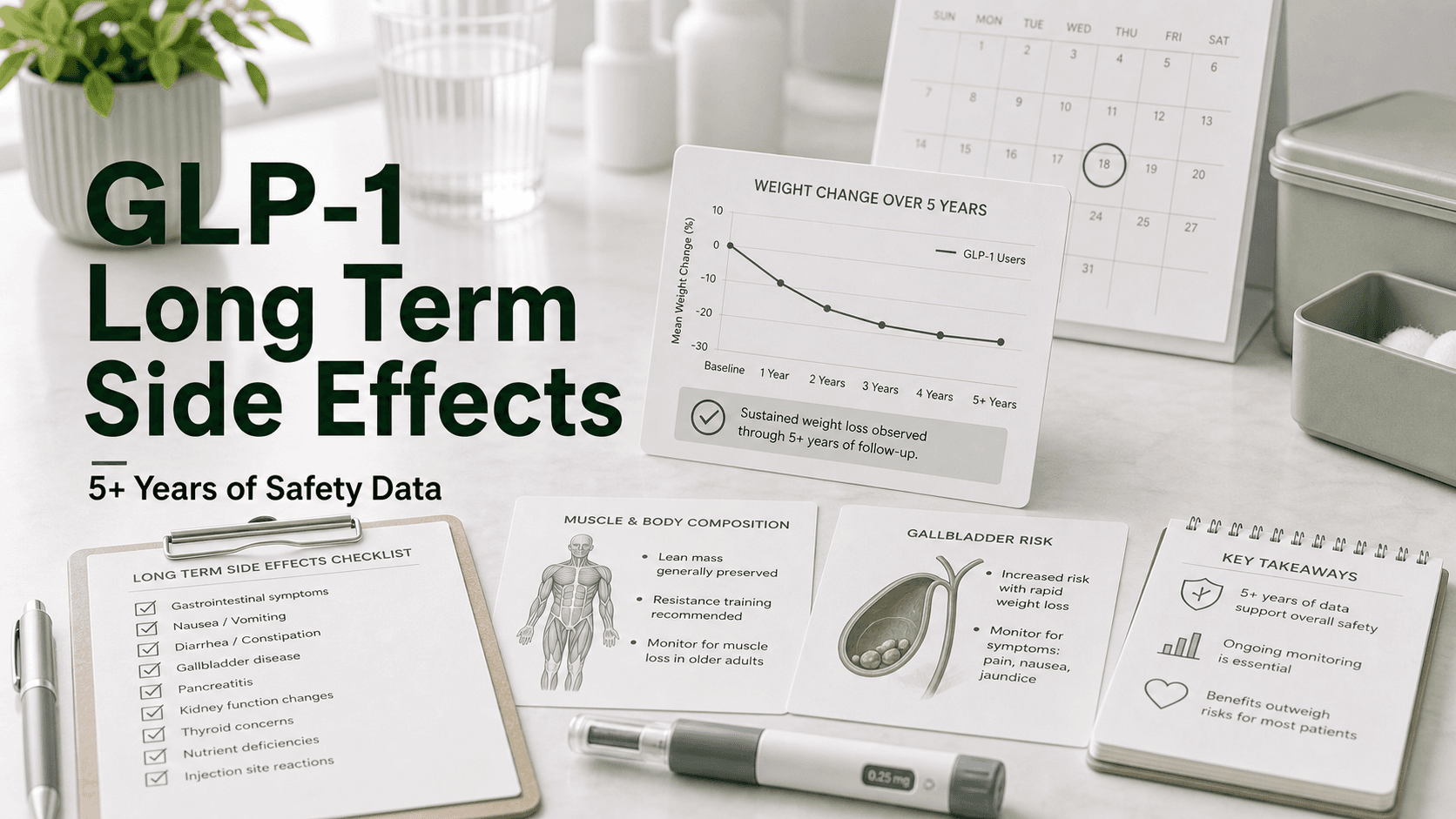
The short-term GLP-1 side effects are well-known by now: nausea, constipation, sulfur burps, fatigue during titration. The longer-term picture is what most patients actually care about, because most who tolerate the first 3 months stay on the drug indefinitely. Semaglutide has been FDA-approved since December 5, 2017 (Ozempic) and since June 4, 2021 at the 2.4 mg obesity dose (Wegovy); tirzepatide since May 13, 2022 (Mounjaro) and November 8, 2023 (Zepbound). Add the SELECT, FLOW, REWIND and SURMOUNT trials and the long-term profile is finally taking shape — with one hard limit worth naming up front: the longest randomized follow-up anywhere in this drug class is 5.4 years.
Direct answer: Most GLP-1 GI side effects fade after 3–6 months but can resurface with dose increases. Trial nausea rates by drug: liraglutide 40.2%, semaglutide 44.2%, tirzepatide 31.0%. Long-term concerns include: lean muscle loss (25–40% of total weight lost without strength training), gallbladder disease (2.6% on semaglutide vs 1.2% placebo), bone density loss (especially in post-menopausal patients), rare acute pancreatitis, the NAION vision signal for semaglutide, persistent gastroparesis in a small subset, and delayed gastric emptying that complicates anesthesia and colonoscopy. After stopping semaglutide, patients regain about 2/3 of lost weight, leaving net loss of 5.6% at 120 weeks. Thyroid C-cell tumor remains a boxed warning but is unconfirmed in humans.
How Long GLP-1s Have Actually Been Studied
"Long term" has a ceiling, and it is worth knowing where that ceiling sits before reading anything below. The longest randomized, placebo-controlled follow-up anywhere in the class is a median of 5.4 years, in the REWIND cardiovascular outcomes trial of dulaglutide. Nothing at obesity doses has run that long.
| Trial (drug) | Longest randomized exposure | What it measured |
|---|---|---|
| REWIND (dulaglutide 1.5 mg) | Median 5.4 years | Cardiovascular outcomes in type 2 diabetes |
| SELECT (semaglutide 2.4 mg) | Median follow-up 41.8 months (~3.5 years), 17,604 patients | Major adverse cardiac events in obesity/overweight without diabetes |
| SURMOUNT-1 (tirzepatide 5/10/15 mg) | 176 weeks (~3.4 years) plus 17 weeks off-drug, 2,539 patients | Weight and progression to type 2 diabetes |
| SCALE (liraglutide 3.0 mg) | 160 weeks (~3.1 years); mean exposure 110 weeks | Weight in patients with prediabetes |
| SURMOUNT-4 (tirzepatide) | 88 weeks, including randomized withdrawal at week 36 | Maintenance and regain |
| STEP obesity program (semaglutide 2.4 mg) | 68 weeks, 2,116 patients | The adverse-reaction rates printed in the Wegovy label |
Market exposure runs much longer than trial exposure, and that is where most of the real reassurance comes from. Exenatide, the first GLP-1 receptor agonist, was approved in April 2005. Liraglutide followed in January 2010 (Victoza) and December 2014 at the 3.0 mg weight-management dose (Saxenda). That is 21 years and 16 years of post-marketing surveillance respectively, across tens of millions of patient-years — enough that a common serious harm would have surfaced.
So the accurate version of "GLP-1s are safe long term" is this: safe for as long as they have been watched, which is up to about 5.4 years of randomized data and about 21 years of post-marketing data for the oldest drug in the class. For semaglutide 2.4 mg and tirzepatide specifically, the randomized window is roughly 3 to 3.5 years. A harm that takes ten years to appear would not have been detected yet, in anyone, and no one can tell you otherwise.
Two things at 176 weeks of tirzepatide in SURMOUNT-1 are worth knowing: weight change was −12.3%, −18.7% and −19.7% at 5 mg, 10 mg and 15 mg versus −1.3% on placebo, and the investigators reported no new safety signals. Gastrointestinal events were still the most common adverse events, still mostly mild to moderate, and still concentrated in the first 20 weeks of dose escalation.
GI Side Effects That Usually Fade
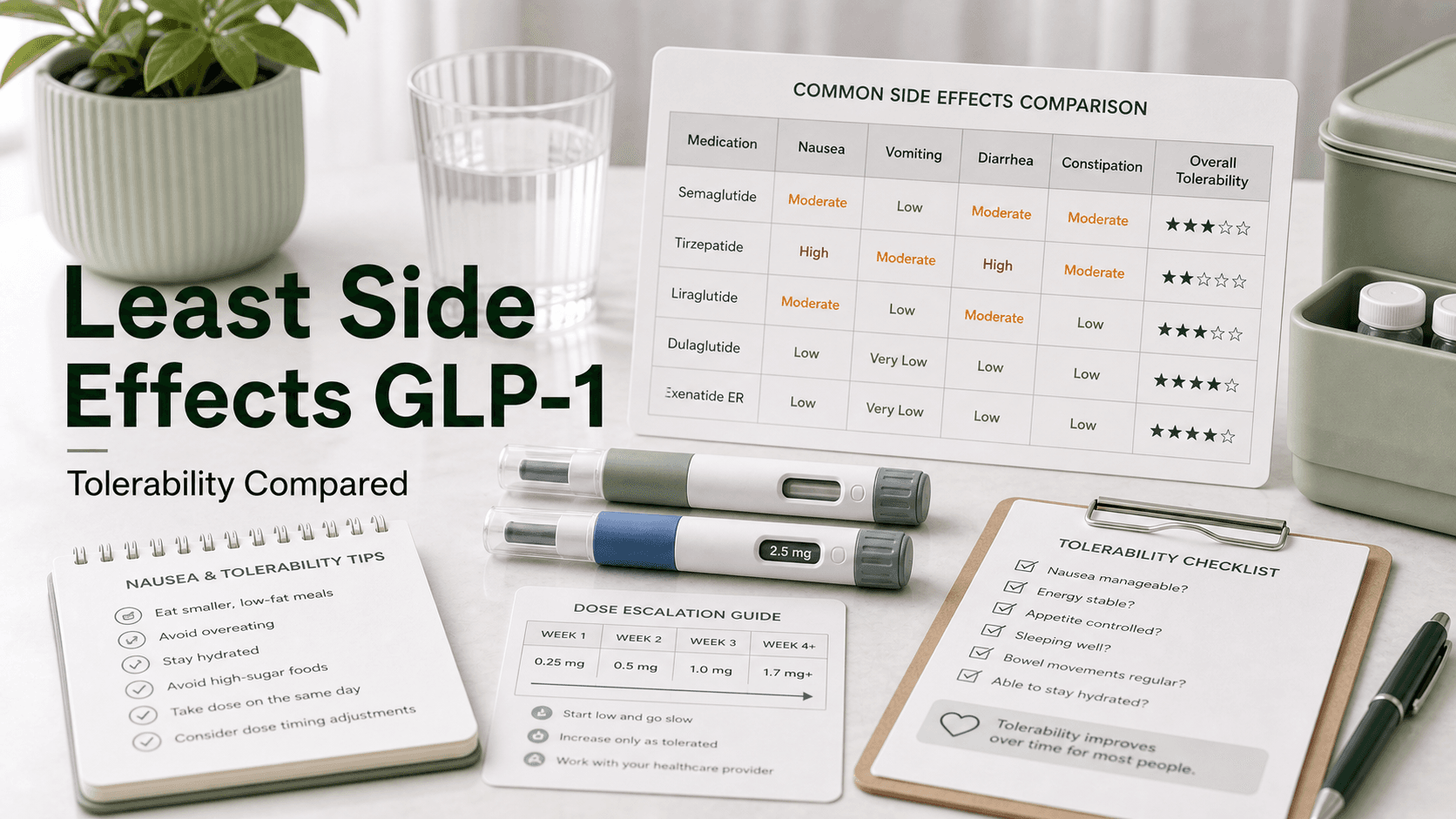
These dominate the first 3 months and then typically settle. Trial data from pooled obesity trials:
| Side effect | Liraglutide 3.0 mg | Semaglutide 2.4 mg | Tirzepatide 15 mg |
|---|---|---|---|
| Nausea | 40.2% | 44.2% | 31.0% |
| Diarrhea | 20.9% | 31.5% | 23.0% |
| Vomiting | 16.3% | 24.8% | 12.2% |
| Constipation | ~15% | ~24% | ~17% |
The pattern: tirzepatide produces less nausea and vomiting than semaglutide despite producing more weight loss. The GIP component appears to buffer GLP-1's nausea ceiling.
Most of these spike again briefly each time the dose is escalated, then re-settle within 1–2 weeks at the new dose.
Side Effects That Persist or Emerge Later
These shape the multi-year decision to stay on a GLP-1.
Lean Muscle Loss
Trial DEXA studies and real-world data show that 25–40% of total weight loss on a GLP-1 can come from lean mass when patients don't resistance train. Not unique to GLP-1s — happens with any rapid weight loss — but it stacks across years on the medication.
Mitigation:
- 1.2–1.6 g protein per kg of body weight per day
- Resistance training 2–3× per week, including compound lifts
- Slower titration if weight is dropping rapidly
- Periodic body composition measurement (DEXA, smart scale, InBody) to confirm fat loss dominates
Bone Density Loss
Smaller studies and bariatric surgery data suggest meaningful weight loss can reduce bone mineral density, particularly at the hip and lumbar spine. Long-term GLP-1 data is still being collected, but the trajectory likely follows other rapid weight loss.
Mitigation:
- Resistance training (impact and load)
- Adequate calcium (1,000–1,200 mg/day) and vitamin D (typically 1,000–2,000 IU/day)
- Baseline + follow-up DEXA scans for at-risk patients (post-menopausal, BMI <22 at goal, fracture history)
Gallbladder Disease
GLP-1s slow gallbladder emptying and biliary motility. Pooled trial data:
| Drug | Gallbladder disorder rate |
|---|---|
| Liraglutide | 0.8% cholelithiasis, 0.5% acute cholecystitis |
| Semaglutide | 2.6% vs 1.2% placebo |
| Tirzepatide | ≤0.6% acute cholecystitis |
A meta-analysis concluded GLP-1 receptor agonists "were linked to a higher risk of gallbladder or biliary diseases, particularly when used at higher doses." Rapid weight loss compounds the risk.
Mitigation:
- Gradual weight loss rather than rapid
- Adequate dietary fat (very low-fat diets paradoxically promote gallstones)
- Surgical consultation for right-upper-quadrant pain, nausea after fatty meals, or jaundice
Pancreatitis
Rare. Trial data:
- Liraglutide: 10 cases (9 mild, 5 gallstone-related) vs 1 placebo
- Semaglutide: 3 mild cases, all recovered, all in patients with prior pancreatitis or gallstones
- Tirzepatide: 4 cases evenly distributed across treatment and placebo, none severe
Multiple meta-analyses show "no significant difference in development of acute pancreatitis or pancreatic cancer" vs placebo overall. Risk is higher in patients with:
- Prior pancreatitis history
- Gallstones
- Heavy alcohol use
- Triglycerides over ~500 mg/dL
Symptoms (severe upper abdominal pain radiating to the back, with vomiting) warrant emergency evaluation.
Chronic Gastroparesis
The most controversial long-term signal. Most GLP-1 patients experience drug-induced delayed gastric emptying that resolves after discontinuation. A small subset develop persistent gastroparesis that lingers months or years after stopping. The MDL-3094 litigation centers on this signal.
Patients with significant pre-existing GI motility issues are at highest risk and often should not be on a GLP-1 at all.
Anesthesia and Procedure Risks
A late-emerging concern: residual gastric contents on semaglutide create aspiration risk during anesthesia. Expert consensus recommends:
- Withhold the medication for at least 3 half-lives (~88% clearance) before procedures with anesthesia
- For weekly semaglutide/tirzepatide: pause 7+ days before elective surgery
- For daily liraglutide: pause 24 hours before
- Treat emergency surgery on a GLP-1 patient as "full stomach"
A separate issue: bowel prep quality for colonoscopy is significantly worse on GLP-1s, leading to a notable increase in repeat colonoscopies.
NAION (Optic Nerve)
Detailed in the GLP-1 and blindness article. Observational data shows ~4× elevated NAION risk with semaglutide in some cohorts, no significant increase in others. Tirzepatide does not show the same signal.
Thyroid C-Cell Tumors (Boxed Warning)
Rats developed thyroid C-cell tumors in pre-clinical studies. Human data has not confirmed this signal, but the boxed warning remains. People with personal or family history of medullary thyroid carcinoma or MEN2 should not take any GLP-1.
Mental Health and Mood
Reports of suicidal ideation prompted FDA and EMA investigations. Trial data has not confirmed a causal link, but ongoing monitoring is part of standard checkup.
Worsening Diabetic Retinopathy
Rapid A1C drops can transiently worsen diabetic retinopathy. Patients with pre-existing retinopathy should have eye stabilization before rapid GLP-1 titration.
The "Tolerability Drift" Pattern
Most patients report side effects in a U-shape:
- Months 1–3: Peak side effects during titration
- Months 4–12: Mostly settle — the "honeymoon" period
- Year 2+: New issues may emerge — fatigue patterns, hair thinning (often from rapid weight loss, not the drug itself), face changes, plateaus, persistent mild constipation
This is partly drug effect, partly the downstream of being at a much lower body weight.
What Long-Term Monitoring Looks Like
A reasonable annual check on a stable GLP-1 patient:
| Test or check | Why |
|---|---|
| Weight and waist | Track plateau or rebound |
| Blood pressure | Confirm continued improvement |
| A1C and fasting glucose | If diabetic |
| Lipid panel | Track cardiovascular benefit |
| Liver enzymes | Track NAFLD/MASH improvement |
| Kidney function | Confirm safety, especially in CKD |
| TSH | Routine thyroid screening |
| Vitamin B12, vitamin D | Often low after sustained weight loss |
| Iron, ferritin | Especially in menstruating women |
| Body composition (DEXA or InBody) | If concerned about lean mass |
| DEXA bone density | Post-menopausal or other at-risk patients |
| Eye exam | Yearly if diabetic; consider baseline for NAION risk |
| Gallbladder ultrasound | If RUQ symptoms or rapid weight loss |
Discontinuation Rates: Who Stops, and Why
Two very different numbers both get called "the discontinuation rate," and they are nowhere near each other.
In trials, where the drug is free and follow-up is structured, permanent discontinuation for adverse reactions looks like this:
| Drug (label dose) | Stopped for any adverse reaction | Placebo | Stopped specifically for GI reactions |
|---|---|---|---|
| Wegovy 2.4 mg | 6.8% | 3.2% | Nausea 1.8%, vomiting 1.2%, diarrhea 0.7% |
| Zepbound 5 / 10 / 15 mg | 4.8% / 6.3% / 6.7% | 3.4% | 1.9% / 3.3% / 4.3% (placebo 0.5%) |
| Saxenda 3.0 mg | 9.8% | 4.3% | Nausea 2.9%, vomiting 1.7%, diarrhea 1.4% |
| Foundayo (orforglipron) 5.5 / 9 / 17.2 mg | 6% / 9% / 10% | 3% | 3% / 6% / 6% (placebo 0.7%) |
| Mounjaro 5 / 10 / 15 mg | Not reported separately | — | 3.0% / 5.4% / 6.6% (placebo 0.4%) |
Two patterns hold across every label: discontinuation rises with dose, and the great majority of it happens in the first few months, during escalation, for gastrointestinal reasons.
In the real world, where cost, coverage and supply intervene, the numbers are several times higher. In a retrospective cohort of 125,474 US adults with overweight or obesity who started liraglutide, semaglutide or tirzepatide between 2018 and 2023, one-year discontinuation was 64.8% in patients without type 2 diabetes and 46.5% in patients with type 2 diabetes. Moderate or severe GI side effects raised the hazard of stopping (HR 1.38 with diabetes, 1.19 without), and every extra 1% of body weight lost lowered it by roughly 3%. Restarting is common: within a year of stopping, 36.3% of the non-diabetic group and 47.3% of the diabetic group had reinitiated. If cost is the constraint, our guide to where to buy semaglutide walks through the available routes.
For a sense of how much of that is the drug rather than everything around it: in SELECT, over a median 41.8 months, 31% of semaglutide patients and 27% of placebo patients permanently stopped study drug. The gap attributable to the medication itself is about 4 percentage points over three and a half years.
What Happens When People Stop
The cleanest long-term safety question: what happens after discontinuation?
- GI symptoms typically resolve within 4–8 weeks
- Weight regain in semaglutide withdrawal studies: patients regained about 2/3 of weight lost; net loss at 120 weeks was only 5.6%
- Lean mass loss does not automatically reverse — it has to be actively rebuilt
- Cardiometabolic gains partially reverse with weight regain
- Chronic gastroparesis in the rare patients who develop it can persist long after discontinuation
Tirzepatide has its own randomized withdrawal data, and it is the sharpest picture available of a full year off the drug after eight months on it. In SURMOUNT-4 (Study 4 in the Zepbound label), 670 patients took open-label tirzepatide for 36 weeks — mean body weight fell from 107.3 kg to 85.8 kg — and were then randomized to continue or switch to placebo through week 88:
| Change from week 36 to week 88 | Switched to placebo | Stayed on tirzepatide |
|---|---|---|
| Body weight | +14.0% | −5.5% |
| Waist circumference | +7.8 cm | −4.3 cm |
| Systolic blood pressure | +8.2 mmHg | +2.0 mmHg |
| HbA1c | +0.3% | −0.0% |
The weight is the headline, but the blood pressure and HbA1c rows are the more important finding: the cardiometabolic gains reverse alongside the weight, not independently of it.
Stopping a GLP-1 abruptly is generally safe medically. The loss of appetite suppression often produces rebound hunger; tapering is increasingly common.
What People Get Wrong About Long-Term Use
- "I have to stop after a year — it's not safe forever." No clinical evidence supports a hard time limit. Many patients stay on indefinitely.
- "Side effects only get worse over time." Most actually fade. Long-term issues are different from the early ones.
- "I lost weight, so I can stop." Stopping usually leads to ~2/3 regain over time. Treat obesity like other chronic conditions.
- "It hasn't been studied long enough." Half true, and worth stating precisely. Exenatide has been marketed since 2005 and liraglutide since 2010, and REWIND followed dulaglutide patients a median of 5.4 years. But SELECT's median follow-up was 41.8 months, SURMOUNT-1 ran 176 weeks, and no trial at obesity doses has gone past roughly 3.5 years. Anyone quoting a ten-year safety record for semaglutide 2.4 mg is inventing it.
Frequently Asked Questions
What are the long-term side effects of GLP-1 medications? Most side effects fade after 3–6 months. Longer-term concerns include lean muscle loss, bone density loss, gallbladder disease (2.6% on semaglutide vs 1.2% placebo), rare pancreatitis, persistent gastroparesis in a small subset, the semaglutide NAION signal, and anesthesia/procedure considerations.
Are GLP-1s safe long term? As far as the data reaches, yes. Randomized follow-up runs to a median 41.8 months for semaglutide 2.4 mg (SELECT), 176 weeks for tirzepatide (SURMOUNT-1) and a median 5.4 years for dulaglutide (REWIND), and none of it has produced a new safety signal. Beyond about 5 years there is no randomized evidence at all — only post-marketing surveillance, which for exenatide and liraglutide now spans 21 and 16 years. Monitoring is needed, but the class is not currently considered high-risk for long-term use.
Do you have to stop a GLP-1 after a year? No. Obesity is a chronic condition, and most prescribers treat GLP-1s as long-term therapy when they are working.
Will I lose muscle on a GLP-1 long term? Yes, some — typically 25–40% of total weight lost can be lean mass without strength training. Resistance training and adequate protein significantly reduce this.
Do the GI side effects ever go away? For most patients, yes, within 3–6 months at stable dose. Some patients have persistent mild GI symptoms throughout treatment.
What happens to weight loss after I stop? Withdrawal studies of semaglutide showed patients regained about 2/3 of weight lost, with net loss of only 5.6% at 120 weeks.
How long should I stop before surgery? Withhold weekly GLP-1s (semaglutide, tirzepatide) for at least 7 days before elective surgery. Withhold daily GLP-1s (liraglutide, oral semaglutide, Foundayo) for 24 hours.
Is a GLP-1 bad for you in the long run? Nothing in the evidence so far says the class is bad for you in the long run. SELECT found fewer cardiovascular events on semaglutide over a median 41.8 months, not more, and SURMOUNT-1 reported no new safety signals at 176 weeks. The honest caveat is the ceiling on that evidence: the longest randomized follow-up in the class is 5.4 years, and no obesity-dose trial has run past about 3.5 years. Risks that take a decade to surface would not yet be visible in anyone.
What is the longest a GLP-1 has actually been studied? A median of 5.4 years, in the REWIND cardiovascular outcomes trial of dulaglutide. At obesity doses the longest are 176 weeks for tirzepatide (SURMOUNT-1) and a median 41.8 months for semaglutide 2.4 mg (SELECT).
How many people stop a GLP-1, and how many stop because of side effects? In trials, 4.8% to 9.8% stopped for adverse reactions depending on drug and dose, versus 3.2% to 4.3% on placebo, and most of that was gastrointestinal and happened during escalation. In the real world the number is far higher — 64.8% of patients without type 2 diabetes had stopped within a year in a 125,474-patient US cohort — but cost, coverage and supply drive most of that, not tolerability.
Does the incidence of side effects rise the longer you stay on? No. Nausea, vomiting and diarrhea peak during dose escalation and decline afterward, which the Mounjaro, Zepbound and Foundayo labels all state explicitly. The issues that emerge later — lean mass, bone density, gallbladder disease — track the amount and speed of weight loss more than the number of years on the drug.
Is there a scenario where stopping is the safer choice? Yes, several. Persistent vomiting or severe GI symptoms that do not settle at a lower dose, suspected pancreatitis, a planned pregnancy, a diagnosis of gastroparesis, or a procedure requiring general anesthesia where the medication cannot be safely held. Every current GLP-1 label states the drug is not recommended in patients with severe gastroparesis.
Last reviewed: May 13, 2026
Sources
- GLP-1 RAs for obesity: outcomes, tolerability, side effects, risks — PMC
- Weight Loss That Lasts: Long-Term Impact of GLP-1 Receptor Agonists — PMC
- Comparative safety of semaglutide and tirzepatide — ScienceDirect
- WEGOVY (semaglutide) Prescribing Information — DailyMed/FDA
- ZEPBOUND (tirzepatide) Prescribing Information — DailyMed/FDA
- MOUNJARO (tirzepatide) Prescribing Information — DailyMed/FDA
- SAXENDA (liraglutide) Prescribing Information — DailyMed/FDA
- TRULICITY (dulaglutide) Prescribing Information — DailyMed/FDA
- FOUNDAYO (orforglipron) Prescribing Information — DailyMed/FDA
- Tirzepatide for Obesity Treatment and Diabetes Prevention (SURMOUNT-1, 176 weeks) — NEJM
- Weight regain and cardiometabolic effects after withdrawal of semaglutide: the STEP 1 trial extension — PMC
- Discontinuation and Reinitiation of Dual-Labeled GLP-1 Receptor Agonists Among US Adults With Overweight or Obesity — JAMA Network Open