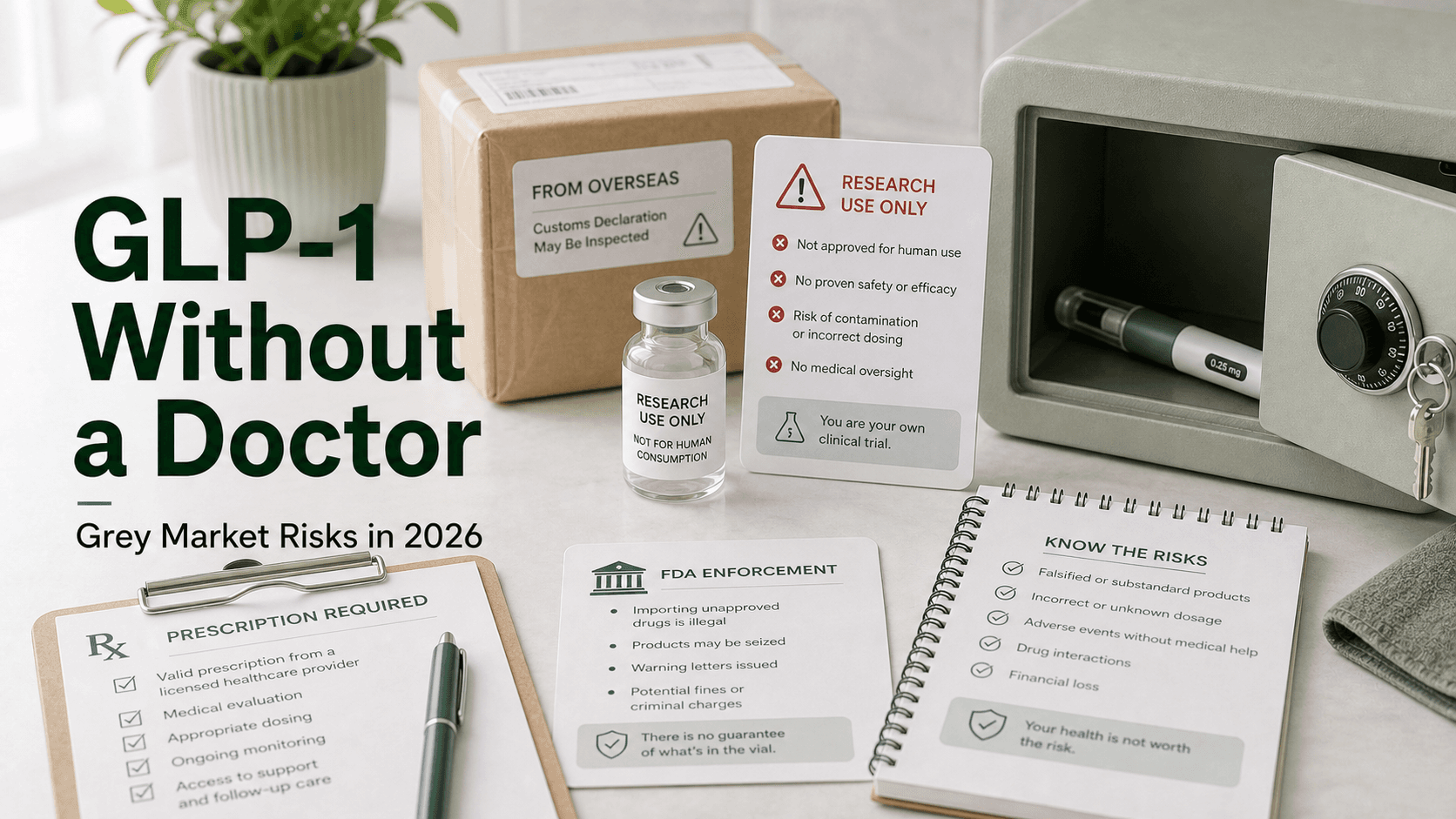
Search any peptide forum and the pitch is the same: skip the prescription, skip the $300/month telehealth bill, order a vial of "semaglutide for research use only" from an overseas supplier, and inject it yourself. The vials cost $40–$90. The websites look professional. The disclaimers — "not for human consumption" — make it feel like a clever legal workaround.
It is not. And by 2026, the gap between the grey-market price and the cheapest legal price has narrowed to the point where the risk math no longer makes sense.
Direct answer: There is no legal way to buy semaglutide, tirzepatide, retatrutide, or any other GLP-1 receptor agonist in the United States without a prescription. The "research peptide" market is not a loophole — the FDA has explicitly closed the "research use only" labeling argument in 2026 warning letters, US Customs has been seizing peptide shipments from China at record volumes, and FDA spot-checks of online peptides have found up to 40% with incorrect dosages or undeclared ingredients. Meanwhile, legitimate cash-pay telehealth programs now start at $99–$179/month for compounded semaglutide. The grey-market price advantage has effectively collapsed.
This article is a careful look at what people are actually buying, why the legal cover is fictional, what the testing data shows about contamination, and what legitimate options now cost.
What People Are Actually Buying When They Skip the Doctor
The grey market for GLP-1 has three main supply paths, and all three end at the same place: an unregulated factory, usually in China.
1. "Research peptide" websites. US-based sellers ship lyophilized (powdered) peptide vials labeled "for research purposes only" or "not for human consumption." Names are often coded — "GLP-1 SM" instead of semaglutide, "TZ" instead of tirzepatide. Prices run $40–$90/month-equivalent. Bacteriostatic water, syringes, and reconstitution guides are sold separately or in the same cart.
2. Direct overseas orders. Buyers order from Chinese suppliers on Alibaba, Telegram channels, or Instagram-marketed sites. Shipments arrive labeled as "cosmetic peptides," "skincare research material," or supplement powders. Prices are lower — sometimes $20–$40 — but seizure rates are higher.
3. Telegram/social media resellers. Individuals buy bulk overseas, reconstitute and re-vial in unsterile home kitchens, and sell pre-filled syringes through DMs. This is the highest-risk tier and the one most often associated with hospital admissions.
According to US Customs data cited by congressional investigators, imports of hormone and peptide compounds from China reached $328 million in the first three quarters of 2025, up from $164 million in the same period the year before. That doubling tracks the exact period that the FDA-approved compounded GLP-1 market started getting restricted.
The active pharmaceutical ingredient (API) is real — that part is mostly true. What is also true is that the API is being produced in facilities that have not been inspected for sterility, dosing accuracy, residual solvents, or heavy-metal contamination by any agency the buyer would recognize.
Why "For Research Use Only" Is Not Legal Cover
The single most persistent myth in the grey-market peptide world is that the "research use only" or "not for human consumption" label puts the buyer (and seller) in a legal grey zone. It does not. The FDA has been extremely explicit about this, and in 2026 the agency closed any ambiguity that might have remained.
On April 7, 2026, the FDA published seven coordinated warning letters (all dated March 31) against online peptide sellers including Gram Peptides, Pink Pony Peptides, Mile High Compounds, Prime Sciences, PekCura Labs, FormPour, and Guangzhou Huli Technology. Every letter made the same argument:
"Despite statements on your product labeling marketing your products for 'Research Use Only,' and 'not intended for human consumption, medical use, or veterinary use,' evidence obtained from your website establishes that your products are intended to be drugs for human use."
The FDA looked at the product pages, which described appetite suppression and weight loss. It looked at the shopping cart, which included bacteriostatic water for injection and insulin syringes. It looked at the coded SKUs ("GLP-1 SM"). And it concluded that the disclaimer was decorative — the actual intent was selling unapproved drugs.
Policy tracking firms have counted 175 FDA warning letters in 2026 through May, with 43 of them touching GLP-1, peptides, or compounded semaglutide/tirzepatide — compared with 14 in all of 2024. Enforcement is accelerating, not slowing.
Three specific points buyers consistently misunderstand:
- Possession with intent to use as a drug is itself a violation. The FDA does not need to prove you injected the product. Evidence of intent (cart contents, search history, dosing notes) is sufficient under the Federal Food, Drug, and Cosmetic Act.
- Importing prescription drugs across the US border violates 21 USC §331(d) and §355. US Customs and Border Protection has been seizing peptide shipments throughout 2024–2026. In one Cincinnati case, CBP intercepted over 5,000 unapproved peptide vials in a single shipment from China.
- State attorneys general are now also enforcing. Connecticut AG William Tong sued Triggered Brand in 2025 for selling bootleg GLP-1s. Several other states have followed.
The "research only" label was never a legal shield. It was a marketing decision that the FDA has now publicly stated it will not respect.
What Testing Has Actually Found in Seized Batches
The strongest argument against grey-market GLP-1 is not the legal exposure — most buyers calculate (correctly) that the FDA is not going to come after an individual. The strongest argument is what is actually inside the vials.
Testing of seized illicit peptide medicines in Europe and the US has produced consistent findings:
- FDA spot-checks have reported up to 40% of online peptides contain incorrect dosages, wrong peptide species, or undeclared ingredients.
- Texas testing lab Finnrick found roughly 8% of grey-market peptide samples had measurable bacterial contamination.
- European seizures repeatedly found products that did not match label claims — some with zero active ingredient, some with 2–3× the labeled dose, and some containing entirely different peptides than what was advertised.
- Counterfeit branded products (vials labeled as authentic Ozempic or Mounjaro) have been imported from China, Turkey, and India and repackaged for US distribution. Several FDA-confirmed counterfeit Ozempic seizures occurred in 2024 and 2025.
The FDA has received hundreds of adverse event reports linked to illicit compounded or grey-market GLP-1s, including:
- Severe hypoglycemia from overdosing (concentrations 5–10× labeled)
- Bacterial injection-site infections and abscesses
- GI disorders severe enough to require hospitalization
- Cardiac and psychiatric reactions
- Several deaths
The contamination risk has several technical drivers. Chinese API manufacturers producing peptides for "research" markets are not subject to cGMP (current Good Manufacturing Practice) inspections. Residual solvents from synthesis (acetonitrile, trifluoroacetic acid) are not validated. Heavy metals from reactor vessels are not tested. Endotoxin (bacterial cell wall fragment) testing is not required. And the reconstitution step — where the buyer adds bacteriostatic water in their own kitchen — introduces yet another contamination opportunity.
The often-quoted reassurance "but the molecule itself is the same as Ozempic" is partly true and entirely misleading. The molecule may be the same. What is around it almost certainly is not.
The Compounding Era Is Over (And That Matters)
A common confusion in 2026 is conflating "research peptides" with "compounded semaglutide." They are not the same thing, and the legal landscape changed sharply in 2025.
During the official FDA shortage (declared in 2022, resolved February 21, 2025), 503A and 503B compounding pharmacies could legally produce semaglutide and tirzepatide for individual patients under a prescription. Enforcement discretion ended on April 22, 2025 for 503A pharmacies and May 22, 2025 for 503B outsourcing facilities.
What changed:
- Compounded semaglutide and tirzepatide can still be made under 503A — but only with a documented, individualized medical necessity (e.g., allergy to a specific inactive ingredient in the branded version). Cost savings and patient preference are explicitly insufficient justification under current FDA guidance.
- In May 2026, the FDA proposed adding semaglutide, tirzepatide, and liraglutide to the "Do Not Compound" 503B bulks list, which would close large-scale compounding entirely.
- Telehealth platforms have shifted to either branded products at sticker price, microdosing protocols, or compounded formulations with genuinely individualized clinical justification.
This is the part the grey market exploits: the perception that "compounded GLP-1 is no longer available" gets translated into "I'll just order research peptides." The translation is wrong. Compounded GLP-1 with a legitimate prescription is still available through compliant telehealth providers — at prices that have come down significantly.
What Legitimate Telehealth Actually Costs Now
The price gap is the single biggest reason the grey market has lost its economic logic in 2026. Major cash-pay telehealth pricing (current as of May 2026):
| Provider | Compounded semaglutide | Compounded tirzepatide |
|---|---|---|
| Mochi Health | $178/mo (membership $79 + meds $99) | $278/mo |
| Henry Meds (12-mo prepay) | ~$197/mo effective | varies |
| Henry Meds (monthly) | $297/mo standard dose | varies |
| Eden | $249/mo flat (any dose) | $329/mo |
| LillyDirect (Zepbound) | $349/mo single-dose vials | — |
| Manufacturer savings cards | $25–$499/mo depending on insurance | $25–$549/mo |
For practical comparison against grey-market sourcing:
| Path | Approx. monthly cost | Includes |
|---|---|---|
| Chinese "research peptide" | $40–$90 | Vial only. No water, no syringes, no titration plan, no labs, no oversight, ~40% chance of mislabeled dose. |
| Mochi compounded semaglutide | $178 | Real prescription, real pharmacy, dosing plan, side-effect support, refills handled. |
| Henry Meds 12-mo prepay | ~$197 | Same, plus liraglutide and microdose options. |
The grey-market saving is roughly $80–$140/month versus the cheapest legal option. For that delta, the buyer takes on: legal exposure (small but nonzero), a 40% odds-on chance of wrong dose, an 8% chance of bacterial contamination, no clinical monitoring, no titration schedule, no liability recourse if something goes wrong, and the obligation to self-reconstitute under non-sterile conditions.
It is possible to construct a scenario where that math makes sense. It is not common.
Why the Small Savings Are Not Worth It
The harms documented in the medical literature are concrete:
- Pancreatitis risk rises with rapid dose escalation. Grey-market vendors provide no titration schedule. The standard clinical schedule (0.25 → 0.5 → 1.0 → 1.7 → 2.4 mg over 16+ weeks for semaglutide) exists because faster ramps cause hospitalizations.
- Severe hypoglycemia has been documented in patients who reconstituted overdosed grey-market vials and didn't know it.
- Injection-site abscesses from contaminated vials require IV antibiotics and sometimes surgical drainage.
- Gastroparesis with persistent vomiting is harder to manage without a clinician to titrate down or pause therapy.
- Lab monitoring (kidney function, lipase, B12) is part of standard GLP-1 care and is missing entirely from grey-market protocols.
The "I'll just be careful" framing only works until something goes wrong. And the moment something goes wrong, the buyer has no provider, no records, and frequently nobody at the supplier to call.
If You Are Determined: Harm Reduction
This site does not endorse using grey-market peptides. If you are going to do it anyway despite the above, the following reduce — but do not remove — risk:
- Do not skip telehealth on a price comparison without checking first. Mochi at $178 or Henry Meds 12-mo prepay at ~$197 may be closer to your grey-market price than you think after you add bac water, syringes, and alcohol pads.
- Buy from sellers who provide independent third-party COAs (Certificates of Analysis) with HPLC/MS purity data, endotoxin testing, and bacterial counts. Many vendors fake these. Cross-check the testing lab's actual website.
- Never inject reconstituted product that looks cloudy, has particulates, or smells off. Discard the vial.
- Use bacteriostatic water, not sterile water, for multi-dose vials. Bac water contains benzyl alcohol that suppresses bacterial growth.
- Refrigerate after reconstitution and use within 28 days. This is the same shelf life the branded product follows.
- Titrate slowly — start at 0.25 mg semaglutide weekly and do not escalate faster than every 4 weeks regardless of what forums recommend.
- Get baseline labs through your PCP before starting — comprehensive metabolic panel, lipase, HbA1c, TSH, B12. You don't need to tell them what you're doing; standard wellness labs cover most of it.
- Have a plan for adverse events. Know which urgent care or ER you'd go to. Bring the vial.
None of this makes the product equivalent to a regulated prescription. It just narrows the worst tail risks.
What People Get Wrong
- "Research labeling means it's legal." It does not. The FDA has been explicit, repeatedly, throughout 2024–2026 that disclaimer language does not override actual intended use.
- "Customs doesn't seize personal-use peptides." CBP has seized thousands of vials. Individual buyers have had shipments confiscated and have received warning letters.
- "It's the same molecule as Ozempic." Possibly. The molecule may be correct. The dose, sterility, residual solvents, endotoxin level, and heavy-metal content are not validated.
- "Compounded GLP-1 is no longer legal." Compounded GLP-1 with a legitimate prescription and documented individualized medical need is still legal. The shortage-era mass compounding is over.
- "$80/month versus $300/month is a no-brainer." It used to be $80 versus $1,300. With Mochi at $178 and Henry Meds at ~$197, the gap is now $90–$110/month — for which you give up every safety guarantee.
- "At least I know what's in it because I bought from a US vendor." US-based research peptide vendors source the API from the same Chinese factories. The "Made in USA" label refers to the labeling and the bottle, not the molecule.
Frequently Asked Questions
Is it illegal to buy semaglutide without a prescription? Yes. Semaglutide and other GLP-1 medications are prescription-only under federal law. Selling, importing, or possessing them with intent to use as drugs without a prescription violates the Federal Food, Drug, and Cosmetic Act.
Doesn't "for research only" make it legal? No. The FDA has stated in multiple 2026 warning letters that "research use only" disclaimers do not override evidence of intended human use, including marketing copy, cart contents, and product framing.
What percentage of grey-market peptides are contaminated or mislabeled? FDA spot-checks have reported up to 40% with incorrect dosages or undeclared ingredients. Independent lab testing has found roughly 8% with measurable bacterial contamination.
Where do "research peptides" actually come from? Most US-based sellers source the active pharmaceutical ingredient from Chinese manufacturers. US Customs reports peptide and hormone imports from China reached $328 million in the first three quarters of 2025.
What is the cheapest legitimate way to get GLP-1? As of May 2026: Mochi Health at $178/month (membership + compounded semaglutide), Henry Meds at ~$197/month effective with 12-month prepay, manufacturer savings cards on Wegovy or Zepbound for eligible patients (as low as $25/month with insurance).
Will US Customs seize a peptide shipment from China? They have, repeatedly. Cincinnati CBP intercepted over 5,000 unapproved peptide vials in a single shipment in 2024. Individual buyers have had shipments confiscated.
Is grey-market semaglutide the same molecule as Ozempic? The molecule may be the same. What surrounds it — dose accuracy, sterility, residual solvents, endotoxin levels, heavy metals — is not validated to any pharmacopeial standard.
Can compounded semaglutide still be prescribed? Yes, but only under 503A compounding with documented individualized medical necessity. The shortage-era enforcement discretion ended April 22, 2025. Cost savings alone are not sufficient justification under FDA guidance.
Last reviewed: May 13, 2026
Sources
- FDA's Concerns with Unapproved GLP-1 Drugs Used for Weight Loss
- FDA Targets GLP-1 and Peptide Compounding and 'Research Use Only' Labeling — Health Law Alliance
- Cincinnati CBP foils scheme to smuggle over 5,000 unapproved peptides into the U.S. — US Customs and Border Protection
- Made in China: The international supply of illicit semaglutide — ScienceDirect
- How Illegal Online Drug Sellers Are Taking Advantage of GLP-1 Demand — NABP
- FDA Proposes to Exclude Semaglutide, Tirzepatide, and Liraglutide on 503B Bulks List
- FDA Clarifies Policies for Compounders as GLP-1 Supply Stabilizes
- Inside the booming, gray-market world of injectable peptides — The Hill
- Grey Market GLP-1 — Is It Safe? — Doctronic
- Grey-Market GLP-1s, Peptides, and Retatrutide — Southwest Family Physicians
- Attorney General Tong Sues GLP-1 Weight Loss Drug Distributor Triggered Brand — Connecticut AG