Wegovy is now a semaglutide brand with both oral and injectable forms in the US. That creates a practical question: daily pill or weekly shot?
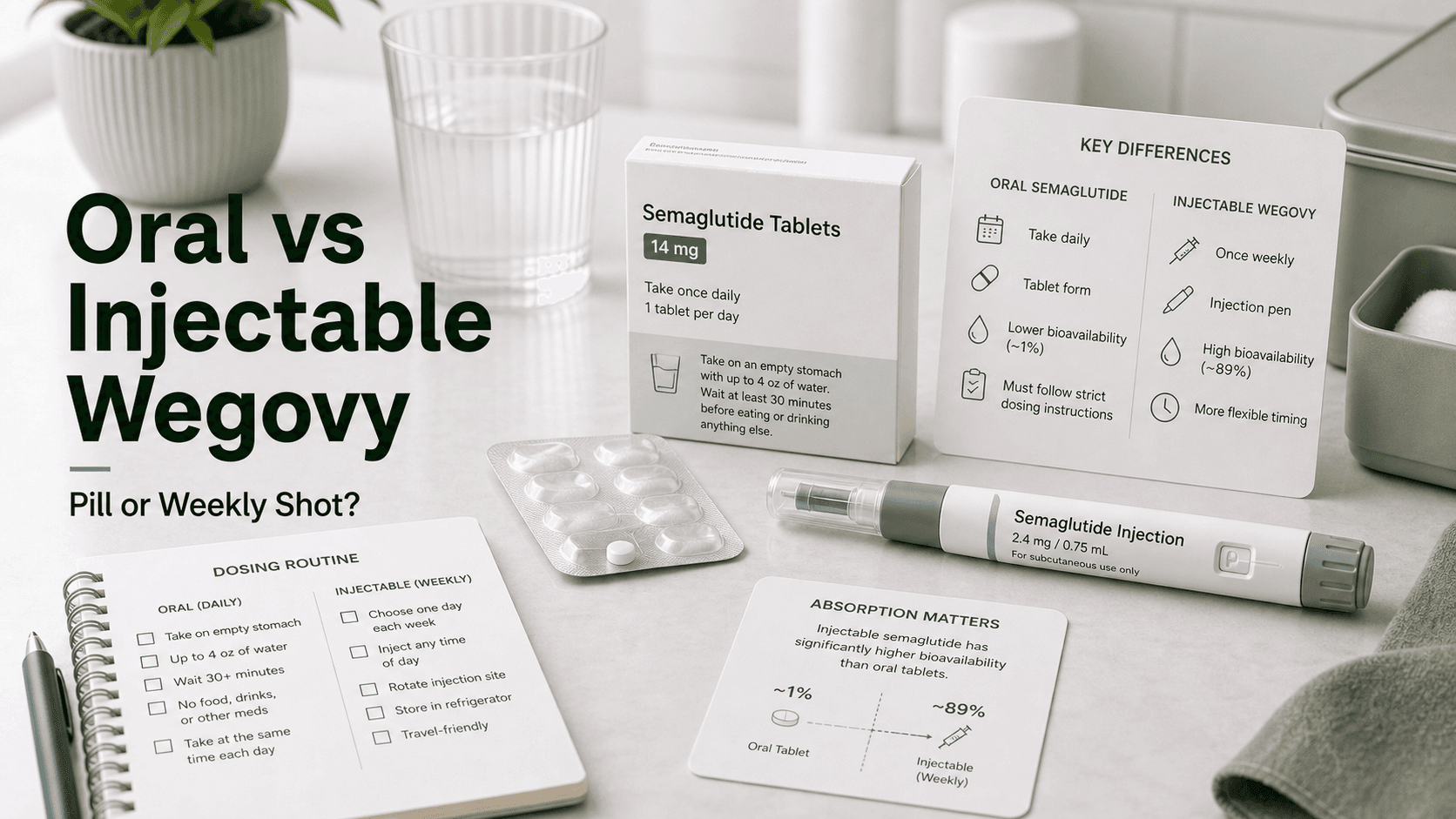
Direct answer: Oral Wegovy is once-daily semaglutide tablet therapy, while injectable Wegovy is once-weekly semaglutide injection. The pill avoids needles but requires stricter daily administration rules and depends on oral absorption. The injection is weekly and familiar from earlier Wegovy use, but some people dislike needles or pens. The better choice depends on adherence, side effects, insurance, dose availability, and clinician judgment.
Quick Comparison
| Topic | Oral Wegovy | Injectable Wegovy |
|---|---|---|
| Form | Tablet | Injection pen |
| Schedule | Daily | Weekly |
| Main practical challenge | Empty-stomach timing and consistency | Needle/pen comfort and weekly routine |
| Active ingredient | Semaglutide | Semaglutide |
| Current US status | FDA-approved Wegovy pill | FDA-approved Wegovy injection |
Why The Pill Is Different
Oral semaglutide has to survive the stomach and be absorbed through the gut. That means timing rules matter more than with injections. Missing the routine, eating too soon, or taking other medications too close may affect exposure.
The injection bypasses the gut absorption problem, but it requires comfort with a weekly injection and proper storage/handling.
Which Is More Effective?
Search results focus heavily on effectiveness. The honest answer is that trial context, dose, adherence, and tolerability matter. A pill that is taken incorrectly may underperform. An injection that a person avoids because of needle anxiety also underperforms.
Who Might Prefer Each?
| Person | May prefer |
|---|---|
| Needle-averse | Oral Wegovy |
| Already stable on weekly shots | Injectable Wegovy |
| Struggles with daily morning routines | Injectable Wegovy |
| Wants no injection supplies | Oral Wegovy |
| Has complex morning medications | Clinician/pharmacist review needed |
Internal Reading Path


FAQ
Is oral Wegovy the same as Rybelsus?
No. Both involve oral semaglutide concepts, but product, indication, dosing, and labeling differ.
Is the pill easier?
It avoids injections, but daily timing rules can make it harder for some people.
Can I switch between oral and injectable Wegovy?
Only with prescriber guidance. Do not convert doses yourself.
How to Decide Whether This Comparison Matters for You
For oral wegovy vs injectable wegovy, the most important distinction is not marketing language. It is indication, active ingredient, dose range, safety history, and coverage. A drug can look better in a headline and still be the wrong fit if the diagnosis, contraindications, side effects, or insurance criteria do not match.
| Decision point | Why it matters |
|---|---|
| Diagnosis | Diabetes, obesity, cardiovascular risk, OSA, and MASH criteria can point to different products |
| Active ingredient | Semaglutide and tirzepatide are not interchangeable |
| Dose history | Tolerating one dose does not guarantee tolerating another drug |
| Side effects | GI symptoms often decide whether a plan is sustainable |
| Coverage | Insurance rules often determine what can actually be filled |
Practical Scenarios
Someone with type 2 diabetes and multiple glucose-lowering medications needs a different conversation than someone using a medication only for chronic weight management. Someone switching because of side effects needs a different plan than someone switching because of supply or insurance. Someone with severe nausea, repeated vomiting, or dehydration should stabilize first rather than treating the switch as routine paperwork.
A strong prescriber visit should cover the current dose, last injection date, side effects, glucose readings if relevant, weight trend, nutrition intake, other medications, and what will happen if the new medication is not tolerated. That planning matters more than a simple comparison chart.
Cost, Supply, and Prior Authorization
Search results often understate how much access shapes the real answer. The clinically preferred option may not be the covered option. Prior authorization can require diagnosis codes, BMI, A1c history, comorbidities, prior medication trials, or documentation of lifestyle support. Supply can also interrupt escalation or force a temporary change.
Before changing therapy, ask the pharmacy which dose forms are available, ask the insurer which criteria apply, and ask the prescriber what to do if the intended dose cannot be filled.
Questions to Bring to the Prescriber or Pharmacist
- Does my current dose and timing match the official label or my prescription?
- Are my symptoms or concerns expected at this stage, or do they suggest changing the plan?
- Should I delay escalation, restart lower, hold steady, or be evaluated before continuing?
- Are any of my other medications increasing risk, especially insulin, sulfonylureas, blood pressure medication, diuretics, or drugs affected by delayed gastric emptying?
- What exact symptoms should make me call urgently or seek same-day care?
- If cost or supply interrupts therapy, what is the safest backup plan?
Bottom Line for Oral Wegovy vs Injectable Wegovy: Pill Or Weekly Shot?
The practical answer is rarely just one number, food list, or yes-or-no rule. For oral wegovy vs injectable wegovy, the safest approach is to combine the direct answer with the variables that change it: product type, dose, timing, side effects, storage history, other medications, and the person's medical context. When those variables are unclear, the best next step is to ask the prescriber or pharmacist before acting.
Additional Scenarios Readers Commonly Compare
| Scenario | How to think about it |
|---|---|
| Symptoms started after a dose increase | Treat escalation as a likely contributor and ask whether to hold the dose longer |
| The plan changed because of supply | Confirm whether a restart or lower dose is safer after the gap |
| Advice online conflicts with the label | Use the label, pharmacy, and prescriber as the authority |
| The medication is compounded | Verify concentration, BUD, storage, sterility, and dose instructions directly with the pharmacy |
| The goal is maintenance | Prioritize sustainable intake, resistance training, monitoring, and follow-up |
More FAQ
Why do different websites give different answers?
Most differences come from assuming different products, concentrations, patient goals, dose histories, or risk tolerance. A chart or tip can be mathematically correct but still wrong for a specific prescription.
What information should I keep in my notes?
Keep the medication name, dose, date taken, pharmacy label, concentration if vial-based, side effects, food and fluid changes, weight trend, and any clinician instructions. This makes follow-up safer and more specific.
When is it better not to troubleshoot at home?
Do not troubleshoot at home when symptoms are severe, rapidly worsening, involve chest pain or fainting, include repeated vomiting or dehydration, suggest allergic reaction, or involve a possible dosing or storage error.