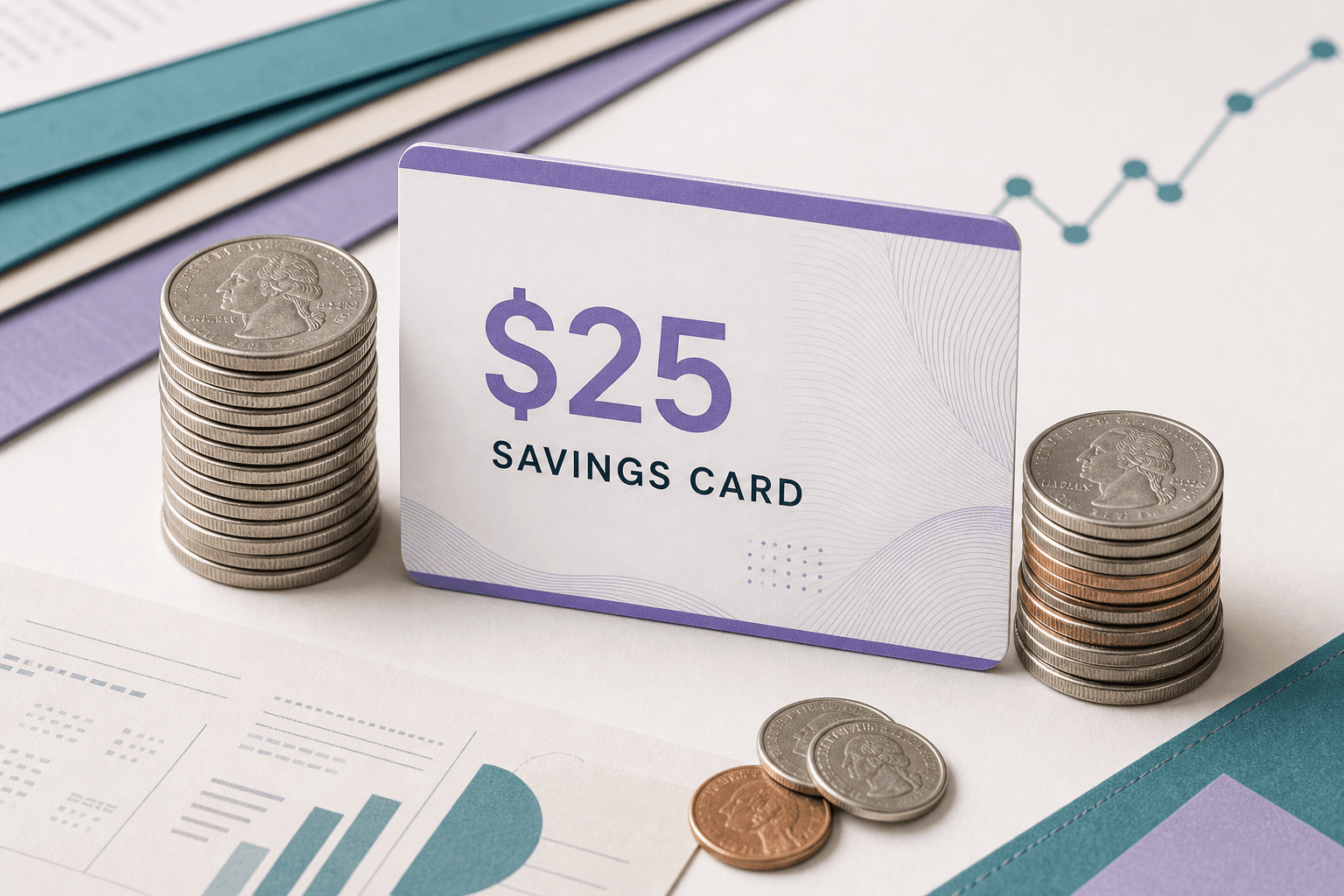
The Ozempic savings card is Novo Nordisk's official copay assistance offer — the card patients and pharmacists call the Ozempic copay card — and in 2026 it's still the single biggest discount available on the drug when you qualify. The catch is the word "when": the card has an insurance requirement, an indication requirement, a monthly savings cap, and a 48-month expiration that most coupon roundups never mention. This is the complete fine print, pulled from Novo's own terms pages.
Direct answer: With the 2026 Ozempic savings card, eligible patients pay as little as $25 per prescription fill — whether that fill is a 1-, 2-, or 3-month supply. Novo's contribution is capped at $100 per 1-month, $200 per 2-month, or $300 per 3-month supply, and the card is valid for up to 48 months from activation. You must have commercial or private insurance that covers Ozempic, a prescription for an FDA-approved use (type 2 diabetes), and US residency. Medicare, Medicaid, Medigap, VA, DoD, and TRICARE beneficiaries — and the uninsured — are excluded. Novo brands it a "savings offer"; there is no separate Ozempic copay card, discount card, or coupon card to hunt down. They are all this one program.
This article is the deep dive on the official card only. For every other discount route — NovoCare self-pay, GoodRx, Costco, patient assistance — see our Ozempic coupon master guide.
Ozempic Savings Card 2026: Terms at a Glance
| Term | 2026 value |
|---|---|
| Minimum out-of-pocket | $25 per fill (1-, 2-, or 3-month supply) |
| Maximum benefit | $100 / 1-month, $200 / 2-month, $300 / 3-month |
| Card lifespan | 48 months from activation date |
| What counts as 1 month | 1 box of 1 pen (28 days) or 1 bottle of 30 tablets |
| Covered products | Ozempic pens (0.25, 0.5, 1, 2 mg) and Ozempic tablets |
| Insurance requirement | Commercial/private plan that covers Ozempic |
| Indication requirement | FDA-approved use — type 2 diabetes |
| Cost to enroll | $0 — the card is always free |
| Administrator | ConnectiveRx, on behalf of Novo Nordisk |
| Limits | One offer per person; no stacking with other coupons; not insurance |
Novo Nordisk reserves the right to modify or cancel the program at any time — terms live at SavingsCardEligibility.com, which redirects to novocare.com/eligibility/diabetes-savings-card.html. The full PDF terms sit behind ozempicsavingsterms.com and were last updated July 28, 2026. Both vanity domains have a broken HTTPS certificate, so typing them with https:// throws a browser warning; go to the NovoCare pages directly instead.
Ozempic Copay Card vs Savings Card vs Discount Card
Novo Nordisk does not use the phrase "copay card" in its marketing. The brand name is the Ozempic Savings Offer, issued under the Diabetes Savings Card Program and administered by ConnectiveRx. Everyone else uses a different word for the same digital card. Novo's own terms document drops the branding once and calls it what it is: medication filled before you enroll "will not be eligible for copay assistance."
| What people search | What it actually is |
|---|---|
| Ozempic copay card | The Ozempic Savings Offer — this card |
| Ozempic coupon card | Same card |
| Ozempic discount card | Same card |
| Novo Nordisk Ozempic savings card | Same card, run by ConnectiveRx for Novo |
| Ozempic manufacturer coupon | Same card |
| Ozempic savings card 2026 | Same card; terms last updated July 28, 2026 |
| Ozempic self-pay offer | A different Novo program — cash price, no insurance claim |
| GoodRx / SingleCare Ozempic coupon | Third-party discount cards, not Novo's, and not stackable with this one |
The practical consequence is at the counter. If a pharmacy tech asks whether you have "a copay card" and you say no because Novo handed you a "savings offer," you just paid full copay. The same four numbers — BIN, PCN, Group, ID — go into the system either way.
How the Savings Math Actually Works
"Pay as little as $25" is doing heavy lifting. The card pays up to $100 of your copay per month, and your floor is $25. Three realistic 2026 scenarios:
| Your situation | Insurance copay | Card pays | You pay |
|---|---|---|---|
| Good formulary tier | $60/month | $35 | $25 |
| Typical tier 3 copay | $125/month | $100 (cap) | $25 |
| High-deductible plan, deductible unmet | $550/month | $100 (cap) | $450 |
That last row is the one that surprises people. Early in the year, before a high deductible is met, the card knocks $100 off a $550+ claim and you still owe hundreds. If that's you, compare what cash routes cost in our cheapest GLP-1 rankings — Novo's own self-pay price of $349/month can beat your insurance until the deductible is met. If the card is rejected or you are uninsured, a current Ozempic coupon guide covers the routes that still work.
The Ozempic Pill Copay Card: Tablets on the Same Offer
There is no separate copay card for the Ozempic tablet. The Diabetes Savings Card Program covers Ozempic tablets on identical terms to the pen: pay as little as $25, with maximum savings of $100 per 1-month, $200 per 2-month, and $300 per 3-month prescription. For tablets, a 1-month fill is one bottle of 30 tablets (a 30-day supply), so a 3-month fill is three bottles and the cap becomes $300.
Two things trip people up:
- Ozempic tablets and Rybelsus are both oral semaglutide, and both sit on the same savings card. Rybelsus 7 mg and 14 mg carry the same $100/$200/$300 caps under the Diabetes Savings Card Program. "One offer per person" still applies across them.
- Self-pay tablet prices run well below the pen, which matters when the card does not apply to you:
| Ozempic tablets, self-pay | 1 month | 2 months | 3 months |
|---|---|---|---|
| 1.5 mg, 30-tablet bottle | $149 | $298 | $447 |
| 4 mg | $199 | $398 | $597 |
| 9 mg | $299 | $598 | $897 |
Self-pay pens, for comparison, are $349/month ($698 / $1,047) for 0.25-1 mg and $499/month ($998 / $1,497) for 2 mg. New patients — Novo defines that as anyone who has not redeemed an Ozempic injection savings offer in the past 365 days — get $199/month on the first two 28-day fills of 0.25 or 0.5 mg, provided the prescription is redeemed and filled by December 31, 2026. The third fill reverts to $349.
Who Qualifies for the Ozempic Savings Card
All of these must be true:
- Commercial or private insurance that includes Ozempic on its formulary (prior authorization or step therapy may still apply — our GLP-1 insurance coverage guide covers how to clear those).
- A prescription for an FDA-approved indication — Ozempic is labeled for type 2 diabetes. An off-label weight-loss script fails this test; that's Wegovy's territory (Ozempic vs Wegovy explains the label split).
- US or US-territory residency, age 18+.
- A valid prescriber ID on the prescription.
Worth repeating because Novo spells it out: ACA Marketplace plans, FEHB (federal employee) plans, and state-employee plans count as commercial insurance. Having one of those does not disqualify you.
One state footnote most roundups miss: Novo makes Massachusetts availability contingent on "state law in effect at the time patient presents the Savings Offer" — the only state singled out in the terms.
Who Is Excluded From the Ozempic Discount Card
Per the official terms, the card is void for anyone "enrolled in any federal or state health care program with prescription drug coverage":
- Medicare — Parts A, B, C (Advantage), D, and Medigap
- Medicaid, including managed-care plans
- VA, DoD, TRICARE
- State pharmaceutical assistance programs
- Cash payers / uninsured — the card discounts an insurance claim; with no claim there's nothing to discount
- Plans that already reimburse the entire cost
There is no workaround, no appeal, and "I'll just not mention my Medicare plan" is fraud. If you're excluded, your real options are Novo's self-pay pricing ($199 intro / $349-$499 per month), the Patient Assistance Program if your income qualifies, or compounded semaglutide — all covered in the Ozempic coupon guide.
Using it for weight loss, or no insurance? SkinnyRx — an online intake reviewed by a licensed provider, who decides whether prescription treatment is appropriate. Compounded semaglutide and tirzepatide as weekly injections or daily tablets, plus FDA-approved options through the SkinnyRx Membership. (Partner link: we may earn a commission. Compounded drugs are not FDA-approved or evaluated for safety, effectiveness or quality by the FDA.)
Using an Ozempic Coupon When You Have Insurance
"Can I use an Ozempic coupon with insurance?" has three different answers, and which one applies depends entirely on what your plan does with Ozempic — not on whether you have a plan at all.
| Your insurance | Savings card works? | What to actually use |
|---|---|---|
| Commercial plan, Ozempic on formulary | Yes | The savings card as secondary — $25 floor, $100/month cap |
| Commercial plan, Ozempic excluded or denied | No — the card needs a covered claim | Novo's self-pay offer, $349/month, processed outside your plan |
| Medicare, Medicaid, VA, DoD, TRICARE | No — permanently excluded | Self-pay offer, or the Patient Assistance Program (1-866-310-7549) |
Three rules decide most real cases:
- The savings card is not a discount coupon. It needs an insurance claim to attach to. It adjudicates as secondary after your plan pays. No claim, no discount — which is exactly why the uninsured cannot use it and why "commercial insurance" alone is not enough if that plan excludes the drug.
- You cannot stack. Per the terms, the offer "may be combined with a manufacturer sponsored automatic eVoucher offer (at participating pharmacies) but cannot be combined with any other coupon, self-pay discount, certificate, voucher, or similar offer." A GoodRx or SingleCare price and this card are an either/or at the register. Have the pharmacist price both and take the lower.
- Having insurance does not lock you out of the cash price. Novo writes the self-pay offer for "patients with insurance that does not cover Ozempic, or those that are self-paying/opting to process outside of their insurance plan." The trade is explicit: you agree not to submit the claim to any plan, not to seek reimbursement, and not to apply the money toward your deductible or true out-of-pocket maximum. The terms address Medicare beneficiaries directly and allow the same thing on the same condition.
Two plan designs worth checking before you assume the card helps your deductible. The terms name accumulator adjustment programs, where "payments made by you that are subsidized by manufacturer savings offer programs, do not count towards your deductibles," and maximizer programs, which "adjust patient out-of-pocket cost sharing amounts based on the availability of a manufacturer savings offer." Both are listed among arrangements the offer is not to be combined with.
Separately, the July 2026 terms add a hard disqualifier: if your plan runs an alternate funding program that requires you to apply for the Ozempic Self-Pay Offer or go through an outside funding vendor as a condition of covering Ozempic, you are "not eligible to use the Ozempic Savings Offer" at all. Employer plans that route specialty drugs through third-party funding vendors are the usual culprit. Ask HR before enrolling.
How to Enroll: 5-Minute Walkthrough
- Check eligibility and activate. Go to SavingsCardEligibility.com (linked from ozempic.com, and a redirect to novocare.com/eligibility/diabetes-savings-card.html — use the NovoCare address directly if the vanity link throws a certificate warning), or text BEGIN to 21848. You'll answer insurance-type questions — this is where government-plan holders get screened out.
- Have two things ready: your commercial insurance card and your Ozempic prescription details.
- Get the card instantly. It's digital — you receive BIN, PCN, Group, and ID numbers immediately, with a printable/wallet version. Nothing is mailed unless you ask.
- Give it to the pharmacy. Present it with your insurance card; the pharmacist runs your insurance first, then the card as secondary. It works at retail pharmacies and through NovoCare Pharmacy home delivery.
- Need a human? Enrollment help: 1-866-696-4090 (Mon-Fri, 8:30 AM-6:00 PM ET). Card problems after enrollment: 1-877-304-6855 (24/7).
Enrollment is free. Any site charging an "activation fee" for an Ozempic savings card is a scam.
The 48-Month Clock and Renewal
The card is valid up to 48 months from the date you activate it — not from your first fill. Two practical consequences:
- Don't activate early. If insurance hasn't approved your prior authorization yet, wait — activating starts the clock even if you can't fill.
- Eligibility is re-checked over time. Switching from a commercial plan to Medicare mid-stream ends your eligibility immediately, even with months left on the card. Update your insurance info via 1-877-304-6855 when you change jobs or plans so fills don't bounce.
After 48 months you cannot simply re-enroll under the current terms — one offer per person. At that point you're paying your plain insurance copay, or whatever program Novo runs then.
Savings Card Rejected at the Pharmacy? Fixes
| Rejection | What's actually wrong | Fix |
|---|---|---|
| "Card not found / invalid" | BIN/PCN/Group entered wrong | Have the pharmacist re-run all four numbers; call 1-877-304-6855 |
| "Patient not eligible" | Government insurance detected | No fix — switch to self-pay pricing or PAP |
| "Drug not covered" | Your plan excludes Ozempic; card needs a covered claim | File a coverage appeal or use NovoCare self-pay ($349/month) |
| "Prior authorization required" | Plan covers it but wants paperwork first | Prescriber files the PA; card works once approved |
| "Maximum benefit reached" | You filled a >1-month supply against a 1-month cap | Sync prescription day-supply with the fill (28/56/84 days) |
| Old insurance on file | You changed plans since activating | Update insurance through the card helpline |
What Changed in 2026
- The card now covers the Ozempic pill. With oral semaglutide sold under the Ozempic brand, the terms define a month as 1 pen box or 1 bottle of 30 tablets.
- The 48-month validity is current — older articles citing 24-month cards are out of date.
- The fallback got cheaper. If the card can't help you, Novo's self-pay floor is the lowest it's been: $199/month for the first 2 fills of 0.25/0.5 mg for new patients, redeemed and filled by December 31, 2026, then $349/month (0.25-1 mg) and $499/month (2 mg). Ozempic tablets self-pay lower still, from $149/month for the 1.5 mg bottle.
- Caps held steady at $100/$200/$300 — no reduction from prior years.
- The terms were refreshed July 28, 2026. They now spell out the alternate-funding-program disqualifier and name accumulator and maximizer programs directly. Novo also flags that its posted self-pay pricing will be updated after December 31, 2026, so re-price before a January fill.
If you're comparing manufacturers before committing, Lilly runs a similar copay card for Mounjaro — see Ozempic vs Mounjaro, and our GLP-1 coupons and savings overview compares the programs across every brand. If you're brand new to semaglutide, start with the Ozempic guide.
Frequently Asked Questions
How much does the Ozempic savings card actually save? Up to $100 per month off your copay ($300 per 3-month fill), with a $25 floor. Over the full 48 months, that's a maximum of $4,800 — real money, but far from "free Ozempic" if your plan has a high deductible.
Does the Ozempic savings card work with Medicare? No. Medicare (including Advantage and Part D), Medicaid, Medigap, VA, DoD, and TRICARE are all excluded under federal anti-kickback rules. Excluded patients should look at NovoCare self-pay or the Patient Assistance Program instead.
Does the savings card cover the Ozempic pill? Yes. The 2026 terms cover both pen and tablet forms — one month is defined as 1 pen box (28 days) or 1 bottle of 30 tablets.
Can I use the savings card with a high-deductible health plan? Yes, as long as the plan is commercial and covers Ozempic — but the $100/month cap means you'll still owe most of a pre-deductible claim. Compare against Novo's $349/month self-pay price until your deductible is met. Also note some plans use copay accumulators, which stop card payments from counting toward your deductible.
How long does enrollment take? About five minutes, online or by texting BEGIN to 21848. The digital card is issued instantly with BIN/PCN/Group/ID numbers you can use the same day.
What happens after 48 months? The offer ends and it's limited to one per person. You'd pay your normal insurance copay, switch to whatever program Novo offers at that point, or move to self-pay pricing.
Is the Ozempic copay card the same as the savings card? Yes — one program, two names. Novo Nordisk brands it the Ozempic Savings Offer, issued through the Diabetes Savings Card Program and administered by ConnectiveRx. Patients, pharmacists, and prescribers call it the copay card. There is no separate Novo Nordisk discount card or coupon card to find.
Is there a copay card for Ozempic tablets? Yes, the same one. Ozempic tablets carry identical terms to the pen — $25 floor, $100 per 1-month, $200 per 2-month, $300 per 3-month — with a 1-month fill defined as one bottle of 30 tablets. Rybelsus 7 mg and 14 mg sit on the same card at the same caps.
Can I use an Ozempic coupon if I have insurance? The savings card requires commercial insurance that covers Ozempic; it runs as a secondary claim after your plan pays. If your commercial plan excludes Ozempic, the card is dead, but Novo's self-pay offer still works — on condition you process it outside your plan and do not count it toward your deductible.
Can I stack the savings card with a GoodRx coupon? No. The terms allow combining only with a manufacturer-sponsored automatic eVoucher at participating pharmacies, and rule out "any other coupon, self-pay discount, certificate, voucher, or similar offer." At the register it is one or the other, so price both.
Is the Ozempic copay card still available in 2026? Yes. Novo last updated the Savings Offer terms on July 28, 2026, and they still read $25 minimum out-of-pocket, $100/month maximum savings, and up to 48 months from date of enrollment. Novo notes that posted self-pay pricing will be updated after December 31, 2026, and the limited-time $199 self-pay price ends that date.
Where do I activate the Ozempic copay card? SavingsCardEligibility.com and ozempicsavingsterms.com are Novo redirect domains — they land on the NovoCare eligibility page and the terms PDF respectively, but both have a broken HTTPS certificate, so go to novocare.com directly or text BEGIN to 21848.
Last reviewed: August 20, 2026
Sources
- Diabetes Savings Card Program Terms — NovoCare (official)
- Ozempic Savings Offer — NovoCare (official)
- Ozempic Cost & Coverage — Ozempic.com (Novo Nordisk official)
- Ozempic Savings, Self Pay, & Home Delivery — NovoCare Pharmacy
- Ozempic Savings Offer Terms and Conditions, last updated July 28, 2026 (PDF) — Novo Nordisk
- How Do I Get Ozempic for $25 a Month? — SingleCare
- Ozempic Coupon Card: Do I Qualify and How Much Can I Save? — Drugs.com
- Ozempic Coupon: Comprehensive Savings Guide (2026) — NiceRx