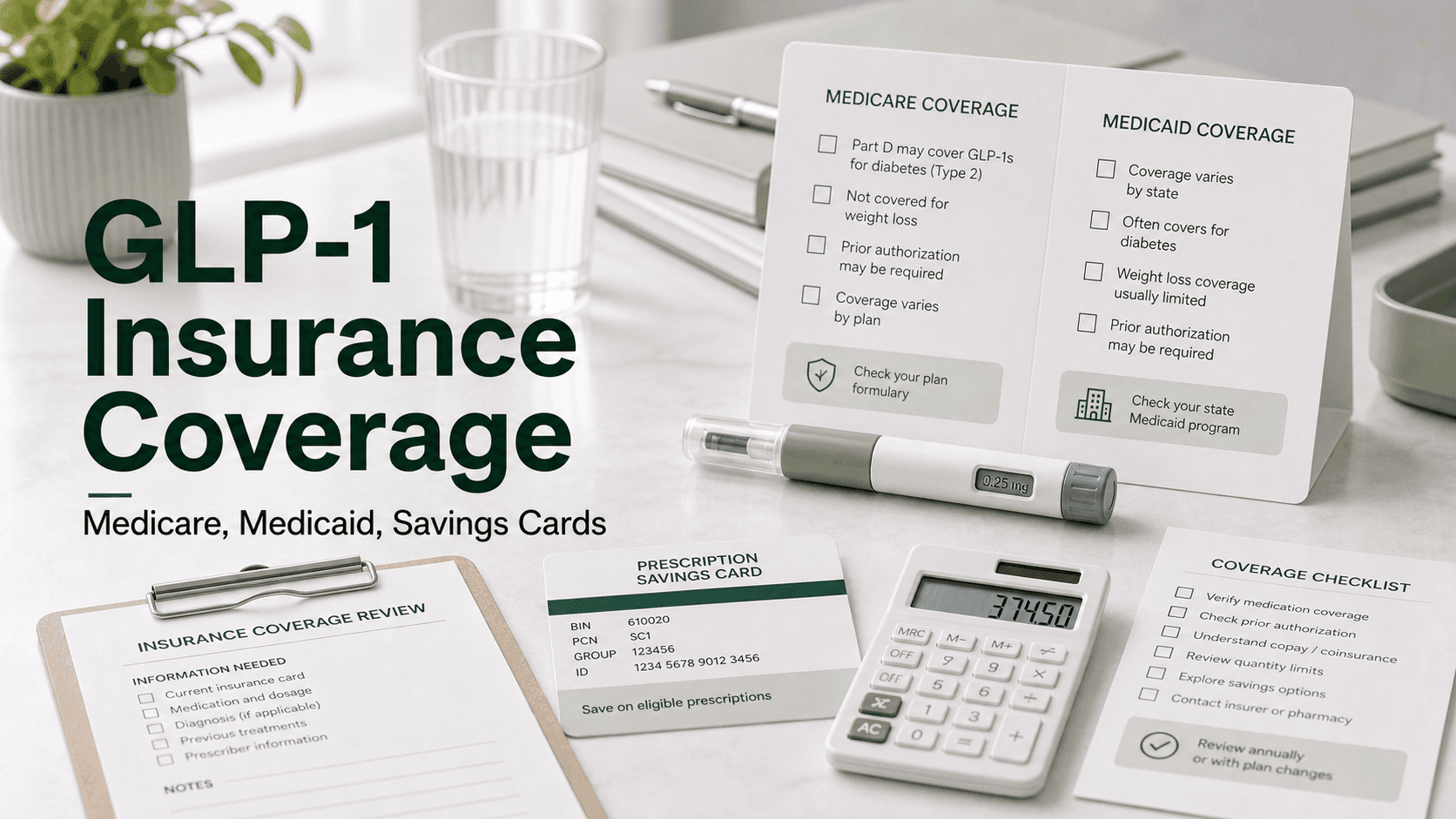
GLP-1 coverage in 2026 is a patchwork. Commercial insurance is shrinking — roughly 12 million Americans lost Wegovy or Zepbound coverage between 2025 and 2026 as employers and PBMs trimmed obesity drugs from formularies. Medicare opened a brand-new door with the GLP-1 Bridge demonstration starting July 1, 2026. Medicaid covers obesity GLP-1s in only about 13 states. Manufacturer savings cards can push commercial copays to $25/month, and FSA/HSA dollars are fair game when there's a prescription on file. The system is navigable, but you have to know the entry points.
Direct answer: If you have commercial insurance that covers GLP-1s, the Wegovy NovoCare savings card drops your copay to as low as $25/month (max savings $100/month) and the Zepbound Savings Card does the same (max $1,300/year). If you're uninsured, LillyDirect sells Zepbound for $349-$549/month by dose, and NovoCare sells injectable Wegovy for $199-$399/month (transitional pricing through mid-2026, then $349-$399). Foundayo (orforglipron pill) starts at $149/month self-pay. Medicare does not routinely cover GLP-1s for obesity alone — but the GLP-1 Bridge offers a flat $50/month for eligible Part D beneficiaries from July 1, 2026 through December 31, 2027. Medicare already covers GLP-1s for type 2 diabetes, cardiovascular risk reduction, and obstructive sleep apnea indications. Medicaid coverage exists in roughly 13 states for obesity; every state covers GLP-1s for diabetes. FSA and HSA funds cover GLP-1s prescribed for an FDA-approved indication — an LMN (letter of medical necessity) is usually required for FSA reimbursement.
Commercial Insurance + Savings Card: The Best-Case Stack
If your employer plan covers a GLP-1, layering a manufacturer savings card on top is the cheapest path. As of May 2026:
| Drug | Savings card price | Eligibility | Max savings cap |
|---|---|---|---|
| Wegovy injection (semaglutide) | $25/month copay | Commercial insurance, covered drug, US resident 18+ | $100/month |
| Wegovy pill (oral semaglutide) | $25/month copay | Same | $100/month |
| Zepbound injection (tirzepatide) | $25/month copay | Commercial insurance, covered drug | $1,300/year |
| Foundayo (orforglipron pill) | $25/month copay | Commercial insurance, covered drug | Varies by dose |
The cards are not for Medicare, Medicaid, VA, Tricare, or any government-funded plan — that's a federal law (anti-kickback statute), not a policy choice by Novo or Lilly. The cards expire annually, so re-enrollment matters: the current Zepbound Savings Card expires 12/31/2026.
If your plan covers the drug but lands you in a high-deductible phase, the savings card still applies but pays toward a different ceiling — Zepbound's commercial card can also cut self-pay-priced fills by up to $469/month for patients whose plans don't cover Zepbound but who otherwise meet card terms. Read your specific card's fine print before relying on a number.
Medicare Part D in 2026: The Bridge Changes Everything
For years the rule was simple and frustrating: Medicare Part D could not pay for a drug whose only indication was weight loss. That stayed true even as Wegovy and Zepbound reshaped the obesity treatment landscape.
Three things shifted that:
- March 2024 FDA expansion — Wegovy gained an indication for reducing major cardiovascular events in adults with established heart disease and obesity. Medicare Part D plans began covering it for that indication.
- December 2024 FDA expansion — Zepbound gained an indication for moderate-to-severe obstructive sleep apnea in adults with obesity. Part D plans began covering it for that indication.
- CMS Medicare GLP-1 Bridge — A temporary demonstration model running July 1, 2026 through December 31, 2027, offering eligible Medicare Part D beneficiaries access to all formulations of Wegovy, the KwikPen formulation of Zepbound, and all formulations of Foundayo at a flat $50/month copay.
Who qualifies for the Bridge
- Enrolled in Medicare Part D
- Diagnosed with obesity (BMI thresholds per FDA labels)
- Not already getting the drug covered by Part D for a Medicare-covered indication (diabetes, CVD risk, OSA, MASH)
What the Bridge does not do
- The $50 copay does not count toward your Part D deductible.
- The $50 copay does not count toward the 2026 $2,100 annual out-of-pocket cap (rising to $2,400 in 2027).
- It is a demonstration, not permanent coverage. The program ends December 31, 2027 unless Congress acts.
If you have a Medicare-covered indication (diabetes, established CVD with obesity, or obstructive sleep apnea with obesity), you stay on your Part D plan's normal coverage and your spend does count toward the cap. That's usually the better deal — work with your prescriber to document the qualifying condition first.
Medicaid: 13 States, A Patchwork
Federal Medicaid law requires every state to cover GLP-1s prescribed for type 2 diabetes. Obesity coverage is optional, and most states have declined.
As of April 2026, the rough state of play:
| Coverage status | States |
|---|---|
| Cover Wegovy and/or Zepbound for obesity | Delaware, Kansas, Massachusetts, Minnesota, Mississippi, North Carolina, Vermont (Wegovy only), Wisconsin, plus selected coverage in California (limited), Colorado, Connecticut, Illinois, Louisiana, New Jersey, New York, Oregon, Pennsylvania, Washington |
| No obesity GLP-1 coverage | The remaining ~37 states |
| Restricted (severe obesity + failed alternatives) | Michigan |
| Recently dropped or cut | California Medi-Cal eliminated Wegovy/Zepbound/Saxenda coverage effective January 1, 2026 |
Roughly 80% of adult Medicaid enrollees live in states without an obesity GLP-1 pathway in 2026.
Two important loopholes:
- Other indications still apply. If you have type 2 diabetes, established cardiovascular disease, MASH, or obstructive sleep apnea, your state Medicaid likely covers the GLP-1 for that condition — not the obesity indication. Documentation matters.
- EPSDT for under-21. Federal Early and Periodic Screening, Diagnostic and Treatment law requires Medicaid to cover medically necessary treatments for enrollees under 21, even when adult coverage is excluded. Adolescents with severe obesity may be eligible regardless of state policy.
Always confirm with your state Medicaid program directly — formularies change quarterly.
FSA and HSA: Yes, With a Prescription
GLP-1 medications are eligible for both Flexible Spending Account and Health Savings Account funds — provided they're prescribed for an FDA-approved indication. That covers Wegovy and Zepbound for obesity, Ozempic and Mounjaro for type 2 diabetes, Wegovy for cardiovascular risk reduction, Zepbound for obstructive sleep apnea, and Foundayo for obesity.
What the IRS rules require:
- A valid prescription from a licensed provider
- The drug must be for a diagnosed medical condition, not cosmetic weight loss
- Itemized receipts showing drug, date, and amount paid
- For most FSA plans (and some HSA administrators), a Letter of Medical Necessity signed by the prescriber
What an LMN should include
- Patient name, date of birth
- Diagnosis with ICD-10 code (e.g., E66.01 for morbid obesity, E11.x for type 2 diabetes)
- Drug name and dosage
- Statement that the medication is medically necessary
- Duration of treatment
Practical tips
- HSA dollars roll over; FSA dollars typically don't. Spend FSA first if you have both.
- Save the EOB and pharmacy receipt for every fill. Audits happen.
- Some FSA administrators reject GLP-1 reimbursement without an LMN even though IRS rules don't strictly require one for prescription drugs. Get the letter; it's a five-minute ask.
- Self-pay through LillyDirect, NovoCare, or a compounding pharmacy is eligible the same way as retail pharmacy fills.
Manufacturer Patient Assistance Programs
These are different from savings cards. PAPs are for low-income, uninsured patients and provide medication free or near-free.
Novo Nordisk Patient Assistance Program
Novo's traditional PAP covers many of its products free of charge for uninsured patients at or below 400% of the federal poverty level. Wegovy is not currently on the PAP medication list — Novo has steered uninsured Wegovy patients to NovoCare Pharmacy's reduced cash pricing instead.
Medicare GLP-1 Bridge (Novo's "bridge" answer)
This is the program most people mean when they search "Novo Bridge program." It's the CMS-administered Medicare demonstration covering Wegovy and Foundayo at $50/month, with Novo and Lilly as participating manufacturers. The bridge metaphor: it bridges the gap until Congress decides whether Medicare should cover obesity drugs permanently.
Lilly Patient Solutions / LillyCares
Lilly's PAP (LillyCares) covers eligible uninsured patients earning up to 400% of FPL for many products. Like Novo, Lilly has channeled Zepbound demand into the LillyDirect self-pay channel rather than full PAP coverage. If you are hoping for a cheaper copy of the same molecule, see our guide to whether a Zepbound generic exists.
LillyDirect self-pay (May 2026)
| Zepbound dose | Self-pay price |
|---|---|
| 2.5 mg KwikPen (1-month) | $349 |
| 5 mg KwikPen (1-month) | $499 |
| 7.5 mg KwikPen (1-month) | $499 |
| 10 mg / 12.5 mg / 15 mg KwikPen | $549 |
NovoCare self-pay (May 2026)
| Wegovy product | Self-pay price |
|---|---|
| Wegovy injection 0.25-2.4 mg | $349/month (after introductory $199 for first two fills) |
| Wegovy HD 7.2 mg injection | $399/month |
| Wegovy pill 1.5 mg | $149/month |
| Wegovy pill 4 mg | $149 through Aug 31, 2026; $199/month after |
Foundayo (LillyDirect)
| Foundayo dose | Self-pay price |
|---|---|
| 0.8 mg starter | $149/month |
| 2.5 mg | $199/month |
| 5.5-17.2 mg (maintenance) | $299/month |
Prior Authorization: What Plans Actually Require
Almost every commercial plan that covers Wegovy or Zepbound requires prior authorization. The criteria are usually some combination of:
- BMI threshold — typically ≥30, or ≥27 with a weight-related comorbidity (hypertension, type 2 diabetes, dyslipidemia, cardiovascular disease, obstructive sleep apnea). Some UHC plans require BMI ≥40 for Wegovy.
- Documented comorbidity with diagnosis code and recent labs or imaging
- Lifestyle intervention attempt — most plans want 3 to 6 months of documented behavioral/dietary effort. BCBS of Texas raised this from 3 to 6 months effective 2026.
- No contraindications — personal or family history of medullary thyroid carcinoma or MEN2, prior pancreatitis (relative)
- Age — usually 18+, some adolescent expansions for Wegovy ≥12
- Prescriber attestation that the patient will combine the drug with reduced-calorie diet and increased physical activity
How to make PA approval more likely
- Track weight, BMI, and waist circumference at every visit for 6 months before the request
- Document comorbidities with labs: A1c for prediabetes, BP readings for hypertension, lipid panel for dyslipidemia, sleep study for OSA
- Note prior attempts with phentermine, naltrexone-bupropion, orlistat, or structured lifestyle programs if applicable
- Use the manufacturer's PA form when available — Novo's Wegovy PA portal and Lilly's coverage portal have plan-specific shortcuts
- Submit electronically through CoverMyMeds or the plan's portal — paper faxes get lost
Coverage Criteria Cheat Sheet
| Drug | Indication | Typical PA criteria |
|---|---|---|
| Wegovy injection | Chronic weight management | BMI ≥30, or ≥27 + comorbidity |
| Wegovy injection | CV risk reduction | Established CVD + BMI ≥27 |
| Wegovy pill | Chronic weight management | Same as injection |
| Zepbound | Chronic weight management | BMI ≥30, or ≥27 + comorbidity |
| Zepbound | Obstructive sleep apnea | Moderate-to-severe OSA + BMI ≥30 |
| Foundayo | Chronic weight management | BMI ≥30, or ≥27 + comorbidity |
| Ozempic / Mounjaro | Type 2 diabetes | A1c ≥6.5%, documented diabetes |
No Insurance? Cash-Pay Options Ranked
For patients with no coverage and no realistic PA path, ranked from cheapest:
- Foundayo via LillyDirect — $149/month for starter dose
- Wegovy pill via NovoCare — $149/month for 1.5 mg dose
- Compounded semaglutide — $129-$249/month at telehealth providers like Henry Meds, Mochi, Eden (availability has tightened since the FDA shortage resolution and Novo settlements)
- TrumpRx government direct channel — Zepbound ~$350/month, launched Feb 2026
- Zepbound 2.5 mg via LillyDirect — $349/month
- Wegovy injection via NovoCare — $349/month maintenance
- Zepbound 5-15 mg via LillyDirect — $499-$549/month
- Retail pharmacy cash list price — $1,300-$1,400+ (avoid; rarely the cheapest path)
How to Appeal a Denial
Up to 80% of well-prepared appeals for GLP-1 medications are eventually overturned. The process is bureaucratic but predictable.
Step 1 — Read the denial letter
It will state the specific reason: not medically necessary, plan exclusion (employer carved out obesity drugs), step therapy requirement, missing documentation, or BMI not met. Each reason has a different counter.
Step 2 — Internal appeal (first level)
You typically have 30-180 days to file (check your letter). Submit:
- Letter of Medical Necessity from your prescriber addressing every denial reason point by point
- Weight history, BMI, comorbidities with lab evidence
- Documentation of prior lifestyle attempts and any prior weight-loss medications tried
- ICD-10 codes for obesity (E66.x) and each comorbidity
Most plans must respond within 30 days for standard appeals, 72 hours for urgent.
Step 3 — Peer-to-peer review
If the first appeal is denied, request a peer-to-peer: your prescriber speaks with the plan's medical director. These often flip a denial because a real conversation can surface clinical context the form missed.
Step 4 — Second-level internal appeal
Most plans offer a second internal appeal with a different reviewer.
Step 5 — External review
If internal appeals exhaust, you have the right to independent external review. State insurance commissioners administer this for fully-insured plans; self-funded (ERISA) employer plans use Independent Review Organizations. Decision is binding on the plan. File within 4 months of the final internal denial.
Step 6 — Plan exclusion workaround
If your employer specifically excludes obesity drugs, no appeal will overturn that — it's a benefit design choice, not a coverage decision. Options:
- Ask HR to add the benefit (more employers are doing this in 2026)
- Document a covered indication (CVD, OSA, diabetes) if clinically true
- Switch to a self-pay path
What People Get Wrong About GLP-1 Insurance
- "Medicare covers Wegovy for weight loss in 2026." Only via the Bridge demonstration, only at $50/month, only July 2026 to December 2027, and the spend doesn't count toward your $2,100 cap. Standard Part D coverage still requires a non-obesity indication.
- "My savings card works on Medicare." It does not. Anti-kickback law prohibits manufacturer coupons on any federal plan, including Medicare Part D, Medicaid, Tricare, and the VA.
- "FSA won't cover Wegovy because it's a weight-loss drug." Wrong. FSA covers GLP-1s prescribed for an FDA-approved indication. Get an LMN to be safe.
- "If my plan denies once, I'm out." Most denials are overturned on appeal with proper documentation.
- "Compounded semaglutide is cheaper, so I should skip insurance entirely." Compare math. Insurance + savings card at $25/month beats compounding at $129-$249/month, and you get a brand-name FDA-approved product.
- "My BMI is 28 so I don't qualify." BMI ≥27 with one weight-related comorbidity meets every major plan's criteria.
- "I have to fail other weight-loss drugs first." Step therapy requirements vary widely. Many plans don't impose them; some accept documented behavioral attempts in place of pharmacological ones.
- "The Medicare Bridge covers Mounjaro and Ozempic." No. The Bridge covers Wegovy (all forms), Zepbound KwikPen, and Foundayo. Diabetes GLP-1s are already covered under standard Part D for diabetes patients.
FAQ
Are GLP-1 drugs covered by Medicare in 2026? Standard Part D covers GLP-1s for diabetes, established cardiovascular disease, and obstructive sleep apnea — not for obesity alone. The Medicare GLP-1 Bridge demonstration adds $50/month obesity coverage for Wegovy, Zepbound KwikPen, and Foundayo from July 1, 2026 through December 31, 2027.
How much is Wegovy with insurance? With commercial insurance covering Wegovy plus the NovoCare savings card, copay drops to as low as $25/month (max $100/month savings). Without coverage, NovoCare self-pay runs $349/month for maintenance doses.
How much is Zepbound with insurance? With commercial coverage plus the Zepbound Savings Card, copay drops to as low as $25/month (annual max savings $1,300). Self-pay through LillyDirect ranges $349-$549/month by dose.
What is the Novo Nordisk Bridge program? "Bridge" usually refers to the new Medicare GLP-1 Bridge, a CMS demonstration starting July 1, 2026, providing eligible Medicare Part D beneficiaries access to Wegovy (all forms), Zepbound KwikPen, and Foundayo at $50/month through December 31, 2027. Novo Nordisk participates by supplying Wegovy.
Are GLP-1s FSA eligible? Yes, when prescribed for an FDA-approved indication. Most FSA administrators require a Letter of Medical Necessity from the prescriber. Save itemized receipts.
Are GLP-1s HSA eligible? Yes. IRS rules treat prescription drugs as qualified medical expenses; an LMN is often recommended but not always required.
Does Medicaid cover Wegovy or Zepbound? For obesity: only in about 13 states as of April 2026. For type 2 diabetes or other approved indications: all states. Coverage rules and prior authorization vary by state Medicaid program.
What's the BMI requirement for GLP-1 coverage? Typically BMI ≥30, or BMI ≥27 with a weight-related comorbidity (hypertension, type 2 diabetes, dyslipidemia, CVD, OSA). Some plans require BMI ≥40 specifically for Wegovy.
How long does prior authorization take? Standard PA decisions: typically 7-15 business days. Expedited (urgent) PA: 72 hours. Plans must respond within 30 days for standard appeals.
Can I appeal a GLP-1 denial? Yes. File internal appeals within the deadline on your denial letter (usually 30-180 days). If internal appeals fail, request an independent external review. About 80% of well-documented appeals succeed.
What if my employer excludes obesity drugs entirely? Appeals can't overturn a benefit design exclusion. Ask HR to add coverage, document a covered non-obesity indication if clinically appropriate, or move to a self-pay path (LillyDirect, NovoCare, Foundayo).
Last reviewed: May 13, 2026
Sources
- Medicare GLP-1 Bridge — CMS
- Coming Soon: CMS to Provide $50 Monthly Access to GLP-1 Medications — CMS Newsroom
- What to Know About the BALANCE Model and Medicare GLP-1 Bridge — KFF
- Medicaid Coverage of and Spending on GLP-1s — KFF
- A new Medicare option for weight loss drugs is coming — NPR
- Patients struggle to pay for obesity drugs as insurance coverage slips — NPR
- Savings Offer Program for Wegovy — NovoCare
- Wegovy Cost, Coverage, & Savings — NovoCare
- Savings Options — Zepbound (Lilly)
- Coverage, Affordability, and Savings — Zepbound HCP
- FDA approves Lilly's Foundayo (orforglipron) — Eli Lilly
- GLP-1 Insurance Coverage Guide — GoodRx
- Tracking Insurance Coverage for Weight Loss Meds — GoodRx
- GLP-1 Insurance Coverage for Weight Loss: 2026 Guide — Healthline
- Medicare Coverage of Anti-Obesity Medications — HHS ASPE
- Glucagon-Like Peptide-1 Agonists Prior Authorization — Cigna
- Wegovy Prior Authorization Criteria — Novo MedLink
- Appealing a Denied Prior Authorization — Obesity Action Coalition
- Novo Nordisk Patient Assistance Program — NovoCare
- HSA Eligible Weight Loss Drugs — HSA Store