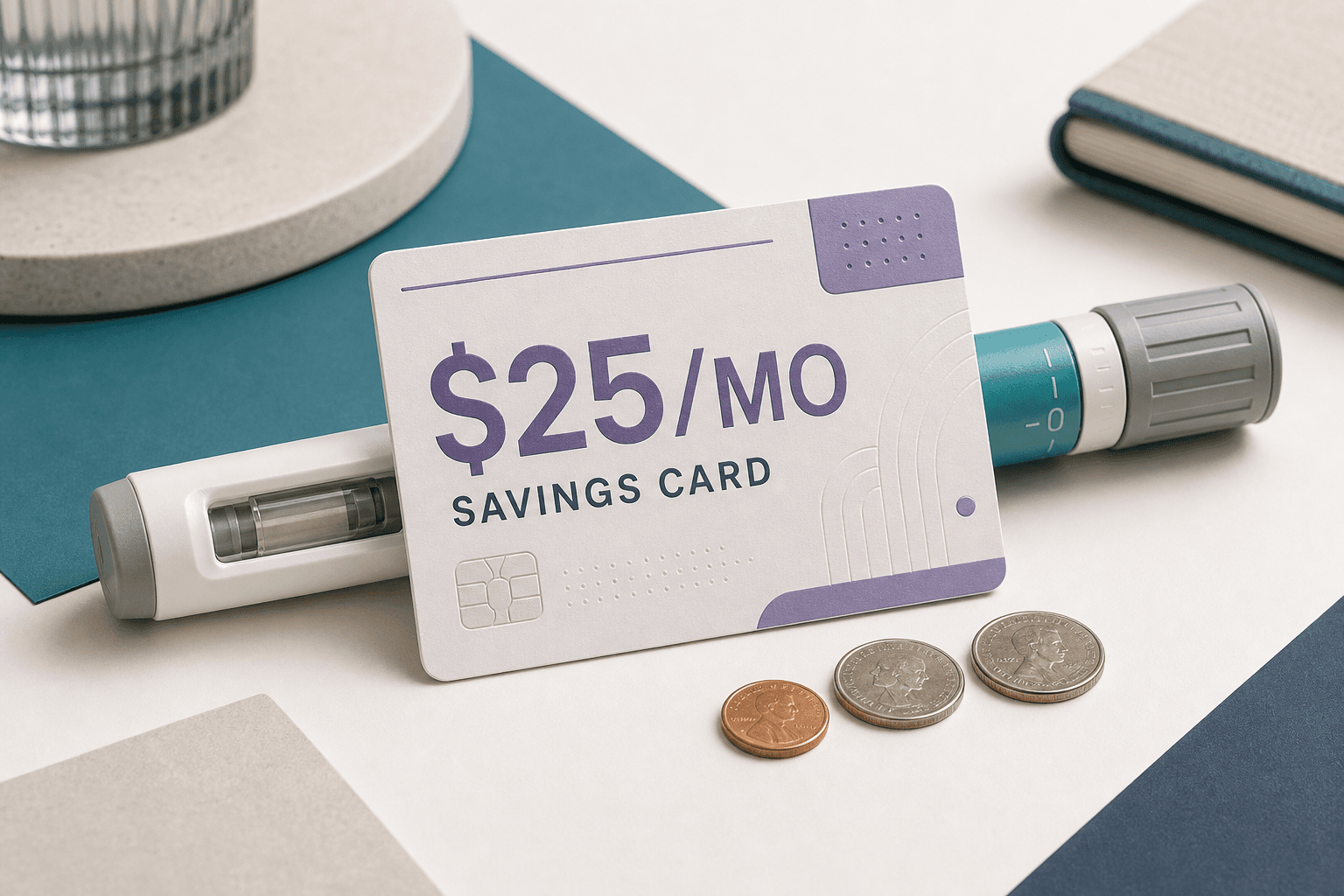
The Zepbound savings card — the same card patients and pharmacists call the Zepbound copay card — is Eli Lilly's manufacturer copay program: the single biggest legitimate discount on Zepbound for people with the right insurance, and completely useless for everyone else. The terms are published in fine print on Lilly's own pages; this article translates them into plain numbers: what you'll actually pay, where the caps bite, who is excluded and why, and how to fix a card that gets rejected at the pharmacy counter.
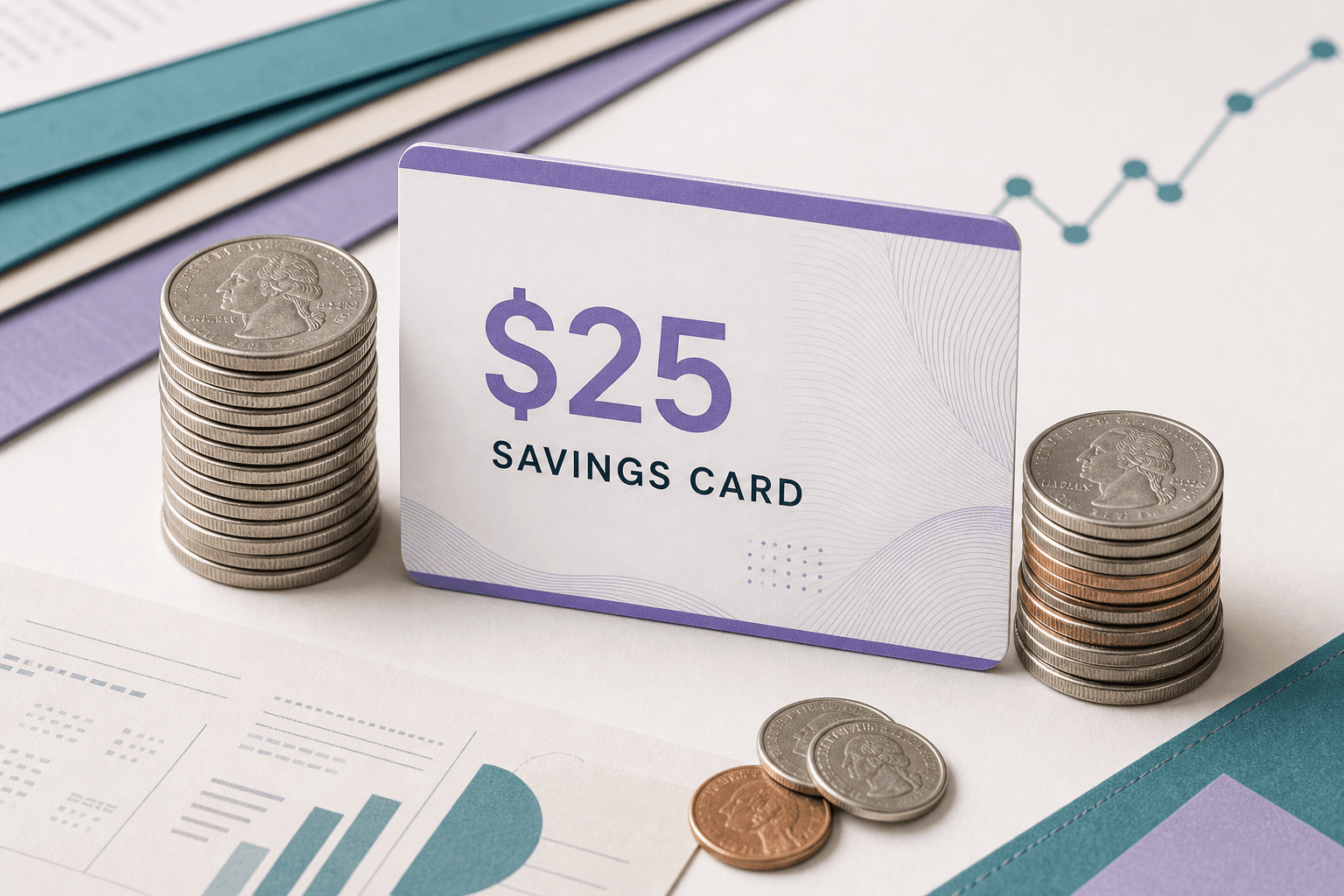
Direct answer: With commercial insurance that covers Zepbound single-dose pens, the savings card drops your cost to as little as $25 per fill for a 1-, 2-, or 3-month prescription. Savings are capped at $100 per 1-month fill ($200 per 2-month, $300 per 3-month) and a separate $1,300 maximum per calendar year, across up to 13 fills. If your commercial plan does not cover Zepbound, the card switches to a different track: the multi-dose KwikPen for $299/month (2.5 mg), $399 (5 mg), or $449 (7.5–15 mg). Government plans — Medicare, Medicaid, TRICARE, VA — are excluded entirely. The current card expires December 31, 2026.
If you want the full menu of discounts beyond the official card — GoodRx prices, self-pay vials, telehealth routes — that's covered in our companion piece, every legit Zepbound coupon in 2026. This page goes deep on the Lilly program only.
Zepbound Savings Card Terms at a Glance
| Plan covers Zepbound | Plan doesn't cover Zepbound | |
|---|---|---|
| Product | Single-dose pens | KwikPen (1 pen = 4 weekly doses) |
| You pay | As little as $25/fill | $299–$449/month (KwikPen) or $499 (single-dose pens) |
| Max savings | $100/$200/$300 per 1/2/3-month fill | Monthly cap varies by dose (e.g., $215 on 2.5 mg) |
| Annual cap | $1,300 per calendar year | Monthly caps apply |
| Fills | Up to 13 per calendar year | Up to 11 per calendar year |
| Insurance required | Commercial, with coverage | Commercial, without coverage |
| Card expires | 12/31/2026 | 12/31/2026 |
Two definitions worth knowing because pharmacies apply them literally: one month is 28 days and up to four single-dose pens (or one KwikPen), and the card is not insurance — it's a manufacturer subsidy that rides on top of (or substitutes for) your plan's claim.
Zepbound Copay Card vs Savings Card: One Program, Several Names
Lilly's official name is the Zepbound Savings Card. Almost nobody at a pharmacy counter calls it that. Searchers, pharmacists, and benefits teams use half a dozen labels for the same enrollment at zepbound.lilly.com/savings:
| What people call it | What it actually is |
|---|---|
| Zepbound copay card | The savings card, processed as a secondary claim behind your commercial plan |
| Zepbound coupon card / Lilly Zepbound coupon | The same card. "Coupon" is retail-pharmacy shorthand, not a separate offer |
| $25 Zepbound copay savings card | The covered-benefit track, where the card's help stops at $100/month |
| Zepbound discount card | The same card — but not the same thing as a GoodRx-style cash discount card |
| Zepbound KwikPen copay card | The non-covered track, which prices the multi-dose KwikPen at $299–$449 |
There is one enrollment and one 2026 Zepbound copay card. Which price you get is decided by your insurance, not by which name you searched. The distinction that does cost money: a manufacturer copay card requires commercial insurance and pays down a real claim, while a discount card (GoodRx, SingleCare) replaces insurance and is open to anyone — including Medicare members, who cannot use Lilly's card at all.
How the $25 Zepbound Coupon Card Actually Works
"As little as $25" hides the cap math. The card pays the difference between your plan's copay and $25 — but never more than $100 per monthly fill. So:
| Your plan's monthly copay | Card contributes | You actually pay |
|---|---|---|
| $50 | $25 | $25 |
| $125 | $100 | $25 |
| $200 | $100 (cap hit) | $100 |
| $400 | $100 (cap hit) | $300 |
The $25 headline holds only while your copay is $125/month or less. Above that, you pay copay minus $100. The annual ceiling is consistent with the monthly one: 13 fills × $100 = $1,300 per calendar year, after which the card contributes nothing until January.
High-deductible plan? Early in the year your "copay" may be the full list price, which blows far past the $100 cap — the card helps least exactly when the bill is biggest. Check how your plan structures GLP-1 cost-sharing in our GLP-1 insurance coverage guide.
Zepbound Savings Card Eligibility in 2026
You qualify for the $25 track if all of these are true:
- You have commercial (private/employer) drug insurance that covers Zepbound single-dose pens
- Your prescription is for an FDA-approved use — chronic weight management or obstructive sleep apnea
- You are 18 or older and a resident of the US or Puerto Rico
- You are not enrolled in any government-funded program: Medicaid, Medicare, Medicare Part D, Medicare Advantage, Medigap, DoD, VA, TRICARE/CHAMPUS, or any state prescription drug assistance program
- You provide a valid HIPAA authorization during enrollment
If your commercial plan exists but excludes Zepbound, you drop to the $299–$449 KwikPen track below. If you have no insurance at all, the card isn't for you — but Lilly's self-pay vial program charges the same $299–$449 (see the coupon overview for that route and how it compares to the cheapest GLP-1 options overall).
Why Medicare and Government Plans Are Excluded
This isn't Lilly being stingy — it's federal law. The Anti-Kickback Statute treats manufacturer copay subsidies on government-funded prescriptions as an inducement to use a more expensive drug at taxpayer expense, so every brand copay card in the US carries the same exclusion. Medicare Part D members can't use the Zepbound card, period. Their realistic options are paying cash through LillyDirect ($299–$449/month) or a free discount card processed instead of their Part D benefit — both covered in the coupon survey.
What changed on July 1, 2026: the card still excludes Medicare, but Medicare stopped being a dead end. The Medicare GLP-1 Bridge now lets eligible Part D members get the Zepbound KwikPen for no more than $50 a month — less than a covered patient with a $200 copay pays after the savings card's $100 cap. It works because it is a CMS program rather than a manufacturer copay subsidy, so the anti-kickback problem never arises. To qualify you need to be 18 or older with active Medicare Part D drug coverage, a prescription for weight management (obstructive sleep apnea does not qualify here), and a BMI of 35 or higher, or 27 or higher with a weight-related condition. Only the KwikPen is included — not single-dose pens, not vials. Prior authorization is handled after the pharmacy's first submission, and refills do not need re-approval once you are through.
How to Enroll in the Lilly Zepbound Savings Program
Enrollment takes minutes; the prep is what saves you a wasted pharmacy trip:
- Confirm coverage first. Call the member line on your insurance card and ask whether Zepbound single-dose pens are on the formulary, and whether prior authorization is required. The card cannot fix a missing prior auth.
- Go to zepbound.lilly.com/savings and answer the eligibility questionnaire (insurance type, government-plan status, age).
- Sign the HIPAA authorization — participation requires it.
- Save the card (download, print, or send to your phone) and bring it with your prescription.
- Hand it to the pharmacist. It processes as a secondary claim after your insurance. If you fill by mail order, call the pharmacy and ask them to add the card's BIN/PCN/Group numbers to your profile.
The card applies at essentially any US retail pharmacy that can process secondary claims — there is no Lilly-only pharmacy network for the $25 track.
No Coverage? The $299–$449 KwikPen Track
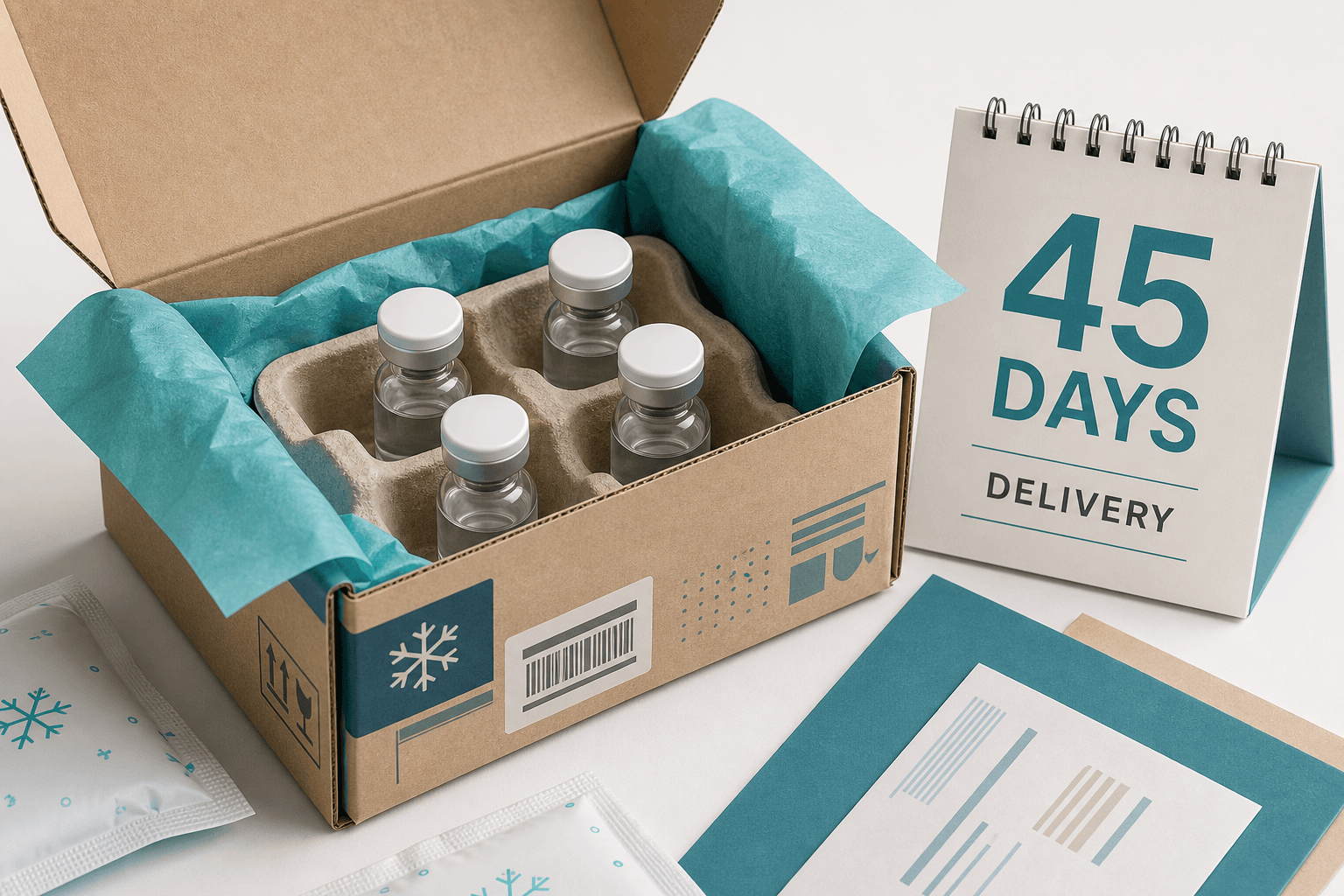
If you're commercially insured but your plan excludes Zepbound, the savings card still prices the Zepbound KwikPen — a single multi-dose pen holding four weekly doses — at $299/month for 2.5 mg, $399 for 5 mg, and $449 for 7.5, 10, 12.5, and 15 mg. On the higher doses, the discounted price requires refilling within 45 days of your previous fill's delivery date; outside the window, regular self-pay prices of $499–$699 apply. Pen needles are sold separately and a new one is required each week.
This track exists because Lilly would rather sell you the drug near its direct-to-consumer price than lose you entirely — the numbers deliberately match the LillyDirect Self Pay Journey Program. Which tier you land in depends on your maintenance dose, so it is worth checking a Zepbound dosage chart before assuming a price.
The non-covered track has a second, less-advertised option. If you would rather stay on single-dose pens than switch to the KwikPen, the same savings card prices a 1-month single-dose-pen fill as low as $499 — the only pen price the card offers when your plan excludes Zepbound, and $50 to $200 a month more than the KwikPen equivalent.
| Non-covered commercial plan | Card price | Most the card pays |
|---|---|---|
| Single-dose pens, 1-month fill | $499 | Varies by dose |
| KwikPen 2.5 mg | $299 | Up to $215/month |
| KwikPen 5 mg | $399 | Up to $115/month |
| KwikPen 7.5 mg | $449 | Up to $65/month |
| KwikPen 10, 12.5, 15 mg | $449 | Up to $271/month |
Two limits people miss on this track: fills are capped at 11 per calendar year, not the 13 the covered $25 track allows, and the 45-day refill clock runs from the delivery date of your last fill, not the day you called it in.
Denied because your plan excludes weight-loss drugs — or no insurance at all? SkinnyRx — an online intake reviewed by a licensed provider, who decides whether prescription treatment is appropriate. Compounded semaglutide and tirzepatide as weekly injections or daily tablets, plus FDA-approved options through the SkinnyRx Membership. (Partner link: we may earn a commission. Compounded drugs are not FDA-approved or evaluated for safety, effectiveness or quality by the FDA.)
Zepbound Discount Card Expiration and Renewal
The card printed today expires December 31, 2026, and the $1,300 annual savings pool resets each calendar year. Practical implications:
- Re-enroll every January. Expired cards reject silently at the register; downloading a fresh card takes two minutes.
- Lilly can change or kill the program at any time, with or without notice — the terms say so explicitly. The structure has held through 2026 so far, but nothing is contractually guaranteed.
- The 13-fill limit matters mostly for people filling monthly plus an early vacation override; a standard 12-fills-a-year patient never touches it.
Troubleshooting: Savings Card Denied at the Pharmacy
The card rejects for a handful of predictable reasons:
- You're on a government plan — even as secondary coverage. Any Medicare/Medicaid enrollment disqualifies you. No workaround exists.
- Your plan doesn't actually cover Zepbound. The $25 track requires a paid primary claim. Ask the pharmacist whether the insurance rejected it (exclusion or missing prior authorization) before blaming the card.
- Prior authorization not on file. The card processes only after insurance pays; chase the PA with your prescriber first.
- Annual cap exhausted. If the card has already paid out $1,300 this calendar year, it contributes $0 until January.
- Expired card. Re-download at zepbound.lilly.com/savings.
- Processing error. Pharmacies occasionally run the card as primary. Ask them to re-run it as a secondary claim with the card's BIN/PCN.
If the root cause is "plan excludes weight-loss drugs," your appeal options run through your employer's benefits team — or you pivot to the $299–$449 cash tracks.
Zepbound Savings Card 2026 vs 2025: What Changed
The card's core structure — $25 per fill, $100/$200/$300 monthly caps, $1,300 annual maximum — carried over from 2025 into 2026 intact, with the expiration date rolled forward to 12/31/2026. The real movement was on the non-covered and self-pay side: effective December 1, 2025, Lilly cut the cash prices from $349 to $299 (2.5 mg), $499 to $399 (5 mg), and $499 to $449 (7.5–15 mg), and those lower prices define the card's non-covered KwikPen track in 2026. If you priced Zepbound in mid-2025 and walked away, the no-coverage math is $50–$100/month better now.
Frequently asked questions
How much is Zepbound with the savings card? As little as $25 per fill if your commercial plan covers Zepbound and your copay is $125/month or under. With a higher copay you pay copay minus $100. Without coverage, the KwikPen track runs $299–$449/month.
What is the maximum savings on the Zepbound savings card? $100 per 1-month fill ($200 per 2-month, $300 per 3-month) and $1,300 per calendar year, across a maximum of 13 fills.
When does the Zepbound savings card expire? The current card expires December 31, 2026. Annual caps reset each calendar year, and you should re-download the card every January. Lilly reserves the right to amend or end the program at any time.
Why was my Zepbound savings card denied? Most often: a government plan on file, no prior authorization, a plan that excludes Zepbound, the $1,300 annual cap already spent, or an expired card. Ask the pharmacist whether the rejection came from your insurance or from the card — the fixes are different.
Does the savings card work on Zepbound vials? The $25 track applies to single-dose pens; the non-covered track applies to the KwikPen, or to single-dose pens at $499 a month. Vials are sold through Lilly's separate Self Pay Journey Program at the same $299–$449 — details in our Zepbound coupon overview.
Can I use the savings card with Medicare Part D? No. Federal anti-kickback rules exclude all government plans. Since July 1, 2026 the separate Medicare GLP-1 Bridge covers the Zepbound KwikPen at no more than $50/month for eligible Part D members — a CMS program, not the Lilly card, and KwikPen only. Note the card also doesn't transfer to Mounjaro, which has its own program — see Mounjaro vs Zepbound. Cross-drug savings options are in our GLP-1 coupons and savings guide.
Is the Zepbound copay card the same as the Zepbound savings card? Yes. "Copay card," "coupon card," and "discount card" are patient and pharmacy shorthand for the one program Lilly calls the Zepbound Savings Card, enrolled at zepbound.lilly.com/savings. There is no second card to hunt for.
Does the Zepbound copay card work on the KwikPen? Yes, on the non-covered track only. If your commercial plan excludes Zepbound, the card prices the KwikPen at $299 (2.5 mg), $399 (5 mg), or $449 (7.5 through 15 mg), capped at 11 fills per calendar year and requiring a refill within 45 days of your last delivery. The $25 track is for single-dose pens, not the KwikPen.
Where do I get the Lilly Zepbound coupon card? Straight from Lilly at zepbound.lilly.com/savings. It is free, takes a few minutes, and needs an eligibility questionnaire plus a signed HIPAA authorization. Third-party sites that "issue" a Zepbound coupon card are either mirroring Lilly's enrollment or handing you a generic discount card that is not the manufacturer program.
Is the $25 Zepbound copay savings card still available in 2026? Yes. The 2026 card takes commercially insured patients whose plan covers Zepbound single-dose pens down to $25 per fill, contributes at most $100/$200/$300 per 1/2/3-month fill and $1,300 per calendar year across 13 fills, and expires 12/31/2026.
What does the savings card cost on Zepbound single-dose pens? $25 a fill if your commercial plan covers them. If your plan does not cover Zepbound, the card prices single-dose pens as low as $499 per 1-month fill — $50 to $200 more than the KwikPen carrying the same dose, which is why most non-covered patients switch.
Is a Zepbound discount card the same as the manufacturer savings card? Not necessarily, and the difference decides whether you can use it. Lilly's card is a copay card: it needs commercial insurance and pays down a real pharmacy claim. A discount card such as GoodRx or SingleCare replaces your insurance and is open to anyone, Medicare members included — but it is a cash price on a brand drug rather than a subsidy, so price it against the $299–$449 self-pay tracks before assuming it wins. Full comparison in our Zepbound coupon overview.
Last reviewed: August 20, 2026
Sources
- Savings Options — Zepbound (tirzepatide), Eli Lilly
- Coverage, Affordability, and Savings — Zepbound (tirzepatide), Eli Lilly
- Medicare Part D Coverage and the Medicare GLP-1 Bridge — Zepbound (tirzepatide), Eli Lilly
- Authentic Zepbound Shipped to You — LillyDirect
- Lilly Reduces Price of Zepbound Single-Dose Vials for Self-Pay Patients — PharmExec
- Zepbound 2026 Prices, Coupons & Savings Tips — GoodRx
References
- Zepbound (tirzepatide) label — DailyMed, NIH — FDA label confirming Zepbound's approved uses: chronic weight management and moderate-to-severe obstructive sleep apnea in adults with obesity.
- Tirzepatide — StatPearls, NCBI Bookshelf — independent medical overview confirming tirzepatide is an FDA-approved dual GIP/GLP-1 receptor agonist.
- Zepbound Savings Options — Eli Lilly — official manufacturer savings-card terms and enrollment.