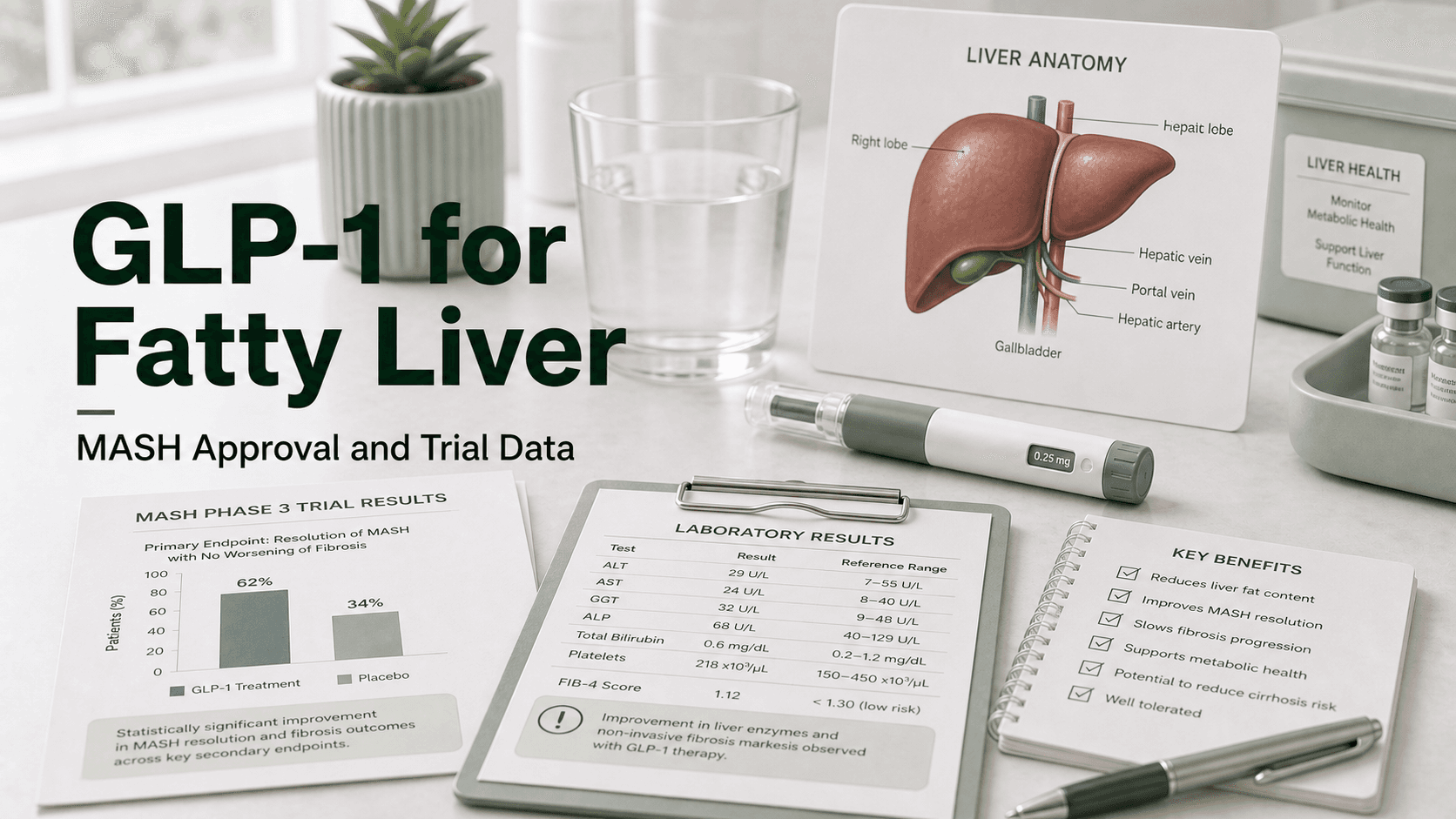

In a phase 2 substudy, retatrutide reduced liver fat by an average of 82.4% at the top dose at 24 weeks — and hepatic steatosis resolved in more than 85% of participants on the two highest doses. That's not a typo. For context, the best-documented lifestyle comparison is the Look AHEAD fatty liver substudy, where a 12-month intensive lifestyle program producing 8.5% weight loss cut hepatic steatosis by 50.8%. This is a different league.
Week 24 is the trial's primary endpoint. The week-48 liver-fat figures rest on a much smaller sample: the authors report that 48-week MRI data were missing for 56.1% of participants, which they flag as limiting interpretation of the 48-week dose-response.
Key Takeaways
- Retatrutide is a triple GIP/GLP-1/glucagon receptor agonist — the glucagon component gives it a unique, direct fat-burning effect in the liver that GLP-1 drugs alone don't replicate
- A Nature Medicine 2024 substudy of 98 MASLD patients showed 82.4% liver fat reduction at 24 weeks and 86.0% at 48 weeks on the 12 mg dose, measured by MRI-PDFF
- Over 85% of participants no longer met the diagnostic threshold for fatty liver disease after treatment
- The distinction between NAFLD (simple fat accumulation) and NASH (fat + inflammation + damage) matters — and it matters here, because this substudy measured fat on imaging, not inflammation on biopsy
- No hepatotoxicity signal appeared through 48 weeks and no Hy's Law cases were reported — but ALT and AST were near-normal at baseline and did not change consistently versus placebo, so this trial neither demonstrated enzyme benefit nor could rule out rare liver injury
- Retatrutide produced larger liver fat reductions than semaglutide or tirzepatide across separate trials — no head-to-head study exists — which the authors attribute to "the greater weight reduction achieved with retatrutide, direct hepatic effects of glucagon receptor agonism or both"
Getting a fatty liver diagnosis feels like a slow-motion warning. You can't see the damage, you probably don't feel symptoms, and most doctors say the same thing: lose weight, cut carbs, come back in a year. But you're reading this because you want to understand what the newer options actually do — and whether retatrutide is worth paying attention to. The short answer: it might be the most powerful pharmacological tool for liver fat ever studied in a clinical trial. Here's what the data actually shows, and what it might mean for you.
Retatrutide and Fatty Liver: The Direct Answer
Retatrutide and fatty liver have an exceptionally close relationship: in a Phase 2 substudy, retatrutide reduced liver fat content by an average of 82.4% at the 12 mg dose at 24 weeks, rising to 86.0% at 48 weeks — and 93% of participants on that dose dropped below the 5% liver-fat threshold that defines fatty liver disease in the first place. Placebo, over the same 24 weeks, moved liver fat by +0.3%.
Community shorthand for retatrutide is "reta," and both names refer to the same molecule — Eli Lilly's investigational compound LY3437943.
That makes retatrutide's liver fat numbers among the largest reported for any incretin-based drug, ahead of semaglutide and tirzepatide across separate trials. The likely mechanism is the glucagon receptor — retatrutide activates it, the other two do not — though the authors themselves stop short of assigning credit, writing that the extra effect "may be related to the greater weight reduction achieved with retatrutide, direct hepatic effects of glucagon receptor agonism or both." The most direct evidence that glucagon adds something beyond weight loss is a separate study they cite: at matched degrees of weight loss, the GLP-1/glucagon dual agonist efinopegdutide cut liver fat more than semaglutide in every band (52.4%, 76.6% and 86.2% versus 13.4%, 39.6% and 64.2%). Glucagon is not the only route to this magnitude, though — the same discussion places FGF21 analogs in the same top tier, and they do not touch the glucagon receptor at all.
Why Retatrutide Works for Fatty Liver
Three mechanisms stack:
- Glucagon-driven hepatic lipid oxidation. Liver cells burn their own stored fat in response to glucagon receptor activation. This is the differentiator from semaglutide.
- GLP-1-driven weight loss. Weight loss alone reduces liver fat. In the Look AHEAD fatty liver substudy, 8.5% weight loss over 12 months cut hepatic steatosis by 50.8% on MR spectroscopy, against 22.8% in the education-only arm (n=96, all with type 2 diabetes).
- GIP-driven insulin sensitivity. Reduces hepatic insulin resistance, which drives ongoing fat accumulation.
The 82% number combines all three, and this trial cannot separate them. Liver fat reduction correlated strongly with weight loss (r=0.800 at 24 weeks, r=0.739 at 48 weeks), and near-maximal fat clearance arrived at roughly 20% body-weight loss.
Who Benefits Most From Retatrutide for Fatty Liver
Only the first group below was actually studied. The rest are inferences from mechanism and unmet need, not populations in which retatrutide has been tested.
- Adults with MASLD/NAFLD (simple fatty liver, ≥5% liver fat) — this is the substudy population
- Adults with MASH/NASH (fat + inflammation, often with ALT elevation) — nobody in the substudy had biopsy-confirmed MASH
- Type 2 diabetes patients — 55.5% of people with type 2 diabetes have NAFLD (95% CI 47.3–63.7), rising to 68% in European cohorts — but the substudy excluded type 2 diabetes
- Patients who failed weight loss alone
- Patients with moderate fibrosis (F1–F2) — untested; only seven substudy participants had biomarker evidence of meaningful fibrosis
- Less ideal for advanced cirrhosis (F4) where structural damage is permanent
Retatrutide and Fatty Liver: What It Cannot Do (Yet)
- Not yet FDA-approved for fatty liver, MASH, NAFLD, or anything else. The phase 3 trial testing retatrutide against hard liver outcomes did not begin until October 2025 and is scheduled to run to 2032.
- Cannot reverse cirrhosis (F4) — structural scarring is largely permanent, and no completed retatrutide trial has enrolled cirrhotic patients. The ongoing phase 3 liver programme excludes prior decompensated liver disease and caps entry below 20 kPa on elastography.
- Cannot replace lifestyle changes — patients who continue heavy alcohol use, fructose excess, or poor diet undercut the drug's effect.
- No biopsy data exists — the 82% number is MRI-PDFF imaging, not histology. Nobody has shown retatrutide resolves NASH on a liver biopsy, because it has not been measured.
What Is NAFLD/NASH — and Why Does It Matter?
NAFLD stands for non-alcoholic fatty liver disease, a term covering a wide spectrum of conditions that begin when fat starts accumulating in your liver cells — without alcohol being the cause. The updated clinical terminology is MASLD (metabolic dysfunction-associated steatotic liver disease), but NAFLD and MASLD describe essentially the same thing and you'll see both used.
NIDDK estimates that about 24% of U.S. adults have NAFLD, and 1.5% to 6.5% have NASH. Most of them don't know it. Fatty liver in its early stage is largely silent — no pain, no jaundice, no obvious signal. But it doesn't necessarily stay that way.
The spectrum looks like this:
- Simple steatosis (early NAFLD/MASLD): Fat accumulation alone, ≥5% of liver weight. Still largely reversible.
- NASH (Non-Alcoholic Steatohepatitis): Fat plus inflammation plus liver cell damage. Now renamed MASH (metabolic dysfunction-associated steatohepatitis). This is where real risk starts compounding.
- Fibrosis: Liver tissue starts scarring. Stages F0–F4.
- Cirrhosis (Stage F4): Extensive scarring, irreversible damage, risk of liver failure.
Why does it matter beyond the liver itself? Because fatty liver disease is tightly coupled with metabolic syndrome, insulin resistance, cardiovascular risk, and type 2 diabetes. Pooled across 80 studies in 20 countries, 55.5% of people with type 2 diabetes have NAFLD (95% CI 47.3–63.7). It's not just a liver issue — it's a whole-body metabolic signal.
The catch: until recently, there were no FDA-approved drugs specifically for NAFLD/NASH. Resmetirom (Rezdiffra), approved in March 2024, was the first — for moderate-to-advanced NASH with fibrosis. Semaglutide has since joined it: Wegovy injection now carries an accelerated approval for "noncirrhotic metabolic dysfunction-associated steatohepatitis (MASH) … with moderate to advanced liver fibrosis (consistent with stages F2 to F3 fibrosis) in adults." Both approvals stop at the same place — neither covers cirrhosis, and neither covers simple steatosis. That leaves a large patient population with few options except lifestyle changes. That's the gap retatrutide may eventually help fill.
NAFLD vs. NASH: Why the Distinction Matters for Treatment
If a doctor told you that you have "fatty liver disease," you might have simple steatosis or you might have NASH — and the difference in urgency is significant.
Simple steatosis (NAFLD/MASLD) is fat without active injury. Your liver enzymes (ALT, AST) may be mildly elevated or normal. The condition can often be reversed with meaningful weight loss. In a prospective study of 293 patients with biopsy-proven NASH, every patient who lost ≥10% of body weight over 52 weeks improved on the NAFLD activity score, 90% had NASH resolution and 45% had fibrosis regression on paired biopsy; among those losing ≥5%, 58% had NASH resolution.
NASH/MASH is a different story. Here, the fat has triggered an inflammatory response. Liver cells are being damaged. Ballooning degeneration may be visible on biopsy. This inflammatory phase is what drives progression to fibrosis. ALT and AST are typically elevated. GGT may be elevated too. Once significant fibrosis sets in, reversal becomes much harder.
The therapeutic goal in NAFLD/MASLD is: reduce fat before inflammation takes hold. The goal in established NASH is: halt inflammation and, ideally, reverse fibrosis. Both goals require effective liver fat clearance — which is exactly what retatrutide appears to deliver. Whether clearing the fat also clears the inflammation is the question retatrutide has not yet been tested on.
The 82% Liver Fat Reduction: What the Nature Medicine Data Actually Shows
The headline number comes from a Phase 2a substudy published in Nature Medicine in June 2024, led by hepatologist Dr. Arun Sanyal at Virginia Commonwealth University. It's worth understanding what was actually measured, because it matters.
Study design:
- 98 adults with obesity and confirmed MASLD (≥10% liver fat by MRI-PDFF), drawn from the larger phase 2 obesity trial
- Randomized to once-weekly subcutaneous retatrutide at 1 mg (n=20), 4 mg (n=19), 8 mg (n=22), or 12 mg (n=18) — or placebo (n=19)
- Primary endpoint: relative change in liver fat at 24 weeks
- Secondary endpoint: extended to 48 weeks
- Mean baseline liver fat 19.1%; 76 of 98 participants (77.6%) completed the substudy, but 48-week MRI data are missing for 56.1% of participants
MRI-PDFF (Magnetic Resonance Imaging Proton Density Fat Fraction) is the gold standard for quantifying liver fat content non-invasively. It's far more precise than ultrasound, which can only estimate fat severity in broad categories.
What the data showed:
| Dose | Week 24 Liver Fat Change | Week 48 Liver Fat Change | % Reaching <5% Liver Fat (Week 24) | % Reaching <5% Liver Fat (Week 48) |
|---|---|---|---|---|
| Placebo | +0.3% | −4.6% | 0% | — |
| 1 mg | −42.9% | −51.3% | 27% | — |
| 4 mg | −57.0% | −59.0% | 52% | — |
| 8 mg | −81.4% | −81.7% | 79% | 89% |
| 12 mg | −82.4% | −86.0% | 86% | 93% |
All retatrutide doses beat placebo at P<0.001. Across the active arms, 71–100% of participants achieved at least a 30% relative reduction in liver fat at week 24, versus 4% on placebo.
The 5% threshold matters because that's the diagnostic cutoff for fatty liver disease. Dropping below it means you no longer qualify for the diagnosis. At 12 mg after 48 weeks, 93% of participants crossed that line — though read that figure against its denominator: only 9 of the 18 participants in that arm had a week-48 MRI at all.
The authors' own framing in the paper is more restrained than the coverage that followed it, and more useful. They note that a relative liver fat reduction of ≥30% has been associated with histological improvement in MASH, that "greater reductions in liver fat may result in higher odds of histological improvement, particularly if there is complete resolution of steatosis," and — in the same paper — that the results "should be considered as hypothesis-generating and not definitive." That is a plausibility argument for a histology benefit, not a demonstration of one.
The Caveat That Belongs Next to Every One of These Numbers
This was a substudy of an obesity trial, not a dedicated MASH trial, and the difference is not cosmetic:
- Participants were selected on imaging, not histology. Entry required ≥10% liver fat on MRI. Nobody had a biopsy, so nobody was confirmed to have NASH.
- The population had minimal fibrosis. Baseline FIB-4 ran 0.7–0.9 and ELF 7.8–8.3. Only seven participants (7.1%) had a FIB-4 above 1.3 or an ELF above 9.8. The authors concluded that "it is likely that most participants in this study had simple steatosis or MASH with mild fibrosis."
- Participants without type 2 diabetes only. The substudy excluded T2D, which is the group with the highest fatty liver burden.
- Fat is not inflammation and not fibrosis. MRI-PDFF measures how much fat sits in the liver. It does not measure hepatocyte ballooning, lobular inflammation, or scarring — the things that actually define MASH and drive progression to cirrhosis.
- The 48-week numbers rest on half the sample. The authors list among their limitations "the absence of 48-week MRI data for 56.1% of participants, which limits interpretation of the dose-response relationship for liver fat reduction at 48 weeks." Per arm, the week-48 scans came from 8 or 9 people. The week-24 primary endpoint is the sturdier number.
So the accurate statement is: retatrutide cleared liver fat, dramatically, in people who mostly had early disease. Whether that translates into resolved steatohepatitis, reversed fibrosis, or fewer cirrhosis diagnoses is a separate question that this trial was not built to answer.
For a full breakdown of what Phase 2 and 3 trials have shown overall, see our retatrutide clinical trial overview →.
How the Triple Mechanism Targets Liver Fat — Especially Glucagon
This is where retatrutide separates itself from other drugs in this class. Other peptides tackle visceral and liver fat through different mechanisms — for instance, combining tesamorelin with retatrutide. Understanding the mechanism helps you understand why the liver fat numbers are so dramatic.
Semaglutide (Ozempic/Wegovy) is a GLP-1 agonist — one receptor. Tirzepatide (Mounjaro/Zepbound) hits two — GLP-1 and GIP. Retatrutide hits three: GLP-1, GIP, and glucagon.
The GLP-1 component reduces appetite, slows gastric emptying, and helps regulate blood glucose — this is what drives the calorie deficit and weight loss that secondarily benefits the liver.
The GIP component improves insulin sensitivity and influences fat distribution.
The glucagon component is what makes this different for liver fat specifically.
Glucagon acts directly on hepatocytes (liver cells). The two mechanisms the Nature Medicine authors actually name, and they name them as preclinical findings rather than measured human ones, are that glucagon activity "may reduce liver fat by stimulating hepatic fatty acid oxidation and reducing hepatic lipogenesis":
- It upregulates hepatic beta-oxidation — the process by which the liver breaks down and burns fatty acids
- It reduces fat synthesis (lipogenesis) in liver tissue
In other words, glucagon tells liver cells to stop hoarding fat and start burning it. This is proposed as a direct hepatic effect that doesn't depend entirely on how much weight you lose — but note the hedge in the source: this is the mechanism from animal work, and the human trial was not designed to isolate it.
The trial produced a biochemical fingerprint consistent with this. Beta-hydroxybutyrate — a marker of fatty acid oxidation — "increased two to threefold in a dose-related pattern with retatrutide doses 4 mg and higher", with the largest increases apparent by week 24, when most of the reduction in liver fat had already happened; the two changes were significantly correlated at week 24 but not at week 48. Those increases were not associated with ketoacidosis in any participant.
The Nature Medicine paper noted explicitly: "The additional liver fat lowering observed with retatrutide compared with GLP-1 mono-agonists and tirzepatide may be related to the greater weight reduction achieved with retatrutide, direct hepatic effects of glucagon receptor agonism or both."
That's important: some of the liver benefit comes from weight loss (indirect), and some comes from glucagon's direct action on liver cells (direct). You get both. The authors also noted that liver fat reduction correlated strongly with weight loss, with near-maximal fat reduction reached around 20% body weight loss — so the two effects are not cleanly separable in this dataset.
For a full breakdown of how retatrutide works across all its mechanisms, see our retatrutide benefits guide →.
How Retatrutide Compares to Semaglutide and Tirzepatide for Liver Outcomes
Two different things get compared under the heading "liver outcomes," and mixing them up is the single most common error in coverage of this drug. Liver fat reduction is an imaging measurement. MASH resolution is a biopsy measurement. Retatrutide has data on the first and none on the second.
| Drug | Receptors | Liver fat reduction (MRI-PDFF) | Biopsy-confirmed MASH resolution | Approved for liver disease? |
|---|---|---|---|---|
| Dulaglutide | GLP-1 | ~32% at 24 weeks | Not established | No |
| Semaglutide 2.4 mg | GLP-1 | ~50% at 72 weeks | 62.9% vs 34.3% placebo at 72 weeks (ESSENCE, phase 3; planned interim analysis of the first 800 of 1,197 randomized, F2–F3 fibrosis) | Yes — Wegovy injection, accelerated approval, noncirrhotic MASH with F2–F3 fibrosis |
| Tirzepatide | GLP-1 + GIP | ~47% at 52 weeks | 44% / 56% / 62% at 5 / 10 / 15 mg vs 10% placebo at 52 weeks (SYNERGY-NASH, phase 2; 190 randomized, 157 with evaluable week-52 biopsies) | No |
| Efinopegdutide | GLP-1 + GCG | up to ~73% at 24 weeks | Not established | No |
| Pemvidutide | GLP-1 + GCG | up to ~76% at 24 weeks | Not established | No |
| Retatrutide 12 mg | GLP-1 + GIP + GCG | 82.4% at 24 weeks, 86.0% at 48 weeks | No biopsy data published | No — not approved for any indication |
The comparison is cross-trial, not head-to-head. Every liver-fat figure in that column is quoted from the Nature Medicine discussion, which assembles them from separate studies with different populations, doses, durations and entry criteria. No completed trial has compared retatrutide against another incretin on a liver endpoint; the ongoing phase 3 master protocol does assign participants to retatrutide, tirzepatide or placebo, but each agent is tested against its own matching placebo rather than against the other.
The directional signal is consistent, and the middle of the table is suggestive: the two compounds that cluster nearest retatrutide on liver fat — efinopegdutide and pemvidutide — both hit the glucagon receptor. That is a real pattern, but it is not exclusive. The same discussion reports that a GLP-1/GIP/glucagon triple agonist, efocipegtrutide, reached 81% at 12 weeks, and that the FGF21 analog efruxifermin reached 72% at 12 weeks in biopsy-proven MASH — a comparable tier from a mechanism with no glucagon component at all.
The honest scoreboard as it stands: semaglutide has proven, biopsy-confirmed, FDA-recognized benefit in MASH with fibrosis. Retatrutide has the most dramatic liver fat clearance anyone has measured and no histology at all. Those are different kinds of evidence, and the second has not yet earned the conclusions people draw from the first.
What the Liver Improvement Timeline Looks Like
If you're thinking about timelines, the honest starting point is that this trial has only three data points. MRI-PDFF was performed at baseline, week 24 and week 48 only — nothing was measured in between — so any week-by-week account of when liver fat starts to move is somebody's inference, not a trial finding.
- Weeks 1–23: No liver imaging. Weight loss is under way (the parent obesity trial measured its primary weight endpoint at week 24), but nobody scanned a liver in this window
- Week 24: Primary endpoint in the substudy — 82.4% liver fat reduction at 12 mg, with 86% of that group already below the 5% diagnostic threshold; beta-hydroxybutyrate increases are largest here too
- Week 48: Fat clearance held rather than deepened; 89% (8 mg) and 93% (12 mg) of participants below 5% liver fat, measured in the 8 or 9 people per arm who still had a scan
One key point, and the authors make it themselves: "almost all the reduction in liver fat occurred within the first 24 weeks." At the 8 mg dose the week-24 and week-48 figures are effectively the same (−81.4% versus −81.7%). The extra 24 weeks bought very little additional fat clearance at that dose, though it did move more participants across the <5% line. Most of the action is in the first six months.
What the timeline does not include is enzyme normalization, which earlier versions of this page and a lot of secondhand coverage assert. The trial did not show it — see the next section for what actually happened to ALT.
Liver Biomarkers to Monitor: ALT, AST, and GGT
If you have fatty liver disease and you're tracking your progress — whether on a GLP-1 drug, retatrutide, or through lifestyle — these are the three blood markers to watch.
| Biomarker | What It Measures | Normal Range | In Fatty Liver | Monitoring Schedule |
|---|---|---|---|---|
| ALT (Alanine Aminotransferase) | Liver cell damage (most specific) | <40 U/L (men), <30 U/L (women) | Often elevated in NASH; may be normal in simple steatosis | Baseline, then every 3 months |
| AST (Aspartate Aminotransferase) | Liver + muscle damage | <40 U/L | Elevated in NASH; AST:ALT ratio >2 may indicate advanced disease | Baseline, then every 3 months |
| GGT (Gamma-Glutamyl Transferase) | Bile duct function + oxidative stress | <50 U/L (men), <35 U/L (women) | Elevated in fatty liver; particularly sensitive to metabolic improvement | Baseline, then every 6 months |
| MRI-PDFF or FibroScan | Liver fat + stiffness (fibrosis proxy) | <5% fat; stiffness <7 kPa | Elevated in MASLD/NASH | Baseline, then annually or per physician guidance |
Reference ranges in that table are the conventional laboratory cutoffs, not a single authoritative standard — they differ between labs and between guideline bodies, so read your own report's stated range rather than this one.
ALT is the most direct signal of liver cell health. GGT is underused but valuable — it's sensitive to oxidative stress in the liver, tends to stay elevated longer than ALT in metabolic liver disease, and is a useful secondary confirming marker.
A caution specific to retatrutide: the phase 2a substudy did not demonstrate that these enzymes improve on treatment. Details in the next section. Enzyme monitoring is still worth doing — it is how you would detect a problem — but do not expect the trial data to predict your ALT trajectory.
Can Retatrutide Damage Your Liver? What the Safety Data Shows
The question underneath most searches for "retatrutide liver damage" is a fair one. A compound that moves this much fat out of hepatocytes is clearly acting on them directly, and glucagon agonism is not a mechanism most people associate with liver safety.
In the published human data, there was no hepatotoxicity signal. The Nature Medicine authors state it plainly: "There were no hepatotoxicity signals in the overall obesity trial population or in the subset of participants with MASLD through 48 weeks." They back that with eDISH plots — the standard regulatory screen for drug-induced serious hepatotoxicity — for both the 98-participant MASLD substudy and the 336-participant obesity population, and report no Hy's Law cases. Hy's Law is the combination of ALT above 3× the upper limit of normal with total bilirubin above 2× ULN, the pattern that predicts serious drug-induced liver injury.
That is the entirety of the published hepatic safety record for this drug. It is a real finding. It is also a small one, and the gap between "no signal was found" and "it is safe for your liver" is where most of the useful information lives.
What the Safety Data Can and Cannot Tell You
| Question | What the published data answers | Confidence |
|---|---|---|
| Did retatrutide raise transaminases as a group effect through 48 weeks? | No — no consistent change versus placebo | Reasonable |
| Did any participant show the Hy's Law pattern of serious drug-induced liver injury? | No such cases are reported; the paper publishes eDISH plots for both populations | Reasonable |
| Is it safe in cirrhosis or advanced fibrosis? | Unanswerable — those patients were excluded from the trial | None |
| Does it cause rare idiosyncratic liver injury? | Unanswerable — 98 participants is far too few to detect it | None |
| Is it safe beyond 48 weeks? | Unanswerable — no published hepatic data extends past 48 weeks | None |
| Is the material sold online hepatically safe? | Unanswerable — it was never what was tested | None |
The substudy enrolled 98 people, 76 of whom completed it. Idiosyncratic drug-induced liver injury is rare enough that it routinely escapes detection until a drug has been given to far more people than any phase 2 trial enrolls — which is why serious hepatotoxicity is so often discovered after approval rather than before. A clean signal in 98 participants over 48 weeks is genuinely reassuring about common, dose-dependent liver toxicity. It says nothing at all about the rare kind.
Retatrutide and Liver Enzymes: What Actually Happened to ALT and AST
This is the part that secondhand coverage most often gets wrong, and it is worth being precise about.
Baseline ALT and AST in the substudy were normal or only modestly elevated. That follows from the design: participants were selected on imaging (≥10% liver fat by MRI-PDFF), not on enzyme elevation, and most of them had simple steatosis or MASH with mild fibrosis rather than active, enzyme-elevating hepatitis.
Against that baseline, ALT drifted downward in the retatrutide arms by week 48 — 15.8% to 33.6% lower depending on dose — but so did placebo, by 2.9%, and only the 4 mg arm separated from placebo statistically (P=0.009). AST behaved differently again: it fell 1.5% to 21.8% on retatrutide while rising 18.3% on placebo, with a standard error of 19.4 on that placebo figure. The investigators declined to call any of it a treatment effect: "Mean ALT, AST, FIB-4 and ELF did not change consistently versus placebo." Their explanation of why is the honest one: "Mean ALT and AST levels were also normal at baseline; thus, the absence of consistent change in these enzymes after retatrutide treatment is neither surprising nor determinant."
In plain terms: enzymes that start inside the normal range have very little room to fall, so this trial could not use them to demonstrate liver benefit — and by the same token, it did not show enzyme harm. If your ALT is genuinely elevated from fatty liver, this study does not tell you what will happen to it. Anyone claiming retatrutide "normalizes ALT" is extrapolating past the published data.
Fibrosis biomarkers behaved the same way. FIB-4 and ELF did not move consistently either, which is unremarkable in a population whose baseline scores were already in the low-risk range.
Retatrutide, Cirrhosis, and Impaired Liver Function
There are no reported cases of liver failure attributable to retatrutide in the published trial literature. There is also no published evidence that it is safe in people who already have advanced liver disease, for the straightforward reason that such people were never enrolled. The authors flag this themselves as a limitation: "This study did not include patients with advanced fibrosis or cirrhosis; thus, potential safety concerns with use of retatrutide in such patients cannot be assessed from these data."
Three things follow for anyone with cirrhosis or significant fibrosis:
- Retatrutide has never been studied in decompensated liver disease. The phase 3 MASLD program now underway excludes participants with prior decompensated liver disease and caps entry at liver stiffness below 20 kPa on transient elastography — that is, it deliberately stops short of cirrhosis.
- There is no published dosing guidance for hepatic impairment. Eli Lilly ran a dedicated phase 1 pharmacokinetic study of retatrutide in participants with mild, moderate and severe hepatic impairment against healthy controls (NCT05916560, 43 participants, completed March 2025). No results have been posted. Until they are, no validated dose adjustment for impaired liver function exists — and no vendor or protocol circulating online is drawing on data that has been made public.
- In cirrhosis, fat is no longer the main problem. Once scarring is established, clearing steatosis does not undo the architectural damage, and the trials showing dramatic fat clearance were run in people who did not have that damage.
The Risk the Trials Did Not Measure
Every safety figure on this page describes pharmaceutical-grade retatrutide, manufactured by Eli Lilly, administered on a fixed schedule under trial supervision with scheduled laboratory monitoring and physician oversight.
Retatrutide is not FDA-approved for any indication and is not available by prescription anywhere. Every vial obtained outside a clinical trial comes from the research-chemical market, where identity, purity, concentration, endotoxin content and sterility rest on the seller's own attestation. Nothing about that supply is captured by any pharmacovigilance system, which is also the right way to read "no reported cases of retatrutide liver failure": it reflects an absence of reports from controlled trials, not surveillance of real-world use. There is no MedWatch pipeline for a compound nobody is licensed to dispense. Vetting that supply is its own problem, and we work through it in our guide to where to buy retatrutide.
If you are considering reta outside a trial and you already have liver disease, the molecule's own hepatic safety profile is not the largest uncertainty you are taking on.
Who Has the Most to Gain From Retatrutide's Liver Effects?
Not everyone with fatty liver is in the same risk category, and it's worth being clear about who appears to benefit most from retatrutide's liver effects in the current data.
High-potential candidates:
- People with confirmed MASLD/NAFLD and BMI ≥30 who haven't responded adequately to lifestyle intervention
- People with early-to-moderate NASH (pre-cirrhotic, F1–F3 fibrosis) where reversal is still possible
- People with both obesity and type 2 diabetes — the overlap group where liver disease risk compounds quickly
- People with elevated ALT/AST despite not yet having a formal NASH diagnosis
Who may have less liver-specific benefit:
- People with isolated mild steatosis who lose weight successfully through other means (they may not need a drug this potent)
- People with advanced cirrhosis (F4) — at this stage, the fibrosis is the primary problem, not just fat content, and this is explicitly not what retatrutide trials are targeting
Worth noting: the phase 2a evidence base was built almost entirely in the early group, and the first two categories above are extrapolations from it rather than populations where retatrutide has been tested.
The Phase 3 Trial That Will Actually Settle This
The study that will determine whether retatrutide changes liver outcomes rather than liver images is SYNERGY-Outcomes (NCT07165028), an Eli Lilly phase 3 master protocol in MASLD that began enrolling on 15 October 2025.
| Design | Randomized, controlled master protocol testing multiple agents |
| Arms | Retatrutide, tirzepatide, and matching placebos |
| Enrollment | ~4,500 adults |
| Entry criteria | Liver fat ≥8%, ELF score 9.0–10.8, liver stiffness ≥10 and <20 kPa, BMI ≥25 |
| Primary endpoint | Time to first major adverse liver outcome — progression to cirrhosis, varices or variceal hemorrhage, ascites, hepatic encephalopathy, MELD rising from ≤12 to ≥15, liver transplantation, or all-cause mortality |
| Follow-up | ~224 weeks |
| Estimated completion | August 2032 |
Two features matter. First, this enrolls people with genuine fibrosis — the ELF and elastography thresholds select for the at-risk population the phase 2a substudy specifically lacked. Second, the endpoint is clinical events, not imaging: it asks whether fewer people develop cirrhosis and its complications, which is the question that actually matters and the one no amount of MRI-PDFF data can answer.
It also sets a realistic timeline. Anyone telling you retatrutide will be approved for fatty liver in the next year or two is not reading the trial registry.
FAQs: Retatrutide and Liver Fat
Does retatrutide directly reduce liver fat, or is it just because of weight loss?
Both mechanisms are at work. Weight loss itself reduces liver fat — even independent of the drug. But retatrutide's glucagon receptor component appears to accelerate hepatic fat oxidation directly, beyond what weight loss alone explains. The Nature Medicine paper explicitly noted this as a likely contributor to results exceeding those seen with GLP-1 mono-agonists at comparable weight loss levels. The authors were careful to say "or both," though, since liver fat reduction also correlated strongly with weight loss in their data.
Can retatrutide cause liver damage?
No liver damage attributable to retatrutide has been reported in the published trials. In the phase 2a MASLD substudy, the investigators found no hepatotoxicity signals in either the MASLD subgroup or the wider obesity trial population through 48 weeks, published eDISH plots for both, and reported no Hy's Law cases. The limits of that reassurance are real, though: 98 participants over 48 weeks cannot detect rare idiosyncratic liver injury, nobody with advanced fibrosis or cirrhosis was enrolled, and no data extends beyond 48 weeks. And none of it applies to unregulated material bought outside a trial.
Does retatrutide raise liver enzymes like ALT and AST?
Not as a group effect in the published data. Mean ALT and AST "did not change consistently versus placebo" through 48 weeks in the phase 2a substudy. ALT trended modestly downward in the retatrutide arms — but it also drifted down on placebo, and only one dose arm separated statistically. AST fell on retatrutide while rising on placebo, on a placebo estimate too noisy to lean on. The investigators did not treat any of it as a real effect, largely because baseline enzymes were already normal and had little room to move. The practical implication is symmetrical: the trial showed neither enzyme benefit nor enzyme harm.
Has retatrutide caused liver failure?
There are no reported cases of liver failure attributable to retatrutide in the published trial literature, and no reported cases meeting the Hy's Law pattern that predicts serious drug-induced liver injury. That said, no retatrutide trial has enrolled anyone with advanced fibrosis or cirrhosis, published hepatic follow-up stops at 48 weeks, and there is no post-marketing surveillance system tracking the drug because it has never been approved or dispensed. Absence of reported cases here is weaker evidence than it would be for an approved drug.
Can you take retatrutide if you have cirrhosis?
No retatrutide trial has enrolled patients with cirrhosis, and the phase 2a investigators explicitly stated that safety in advanced fibrosis or cirrhosis "cannot be assessed from these data." The ongoing phase 3 liver program excludes prior decompensated liver disease and stops below 20 kPa liver stiffness. A phase 1 pharmacokinetic study in mild, moderate and severe hepatic impairment (NCT05916560) completed in March 2025 but has posted no results, so there is not even published PK guidance on how the drug behaves in an impaired liver. This is a question for a hepatologist, not a dosing chart.
Does reta help with fatty liver if my liver enzymes are already normal?
Normal enzymes do not rule out fatty liver — the substudy population is the proof, since participants qualified on ≥10% liver fat by MRI while their mean ALT and AST were normal or only modestly elevated. Fat clearance in that group was dramatic. What normal enzymes do mean is that ALT is a poor tool for tracking your response, because it has nowhere to fall. Imaging (MRI-PDFF or FibroScan) is the marker that actually moves.
Is retatrutide approved for NAFLD/NASH treatment?
No. As of 2026, retatrutide has not received FDA approval for any indication. The liver fat data comes from a phase 2a substudy, and the phase 3 liver outcomes trial (SYNERGY-Outcomes) is not scheduled to complete until 2032. For approved options, resmetirom (Rezdiffra) and semaglutide (Wegovy injection) both carry indications for noncirrhotic MASH with moderate-to-advanced fibrosis.
How long does it take to see liver improvement on retatrutide?
Based on phase 2 data, most of the liver fat reduction happens within the first 24 weeks at therapeutic doses — the 8 mg arm reached −81.4% by week 24 and only −81.7% by week 48. MRI-based confirmation at week 24 showed 82.4% fat reduction at 12 mg. There is no earlier reading than that: the trial scanned livers at baseline, week 24 and week 48 only, so nobody knows what week 8 or week 12 looked like. Do not expect blood work to show you this on the same timeline; enzymes did not track the imaging changes in the trial.
Can retatrutide reverse NASH (not just simple fatty liver)?
Unknown, and this is the honest answer rather than a hedge. The phase 2a data shows MRI-confirmed liver fat clearance in a MASLD population that was mostly early-stage — no biopsies were performed, and only about 7% of participants had biomarker evidence of meaningful fibrosis. Histological NASH resolution has never been measured for retatrutide. The mechanistic case is reasonable, since clearing fat is the upstream target in MASH, but semaglutide and tirzepatide both had to prove resolution on biopsy and retatrutide has not been asked the question yet.
How does retatrutide compare to Ozempic for the liver?
On liver fat, retatrutide is clearly ahead: the Nature Medicine authors put semaglutide at roughly 50% liver fat reduction after 72 weeks against retatrutide's 82.4% at 24 weeks. On proven clinical benefit, semaglutide is ahead by a wide margin — the phase 3 ESSENCE trial showed steatohepatitis resolution without worsening fibrosis in 62.9% of semaglutide patients versus 34.3% on placebo, on biopsy, in a planned week-72 interim analysis of the first 800 of 1,197 randomized patients with F2–F3 fibrosis, and that evidence earned Wegovy injection an accelerated approval for noncirrhotic MASH. Retatrutide has better imaging numbers and no histology. Those are not the same currency.
What liver biomarkers should I monitor if I'm on a GLP-1 or triple agonist therapy?
ALT and AST every 3 months initially, GGT every 6 months, and a baseline MRI-PDFF or FibroScan if available. Monitoring is worth doing as a safety check — it is how a problem would surface — but be aware that in the retatrutide substudy enzyme changes did not track imaging improvements, so stable ALT is not evidence the drug isn't working.
What dose of retatrutide showed the best liver outcomes?
The 8 mg and 12 mg doses showed the strongest liver fat results in the phase 2a substudy. At 12 mg, liver fat fell 82.4% by week 24 and 86.0% by week 48, with 93% of participants below the 5% diagnostic threshold at week 48. At 8 mg, the figures were 81.4% and 81.7%, with 89% below threshold — nearly identical fat clearance for a lower dose. The week-48 percentages come from the 8 or 9 people per arm who still had an MRI at that visit, so treat the week-24 numbers as the firmer ones. The 1 mg and 4 mg doses produced smaller but still highly significant reductions (51.3% and 59.0% at week 48). These are trial doses in supervised participants, not a dosing recommendation.
Where to Learn More
If you've been diagnosed with fatty liver and you're researching what retatrutide is and whether it might be relevant to you, these additional guides cover what you need to know:
- Retatrutide benefits: full mechanism breakdown →
- Retatrutide clinical trial data: Phase 2 and Phase 3 summary →
- Retatrutide side effects: what to expect →
Ready to Explore Your Options?
If you're looking for retatrutide from a verified source, Ascension Peptides lists it as R-10 (retatrutide, 10 mg) and R-30 (retatrutide, 30 mg), with every batch independently tested by a third-party lab and batch-specific certificates published.
Explore Ascension's R-10 (retatrutide, 10 mg) →
Medical disclaimer: This article is written for informational and educational purposes only. It does not constitute medical advice, and it is not a substitute for consultation with a licensed healthcare provider. Retatrutide is not FDA-approved for any indication as of the date of publication. Any decisions about treatment should be made in collaboration with a qualified physician. The clinical data referenced here comes from Phase 2 trials; Phase 3 results may differ.
References
- Sanyal AJ, et al. Triple hormone receptor agonist retatrutide for metabolic dysfunction-associated steatotic liver disease: a randomized phase 2a trial. Nat Med 2024 (PubMed) — randomized, double-blind, placebo-controlled phase 2a substudy (n=98). At 24 weeks the relative reduction in liver fat was 81.4% (8 mg) and 82.4% (12 mg) vs +0.3% placebo, and normal liver fat (<5%) was reached by 79% (8 mg) and 86% (12 mg) of participants.
- Sanyal AJ, et al. Nature Medicine 2024 — full article — confirms retatrutide is an investigational GIP/GLP-1/glucagon triple receptor agonist and the MRI-PDFF liver-fat findings.
- Sanyal AJ, et al. Nat Med 2024 — full text (PMC11271400) — source for week-48 results (−81.7% at 8 mg, −86.0% at 12 mg), hepatic safety ("no hepatotoxicity signals … through 48 weeks", eDISH plots for both the substudy and the full obesity population), the finding that mean ALT, AST, FIB-4 and ELF "did not change consistently versus placebo", the week-48 ALT and AST percentage changes in Table 2, baseline fibrosis biomarkers, the β-hydroxybutyrate "two to threefold" increase at 4 mg and higher, the comparator liver-fat figures for dulaglutide, tirzepatide, semaglutide, efinopegdutide, pemvidutide, efocipegtrutide and efruxifermin, MRI timing at baseline/week 24/week 48, and the stated limitations that advanced fibrosis and cirrhosis were not studied and that 48-week MRI data were missing for 56.1% of participants.
- Jastreboff AM, et al. Triple-Hormone-Receptor Agonist Retatrutide for Obesity — A Phase 2 Trial. N Engl J Med 2023;389(6):514-526 — the parent obesity trial (n=338) from which the MASLD substudy was drawn; week-48 weight loss of −24.2% at 12 mg vs −2.1% placebo, with dose-related gastrointestinal adverse events and a transient dose-dependent heart rate increase.
- Sanyal AJ, Newsome PN, Kliers I, et al. Phase 3 Trial of Semaglutide in Metabolic Dysfunction-Associated Steatohepatitis. N Engl J Med 2025;392(21):2089-2099 (ESSENCE) — semaglutide 2.4 mg comparator data: steatohepatitis resolution without worsening fibrosis in 62.9% vs 34.3% placebo, and fibrosis improvement in 36.8% vs 22.4%, at week 72 in 800 patients with F2–F3 fibrosis.
- Loomba R, et al. Tirzepatide for Metabolic Dysfunction-Associated Steatohepatitis with Liver Fibrosis. N Engl J Med 2024 (SYNERGY-NASH) — phase 2 tirzepatide comparator data: MASH resolution without worsening fibrosis in 44%, 56% and 62% at 5, 10 and 15 mg vs 10% placebo at 52 weeks.
- WEGOVY (semaglutide) prescribing information, DailyMed (label revised 18 June 2026) — source for the accelerated approval of Wegovy injection for noncirrhotic MASH with stage F2–F3 fibrosis.
- SYNERGY-Outcomes: A Master Protocol of Multiple Agents in Adults With MASLD (NCT07165028) — Eli Lilly phase 3, retatrutide and tirzepatide vs placebo, ~4,500 participants, major adverse liver outcomes endpoint, started 15 October 2025, estimated completion August 2032.
- A Study of LY3437943 in Participants With Impaired and Normal Liver Function (NCT05916560) — Eli Lilly phase 1 pharmacokinetic study of retatrutide across mild, moderate and severe hepatic impairment; 43 participants, open-label single-dose design, completed 2 March 2025, no results posted.
- Younossi ZM, et al. The global epidemiology of NAFLD and NASH in patients with type 2 diabetes: a systematic review and meta-analysis. J Hepatol 2019;71(4):793-801 — 80 studies, 49,419 people with type 2 diabetes; pooled global NAFLD prevalence 55.5% (95% CI 47.3–63.7), highest in Europe at 68.0%, and pooled NASH prevalence 37.3%.
- Lazo M, et al. Effect of a 12-month intensive lifestyle intervention on hepatic steatosis in adults with type 2 diabetes. Diabetes Care 2010;33(10):2156-63 (Look AHEAD Fatty Liver Ancillary Study) — n=96 with ¹H-MRS at baseline and 12 months; the intensive lifestyle arm lost 8.5% of body weight and cut hepatic steatosis by 50.8%, versus 22.8% in the support-and-education arm, with no significant change in ALT or AST.
- Vilar-Gomez E, et al. Weight loss through lifestyle modification significantly reduces features of nonalcoholic steatohepatitis. Gastroenterology 2015;149(2):367-378 — 293 patients with biopsy-proven NASH over 52 weeks; among those losing ≥10% of body weight, all had NAFLD activity score reductions, 90% had NASH resolution and 45% had fibrosis regression; ≥5% weight loss produced NASH resolution in 58%.
- NIDDK. Definition & Facts of NAFLD & NASH — source for the U.S. prevalence figures: about 24% of U.S. adults have NAFLD and 1.5–6.5% have NASH.
- REZDIFFRA (resmetirom) prescribing information, DailyMed — accelerated approval for noncirrhotic MASH with stage F2–F3 fibrosis; FDA original approval of NDA 217785 dated 14 March 2024.
Note: Retatrutide is an investigational drug and is not FDA-approved for obesity, MASLD, or MASH.