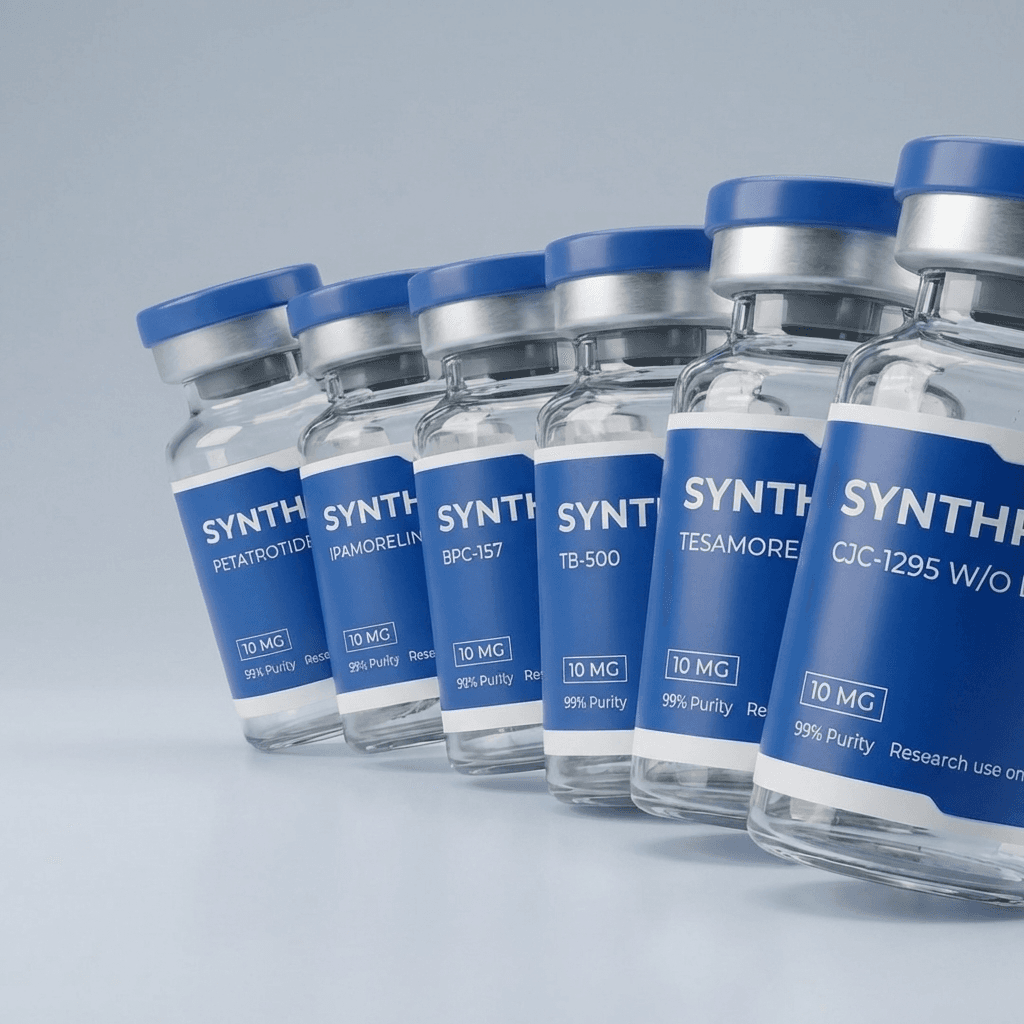

There is no clinical trial that has studied tesamorelin and retatrutide together, so no medical body recommends the combination. The two drugs act on completely different systems: tesamorelin is a growth hormone releasing hormone (GHRH) analogue that nudges your pituitary to release more growth hormone, while retatrutide is an investigational triple receptor agonist (GIP, GLP-1, and glucagon) for weight loss. The pairing is theoretical, it is not approved, and retatrutide itself is not yet available outside Lilly's clinical trials. This article explains the rationale people cite, the realistic interactions, and why caution is warranted.
Quick answer
- No combined trials exist. Every claim about stacking these two is extrapolation, not evidence.
- Retatrutide is investigational. As of 2026 it is in Phase 3 and is legally available only to participants in Eli Lilly's trials. It has no FDA approval.
- Tesamorelin is FDA approved, but only for one narrow use: reducing excess abdominal fat in adults with HIV-associated lipodystrophy.
- The theoretical rationale is that retatrutide drives large total weight loss while tesamorelin targets visceral fat and may support lean body mass. Whether that synergy is real or safe is unknown.
- The clearest caution is glucose: tesamorelin raised diabetes incidence in trials, which matters when you are also manipulating glucagon and GLP-1 signaling.
What each drug actually is
Tesamorelin: a GHRH analogue for visceral fat
Tesamorelin is a synthetic analogue of growth hormone releasing hormone. Instead of injecting growth hormone directly, it stimulates your own pituitary gland to release more of it, which in turn raises insulin-like growth factor 1 (IGF-1). The downstream effect that earned its approval is a reduction in visceral adipose tissue (VAT), the metabolically active fat packed around the abdominal organs.
The evidence base is specific and worth knowing:
- Dose: 2 mg once daily by subcutaneous injection in the pivotal trials.
- VAT reduction: In pooled Phase 3 data, tesamorelin produced roughly a 15.4% net reduction in visceral fat over 26 weeks versus placebo (for example, around -27.8 cm² with tesamorelin against +5.1 cm² with placebo in one study).
- IGF-1: Levels rose by roughly 100 ng/mL in treated groups.
- Lean body mass: Modest gains of about 1.2 to 1.3 kg versus placebo were recorded.
- Reversibility: When patients were switched to placebo after 26 weeks, visceral fat re-accumulated toward baseline. The benefit depends on continued dosing.
Tesamorelin is approved only for HIV-associated lipodystrophy. Use for general body recomposition or "biohacking" is off-label and not supported by approval data.
Retatrutide: an investigational triple agonist
Retatrutide activates three receptors at once: GIP, GLP-1, and glucagon. The GLP-1 and GIP arms suppress appetite and improve glucose handling (the same incretin pathways used by tirzepatide), while the glucagon arm is thought to increase energy expenditure and influence fat metabolism. You can read more in our explainers on what retatrutide is and its mechanism of action.
The published efficacy numbers are large:
- In the Phase 2 obesity trial (published in the New England Journal of Medicine in 2023), average weight loss at 48 weeks reached roughly 17.5% at the 8 mg dose and about 24.2% at the 12 mg dose, far above the placebo group.
- Weight loss had not clearly plateaued by week 48 at the highest dose, which is part of why expectations for longer trials are high.
- The Phase 3 TRIUMPH program is ongoing and is expected to confirm longer-term efficacy and the cardiovascular and safety profile before any regulatory submission.
- The most common side effects were gastrointestinal: nausea, diarrhea, constipation, and vomiting, more frequent at higher doses and during dose escalation.
Crucially, retatrutide is not FDA approved. It remains investigational and is legally available only inside Lilly's clinical program. See our overview of the retatrutide clinical trial and when retatrutide may become available.
Side-by-side comparison
| Feature | Tesamorelin | Retatrutide |
|---|---|---|
| Drug class | GHRH analogue | GIP / GLP-1 / glucagon triple agonist |
| Primary target | Visceral fat (VAT) | Total body weight, appetite |
| FDA status | Approved (HIV lipodystrophy only) | Investigational, Phase 3, not approved |
| Typical dose | 2 mg subcutaneous daily | 4 to 12 mg subcutaneous weekly (trial doses) |
| Dosing frequency | Daily | Weekly |
| Effect on lean mass | Modest increase (~1.2 to 1.3 kg) | Some lean mass loss as part of total loss |
| Effect on glucose | Raised diabetes incidence in trials | Improves glucose via incretin action |
| Main side effects | Injection-site reactions, joint/limb symptoms, glucose changes | Nausea, diarrhea, vomiting, constipation |
| Reversibility | VAT returns after stopping | Weight regain common after stopping any GLP-1 class drug |
For dosing details on retatrutide alone, see the retatrutide dosage guide and the dosage chart.
The rationale people give for combining them
The combination idea comes from a real gap in GLP-1 class therapy. When you lose 25% to 30% of your body weight quickly, a meaningful share of that loss is lean tissue, not just fat. In retatrutide data, lean mass loss has accounted for roughly a third of total weight lost, which is in line with other obesity drugs but still a concern for long-term metabolic health and physical function.
The argument for adding tesamorelin runs like this:
- Lean mass support. Tesamorelin raises growth hormone and IGF-1, which are anabolic signals. The hope is that this offsets some of the lean tissue lost during aggressive caloric deficit.
- Targeted visceral fat reduction. Visceral fat is the most metabolically harmful fat depot. Tesamorelin specifically shrinks it, in theory complementing retatrutide's broad weight loss.
- Body recomposition. Combining a fat-loss driver with a lean-mass-sparing agent is an appealing concept on paper for people chasing a better fat-to-muscle ratio.
That logic is coherent, but it is hypothesis, not data. No trial has tested whether tesamorelin actually preserves lean mass during retatrutide-driven weight loss, whether the visceral fat effects add up, or whether the combination is safe over months. For context on muscle and dosing strategy with retatrutide alone, see our pieces on retatrutide microdosing and the retatrutide week-by-week timeline.
Interactions and safety cautions
This is the part that matters most, because the two drugs pull on glucose metabolism in opposite-but-overlapping ways.
Glucose and diabetes risk
Tesamorelin's growth hormone stimulation can worsen insulin sensitivity. In its trials, treatment-emergent diabetes and glucose intolerance were more common in the tesamorelin group (odds ratios in the range of 3.4 to 3.6 in some analyses). Retatrutide's glucagon arm can also raise glucose, although its dominant incretin (GLP-1/GIP) effect generally improves glycemic control overall. Layering a growth hormone stimulus on top of triple-agonist therapy creates an unstudied glucose interaction. Anyone with prediabetes, diabetes, or insulin resistance should treat this as a serious unknown.
IGF-1 and growth signaling
Sustained elevation of IGF-1 is not risk-free. Higher growth hormone and IGF-1 levels require monitoring, and tesamorelin trials excluded people with active malignancy, pituitary disease, or those on growth hormone products. Pushing IGF-1 up while the body is in a large caloric deficit from retatrutide has not been characterized.
Overlapping side-effect burden
Retatrutide commonly causes nausea, vomiting, and diarrhea, which can themselves cause dehydration and electrolyte shifts. Tesamorelin adds injection-site reactions and joint or limb discomfort. Stacking two injectable agents increases the total adverse-event surface and makes it harder to tell which drug is causing a given problem.
Reversibility on both ends
Tesamorelin's visceral fat benefit disappears after you stop, and weight regain is common after stopping any GLP-1 class drug. A combination does not solve the maintenance problem; it potentially doubles the cost and complexity of staying on therapy indefinitely.
Sourcing and quality risk
Because retatrutide is investigational, the only legal access is through a clinical trial. Products sold online as "research" retatrutide or compounded versions are unregulated, and combining unverified peptides multiplies the risk. Read our cautions on compounded retatrutide, buying retatrutide without a prescription, and the broader question of whether retatrutide is safe before considering anything off-protocol. On the tesamorelin side, our tesamorelin for sale page covers vendor specs and COA checks.
What the evidence does and does not support
To be precise about the state of knowledge:
- Supported: Tesamorelin reduces visceral fat and modestly raises lean mass in HIV-associated lipodystrophy. Retatrutide produces large weight loss in obesity trials.
- Not supported: That the two work better together, that tesamorelin meaningfully preserves muscle during retatrutide weight loss, or that the combination is safe. None of this has been tested.
- Actively concerning: The combined effect on glucose and on growth signaling, neither of which has trial data.
If your goal is muscle preservation during weight loss, the interventions with the strongest evidence are resistance training, adequate protein intake, and appropriate dose titration, not adding a second injectable. Compare retatrutide with its closest peers in our retatrutide vs tirzepatide and retatrutide vs semaglutide breakdowns.
Frequently asked questions
Is it safe to take tesamorelin and retatrutide at the same time?
No one can answer that from evidence, because the combination has never been studied. The two drugs interact at the level of glucose metabolism and growth signaling in ways that have not been characterized. Retatrutide is also investigational, so any use outside a trial is itself outside approved practice.
Does tesamorelin prevent muscle loss on retatrutide?
There is no trial showing this. Tesamorelin raised lean body mass modestly in HIV-lipodystrophy patients (about 1.2 to 1.3 kg versus placebo), but that population and context are very different from someone losing 25% of body weight on a triple agonist. The claim is theoretical.
Is retatrutide FDA approved in 2026?
No. As of 2026 retatrutide is in Phase 3 development and is legally available only to participants in Eli Lilly's clinical trials. See when retatrutide may be available for the latest timeline.
What is tesamorelin actually approved for?
Tesamorelin is FDA approved to reduce excess abdominal (visceral) fat in adults with HIV-associated lipodystrophy. Any other use, including general fat loss or stacking with weight-loss drugs, is off-label.
Would combining them double my weight loss?
There is no reason to expect that, and no data to support it. Tesamorelin's effect is on a specific fat depot and is small in absolute terms compared with retatrutide's total weight loss. The combination is more likely to add side effects and cost than to multiply results.
Bottom line
Tesamorelin and retatrutide target different biology, and the idea of combining a visceral-fat and lean-mass agent with a powerful weight-loss agent is understandable. But the honest position is that this is an untested pairing built on extrapolation. Retatrutide is not approved and is only legally available in trials, tesamorelin is approved for a narrow condition, and the glucose and growth-signaling interactions raise real safety questions. If you are weighing options, focus first on what is proven, and review the retatrutide side effects and cost before anything else.
This article is for informational purposes only and is not medical advice; talk to a qualified clinician before starting, combining, or stopping any medication.
References
- EGRIFTA (tesamorelin) — FDA prescribing information: approved indication (HIV-associated lipodystrophy), IGF-1 and glucose effects
- Triple-hormone-receptor agonist retatrutide for obesity — a phase 2 trial (NEJM; PubMed, PMID 37366315)
- Changes in lean body mass with glucagon-like peptide-1-based therapies and mitigation strategies (PubMed, PMID 38937282)