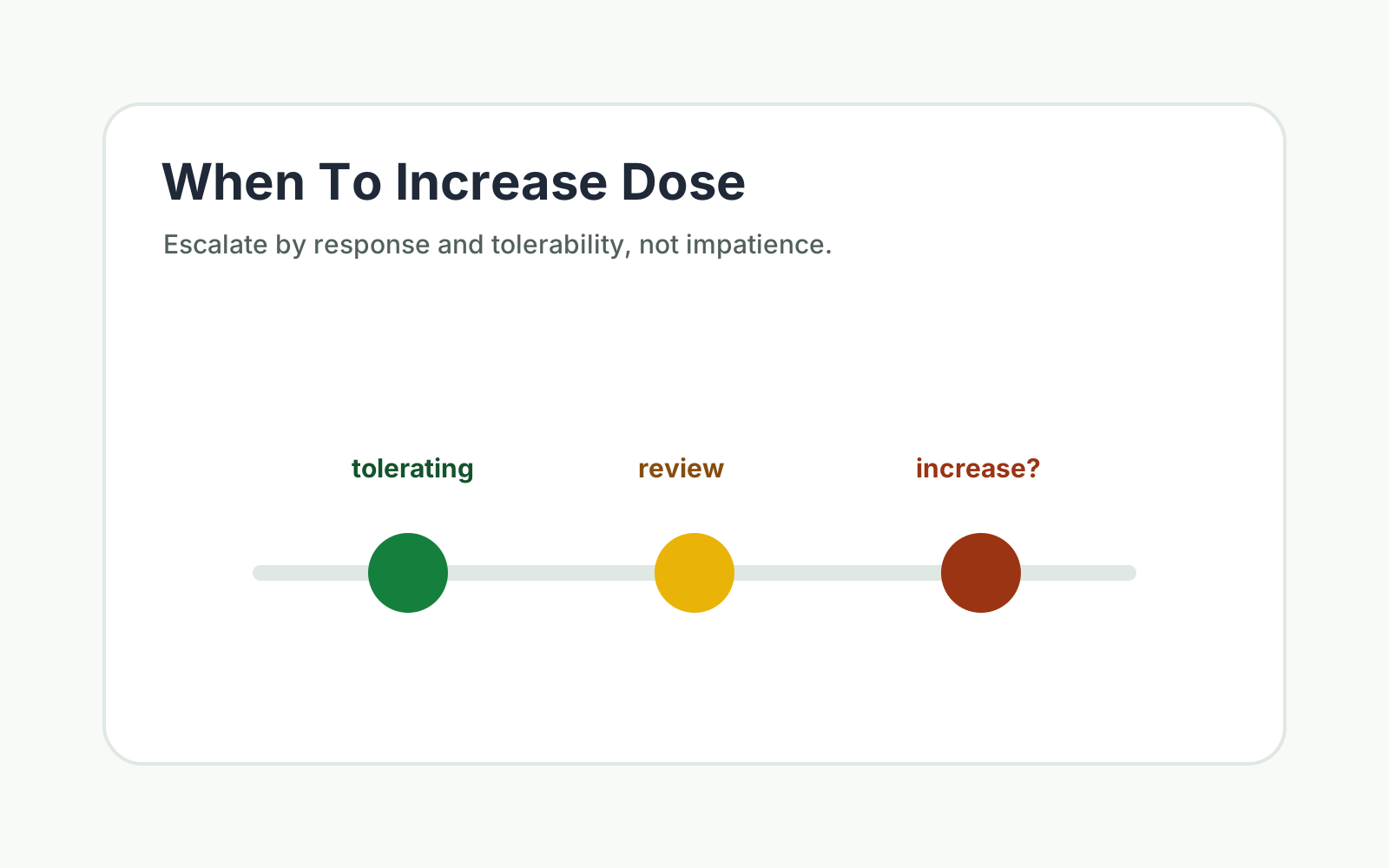
Increasing a GLP-1 dose too quickly can turn a useful medication into a week of nausea, constipation, reflux, dehydration, or fatigue. Waiting too long can also leave blood sugar, hunger, or weight goals under-treated.
Direct answer: A GLP-1 dose increase is usually considered only after the label's minimum time at the current dose and when side effects are controlled. The reason to increase should be clear: inadequate glucose control, persistent hunger, inadequate weight response, or a clinician-agreed target. If nausea, vomiting, constipation, dehydration, poor intake, or fatigue are active, it often makes more sense to wait.
Increase, Hold, Or Step Back?
| Situation | Usual discussion |
|---|---|
| Side effects are active | Hold or reduce before increasing |
| Hunger returns but side effects are controlled | Discuss increasing if label timing allows |
| Weight has stalled for 4+ weeks | Check adherence, protein, calories, activity, sleep, and dose |
| Blood sugar remains above goal | Clinician may adjust dose or other diabetes medications |
| Very low appetite or under-eating | Do not increase without reassessing |
Minimum Time Is Not The Same As Best Time
Many GLP-1 schedules use stepwise dose increases after at least 4 weeks at a dose. That minimum is designed to improve tolerability, not to force every person upward on the fastest possible schedule.
Some people do better holding a dose longer. Others need a dose increase to reach the intended maintenance dose. The right answer is based on response and tolerance.
How Many Weeks — Or Months — Between Dose Increases
Every approved GLP-1 label is written in weeks or days, not months, and nearly all of them land on the same interval: at least 4 weeks — about one month — at each dose before stepping up. The oral products say "at least 30 days," which is the same rule in different units. Daily liraglutide is the exception, titrating weekly.

The table below is the earliest each label allows, assuming every step is tolerated. It is a floor, not a schedule you can fall behind on.
| Product | Starting dose | Minimum time per step | Steps to the usual top dose | Earliest arrival at top dose |
|---|---|---|---|---|
| Wegovy injection | 0.25 mg weekly | 4 weeks | 0.25 → 0.5 → 1 → 1.7 → 2.4 mg | Week 17 (about 4 months) |
| Wegovy injection 7.2 mg (Wegovy HD, weight reduction in adults) | — | 4 weeks at 2.4 mg first | 2.4 → 7.2 mg | Week 21 (about 5 months) |
| Wegovy tablets | 1.5 mg daily | 30 days | 1.5 → 4 → 9 → 25 mg | Day 91 (3 months) |
| Zepbound and Mounjaro | 2.5 mg weekly | 4 weeks | 2.5 → 5 → 7.5 → 10 → 12.5 → 15 mg | Week 21 (about 5 months) |
| Ozempic injection | 0.25 mg weekly | 4 weeks | 0.25 → 0.5 → 1 → 2 mg | Week 13 (about 3 months) |
| Rybelsus | 3 mg daily | 30 days | 3 → 7 → 14 mg | Day 61 (2 months) |
| Ozempic tablets | 1.5 mg daily | 30 days | 1.5 → 4 → 9 mg | Day 61 (2 months) |
| Foundayo (orforglipron) | 0.8 mg daily | 30 days | 0.8 → 2.5 → 5.5 → 9 → 14.5 → 17.2 mg | Day 151 (about 5 months) |
| Trulicity | 0.75 mg weekly | 4 weeks above the 1.5 mg step | 0.75 → 1.5 → 3 → 4.5 mg | Week 13 if every step is held 4 weeks |
| Saxenda | 0.6 mg daily | 1 week | 0.6 → 1.2 → 1.8 → 2.4 → 3 mg | Week 5 (about 1 month) |
| Victoza | 0.6 mg daily | 1 week | 0.6 → 1.2 → 1.8 mg | Week 3 |
Three things the table does not say on its own:
- No label requires you to keep climbing. Wegovy's maintenance dose can be 1.7 mg or 2.4 mg. Zepbound's can be 5 mg, 10 mg or 15 mg. A lower dose that is working is a maintenance dose, not a failed titration.
- Delaying is written into the labels. Wegovy says to consider delaying escalation by 4 weeks if a dose is not tolerated, and Saxenda says about one extra week. A climb that takes five, six or eight months is an anticipated outcome, not a deviation.
- Missed doses can reset the clock. Two or more consecutive missed Wegovy injections, more than 3 days off Saxenda or Victoza, or 7 or more missed Foundayo doses all point toward reinitiating at a lower dose rather than resuming where you left off.
What To Track Before Asking
- Weekly weight trend, not one scale reading
- Hunger and food noise
- Nausea, vomiting, reflux, constipation, diarrhea
- Protein and fluid intake
- Blood glucose if relevant
- Missed doses
- Alcohol intake and high-fat meals
- Exercise and resistance training consistency
Internal Reading Path
FAQ
Should I increase if I am still losing weight?
Not automatically. If the current dose is effective and tolerable, staying put may be reasonable.
Should I increase if I have nausea?
Usually this is a reason to pause and call the prescriber before escalating.
Is the highest dose always best?
No. The best dose is the one that meets clinical goals with acceptable side effects and sustainable nutrition.
Why This Is Not a DIY Timing Decision
For when to increase GLP 1 dose, the main risk is treating a medication transition like a simple calendar swap. GLP-1 medications can have long half-lives, overlapping effects, and dose-escalation schedules designed to reduce side effects. If the switch happens too aggressively, nausea, vomiting, dehydration, reflux, constipation, or glucose changes can become harder to manage.
The prescriber needs to know the exact current medication, dose, last dose date, side effects, reason for switching, diabetes medications, pregnancy or procedure plans, and whether the new product is already approved by insurance.
Starting A Different GLP-1: How Long To Wait
How long do I have to wait before starting a new GLP-1 medication? is one of the most common versions of this question, and the answer has two halves.
Where a label covers the switch, the wait is measured in days. The only switches with printed instructions are the ones between semaglutide products:
| Switch | What the label says |
|---|---|
| Wegovy 2.4 mg injection → Wegovy 25 mg tablets | Start the tablets one week after the last injection |
| Wegovy 25 mg tablets → Wegovy 2.4 mg injection | Inject the day after the last tablet |
| Ozempic 0.5 mg injection → Rybelsus 7 mg or 14 mg | Start the tablet one week after the last injection |
| Ozempic 0.5 mg injection → Ozempic 4 mg or 9 mg tablets | Start the tablet one week after the last injection |
| Rybelsus ↔ Ozempic tablets | Start the other tablet the day after the last one, and not during the first 30 days of treatment |
Where no label covers the switch, there is no official washout at all. Semaglutide to tirzepatide, tirzepatide to orforglipron, brand to brand across manufacturers — none of those transitions appear in any approved US label, and none of these products are interchangeable milligram for milligram. What prescribers reason from instead is two facts:
- The old drug leaves slowly. Semaglutide's elimination half-life is about one week, and the label states it remains in circulation for roughly 5 weeks after the last dose. Tirzepatide and dulaglutide are near 5 days, orforglipron about 29 to 49 hours, liraglutide about 13 hours.
- The new drug starts at the bottom anyway. Zepbound and Mounjaro start at 2.5 mg for everyone. Wegovy and Ozempic start at 0.25 mg. Foundayo starts at 0.8 mg. There is no credit for the dose you were already tolerating, which is why a switch often feels like a step backward for a month or two.
In practice the wait is usually one dosing interval — the new weekly injection on the day the old one would have been due — rather than a multi-week gap, and some overlapping tail exposure is expected rather than an error. The reasons to wait longer are clinical, not pharmacological: active vomiting or dehydration, an upcoming procedure, pregnancy planning, or insulin and sulfonylurea doses that need adjusting first. A long unplanned gap cuts the other way. After two or more missed weekly doses, or more than 3 days off a daily product, the labels point to restarting lower instead of picking up where you left off.
Each of these is a prescriber's decision. The value of knowing the labeled timing is that it makes the conversation specific.
Transition Planning Table
| Question | Why it matters |
|---|---|
| Why switch now? | Plateau, cost, supply, side effects, or indication changes the plan |
| How long since the last dose? | A long gap may require restarting lower |
| Were side effects active? | Switching during active GI symptoms can compound problems |
| Is diabetes medication involved? | Insulin or sulfonylureas can change hypoglycemia risk |
| Is there a procedure or pregnancy plan? | Washout guidance may be different |
| What is the backup plan? | Supply gaps and intolerance are common practical problems |
What to Monitor After the Change
The first several weeks after a change should be treated as a monitoring period. Track appetite, nausea, vomiting, bowel pattern, reflux, hydration, dizziness, glucose readings if relevant, weight trend, and whether protein intake is falling. The point is not to overreact to every symptom. The point is to catch patterns early enough to slow escalation or adjust the plan before symptoms become severe.
Questions to Bring to the Prescriber or Pharmacist
- Does my current dose and timing match the official label or my prescription?
- Are my symptoms or concerns expected at this stage, or do they suggest changing the plan?
- Should I delay escalation, restart lower, hold steady, or be evaluated before continuing?
- Are any of my other medications increasing risk, especially insulin, sulfonylureas, blood pressure medication, diuretics, or drugs affected by delayed gastric emptying?
- What exact symptoms should make me call urgently or seek same-day care?
- If cost or supply interrupts therapy, what is the safest backup plan?
Bottom Line for When To Increase Your GLP-1 Dose
The practical answer is rarely just one number, food list, or yes-or-no rule. For when to increase GLP 1 dose, the safest approach is to combine the direct answer with the variables that change it: product type, dose, timing, side effects, storage history, other medications, and the person's medical context. When those variables are unclear, the best next step is to ask the prescriber or pharmacist before acting.
Additional Scenarios Readers Commonly Compare
| Scenario | How to think about it |
|---|---|
| Symptoms started after a dose increase | Treat escalation as a likely contributor and ask whether to hold the dose longer |
| The plan changed because of supply | Confirm whether a restart or lower dose is safer after the gap |
| Advice online conflicts with the label | Use the label, pharmacy, and prescriber as the authority |
| The medication is compounded | Verify concentration, BUD, storage, sterility, and dose instructions directly with the pharmacy |
| The goal is maintenance | Prioritize sustainable intake, resistance training, monitoring, and follow-up |
More FAQ
How long do I have to wait before starting a new GLP-1 medication?
Usually one dosing interval, not weeks. The labeled semaglutide switches use one week after the final weekly injection, or the next day when moving off a daily tablet. No US label defines a washout before switching to a different molecule, so the practical answer for semaglutide-to-tirzepatide and similar switches is to begin the new drug on the day the old dose would have been due — at the new drug's own starting dose, since none of these products convert milligram for milligram. Reasons to wait longer are clinical: active vomiting or dehydration, a scheduled procedure, pregnancy planning, or diabetes medications that need adjusting first.
About how many months should you go before increasing your dose?
About one month per step for nearly every product: the injectable labels say at least 4 weeks at a dose, and the oral labels say at least 30 days. That puts Wegovy's 2.4 mg at week 17 and Zepbound's 15 mg at week 21 at the earliest — roughly four and five months from the first injection. Those are minimums, not targets. Holding a dose longer because it is working, or because side effects have not settled, is a normal outcome rather than a delay.
Why do different websites give different answers?
Most differences come from assuming different products, concentrations, patient goals, dose histories, or risk tolerance. A chart or tip can be mathematically correct but still wrong for a specific prescription.
What information should I keep in my notes?
Keep the medication name, dose, date taken, pharmacy label, concentration if vial-based, side effects, food and fluid changes, weight trend, and any clinician instructions. This makes follow-up safer and more specific.
When is it better not to troubleshoot at home?
Do not troubleshoot at home when symptoms are severe, rapidly worsening, involve chest pain or fainting, include repeated vomiting or dehydration, suggest allergic reaction, or involve a possible dosing or storage error.
Edge Cases That Change the Answer
For when to increase GLP 1 dose, the usual advice can change when there is a long medication gap, a recent dose increase, active vomiting or diarrhea, diabetes medications that can cause low blood sugar, kidney disease, pregnancy planning, surgery or anesthesia, a compounded vial, or uncertainty about the exact product. Those details should be treated as decision points, not footnotes.
A practical way to handle edge cases is to pause and sort the issue into one of three buckets. The first bucket is routine planning: questions about meals, timing, cost, or what to ask at the next visit. The second bucket is same-week clinical guidance: persistent side effects, repeated missed doses, uncertain conversions, or a plan that cannot be filled. The third bucket is urgent evaluation: severe pain, chest symptoms, fainting, allergic reaction symptoms, dehydration, confusion, or a possible large dosing error.
| Bucket | Examples | Best next step |
|---|---|---|
| Routine planning | Meal changes, mild symptoms, coverage questions | Bring notes to the next visit |
| Prompt guidance | Persistent symptoms, switch timing, unclear label, storage uncertainty | Call prescriber or pharmacist |
| Urgent care | Severe pain, fainting, chest pain, allergic symptoms, dehydration | Seek same-day or emergency care |
Practical Takeaway
If a reader remembers only one thing from this page, it should be that when to increase GLP 1 dose is context-dependent. The safest answer comes from matching the general information to the exact medication, dose, timing, symptoms, product label, and medical history. When those details are incomplete, the right move is to ask before acting.
References
- U.S. Food and Drug Administration. WEGOVY (semaglutide) injection — Prescribing Information. (Stepwise dose escalation at ~4-week intervals to improve gastrointestinal tolerability.)
- Collins L, Costello RA. Glucagon-Like Peptide-1 Receptor Agonists. StatPearls, NCBI Bookshelf. (Pharmacology, dose titration, and side-effect management; hypoglycemia risk with insulin/sulfonylureas.)
- Novo Nordisk. WEGOVY (semaglutide) injection and tablets — Prescribing Information. DailyMed. (Injection escalation to 1.7/2.4 mg and the 7.2 mg maintenance option; tablet escalation to 25 mg; switching between injection and tablets; missed-dose handling.)
- Eli Lilly and Company. ZEPBOUND (tirzepatide) injection — Prescribing Information. DailyMed. (2.5 mg start, 2.5 mg increments after at least 4 weeks on the current dose, 15 mg maximum.)
- Eli Lilly and Company. MOUNJARO (tirzepatide) injection — Prescribing Information. DailyMed. (Same escalation pattern for the type 2 diabetes brand; dosing day may move if doses stay at least 3 days apart.)
- Novo Nordisk. OZEMPIC (semaglutide) injection — Prescribing Information. DailyMed. (0.25 mg for 4 weeks, then 0.5 mg, with further increases after at least 4 weeks; semaglutide half-life of about one week.)
- Novo Nordisk. RYBELSUS and OZEMPIC (oral semaglutide) tablets — Prescribing Information. DailyMed. (30-day escalation steps and the labeled instructions for switching from Ozempic injection to tablets.)
- Eli Lilly and Company. FOUNDAYO (orforglipron) tablets — Prescribing Information. DailyMed. (0.8 mg start, 30 days per step to a 17.2 mg maximum; reinitiate lower after 7 or more missed doses.)
- Novo Nordisk. SAXENDA (liraglutide) injection — Prescribing Information. DailyMed. (Weekly 0.6 mg steps to 3 mg; reinitiate at 0.6 mg after more than 3 days off.)
- Eli Lilly and Company. TRULICITY (dulaglutide) injection — Prescribing Information. DailyMed. (1.5 mg increments after at least 4 weeks to a 4.5 mg maximum; dulaglutide half-life about 5 days.)
- Novo Nordisk. VICTOZA (liraglutide) injection — Prescribing Information. DailyMed. (0.6 mg for one week, then 1.2 mg, then 1.8 mg after at least another week; liraglutide half-life about 13 hours.)