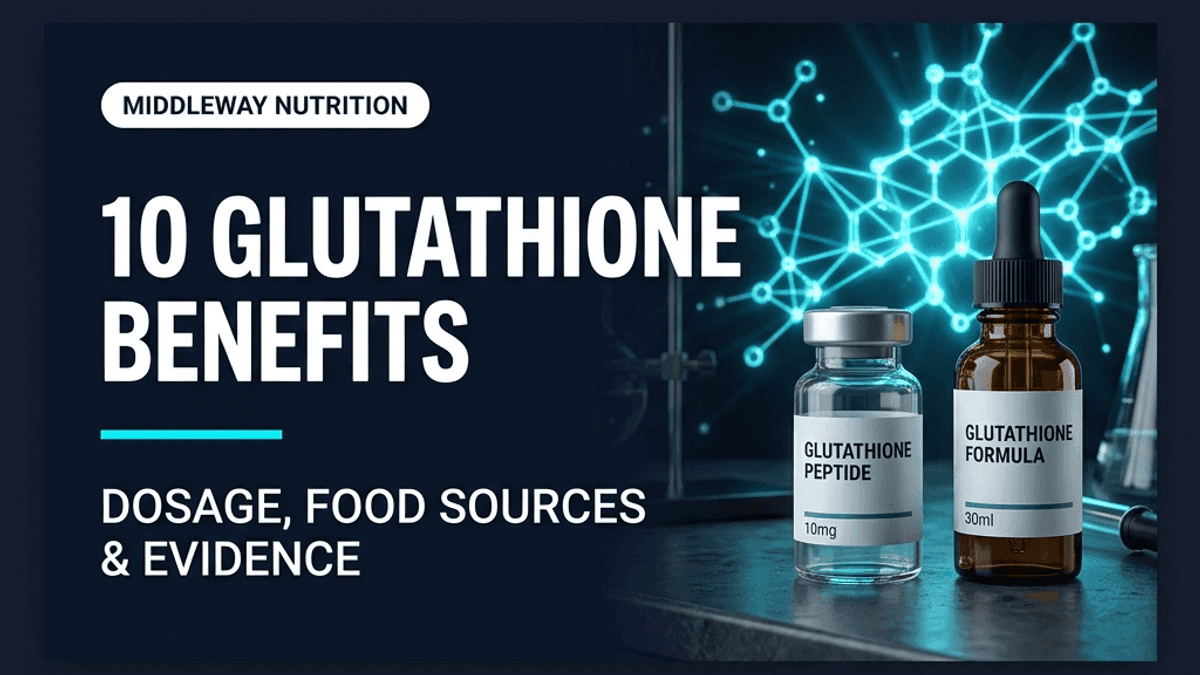
These 10 evidence-backed glutathione benefits (with dosage and food sources) all trace back to one molecule: a tripeptide of cysteine, glutamate and glycine that every cell makes and uses, with the highest concentrations in the liver. The benefits below are the ones with human data behind them, and the practical dose range in trials is 250 to 1,000 mg daily orally, with injectable and intravenous protocols using higher amounts.
Working through evidence-backed glutathione benefits with dosage and food sources means separating three different questions that usually get merged: what glutathione does in the body, whether taking it raises your levels, and whether raising your levels changes anything you would notice. The answers are not the same.
What Glutathione Is
Three amino acids joined together, present in every cell, and central to how cells handle oxidative stress. It exists in two states: reduced glutathione (GSH), which is the active form, and oxidised glutathione (GSSG), which is the spent form. The ratio between them is used as a marker of cellular redox status.
Levels decline gradually with age and fall further with illness, alcohol use, poor nutrition and chronic disease. That decline is the basis of most interest in supplementing it.
10 Evidence-Backed Glutathione Benefits (With Dosage and Food Sources)
1. Reduced markers of oxidative stress. The most consistently demonstrated effect. Supplementation raises measured glutathione stores and shifts oxidative stress markers, which is the mechanism underpinning everything else on this list.
2. Liver support in fatty liver disease. Trial work in nonalcoholic fatty liver disease has reported improvements in liver enzyme markers, particularly ALT, over several months of oral dosing. This is among the better-supported clinical uses.
3. Insulin sensitivity, particularly with age. Older adults with depleted glutathione show impaired fat oxidation and insulin handling, and restoring levels has been associated with improvement. The effect appears larger in those who were deficient to begin with.
4. Support in Parkinson's disease. Intravenous glutathione has been studied for symptomatic improvement in Parkinson's, with some encouraging early reports and mixed results in later work. This is a specialist context, not a self-administered one.
5. Peripheral arterial disease. Intravenous glutathione has been reported to improve walking distance and pain in this population over several weeks.
6. Immune function. Glutathione status affects lymphocyte function, and depletion is associated with impaired immune response. Restoring it in depleted people is plausible support; in replete people, less so.
7. Detoxification pathways. Glutathione conjugation is a genuine phase two detoxification mechanism, particularly for heavy metals and certain drug metabolites. This is real biochemistry, and it is also the claim most abused in marketing.
8. Skin appearance and pigmentation. Studied for skin lightening, with some trial support. This use carries the most safety concern, covered below.
9. Exercise recovery. Some evidence for reduced oxidative damage after exertion. Effect sizes are small and the practical relevance for a recreational trainee is questionable.
10. Respiratory conditions. Nebulised and inhaled glutathione has been investigated in cystic fibrosis and other respiratory conditions, with mixed findings.
Notice how the list degrades. The top few have reasonable human trial support; the bottom half are mechanistically plausible with thin outcome data.
Dosage: What Trials Actually Used
| Form | Typical dose | Notes |
|---|---|---|
| Oral capsule or liposomal | 250 to 1,000 mg daily | The range used in most oral trials |
| Sublingual | 100 to 500 mg daily | Bypasses some digestion, less studied |
| Intravenous | 600 to 1,200 mg per session | Clinical settings, higher doses in specific research |
| N-acetylcysteine as precursor | 600 to 1,800 mg daily | Raises glutathione indirectly, cheaper, well studied |
Meaningful increases in body stores have been reported at 500 to 1,000 mg daily over one to three months. That timescale matters: this is not a compound where anything happens in a week.
The Absorption Question
The old objection was that oral glutathione is destroyed by digestion and therefore pointless. That claim was overstated. Trial work using oral glutathione over several months has reported increased body stores, so absorption is not zero.
It is also not efficient. This is why three alternatives exist:
Liposomal formulations encapsulate the molecule in a lipid carrier to improve uptake, and generally show better results than plain glutathione.
Sublingual avoids first-pass digestion for part of the dose.
N-acetylcysteine is the pragmatic option. It supplies cysteine, the rate-limiting amino acid in glutathione synthesis, letting the body make its own. It is cheaper, better studied, and for most purposes at least as sensible as buying the finished tripeptide.
Food Sources
Diet contributes both preformed glutathione and the raw materials for synthesis.
| Food | Contribution |
|---|---|
| Asparagus | Among the higher preformed glutathione foods |
| Avocado | Preformed glutathione |
| Spinach and okra | Preformed glutathione |
| Whey protein | Cysteine, the limiting precursor |
| Eggs | Sulfur amino acids |
| Garlic and onions | Sulfur compounds supporting synthesis |
| Cruciferous vegetables | Support glutathione-related enzyme activity |
| Selenium sources such as brazil nuts | Cofactor for glutathione peroxidase |
Cooking degrades preformed glutathione, so raw or lightly cooked sources contribute more. Realistically, food supports adequate status rather than producing the increases seen in supplement trials.
The Skin Lightening Caution
Glutathione is widely used, particularly by intravenous injection, for skin lightening. This is the use with the clearest documented risk.
Regulatory bodies in several countries have issued warnings about injectable glutathione for this purpose, citing unapproved products, unsterile administration and reported adverse events. High-dose intravenous use outside a clinical setting is not a cosmetic decision; it is an unregulated injection of an unapproved product.
If skin appearance is the goal, that is the single riskiest route available and the one with the least justification.
Buying Glutathione Sensibly
For oral use, glutathione is sold as a dietary supplement. That means quality varies and nobody is verifying content on your behalf, so third-party certification such as USP or NSF is the thing to look for. Liposomal products vary widely in whether the liposomal claim means anything, and prices vary far more than quality does.
For injectable or research-grade material, you are in a different market with no regulatory backstop, and the documentation is all you have: a batch-specific third-party certificate of analysis, HPLC purity of 98% or higher with a visible chromatogram, and identity confirmation. Insist on all three before buying, and treat a supplier that will not produce a lot-matched certificate as a supplier to walk away from.
Our glutathione peptide page covers the compound in more detail, and glutathione peptide dosage by route works through the absorption question.
Who Actually Benefits
The pattern across the research is that people who are depleted respond, and people with normal status respond much less. That points toward supplementation being most useful in the context of liver disease, ageing with documented decline, chronic illness or heavy alcohol use, and least useful as a general wellness purchase for a healthy person eating well.
FAQ
How much glutathione should I take daily?
Trials have used 250 to 1,000 mg daily orally, with measurable increases in body stores reported at the higher end over one to three months. There is no established optimal dose, and higher amounts have not been shown to produce proportionally more benefit.
Does oral glutathione actually get absorbed?
Partly. The claim that it is completely destroyed by digestion is outdated, since trials of oral supplementation have reported increased body stores. Absorption is inefficient, which is why liposomal and sublingual forms exist and why NAC is often a more practical route.
Is NAC better than glutathione?
For most purposes it is a reasonable and cheaper alternative. NAC supplies cysteine, the rate-limiting precursor, allowing the body to synthesise glutathione itself. It has a larger evidence base and does not depend on absorbing an intact tripeptide.
Is glutathione injection safe for skin lightening?
This is the use with the clearest documented risk. Regulators in several countries have warned about injectable glutathione for skin lightening, citing unapproved products and reported adverse events. It is not a decision to make outside a clinical setting.
What foods are highest in glutathione?
Asparagus, avocado, spinach and okra carry the most preformed glutathione, while whey protein, eggs, garlic and cruciferous vegetables supply the sulfur amino acids needed to make it. Cooking reduces the preformed content, so raw or lightly cooked preparations contribute more.