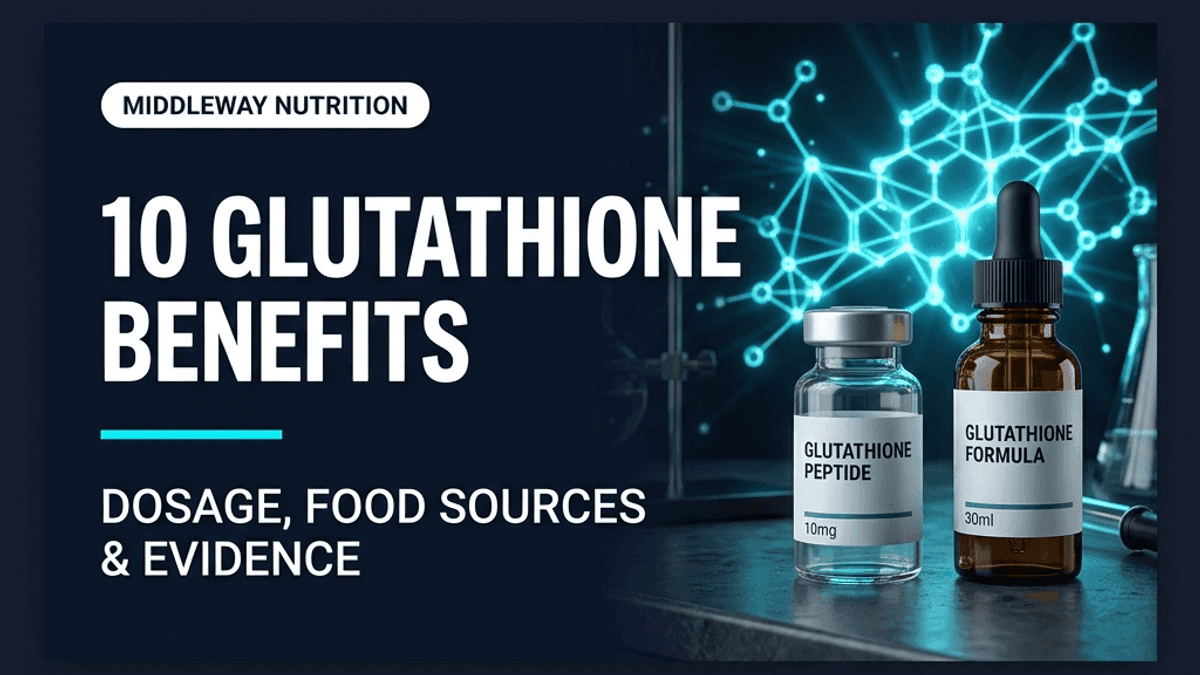
Glutathione is one of the few compounds in this category that is unambiguously a peptide, unambiguously present in your body already, and unambiguously studied in humans. The argument is not whether it matters. It is whether anything you swallow or inject actually raises what is inside your cells, and that is where the marketing and the data separate.
Your liver makes it. Every cell holds it at concentrations roughly a thousand times higher than what circulates in blood. It is not exotic. What is contested is delivery.
Key Takeaways
- Glutathione is a genuine tripeptide, glutamate-cysteine-glycine, molecular weight about 307 g/mol, joined by an unusual gamma bond that makes it resistant to ordinary peptidases.
- Intracellular concentrations run roughly 0.5 to 10 millimolar, with more than 90 percent normally held in the reduced GSH form. The GSH to GSSG ratio is a standard readout of oxidative stress.
- Plain oral glutathione has poor systemic bioavailability, but a six-month randomized trial did report measurable increases in body stores, which is more than most supplements manage.
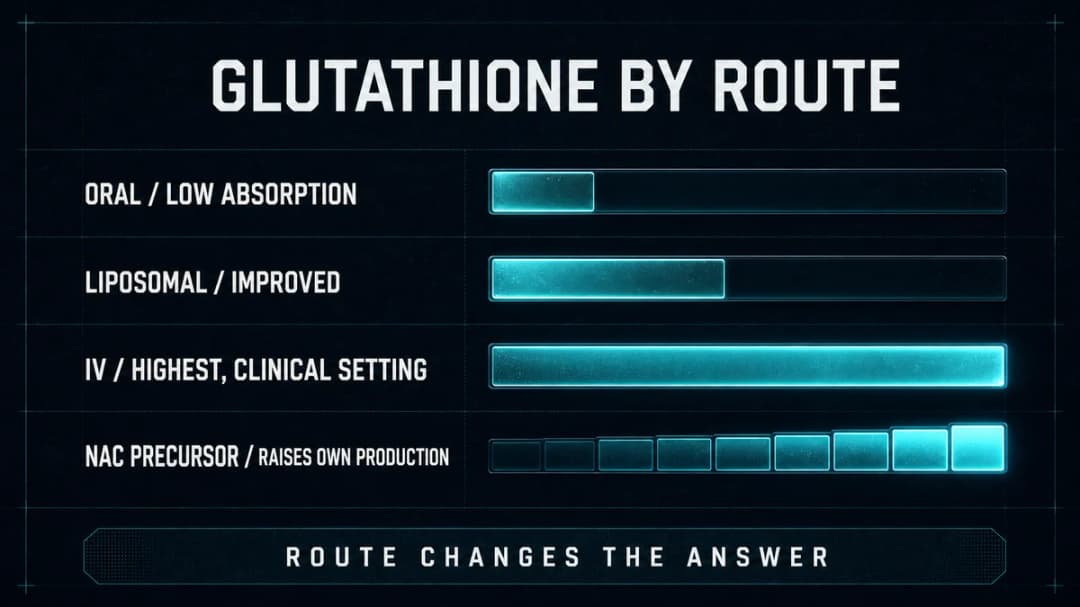
- Liposomal formulations consistently outperform plain powder in absorption comparisons. IV bypasses the gut entirely and is the only route with reliably high plasma exposure.
- Skin lightening drives a large share of search demand. The mechanism is plausible, the human evidence is thin, and multiple regulators have warned specifically against injectable lightening products.
What Glutathione Actually Is
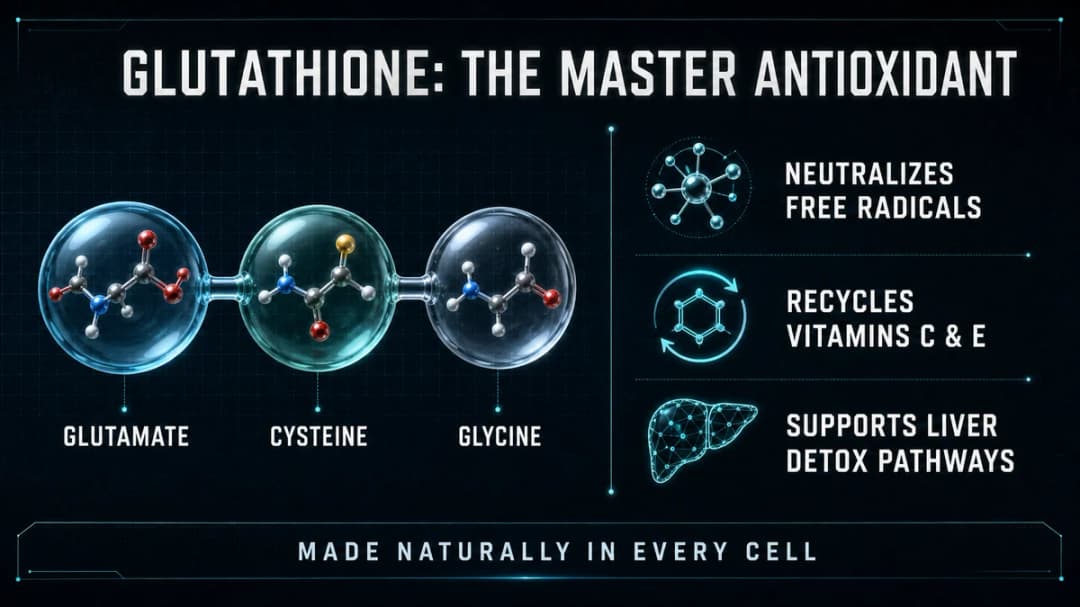
Three amino acids: glutamate, cysteine, glycine. That makes it a tripeptide, and unlike most of the compounds shelved beside it in research supply catalogs, the classification is accurate rather than a marketing convenience. Molecular weight is around 307 grams per mole.
The structural quirk that matters is the linkage. Glutamate connects to cysteine through a gamma peptide bond rather than the standard alpha bond found in normal proteins. Peptidases are built to cleave alpha bonds, so glutathione survives conditions that would shred a comparable three-residue chain.
Synthesis happens in two ATP-dependent steps. Glutamate-cysteine ligase joins the first two residues, and this step is rate-limiting. Glutathione synthetase then attaches glycine. That bottleneck is the practical detail: cysteine availability, not glutathione intake, is usually what caps how much your body can make.
Cells hold it at 0.5 to 10 millimolar, against 2 to 20 micromolar outside. Roughly 80 to 85 percent sits in the cytosol, 10 to 15 percent in mitochondria. In a healthy cell, over 90 percent is in the reduced form, GSH. The oxidized dimer, GSSG, accumulates under oxidative load, which is why labs report the ratio rather than the raw number.
What It Does Once It Is There
Three jobs, and keeping them separate clears up most of the confusion.
Direct antioxidant. GSH donates an electron to neutralize reactive oxygen species, becoming a glutathionyl radical that pairs off into GSSG. Glutathione reductase then regenerates the reduced form using NADPH. It is a recycling loop, not a consumable, which is why a modest pool supports enormous throughput.
Enzyme cofactor. Glutathione peroxidase, glutaredoxin, and the peroxiredoxin family all depend on it. Glutathione peroxidase is selenium-dependent, which is the actual reason selenium status shows up in glutathione discussions at all.
Detoxification. Glutathione S-transferase enzymes conjugate GSH onto lipophilic foreign compounds, making them water-soluble and excretable. The textbook example is acetaminophen: its reactive metabolite is neutralized by glutathione conjugation, and overdose toxicity is fundamentally a story about depleting the hepatic pool faster than it can be rebuilt. That is also why N-acetylcysteine, a cysteine donor, is the standard antidote rather than glutathione itself.
A fourth function gets less attention. Protein S-glutathionylation, the reversible attachment of GSH to cysteine residues on proteins, works as a post-translational switch under oxidative stress, protecting those residues from irreversible damage and modulating enzyme activity. Glutathione is a signaling molecule, not just a scavenger.
Oral glutathione is regulated as a dietary supplement in the US, not as a drug. Intravenous glutathione is not an FDA-approved therapy for any indication. Nothing below is a dosing instruction.
Oral vs Liposomal vs IV: The Bioavailability Question
This is the whole argument, so it deserves precision rather than a shrug.
The problem with plain oral glutathione is straightforward. Intestinal and pancreatic enzymes degrade a fraction of it, cells lack a dedicated membrane transporter for the intact tripeptide, and much of what survives is broken into its constituent amino acids and reassembled. Some sources put systemic bioavailability of the intact molecule below one percent. Taken literally, that would make oral dosing pointless.
The literature is more interesting than that. A six-month randomized, double-blind, placebo-controlled trial in non-smoking adults, published in the European Journal of Nutrition in 2015, tested oral glutathione at 250 mg and 1,000 mg per day. Both doses raised glutathione in blood, red cells, plasma, and lymphocytes relative to baseline, with the largest proportional change reported in buccal cells at the higher dose. Levels returned toward baseline after a washout period. An earlier, much shorter trial using a comparable dose over four weeks found no meaningful movement in oxidative stress markers.
The reconciliation is probably duration. Whether the mechanism is intact absorption or simply supplying cysteine for endogenous synthesis is not fully settled, and for most purposes it does not matter much which pathway gets you there.
Liposomal formulations wrap the tripeptide in phospholipid, shielding it from enzymatic attack and improving uptake across the intestinal mucosa. Human crossover comparisons have consistently shown higher peak plasma concentrations and greater total exposure for liposomal and micellar forms versus standard powder at matched doses. The multiples reported vary substantially between products, so treat any figure you see quoted as formulation-specific rather than a property of "liposomal" as a category.
IV administration sidesteps all of it, and plasma glutathione rises steeply. The catch is that high plasma concentration is not the same as high intracellular concentration in the tissue you care about, and uptake of intact extracellular GSH is limited by the same transporter problem that hampers oral dosing. IV solves absorption. It does not automatically solve delivery. That gap between plasma exposure and tissue delivery is the same one that separates oral peptide capsules from injectables across the wider category.
| Form | Reported dose range | Fate in the body | Human evidence | Honest read |
|---|---|---|---|---|
| Plain oral GSH | 250 to 1,000 mg daily | Largely degraded to amino acids; low intact absorption | One 6-month RCT showed raised body stores; shorter trials null | Works slowly if at all; cheap, low risk |
| Liposomal oral | Commonly 500 mg daily | Phospholipid shell limits enzymatic breakdown | Crossover studies show higher plasma exposure vs plain | Best-supported oral option; formulation quality varies widely |
| Sublingual | Around 100 mg twice daily | Partial buccal absorption, bypassing gut enzymes | Limited; mostly small studies | Plausible, thinly studied |
| N-acetylcysteine (precursor) | 600 to 1,800 mg daily reported | Absorbed well, feeds the rate-limiting synthesis step | Extensive, including clinical use as an antidote | The indirect route with the deepest evidence base |
| Intravenous | Widely varying; clinics report hundreds to thousands of mg | Bypasses gut entirely; high plasma levels | Small studies in specific conditions; no approval | High exposure, uncertain intracellular delivery, clinical setting only |
| Inhaled | Nebulized, protocol-dependent | Direct airway delivery | Studied in lung conditions | Can trigger bronchospasm in asthmatics |
One thing to take from that table: the precursor route has stronger evidence behind it than the direct route, an awkward fact for a category built on selling the finished molecule.
Glutathione for Skin Lightening: What Is Actually Known
A large share of global search volume for this compound has nothing to do with antioxidants. It is about skin tone, and it concentrates heavily in South and Southeast Asia.
The proposed mechanism is not absurd. Glutathione appears to inhibit tyrosinase, the rate-limiting enzyme in melanin production, and to shift melanogenesis away from darker eumelanin toward lighter pheomelanin. That is a coherent biochemical story.
The evidence in practice is much weaker than the popularity suggests. Oral and topical studies have generally been small, short, and inconsistent in how they measure skin tone, with modest effects that often fade after stopping. No published clinical trials establish that injectable glutathione lightens skin, and there are no dosing or duration guidelines for that use.
The safety picture is where this stops being an academic question. The US FDA has not approved any injectable product for skin lightening and has warned about such products sold online and through spas. Regulators in the Philippines, where the practice is most widespread, have issued repeated advisories citing potential toxic effects on the liver, kidneys, and nervous system, the possibility of severe skin reactions including Stevens-Johnson syndrome, and infection transmission risk from non-sterile administration. Theoretical concerns about long-term skin cancer risk from reduced melanin protection have also been raised.
If your interest is skin quality rather than skin color, the mechanism you want is matrix remodeling, which is a different compound class entirely. Our GHK-Cu peptide guide covers the copper tripeptide that has the deepest dermatological literature in this space.
Raising Glutathione Without Buying Glutathione
Because synthesis is capped by cysteine availability, the indirect approaches are not consolation prizes.
Cysteine donors. N-acetylcysteine is the most studied, with decades of clinical use behind it. Whey protein supplies cysteine in a form that survives digestion reasonably well.
Sulfur-rich foods. Cruciferous vegetables, alliums, eggs, and animal protein supply the sulfur amino acids that feed synthesis. Unglamorous, cheap, and the foundation everything else sits on.
Selenium. Glutathione peroxidase is a selenoenzyme. Adequate selenium does not raise glutathione directly, but it determines how usefully the pool gets employed.
Vitamin C. It helps regenerate oxidized glutathione back to the reduced form. Supplemental doses in the several-hundred-milligram range have been reported to raise glutathione in white blood cells.
Sleep and training. Sleep deprivation is associated with lower glutathione and higher oxidative stress. Regular moderate exercise upregulates endogenous antioxidant systems; heavy training without recovery does the opposite.
Glutathione Side Effects and Who Should Be Careful
Oral glutathione is generally well tolerated. Reported effects include bloating, abdominal cramping, and loose stools, mostly at higher doses. Long-term supplementation has been associated with lower zinc levels, which is worth monitoring if you are running it continuously for months.
Inhaled glutathione can trigger bronchospasm and wheezing in people with asthma, a documented concern rather than a theoretical one. IV administration carries the general risks of any infusion, including allergic reaction and infection, compounded by how much of it is delivered outside conventional clinical oversight.
Safety in pregnancy and breastfeeding is not established. Anyone on chemotherapy should raise this with their oncologist first, because glutathione participates in the same detoxification pathways some cytotoxic agents rely on, and that interaction question is genuinely unsettled rather than obviously benign.
Where It Sits Next to Everything Else
Glutathione occupies an unusual position. Most compounds in the longevity aisle have thin human data and enthusiastic marketing. This one has real human data, a well-characterized mechanism, and marketing that mostly overstates the delivery problem rather than the biology.
It is often discussed alongside NAD+, and the pairing makes more mechanistic sense than most stacks do, since NADPH regenerates oxidized glutathione and both sit inside cellular redox maintenance. Worth noting that NAD+ is a dinucleotide coenzyme, not a peptide, despite where it gets shelved. Glutathione genuinely is one. For broader context on the category, our overview of peptide therapy is a better starting point than any single-compound page.
Frequently Asked Questions
Is glutathione a peptide?
Yes. It is a tripeptide made of glutamate, cysteine, and glycine, with a molecular weight of about 307 g/mol. The glutamate-cysteine link is a gamma bond rather than the standard alpha peptide bond, which is unusual but does not change the classification.
Does oral glutathione actually work?
Partially, and more slowly than the label implies. Plain oral glutathione has poor bioavailability of the intact molecule, but a six-month randomized controlled trial reported measurable increases in body stores at 250 mg and 1,000 mg daily. Liposomal forms absorb better in head-to-head comparisons. Trials lasting only a few weeks have generally been null.
Is IV glutathione better than oral?
For plasma levels, yes. For intracellular levels in the tissue you actually care about, less certain, because cells have no efficient transporter for intact extracellular glutathione. IV glutathione is not FDA-approved for any indication.
Does glutathione lighten skin?
The mechanism is plausible, involving tyrosinase inhibition and a shift from eumelanin toward pheomelanin, but human evidence is limited and effects reported in small studies tend to be modest and to reverse after stopping. Injectable glutathione for skin lightening has no supporting clinical trials and has drawn explicit safety warnings from multiple regulators.
Is it better to take glutathione or NAC?
They do different things. NAC supplies cysteine to the rate-limiting step of your own glutathione synthesis and has a deeper clinical evidence base, including established use as an acetaminophen antidote. Glutathione supplies the finished molecule but has to survive digestion first. Neither is universally better, and the choice depends on what you are trying to influence.