What is Cerebrolysin?
Cerebrolysin is a biological drug, not a single molecule. It is made by enzymatically breaking down purified protein from pig brain, which leaves a solution of short peptides and free amino acids.
The approved product is a sterile solution in which each milliliter contains 215.2 mg of porcine brain-derived peptide concentrate, with sodium hydroxide and water for injection as the only other ingredients. It comes in ampoules of 1, 5, 10 and 20 mL, according to the Romanian package leaflet filed with the national medicines agency. The marketing authorization holder is EVER Neuro Pharma GmbH.
The 2023 Cochrane review on acute stroke describes it as a mixture "derived from porcine brain" that is widely used in Russia, Eastern Europe, China and other Asian and post-Soviet countries. The review also analyzed Cortexin, a similar cattle-brain extract.
Because it is an extract, there is no single active ingredient. The manufacturer's prescribing information lists senile dementia of Alzheimer's type, vascular dementia, stroke and craniocerebral trauma.
Is Cerebrolysin FDA approved?
No. Cerebrolysin is not approved by the FDA for any use, and it cannot be legally marketed as a drug in the United States.
The manufacturer's own site says Cerebrolysin is not registered with the U.S. FDA and not approved for sale or distribution in the United States. Elsewhere it is prescription-only, approved country by country rather than through the EU's centralized procedure at the European Medicines Agency. Romania's medicines agency, for example, lists marketing authorization number 4804/2012 for the 215.2 mg/mL injection, and the maker bases its prescribing summary on the Austrian label.
The "more than 50 countries" figure comes from EVER Pharma's own corporate site. We found no independent list of approvals, so treat it as the company's claim. For more on how US law treats unapproved peptides, see our guide to whether peptides are legal.
How is Cerebrolysin supposed to work?
The proposed idea is that the mixture acts like the brain's own growth factors, supporting nerve cell survival and repair. That comes mostly from cell and animal studies; how it works in people is not established.
A 2009 review in Drugs & Aging described the preparation as having pharmacodynamic properties "similar to those of endogenous neurotrophic factors."
Part of the animal research behind that idea has since been withdrawn. In September 2024 a Science investigation reported suspect images across more than 100 papers from a former senior NIH neuroscientist's lab, including eight Cerebrolysin studies partly funded by the manufacturer. The company told Science that the challenged work did not play a crucial role in the drug's clinical development. Journals have since retracted several preclinical Cerebrolysin papers, including a tauopathy mouse study and a Pick's disease model study in BMC Neuroscience. The human trials below are separate, but the mechanism story is weaker than older reviews suggest.
Does Cerebrolysin work for stroke?
The largest trial was neutral, the independent Cochrane review found no effect on death, and the positive results come mainly from smaller recovery and rehabilitation trials.
CASTA (2012). The largest trial randomized 1,070 patients with acute ischemic stroke in Asia to 30 mL of Cerebrolysin or saline by IV infusion daily for 10 days, started within 12 hours of symptom onset. The primary endpoint at 90 days showed no difference. A post hoc analysis found a trend favoring Cerebrolysin in severe strokes (NIHSS above 12), which the authors said needed confirming.
CARS (2016). This rehabilitation trial gave 30 mL a day for 21 days, starting 24 to 72 hours after stroke, alongside a standard 21-day rehab program. Arm function at day 90 favored Cerebrolysin with a large effect size (Mann-Whitney estimator 0.71). The authors called the study exploratory. A pooled analysis of CARS-1 and CARS-2 in 442 patients reported a smaller effect (MW 0.62) and a number needed to treat of 7.1 for a clinically relevant early NIHSS improvement.
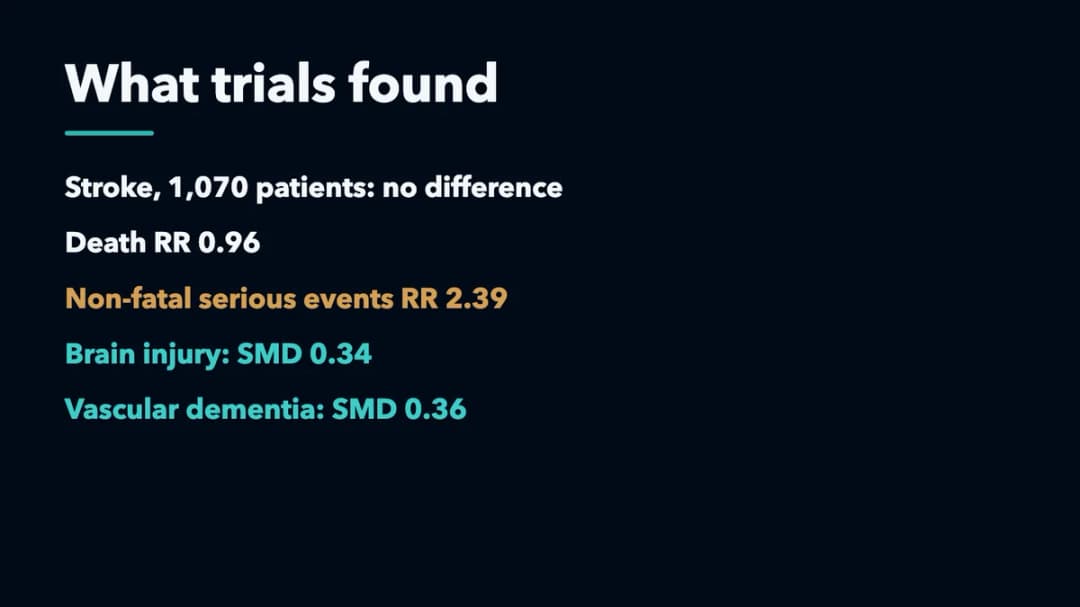
Cochrane review (2023). The independent review pooled 7 trials with 1,773 participants. It found that Cerebrolysin or similar extracts probably make little to no difference to death from any cause (risk ratio 0.96, 95% CI 0.65 to 1.41). It also found an increase in non-fatal serious adverse events (RR 2.39, 95% CI 1.10 to 5.23), which was larger in the 30 mL-for-10-days subgroup (RR 2.87). The reviewers noted that the manufacturer supported three of the multicenter trials and judged much of the evidence at unclear risk of bias.
Newer meta-analysis (2025). A review of 14 randomized trials found a small improvement in NIHSS change (mean difference 1.39 points) but no significant gain in functional independence (modified Rankin 0 to 2: RR 1.31, 95% CI 0.90 to 1.91). It found no increase in serious adverse events (RR 1.08) or death (RR 0.86).
Guidelines disagree. A 2021 European Academy of Neurology guideline on drugs that support early motor rehabilitation recommends Cerebrolysin at 30 mL a day IV for at least 10 days after acute ischemic stroke. Cochrane's reviewers, looking at a different question (survival and harm when started within 48 hours), did not find benefit.
Does Cerebrolysin help after traumatic brain injury?
The TBI evidence comes from two small trials called CAPTAIN I and CAPTAIN II. Both reported small-to-medium benefits on a combined set of outcome scales, but neither was large enough to settle the question.
Both trials used the same regimen: 50 mL a day for 10 days, then two more 10-day cycles at 10 mL a day, on top of standard care, in patients with moderate-to-severe injury.
- CAPTAIN I enrolled 46 patients. The primary multivariate endpoint just missed statistical significance in the intention-to-treat analysis (MW 0.63, 95% CI 0.48 to 0.77). It reached significance only in the per-protocol analysis.
- CAPTAIN II enrolled 142 patients and analyzed 139 with admission Glasgow Coma Scale scores of 7 to 12. The combined endpoint of 13 scales favored Cerebrolysin at day 90 (MW 0.59, p = 0.0119), which the authors called a "small-to-medium" effect.
- A prospective meta-analysis of both trials in 185 patients reported a standardized mean difference of 0.34 at day 90, with safety comparable to placebo.
None of these trials used death as the primary outcome.
Does Cerebrolysin work for dementia or Alzheimer's?
Small trials show short-term gains on cognitive tests, but the quality of the evidence is low and the benefit may be too small to matter in daily life.
For vascular dementia, the 2019 Cochrane review found 6 trials with 597 participants. Combining three studies (420 people), cognition improved by a standardized mean difference of 0.36 (95% CI 0.13 to 0.58), rated very low-quality evidence. Every trial reporting its funding was industry-supported. The reviewers concluded that "the supporting evidence base is weak" and that any benefit "may be too small to be clinically meaningful."
For Alzheimer's disease, a 2015 meta-analysis of 6 trials using 30 mL a day found a cognitive benefit at 4 weeks (SMD 0.40 in Cerebrolysin's favor) that was no longer statistically significant at 6 months (95% CI crossed zero). Clinician-rated global change favored Cerebrolysin at both points, and a 2022 umbrella review also listed it among beneficial options. No large, independent trial has confirmed these results, and there are no trials in healthy people using it to boost memory or focus.
| Indication | Key evidence (date) | What it found |
|---|---|---|
| Acute ischemic stroke | CASTA, 1,070 patients (2012) | No difference on the primary endpoint at 90 days |
| Stroke rehabilitation | CARS pooled, 442 patients (2017) | Better arm recovery, MW 0.62; NNT 7.1 for early NIHSS gain |
| Acute ischemic stroke | Cochrane, 7 trials, 1,773 people (2023) | Death RR 0.96; non-fatal serious adverse events RR 2.39 |
| Acute ischemic stroke | Meta-analysis, 14 trials (2025) | NIHSS gain 1.39 points; functional independence not significant |
| Moderate-to-severe TBI | CAPTAIN I and II pooled, 185 patients (2021) | Small-to-medium benefit, SMD 0.34 at day 90 |
| Vascular dementia | Cochrane, 6 trials, 597 people (2019) | Cognition SMD 0.36, very low-quality evidence |
| Alzheimer's disease | Meta-analysis, 6 trials (2015) | Cognition SMD 0.40 at 4 weeks, not significant at 6 months |
How is Cerebrolysin given, and what doses were used in trials?
Cerebrolysin is given only by injection or IV infusion, usually as a daily course in a hospital or clinic, at 5 to 50 mL a day depending on the condition.
Per the Romanian leaflet, up to 5 mL can go into a muscle and up to 10 mL into a vein. Doses of 10 to 50 mL are given only as a slow IV infusion, diluted to 250 mL in saline, Ringer's solution or 5% glucose and run over 15 to 60 minutes. The leaflet recommends a daily course of 10 to 20 days, with treatment-free breaks of the same length between courses.
| Use | Labeled daily dose (Romanian leaflet) | Manufacturer dosing card | Dose used in key trials |
|---|---|---|---|
| Stroke | 10–50 mL | 20–50 mL for 10–21 days | 30 mL for 10 days (CASTA); 30 mL for 21 days (CARS) |
| Traumatic brain injury | 10–50 mL | 20–50 mL for 7–30 days | 50 mL for 10 days, then two 10-day cycles of 10 mL (CAPTAIN) |
| Dementia (Alzheimer's or vascular) | 5–30 mL | 10–30 mL, 5 days a week for 4 weeks, 2–4 cycles a year | 30 mL a day (Alzheimer's meta-analysis) |
The manufacturer's dosing card gives slightly different ranges and dilution volumes, because national labels vary. Neither is a guide for self-dosing. Decisions about Cerebrolysin belong with a neurologist or other clinician who can weigh it against standard treatment.
What are the side effects of Cerebrolysin?
In trials, most side effects were mild and short-lived: dizziness or vertigo, agitation and a feeling of heat were reported most often. The Cochrane stroke review, however, found more non-fatal serious adverse events with Cerebrolysin than with placebo.
The Romanian leaflet groups its listed reactions as rare or very rare:
- Rare: loss of appetite; agitation, aggression, confusion or insomnia; dizziness, palpitations or irregular heartbeat if injected too quickly; a feeling of heat or sweating with fast injection; itching. One study also reported hyperventilation, blood pressure changes, fatigue, tremor, low mood and flu-like symptoms.
- Very rare: allergic or skin reactions, headache, neck or throat pain, pain in the hands and feet, fever, back pain, shortness of breath, chills and shock-like states; nausea, vomiting, diarrhea or constipation; redness and burning at the injection site; and a single reported case of a grand mal seizure.
A 2012 safety review of dementia and stroke trials found adverse event rates similar to placebo, with vertigo, agitation and feeling hot the most common. The Cochrane signal for non-fatal serious events (RR 2.39, three stroke trials) is the main finding to weigh against that.
Who should not use Cerebrolysin?
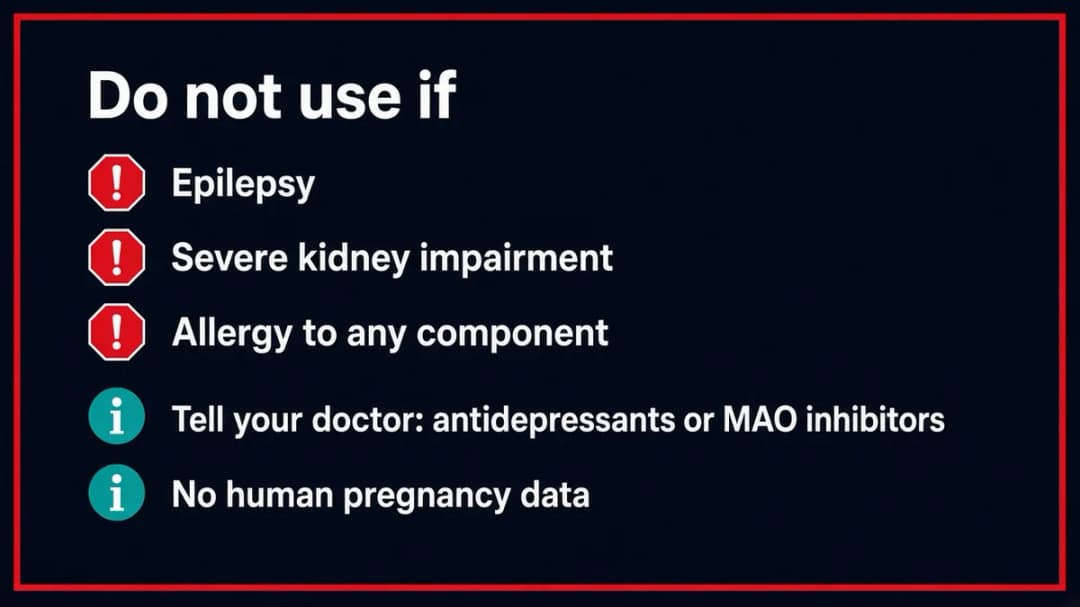
The label lists three contraindications: hypersensitivity to any component, epilepsy and severe kidney impairment. The leaflet adds:
- In people with epilepsy or grand mal seizures, treatment may increase how often seizures occur.
- Extra caution is needed for people prone to allergies.
- Doctors should know about antidepressants or MAO inhibitors, because the dose of those drugs may need to be reduced.
- There are no human data in pregnancy.
Is "research" Cerebrolysin sold online the same drug?
Not necessarily, and a buyer has no way to check. The only authorized product is the manufacturer's prescription ampoule, sold where it is registered.
The problems with online vials, powders, nasal sprays and capsules are specific:
- No defined molecule to test. A synthetic peptide can be checked for identity and purity against a known structure. Cerebrolysin is a variable mixture from animal tissue, so a lab report on a "research" vial cannot show that it matches the licensed product.
- Sterility. The maker's own instructions stress strict sterile handling, single-use infusion sets and starting the infusion right after dilution. An animal-derived injectable made or stored outside those standards carries contamination risk.
- Routes with no evidence. Every label we checked lists only intramuscular and intravenous use. Of the 43 Cerebrolysin studies registered on ClinicalTrials.gov as of November 4, 2026, none tests a nasal spray; the two that mention smell loss used intramuscular injections. Oral versions face digestion in the gut.
- Dosing borrowed from hospitals. Trial doses are 10 to 50 mL of infused solution a day. Online protocols that shrink this to a small injection have no trial data.
Cerebrolysin sold under a "research use only" label in the US is not approved for human use. After a stroke, brain injury or dementia diagnosis, ask the treating neurologist which approved options fit your situation. For a wider look at what goes wrong with unregulated products, see our overview of peptide side effects.
How does Cerebrolysin compare with Semax, Selank and Dihexa?
Cerebrolysin is often grouped with "nootropic peptides," but it is a different kind of product. Semax and Selank are short synthetic peptides with a single known sequence, and Dihexa is a synthetic small molecule, so each can at least be identity-tested. Cerebrolysin is a tissue extract with no single active ingredient, though it has been tested in randomized trials with nearly 2,900 stroke patients. See our Semax peptide guide, the Selank peptide guide, the side-by-side Semax vs Selank comparison, and our page on Dihexa. The Pinealon guide covers another brain-targeted short peptide.
Frequently Asked Questions
What is Cerebrolysin made from?
It is made from pig brain protein broken down by enzymes into short peptides and free amino acids. Each milliliter of the licensed solution contains 215.2 mg of this concentrate. It is a biological mixture, not a single compound.
Is Cerebrolysin FDA approved?
No. Cerebrolysin has never been approved by the FDA, and the manufacturer states it is not registered or approved for sale in the United States. It is a prescription medicine only in countries that have granted national approval, such as Austria and Romania.
What is Cerebrolysin used for?
Where it is approved, labels list dementia of the Alzheimer's type, vascular dementia, stroke and head trauma. In practice it is used most in Russia, Eastern Europe, China and other parts of Asia.
What is the usual Cerebrolysin dosage?
Labeled daily doses range from 5 to 30 mL for dementia and 10 to 50 mL after stroke or head injury, given in courses of about 10 to 20 days. Up to 5 mL can be injected into muscle; 10 to 50 mL must be diluted and given as a slow IV infusion. Stroke trials most often used 30 mL a day.
What are the most common side effects?
Dizziness or vertigo, agitation and a feeling of heat were the most commonly reported effects in trials. Injecting too fast can cause sweating, palpitations or dizziness. The 2023 Cochrane stroke review found more non-fatal serious adverse events with Cerebrolysin than with placebo.
Does Cerebrolysin improve memory in healthy people?
There is no clinical trial evidence for that. Studies were done in people with stroke, brain injury or dementia, and even there cognitive gains were small and, in some analyses, short-lived.
Is nasal spray Cerebrolysin effective?
No nasal Cerebrolysin trial is registered on ClinicalTrials.gov. Approved labels list only intramuscular and intravenous use, so nasal products sold online are untested for safety or effect.
How long does a course of Cerebrolysin last?
The Romanian label recommends daily treatment for 10 to 20 days, followed by a break of the same length before repeating. Stroke trials ran for 10 or 21 days, and the TBI trials added two further 10-day cycles at a lower dose after the first course.
Sources
- Ziganshina LE, et al. Cerebrolysin for acute ischaemic stroke. Cochrane Database Syst Rev, 2023.
- Cui S, et al. Cerebrolysin for vascular dementia. Cochrane Database Syst Rev, 2019.
- Heiss WD, et al. Cerebrolysin in patients with acute ischemic stroke in Asia (CASTA). Stroke, 2012.
- Muresanu DF, et al. Cerebrolysin and Recovery After Stroke (CARS). Stroke, 2016.
- Guekht A, et al. Meta-analysis of the CARS trials. Neurol Sci, 2017.
- Patel PN, et al. Cerebrolysin after acute ischemic stroke: meta-analysis of 14 RCTs. Cureus, 2025.
- Beghi E, et al. EAN/EFNR guideline on pharmacological support in early motor rehabilitation after stroke. Eur J Neurol, 2021.
- Poon W, et al. CAPTAIN I; Muresanu DF, et al. CAPTAIN II; Vester JC, et al. CAPTAIN meta-analysis. Neurol Sci, 2020–2021.
- Gauthier S, et al. Cerebrolysin in mild-to-moderate Alzheimer's disease: meta-analysis. Dement Geriatr Cogn Disord, 2015.
- National Agency for Medicines and Medical Devices of Romania. Cerebrolysin 215.2 mg/mL package leaflet and carton text, MA 4804/2012.
- EVER Neuro Pharma. About Cerebrolysin and dosage recommendation with abbreviated prescribing information.
- ClinicalTrials.gov. Registered studies with Cerebrolysin as an intervention, accessed November 4, 2026.