AOD-9604 before and after expectations should be set low. Its own human trials produced modest fat loss over twelve weeks, enough to be measurable and not enough to carry the compound to approval. Anyone showing dramatic before and after images from AOD-9604 alone is showing you the effect of a diet, not the effect of a peptide.
That is the uncomfortable centre of any honest AOD-9604 before and after discussion. The compound was designed specifically as an anti-obesity drug, it was tested in humans for that purpose, and the results were not strong enough for it to proceed. It is still widely sold, which is why the gap between the marketing and the trial record is worth setting out clearly.
AOD-9604 Before and After: What the Trials Produced
AOD-9604 is a fragment of human growth hormone, roughly amino acids 176 to 191, developed by Metabolic Pharmaceuticals in Australia. The design goal was to keep the fat-metabolising signal and drop the growth-promoting and glucose-affecting parts of the molecule.
On safety, that worked. Human trials found no meaningful effect on fasting glucose, HbA1c, IGF-1 or lipids at the doses tested, which is genuinely unusual for a compound in this space.
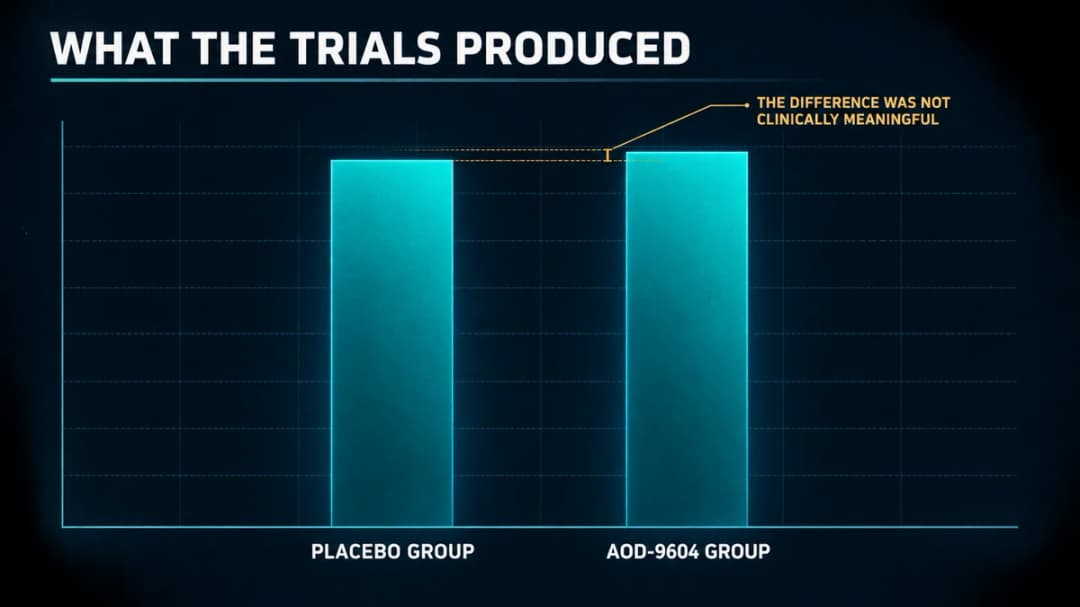
On efficacy, the picture was weaker. Twelve week dosing at around 1 mg per day produced fat loss that was measurable against placebo but small in absolute terms, and increasing the dose did not improve it. Development for obesity did not continue to approval.
Reported figures for exactly how much fat was lost vary between sources, and we are not going to pick one, because the difference between accounts is large enough to suggest at least some of them are wrong. The reliable summary is: statistically detectable, clinically modest, and not enough to justify a drug.
Why Before and After Photos Mislead Here
Three reasons, all of which apply more strongly to this compound than to most.
Almost nobody runs it alone. AOD-9604 is used during a diet, usually alongside training changes and often alongside other compounds. Attributing the result to the peptide requires assuming the diet did nothing.
Twelve weeks of a calorie deficit produces visible change on its own. The typical AOD-9604 cycle length is also long enough for a moderate deficit to produce exactly the kind of change a before and after photo shows.
Photographic variables are large. Lighting, posture, time of day, hydration and pump state change a physique photo more than a modest change in fat mass does.
None of this means people are lying. It means the photos are showing a combined result and the peptide is the least likely component to be responsible for most of it.
What a Realistic Timeline Looks Like
| Period | What is plausible | What people report |
|---|---|---|
| Week 1 to 2 | Nothing attributable | Occasional early appetite or energy changes, likely unrelated |
| Week 3 to 6 | Small changes, hard to separate from the diet | Some report improved fat loss "smoothness" |
| Week 6 to 12 | The window where trial-scale effects would appear | Waist measurement changes, modest |
| After stopping | No mechanism for continued effect | Weight trajectory follows the diet |
The most credible reports describe it as a small additive effect on top of a deficit, which is consistent with what the trials found. The least credible describe transformations, and those are describing a diet.
Who Reports the Best Response
The pattern in accounts, for what it is worth, is that people with more body fat to lose report more, which is also broadly what would be expected from a lipolytic mechanism and what trial subgroup discussion has suggested. People lean enough to be chasing the last few pounds report the least, despite this being the use case the compound is often marketed for.
That inversion is worth noticing. The marketing positions AOD-9604 as a targeted finisher for stubborn fat. The mechanism and the reports both point the other way.

Measuring Properly If You Run It
If you are going to spend twelve weeks and a few hundred dollars on this, the difference between a result and an anecdote is in the setup. Our AOD-9604 for sale page covers vial sizes and what to check before paying.
Take two weeks of baseline data first. Daily weight, weekly waist measurement, weekly photos under fixed conditions. This tells you what your normal variation looks like before anything changes.
Hold the diet constant. Starting a peptide and a new deficit in the same week guarantees you learn nothing. If you must do both, at least acknowledge afterwards that the result is unattributable.
Measure waist, not just weight. A lipolytic compound should move fat mass. Scale weight moves with water, glycogen and food volume, and over twelve weeks that noise is larger than the effect you are looking for.
Set a decision point. Twelve weeks, then compare against the baseline you recorded. Not against how you remember feeling in week one.
The Comparison Nobody Wants to Make
If the goal is fat loss and you are choosing where to spend, the honest comparison is not between peptide protocols. It is between AOD-9604 and the incretin drugs, which have large randomised trials, approved indications and effect sizes an order of magnitude larger.
That comparison has real trade-offs: those drugs need a prescriber, cost more, and carry gastrointestinal side effects that AOD-9604 does not. But pretending the compounds are in the same efficacy category does nobody a service. Our AOD-9604 vs retatrutide page sets them side by side.
What AOD-9604 Does Have Going For It
A clean metabolic safety profile, which is the reason the compound exists. It does not appear to affect glucose handling, insulin sensitivity or IGF-1 the way growth hormone itself does. Side effects in practice are mostly injection site reactions.
For someone who wants a lipolytic signal without touching the growth hormone axis, that is a real, if narrow, argument. It is just not an argument about the size of the result. Our AOD-9604 dosage guide covers the practical protocol. If you are weighing up sources, our guide on where to buy AOD-9604 covers vendor checks, certificate red flags and what to expect from a legitimate seller.
FAQ
How much weight can you lose with AOD-9604?
Trial results at the highest useful dose over twelve weeks were modest, and specific figures differ between sources enough that we would not quote one. The realistic expectation is a small additive effect on top of a calorie deficit, not weight loss driven by the compound itself.
How long does AOD-9604 take to show results?
If anything is attributable to it, the window is weeks six to twelve, matching the trial duration. Changes reported in the first fortnight are more likely to reflect diet changes started at the same time.
Are AOD-9604 before and after photos real?
The photos are usually real; the attribution is the problem. Almost everyone running AOD-9604 is also dieting, and twelve weeks of a deficit produces exactly the change a photo shows. The peptide is the least likely part of that combination to be doing most of the work.
Does AOD-9604 work without dieting?
There is no reason to expect it to. Its mechanism promotes fat mobilisation, and mobilised fat still has to be oxidised rather than re-stored, which requires an energy deficit. No trial has shown it produces weight loss in the absence of dietary change.
Is AOD-9604 better for stubborn fat?
It is frequently marketed that way and the evidence points the other way. Reports and trial subgroup discussion both suggest higher body fat responds better, which is the opposite of the "last five pounds" positioning.