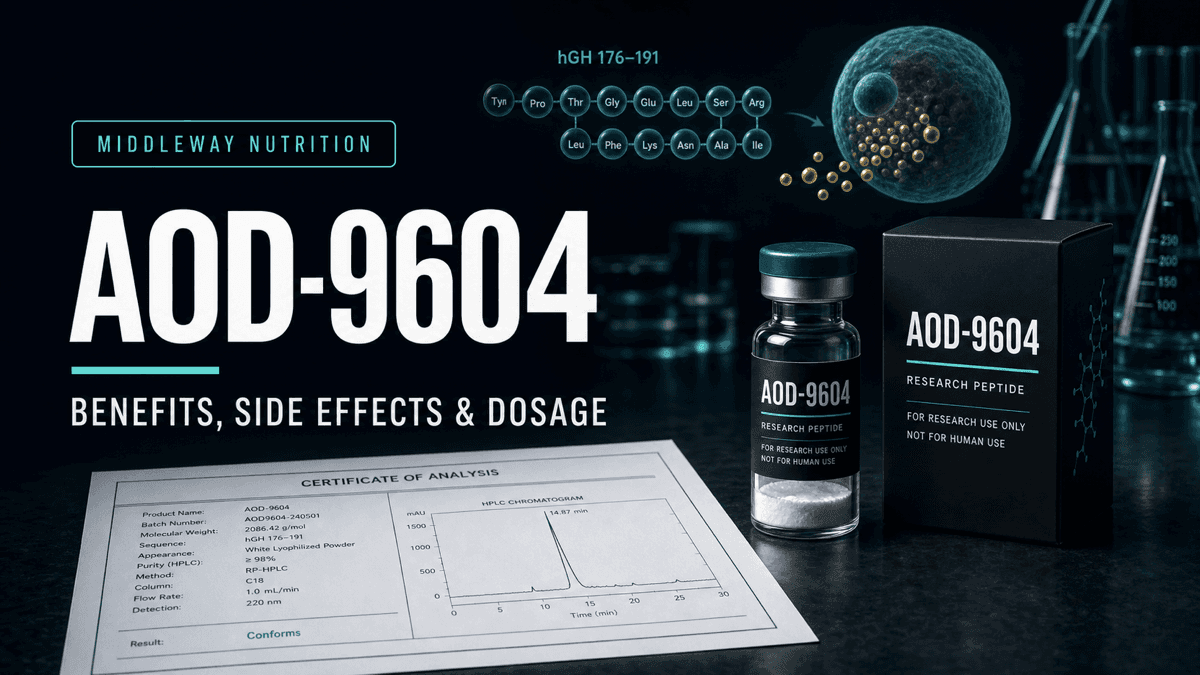
AOD-9604 peptide benefits are narrower than the marketing suggests, its documented side effects are mild and mostly local, and reported research dosage clusters tightly around 300 mcg daily by injection. That last sentence is the honest summary of two decades of work on this compound, and the rest of this guide explains how the field arrived there.
- AOD-9604 is a short synthetic fragment of human growth hormone with a tyrosine added at one end, built to isolate fat metabolism from growth signaling.
- It reached late-stage human obesity trials in the 2000s and did not beat placebo on total weight loss, which is the single most important fact about it.
- Its best-supported property is what it does not do: no measured rise in IGF-1, no disruption of blood glucose or insulin in the human studies conducted.
- Reported research ranges sit at 300 to 500 mcg per day subcutaneously, run in blocks of roughly 8 to 12 weeks. Much higher figures appear for oral and intranasal formats because absorption is worse.
- Plasma half-life is very short, measured in minutes rather than hours, which is why every reported protocol uses daily administration rather than weekly.
- Every human trial ever run on it used oral capsules, oral tablets or a single intravenous infusion. No published human study has tested the subcutaneous injection that research protocols actually describe.
What AOD-9604 Actually Is
AOD-9604 stands for Advanced Obesity Drug 9604, a name that tells you exactly what it was built for and, indirectly, that it never got there. It is a small synthetic chain corresponding to the C-terminal end of human growth hormone, with a tyrosine residue attached at the N-terminus for stability. The published sequence is Tyr-Leu-Arg-Ile-Val-Gln-Cys-Arg-Ser-Val-Glu-Gly-Ser-Cys-Gly-Phe, with a molecular weight of roughly 1,817 daltons. You will see the parent region written as residues 176 to 191 in some sources and 177 to 191 in others, which is a numbering convention difference rather than a difference in the molecule. It is worth knowing where the confusion comes from. In the mature 191 amino acid hormone, position 177 is a leucine and position 176 is a phenylalanine, not a tyrosine. The tyrosine on the front of this peptide was added by chemists for stability, which is why the clinical papers write the molecule as Tyr-hGH177-191 while the market label counts that added residue as though it were position 176. Both names point at the same 16 residue chain at the same 1,817 daltons.
The spelling is just as loose. AOD-9604, AOD 9604 and AOD9604 all refer to the same compound, forum shorthand cuts it to AOD, and a large share of vendor listings sell it as HGH Fragment 176-191 or simply HGH Frag. The trial literature uses the unspaced AOD9604 throughout. Nothing about the molecule changes across those labels, so when you are comparing an AOD 9604 peptide listing against an HGH fragment listing, you are comparing two names for one sequence and the only thing that separates them is the quality of the vendor behind each.
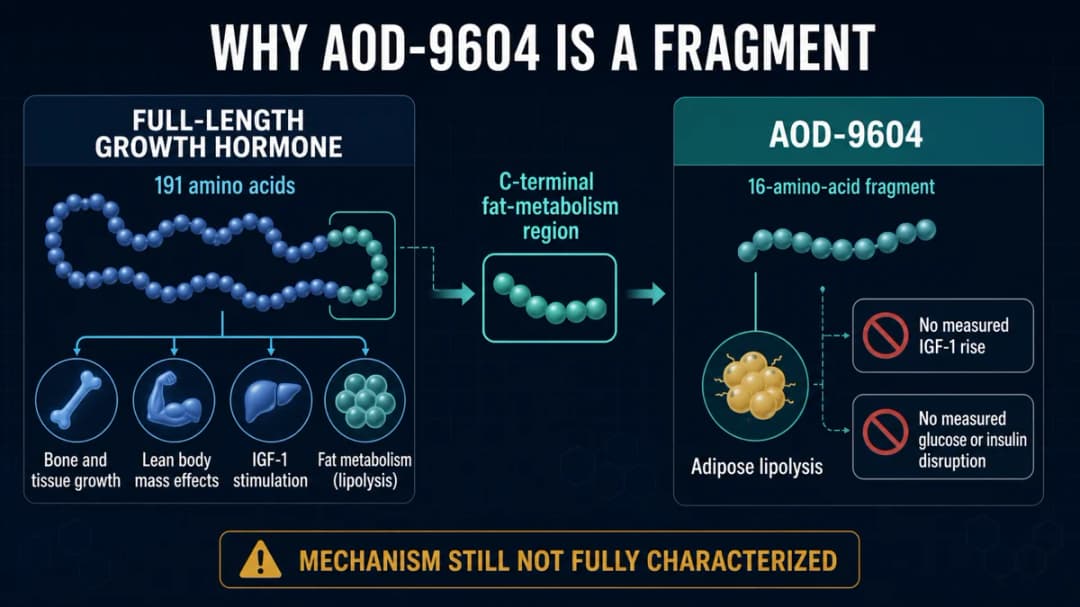
The design logic is worth understanding because it drives everything else. Full-length growth hormone is 191 amino acids and does several things at once: it mobilizes fat, it drives hepatic IGF-1 production, it interferes with glucose handling, and it promotes cell proliferation. Researchers at Metabolic Pharmaceuticals, an Australian biotech, worked from evidence that the lipolytic activity of growth hormone traces largely to its C-terminal region, while the receptor binding responsible for IGF-1 output does not. Cut the molecule down to that fragment and, in theory, you keep the fat effect and drop the rest.
In practice the fragment appears to act on adipose tissue through a mechanism that is still not fully characterized. It does not engage the growth hormone receptor in the classical way. Work in obese rodent models showed reduced fat accumulation and increased fat breakdown, and this is where the strongest and most consistent signal in the literature sits. A separate research thread, pursued after the obesity program ended, looked at cartilage: animal cartilage repair models and work on human articular cartilage tissue suggested the peptide can stimulate proteoglycan synthesis. That line is early and small, and it is not the reason most people search for this compound.
AOD-9604 is not an approved drug in the United States, the EU, or the UK. It is sold as a research chemical, and everything below describes what has been reported in that context rather than a protocol for anyone to follow. If you are also looking at metabolic compounds with different mechanisms, our MOTS-c guide covers a mitochondrial-derived peptide and the 5-Amino-1MQ guide covers an oral NNMT inhibitor, both of which get compared to AOD-9604 for reasons that are more marketing than biology.
AOD-9604 Benefits
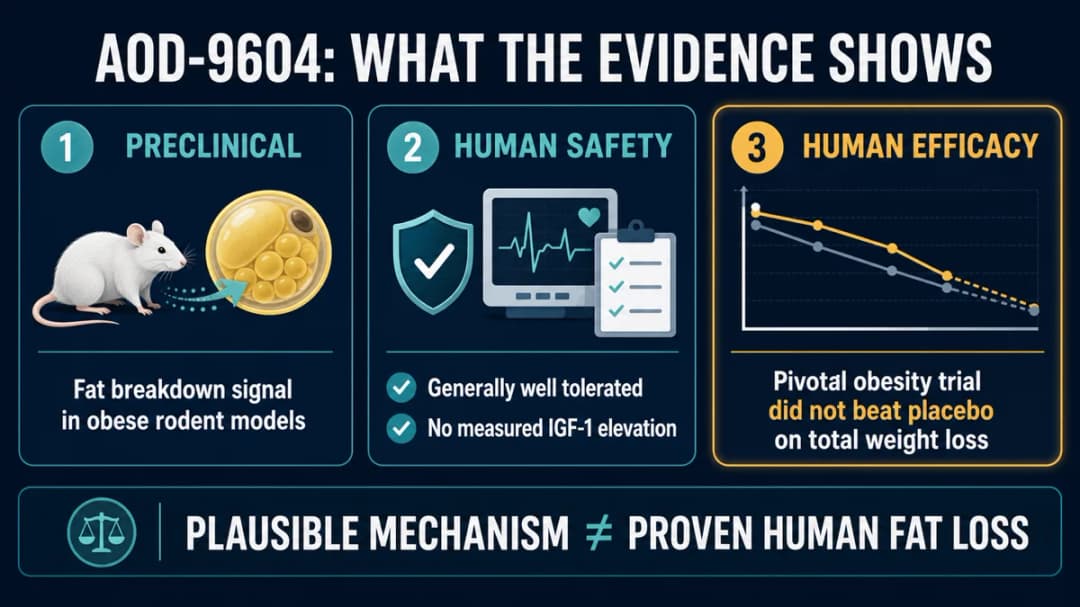
Grading this honestly requires separating three tiers of evidence, because they point in different directions.
Tier one, human clinical data. AOD-9604 went further into human testing than the overwhelming majority of research peptides. Phase 1 work established that it was tolerated in healthy volunteers. Phase 2 work produced encouraging signals on body composition. Then the pivotal trial, a multi-month placebo-controlled study completed in the second half of the 2000s, failed to show statistically significant weight loss against placebo. The developer pointed to trial design and duration, which may be fair, but the result is the result. Anyone telling you AOD-9604 is a proven human fat loss agent is contradicting the only large trial that tested the question. The company later ceased operations and licensed the compound onward for other applications.
Tier two, human safety and biomarker data. This is where AOD-9604 genuinely looks good, and it is an underrated benefit. Across those trials, the peptide did not produce the measurable IGF-1 elevation seen with growth hormone, and it did not disturb fasting glucose or insulin signaling in the way growth hormone does. It was well tolerated. For a compound in this category, having real human tolerability data instead of extrapolation from rat studies is meaningful.
Tier three, animal and in-vitro data. The lipolysis findings in obese rodent models are reasonably consistent: reduced fat accumulation, increased breakdown of stored fat, effects on abdominal fat specifically. The cartilage work is genuinely interesting but preliminary, spanning an animal repair model and tissue-level work showing increased proteoglycan production. Neither has been confirmed in a controlled human trial.
The realistic read is this. AOD-9604 has a plausible mechanism, a clean human safety record, and a failed efficacy trial. That combination is unusual. It is not a reason to dismiss the compound, but it is a reason to treat any claim of dramatic fat loss with skepticism, and to be suspicious of before-and-after content that never mentions the diet running alongside it. If your interest is visceral fat with actual approval behind it, tesamorelin is a more evidenced route, though it works through a completely different pathway and carries its own IGF-1 considerations.
What the Human Trials Actually Showed
Six randomized, double-blind, placebo-controlled trials were run on AOD9604 between 2001 and 2006, all of them in Australia, enrolling roughly 893 subjects between them. That is more human exposure than almost anything else sold as a research peptide has ever seen, and the individual studies are specific enough to be worth laying out one at a time.
| Trial | Design | Subjects | Route and dose | Duration | What it found |
|---|---|---|---|---|---|
| METAOD001 | Phase 1, dose escalation | 15 healthy men, BMI 24 to 30 | Intravenous infusion, 25 to 400 mcg/kg | Single doses, 7 day washouts | Well tolerated, headache the most common complaint. No glucose or IGF-1 trend against placebo or against a recombinant growth hormone control arm |
| METAOD002 | Phase 2a, Latin square | 23 obese men, BMI 35 and above | Intravenous infusion, 25, 50 and 100 mcg/kg | Single doses, 7 day washouts | 118 adverse events, mostly mild or moderate headache in 16 of 23 subjects. Mild euphoria in 5 of 23 on drug and none on placebo. No IGF-1 or glucose change |
| METAOD003 | Phase 2a | 16 obese men per FDA's 2024 briefing (17 in the published safety paper) | Oral, 9, 27 and 54 mg | Once weekly for 4 weeks (FDA's description) | Tolerated at all three doses. No significant IGF-1 change. The 54 mg dose brought more gastrointestinal complaints |
| METAOD004 | Phase 2a, multiple dose | 36 obese men, BMI 30 and above | 10, 30 or 60 mg (route not specified in FDA's summary) | 1 week | IGF-1, fasting glucose, fasting insulin and oral glucose tolerance all unchanged. Again the highest-dose arm reported more headache, diarrhea and flatulence |
| METAOD005 | Phase 2b, efficacy | 300 obese adults, BMI 35 and above, 54% male | Oral capsules, 1, 5, 10, 20 or 30 mg daily | 12 weeks after a 2 week placebo run-in | The 1 mg arm lost an average of 2.8 kg against 0.8 kg on placebo. No significant IGF-1 change in any arm. A trend toward better glucose tolerance that did not reach significance |
| METAOD006 | Phase 2b, pivotal | 502 obese adults randomized out of 536 enrolled, BMI 30 to 45 | Oral tablets, 0.25, 0.5 or 1 mg daily | 24 weeks with a diet and exercise program, primary endpoint at 12 weeks (FDA's December 2024 briefing) | No separation from placebo on weight. IGF-1 unchanged at 12 and 24 weeks, p = 0.51 and p = 0.76. Serious adverse events in 3.6% overall and evenly spread, including 8 of 125 in the placebo arm |
Three things in that table matter more than the rest.
The route. Every one of those six trials delivered AOD9604 either as a single intravenous infusion or as a capsule or tablet swallowed daily. Not one of them used a subcutaneous injection. The 300 mcg subcutaneous figure that dominates research protocols, vendor pages and forum threads has no human trial standing behind it. It is an extrapolation from animal work and community practice, and the honest way to describe it is exactly that.
What happened between the two phase 2b studies. The 12 week study produced its best result at 1 mg per day, the lowest dose tested, with the 5, 10, 20 and 30 mg arms doing no better. A dose response that flattens or runs backwards is a warning sign in any trial. The 24 week study then took the 0.25 to 1 mg range containing that winning dose, ran it in 502 patients for 24 weeks, with the primary endpoint at 12 weeks, and got nothing. Note that FDA's December 2024 briefing describes the trial dosing in METAOD003 and METAOD004 differently from the published safety paper (9, 27 and 54 mg once weekly for 4 weeks, and 10, 30 and 60 mg for one week), so the short-study doses in the table follow FDA's account. A 2014 safety and metabolism paper by Moré and Kenley in the Journal of Endocrinology and Metabolism, written from the sponsor side, put the reason plainly: the weight loss seen in the earlier trials was not seen in the last study, which had an intensive diet and exercise program built into it. Read charitably, a genuine diet swamped a small drug effect. Read plainly, the effect did not survive a properly controlled test.
Publication. The safety data from all six trials were written up by Stier, Vos and Kenley in 2013 in the Journal of Endocrinology and Metabolism, and that paper is the source for most of the table above. The efficacy results were not. A PubMed search for AOD9604 returns roughly two dozen records, and they are animal lipolysis studies, doping control detection methods, a rabbit osteoarthritis model and the safety summary. The 2.8 kg figure traces to a company announcement in December 2004 rather than a peer reviewed analysis. That does not make it wrong, but it means nobody outside the sponsor ever reviewed how it was calculated.
The pharmacokinetics close the loop. In pigs, AOD9604 cleared with a half-life of roughly 3 minutes after intravenous injection, which is the hard number behind every description of it as short-lived. In rats, oral availability was estimated at around 40% from the distribution of radiolabel, a measure that tracks where the label ended up rather than how much intact peptide survived the gut. Both figures come from that same 2014 Moré and Kenley paper. The 3 minute half-life is why no protocol for this compound is ever weekly. The 40% oral estimate is why the sponsor ran its two largest trials with capsules and tablets rather than needles, and why the human oral doses were measured in milligrams while injectable community protocols are measured in micrograms.
AOD-9604 vs Other Fat Loss Peptides
The most useful thing you can do with a compound whose pivotal trial failed is set its best result next to results that held up.
| Compound | Strongest human evidence | Result | Effect on IGF-1 | Status |
|---|---|---|---|---|
| AOD-9604 | 12 week phase 2b, 300 obese adults, 1 mg daily by mouth | 2.8 kg lost against 0.8 kg on placebo, sponsor reported and never peer reviewed. A 502 patient, 24 week trial found no separation | No measurable change at any dose tested | Not approved anywhere, sold as a research chemical |
| Tesamorelin | 412 patients with HIV-associated abdominal fat, 2 mg subcutaneously daily, 26 weeks, New England Journal of Medicine 2007 | Visceral adipose tissue fell 15.2% while placebo rose 5.0%, measured by imaging rather than inferred | Rises sharply, and that rise is the mechanism | FDA approved as Egrifta for HIV-associated lipodystrophy only |
| Semaglutide 2.4 mg | STEP 1, 1,961 adults, 68 weeks, New England Journal of Medicine 2021 | Mean body weight down 14.9% against 2.4% on placebo, 15.3 kg against 2.6 kg | Not a growth hormone pathway drug | FDA approved for weight management |
| 5-Amino-1MQ | None. The fat loss claims trace to a 2018 mouse study of NNMT inhibitors in diet-induced obesity | No human data | Not applicable | Research chemical |
| MOTS-c | None for administered MOTS-c. The human papers measure the body's own circulating levels around exercise | No human data on dosing it | Not applicable | Research chemical |
Two readings come out of that. Measured against the research chemical field, AOD-9604 is unusually well documented. Hundreds of humans, monitored laboratory panels, oral glucose tolerance testing, antibody screening and a clean IGF-1 record are more than 5-Amino-1MQ or MOTS-c can show, and it is why this peptide keeps its reputation despite the failure. Measured against approved drugs, it is not close. Semaglutide's trial produced a mean 14.9% reduction in body weight over 68 weeks. AOD-9604's best human result was 2.8 kg over 12 weeks in a group whose median BMI was 40, which works out to low single digit percentages, and the larger trial did not reproduce even that. If the question is weight on a scale, our peptides for weight loss overview sets out where each class actually sits.
AOD-9604 Side Effects
Documented adverse effects are limited and mild, which is consistent with the clinical trial record. The most frequently reported issues in research settings:
- Local injection site reactions. Redness, mild swelling, or irritation at the subcutaneous site. This is the most common complaint and generally resolves within hours. Rotating sites reduces it.
- Transient fatigue. Reported mostly in the first week or two of administration, tending to settle afterward.
- Mild headache. Noted in some participants, generally short-lived.
- Nausea. Occasional, and more often associated with the upper end of reported dose ranges.
Equally important is the list of growth hormone problems that have not shown up with AOD-9604 in the available data: insulin resistance and blood sugar dysregulation, fluid retention and edema, carpal tunnel symptoms, IGF-1 elevation, and the skeletal or organ growth associated with chronic growth hormone excess. This absence is the compound's main pharmacological selling point.
Now the honest caveats, because this is where most write-ups stop. Human safety data for AOD-9604 covers trial durations measured in months, not years, so nothing is known about multi-year exposure. There is no data in pregnancy or breastfeeding, and no reason to assume safety there. Anyone with an active malignancy should not be experimenting with any growth-hormone-derived compound outside oncology supervision. And a substantial share of real-world adverse reports almost certainly trace not to the peptide but to what was actually in the vial. Contaminated, underdosed, or misidentified product is a more likely explanation for an unexpected reaction than the molecule itself.
FDA's December 2024 briefing document also flagged animal signals worth knowing: in rats, serum osteocalcin changed in ways that could suggest altered bone turnover, and in a 9-month monkey study slight periportal liver vacuolation appeared dose dependently in females. FDA said it could not rule out that these are clinically relevant, and neither finding has been tested in humans.
AOD-9604 Dosage Chart
There is no approved human dose for AOD-9604. What follows is a summary of the ranges reported in research literature and in research-community protocols, presented so you can see the spread. It is a description of what has been used, not a recommendation.
| Context | Reported range | Frequency | Typical cycle |
|---|---|---|---|
| General body composition research (subcutaneous) | 300 mcg per day | Once daily, commonly fasted | 8 to 12 weeks |
| Upper-end fat loss protocols (subcutaneous) | 500 mcg per day | Once daily, often pre-training | 12 weeks |
| Lower-dose maintenance phase | 150 to 250 mcg per day | 3 to 4 days per week | Post-cycle, open ended |
| Oral or sublingual formats | 1,000 to 2,000 mcg per day | Once daily | 8 to 12 weeks |
| Intranasal formats | 200 to 300 mcg per day | Once daily | 8 to 12 weeks |
| Extended protocols | 300 to 500 mcg per day | 5 days on, 2 days off | 16 to 20 weeks, then a 6 to 8 week break |
Several things about this table deserve comment. The gap between the injectable and oral figures is not a dosing preference, it is a bioavailability problem. Oral peptide absorption is poor, so oral protocols compensate with three to six times the material, and whether that actually reproduces the injectable exposure has not been well established. Treat oral AOD-9604 claims with more caution than injectable ones.
The oral figures do have one anchor the injectable figures lack. A community range of 1,000 to 2,000 mcg by mouth is 1 to 2 mg, and 1 mg per day is exactly the dose that produced the best result in the 12 week human trial. Human oral dosing went as high as 30 mg per day for 12 weeks and 54 to 60 mg per dose in the short studies, and none of those higher arms outperformed the 1 mg arm. There is no equivalent anchor anywhere in the injectable column, because no human trial has ever administered AOD-9604 subcutaneously.
The very short plasma half-life, on the order of minutes rather than hours, also explains the daily, single-dose pattern. A compound cleared that fast does not accumulate, so protocols rely on repeated brief exposures rather than sustained levels. The frequent recommendation to administer fasted comes from the reasoning that elevated insulin suppresses lipolysis, which is mechanistically sensible but has not been demonstrated to change outcomes for this specific peptide.
Cycle lengths of 8 to 12 weeks with a break afterward are convention rather than evidence. The stated rationale is avoiding receptor desensitization, and given how poorly the target receptor is characterized, that rationale should be read as precautionary rather than established.
Reconstitution and Storage
AOD-9604 ships as a lyophilized white to off-white powder, most commonly in 5 mg vials. Reconstitution uses bacteriostatic water added slowly against the vial wall, not squirted directly onto the powder, then gentle swirling until dissolved. Do not shake it. The arithmetic is straightforward: 2 mL of bacteriostatic water into a 5 mg vial gives 2,500 mcg per mL, so a 300 mcg dose is 0.12 mL, or 12 units on a standard 100-unit insulin syringe.
Unreconstituted vials keep best frozen at around -20 degrees Celsius for long-term storage and tolerate refrigeration for shorter periods. Once reconstituted, the solution goes in the refrigerator at 2 to 8 degrees Celsius and is generally considered usable for about three weeks. Keep it away from light and avoid repeated freeze-thaw cycles, which degrade peptides faster than simple cold storage does.
Stacking
Documented combination research for AOD-9604 is essentially nonexistent, so treat everything in this section as community practice rather than evidence. The most commonly described pairings are with growth hormone secretagogues such as CJC-1295 and ipamorelin, typically reported at around 100 mcg each before bed while AOD-9604 is taken in the morning. The stated logic is that the secretagogues raise endogenous growth hormone pulses while AOD-9604 works directly on adipose tissue. Worth noting: secretagogues do raise IGF-1, which cancels out the specific advantage that makes AOD-9604 attractive in the first place.
The other frequently described pairing is with BPC-157, reported around 250 to 500 mcg per day, generally in recovery and joint contexts rather than fat loss. Given the cartilage research thread on AOD-9604, this combination has slightly more mechanistic coherence than most, but no controlled data supports it. Sermorelin appears in gentler stack descriptions aimed at older users with age-related growth hormone decline.
How to Verify What You Buy
Because AOD-9604 produces subtle effects rather than obvious ones, a weak or misidentified vial will not announce itself, which makes vendor verification unusually important for this compound. Insist on a third-party certificate of analysis from an external lab with both HPLC for purity and mass spectrometry for identity, and check that the lot on the certificate matches the lot on your vial. Our where to buy AOD-9604 guide walks through vendor testing practices and pricing benchmarks, and the AOD-9604 for sale page tracks current listings and vial formats.
Looking for the numbers behind this guide? Our AOD-9604 dosage chart sets label and trial doses beside what Reddit users report taking.
Frequently Asked Questions
What does AOD-9604 actually do?
It is a fragment of growth hormone that appears to stimulate the breakdown of stored fat in adipose tissue while leaving the IGF-1 and glucose pathways alone. That effect is well documented in obese animal models. In humans, the safety and biomarker findings held up but the pivotal weight loss trial did not reach significance against placebo, so its real-world fat loss magnitude in people is unproven.
Is AOD-9604 safe?
Within the scope of what has been studied, it had a favorable tolerability profile, with mild and mostly local side effects and none of the metabolic problems associated with growth hormone. That is a real finding, but it comes from trials lasting months. Long-term exposure is uncharacterized, there is no pregnancy or breastfeeding data, and product quality is a bigger practical risk than the molecule.
How much AOD-9604 is typically used?
Reported research ranges are 300 to 500 mcg per day subcutaneously, run in 8 to 12 week blocks, with lower 150 to 250 mcg maintenance figures and much higher oral figures of 1,000 to 2,000 mcg per day reflecting poor absorption. These are reported ranges from research contexts, not a dosing recommendation, and no approved human dose exists.
Is AOD-9604 legal?
It is not approved for human use in the United States and is not permitted in pharmacy compounding under current FDA guidance. It can generally be purchased as a research chemical for laboratory use. Australia schedules it as prescription-required through the TGA. It is unapproved as a medicine in the UK and EU, where import rules vary by country. It is also a banned substance in tested sport.
What are AOD9604 benefits, realistically?
Three of them, ranked by how well they hold up. It does not raise IGF-1 and does not disturb glucose handling, measured directly in every long-term trial including oral glucose tolerance testing, and that is the single best supported claim anyone can make about this peptide. It reduces fat accumulation and increases fat breakdown in obese rodents, consistently, across several studies. And in one 12 week human trial the 1 mg oral arm lost 2.8 kg against 0.8 kg on placebo, a result the larger 24 week trial did not reproduce. Everything past that point, including muscle gain and joint repair in people, is untested or animal only.
Is AOD-9604 the same as HGH Fragment 176-191?
In practice, yes. Both names are used for the same 16 amino acid chain at roughly 1,817 daltons, and vendors move between the two labels freely. The split is historical rather than chemical. The clinical papers write the molecule as Tyr-hGH177-191 because the tyrosine at the front is a synthetic addition rather than a native residue, while the market label counts that added tyrosine as though it were position 176 of the hormone, which it is not. AOD-9604, AOD 9604, AOD9604, AOD and HGH Frag all point at the same sequence. A mass spectrometry result on a third party certificate of analysis is what confirms you actually received it.
What do AOD-9604 reviews and before-and-after posts actually show?
They show what a person experienced, not what the peptide did, and the gap matters more here than with most compounds. AOD-9604 produces no acute sensation, no appetite suppression and no scale movement fast enough to attribute with confidence, so a user has nothing to separate the vial from the diet running alongside it. The one human study that controlled for exactly that, the 24 week trial with a structured diet and exercise program built in, found no separation from placebo. Read photo threads as evidence about somebody's training and food, and hold judgment on the peptide.