AOD-9604 and retatrutide are often listed side by side in peptide forums, but they are not in the same drug class and the evidence behind them is not in the same league. AOD-9604 is a fragment of human growth hormone promoted for fat loss, with human trials that failed to beat placebo. Retatrutide is an investigational triple hormone-receptor agonist that produced roughly 24% mean body-weight reduction at 48 weeks in a phase 2 trial. If you are choosing between them for fat loss, this is less a head-to-head and more a comparison between a compound with strong randomized trial data and one without.
Below is a clear, evidence-first breakdown of what each compound is, how it works, what the human data actually shows, and what realistic expectations look like.
Quick answer
- AOD-9604 is a synthetic peptide based on amino acids 176 to 191 of human growth hormone. It is marketed to stimulate fat breakdown (lipolysis). In its largest human obesity trial, it did not produce statistically significant weight loss versus placebo. It is not FDA approved for fat loss.
- Retatrutide is a once-weekly injectable that activates three receptors at once: GLP-1, GIP, and glucagon. In a phase 2 trial of 338 adults, the 12 mg dose produced about 24.2% mean weight reduction at 48 weeks versus about 2.1% for placebo. It is investigational and not yet FDA approved.
These are different categories of intervention. One has decades of weak signals; the other has some of the largest weight-loss numbers ever reported for a single drug, pending phase 3 confirmation.
Side-by-side comparison
| Feature | AOD-9604 | Retatrutide |
|---|---|---|
| Drug class | Modified growth hormone fragment (176-191) | Triple agonist: GLP-1 / GIP / glucagon |
| Proposed mechanism | Stimulates lipolysis, inhibits lipogenesis | Suppresses appetite, slows gastric emptying, raises energy expenditure |
| Route | Subcutaneous injection (also sold as oral/topical, unvalidated) | Once-weekly subcutaneous injection |
| Best human efficacy data | No significant weight loss vs placebo in phase 2b (~300 patients) | ~24.2% mean weight loss at 48 weeks (12 mg) |
| Evidence quality | Mostly preclinical; mixed/negative human trials | Large randomized phase 2; phase 3 (TRIUMPH) ongoing |
| FDA status | Not approved for weight loss | Investigational, not approved |
| Developer | Metabolic Pharmaceuticals (program discontinued) | Eli Lilly |
| Typical positioning | "Fat-loss peptide" in wellness/research channels | Next-generation obesity drug candidate |
What is AOD-9604?
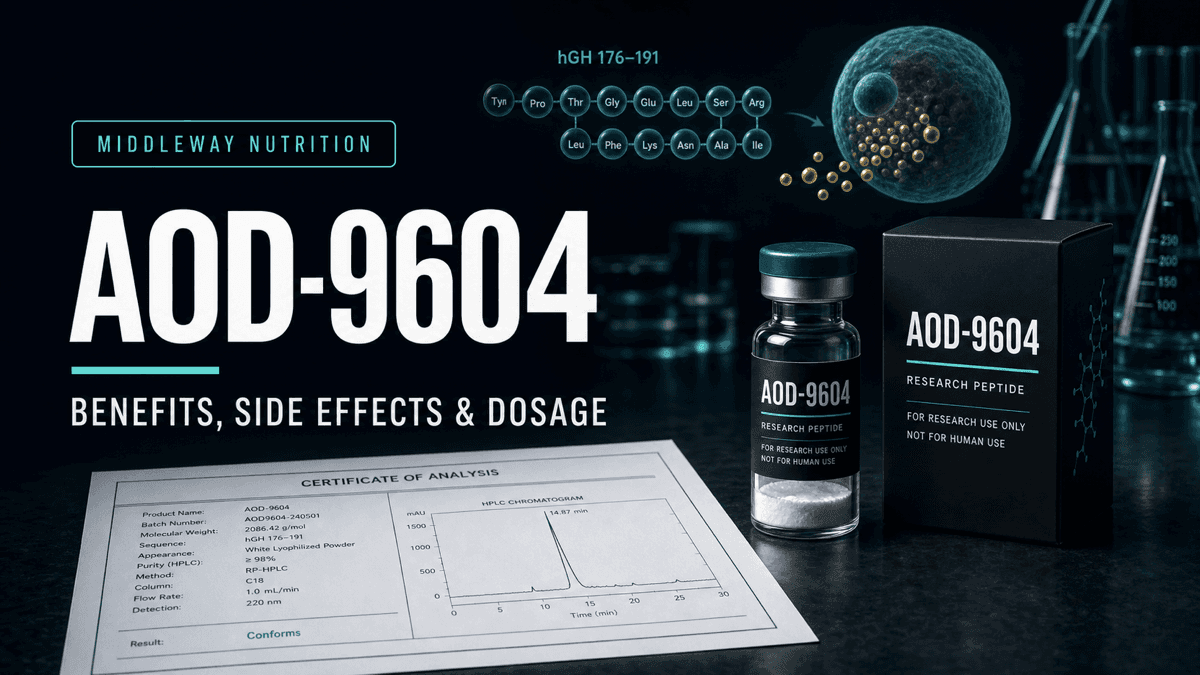
AOD-9604 (the name stands for "anti-obesity drug 9604") is a synthetic peptide that copies the C-terminal region of human growth hormone, specifically the segment spanning amino acids 176 to 191, with a tyrosine added at one end. Researchers isolated this fragment because earlier work suggested the fat-burning activity of growth hormone might be concentrated in that tail end of the molecule.
The appeal was selectivity. Full growth hormone raises IGF-1 and can affect blood sugar and tissue growth. AOD-9604 was designed to trigger fat metabolism without those effects. In laboratory and animal studies, it was associated with increased fat oxidation and lipolysis (the release of stored fat) along with reduced lipogenesis (new fat storage).
That preclinical story is why AOD-9604 still circulates in peptide and wellness channels today. The problem is what happened when it reached people.
The human evidence for AOD-9604
Metabolic Pharmaceuticals, an Australian company, advanced AOD-9604 through human obesity trials in the mid-2000s. The pivotal phase 2b study enrolled roughly 300 adults with obesity. The headline result is the one that matters most: AOD-9604 did not produce statistically significant weight loss compared with placebo.
After that result, the obesity program was discontinued. The compound was never approved by the FDA as a weight-loss drug. It is sometimes described in marketing as "approved" elsewhere, but any such status relates to other contexts (such as investigational use in joint conditions), not validated fat loss in humans.
Smaller summaries sometimes cite a modest 1 to 2 kg edge over placebo at certain doses in earlier or pooled analyses, but those signals were not consistent and were not enough to carry the drug forward. The honest summary is that AOD-9604 has strong marketing, decent animal data, and weak-to-negative human efficacy data. Anyone using it for fat loss is choosing a compound whose best controlled trial did not beat a saline injection.
It is worth separating the safety question from the efficacy question, because the two often get blurred in marketing copy. AOD-9604 was reasonably well tolerated in the trials that ran, and at one point it was evaluated under a food-ingredient (GRAS) pathway in the United States, which marketers occasionally cite as if it were proof of fat-loss benefit. It is not. Being tolerated and being effective are different bars, and a peptide can clear the first while failing the second. The compound has also been studied in unrelated contexts such as cartilage and joint conditions, but none of that work establishes the weight-loss claims attached to it online.
What is retatrutide?
Retatrutide is an investigational once-weekly injectable from Eli Lilly. It is a single molecule engineered to activate three gut and metabolic hormone receptors simultaneously: the GLP-1 receptor, the GIP receptor, and the glucagon receptor. That third target, glucagon, is what separates it from current dual agonists like tirzepatide and adds an energy-expenditure component on top of appetite suppression.
For deeper background, see what is retatrutide and the detailed retatrutide mechanism of action. In short, GLP-1 and GIP activity reduce appetite and slow gastric emptying so you eat less and feel full longer, while glucagon receptor activity is thought to increase energy use and support fat metabolism in the liver.
The human evidence for retatrutide
This is where the contrast becomes sharp. The phase 2 trial, published in the New England Journal of Medicine, randomized 338 adults with obesity or overweight to placebo or one of several retatrutide doses over 48 weeks. The least-squares mean body-weight reductions at 48 weeks were approximately:
| Dose | Mean weight reduction at 48 weeks |
|---|---|
| Placebo | ~2.1% |
| 1 mg | ~8.7% |
| 4 mg | ~17.1% |
| 8 mg | ~22.8% |
| 12 mg | ~24.2% |
At the earlier 24-week mark, the 12 mg dose had already produced up to about 17.5% mean weight reduction. A roughly 24% average reduction at the top dose is among the largest figures reported for any single pharmacological agent in obesity research, and notably the curves had not clearly plateaued by week 48, suggesting more loss might have been possible with longer treatment.
You can read more on the trial design and outcomes in our retatrutide clinical trial overview, and see typical user outcomes in retatrutide before and after.
Weight was not the only thing that moved. The trial also reported improvements in blood pressure, lipids, and blood-sugar markers across the higher dose groups, which is consistent with how meaningful weight reduction tends to pull other cardiometabolic numbers in a healthier direction. A separate analysis in adults with type 2 diabetes showed sizable reductions in A1c alongside weight loss. These are phase 2 findings, so they describe a promising signal rather than a settled clinical profile.
The most common adverse events were gastrointestinal: nausea, diarrhea, vomiting, and constipation. They were generally mild to moderate and tended to cluster during the dose-escalation period, which is why dosing starts low and ramps slowly. A modest, dose-related increase in heart rate was also observed, which is one of the parameters phase 3 is designed to characterize more fully. For a fuller picture, see retatrutide side effects and is retatrutide safe.
How the mechanisms actually differ
The two compounds attack body fat from opposite directions.
- AOD-9604 tries to act directly on fat cells, nudging them to release and burn stored lipids without changing how hungry you are. In theory this is elegant. In practice, fat tissue is highly resistant to a single peptide signal, and appetite and total calorie intake go untouched, which may be why the human results fell flat.
- Retatrutide works mostly through the brain and gut. By blunting appetite and slowing digestion, it reduces how much you eat, and the glucagon component adds a metabolic boost. Eating substantially less is a far more reliable driver of weight loss than trying to coax fat cells into burning faster.
This mechanistic difference explains the evidence gap. Drugs that reduce calorie intake have repeatedly produced large weight loss in trials. Peptides that only target peripheral fat metabolism have repeatedly underperformed.
Practical and access differences
Retatrutide is investigational. It is not sold at pharmacies and is not FDA approved, so legitimate access today is through clinical trials. For timing, see when will retatrutide be available and our notes on retatrutide cost. Phase 3 confirmation is still required before any approval, so treat current numbers as promising but not final.
AOD-9604 is widely sold through "research chemical" and wellness channels, which means quality, dosing, and purity vary and are not guaranteed. The accessibility is part of its appeal and part of its risk: easy to buy does not mean proven to work. If you are buying it anyway, our AOD-9604 for sale page covers vial specs and how to check a certificate.
If you are comparing retatrutide against other incretin drugs rather than a GH fragment, those are more meaningful matchups. See retatrutide vs tirzepatide, retatrutide vs semaglutide, and survodutide vs retatrutide.
Realistic expectations
- If your goal is meaningful, measurable weight loss, the trial evidence points overwhelmingly toward incretin-based drugs, not GH fragments. Retatrutide's phase 2 results are strong, but it is not yet available outside trials.
- AOD-9604 may be marketed as a shortcut to "spot" fat burning, but its best human data did not beat placebo, and no peptide reliably targets fat in one body region.
- Neither compound replaces the basics. The retatrutide trial participants still benefited from the drug's effect on overall calorie intake, not from bypassing diet entirely.
- Anything investigational or sourced outside a pharmacy carries added uncertainty around purity, dosing, and long-term safety.
FAQ
Is AOD-9604 the same class as retatrutide? No. AOD-9604 is a growth hormone fragment that targets fat cells directly. Retatrutide is a triple incretin agonist (GLP-1, GIP, glucagon) that works mainly through appetite and metabolism. They share a goal, not a mechanism or an evidence base.
Does AOD-9604 actually cause weight loss in humans? The strongest available evidence does not support it. In its phase 2b trial of roughly 300 adults with obesity, AOD-9604 did not produce statistically significant weight loss compared with placebo, and the obesity program was discontinued.
How much weight did people lose on retatrutide? In the phase 2 trial, mean reductions at 48 weeks were about 8.7% (1 mg), 17.1% (4 mg), 22.8% (8 mg), and 24.2% (12 mg), versus about 2.1% for placebo. Individual results vary, and these figures still need phase 3 confirmation.
Is retatrutide FDA approved? No. As of 2026, retatrutide is investigational and not approved by the FDA. Eli Lilly's phase 3 TRIUMPH program is ongoing. See retatrutide eli lilly for program details.
Could AOD-9604 be combined with a GLP-1 drug? There is no robust human evidence that adding AOD-9604 improves outcomes on an incretin drug. Given its negative trial data, the expected added benefit is low. Any combination should only be considered with a clinician.
This article is for informational purposes only and is not medical advice; talk to a qualified clinician before starting, stopping, or combining any medication or peptide.
References
- Triple–Hormone-Receptor Agonist Retatrutide for Obesity — A Phase 2 Trial (NEJM, 2023)
- Central and Peripheral Molecular Targets for Anti-Obesity Pharmacotherapy (NIH/PMC) — documents AOD-9604's failed 24-week trial and lack of dose-dependent weight loss
- Increase of fat oxidation and weight loss in obese mice by a modified C-terminal hGH fragment (PubMed) — AOD-9604 preclinical lipolysis