CJC-1295 is a synthetic analogue of growth-hormone-releasing hormone (GHRH) that prompts your pituitary to release more of your own growth hormone (GH), which then raises insulin-like growth factor 1 (IGF-1). It is not FDA-approved for any use, lives in a research-chemical grey zone, and its human evidence rests on one small early trial.
What is CJC-1295 and how does it actually work?
Your hypothalamus normally releases GHRH in pulses. That signal tells the pituitary to secrete GH, and GH then drives the liver to make IGF-1, the hormone responsible for much of GH's downstream anabolic effect. CJC-1295 is a modified fragment of that GHRH signal, so it works one step upstream of GH itself.
This matters more than any marketing claim: CJC-1295 contains no growth hormone and does not behave like injected GH. It raises GH only to the extent your own pituitary still responds, which both caps its ceiling and changes its risk profile compared with exogenous GH. The molecule is built on the first 29 amino acids of GHRH (often labeled GRF 1-29, the same backbone as sermorelin) with amino-acid substitutions that slow enzymatic breakdown. In the single published human trial, those substitutions translated into sustained, dose-dependent rises in GH and IGF-1 in healthy adults [1].
DAC vs no-DAC (modified GRF 1-29): what is the difference?
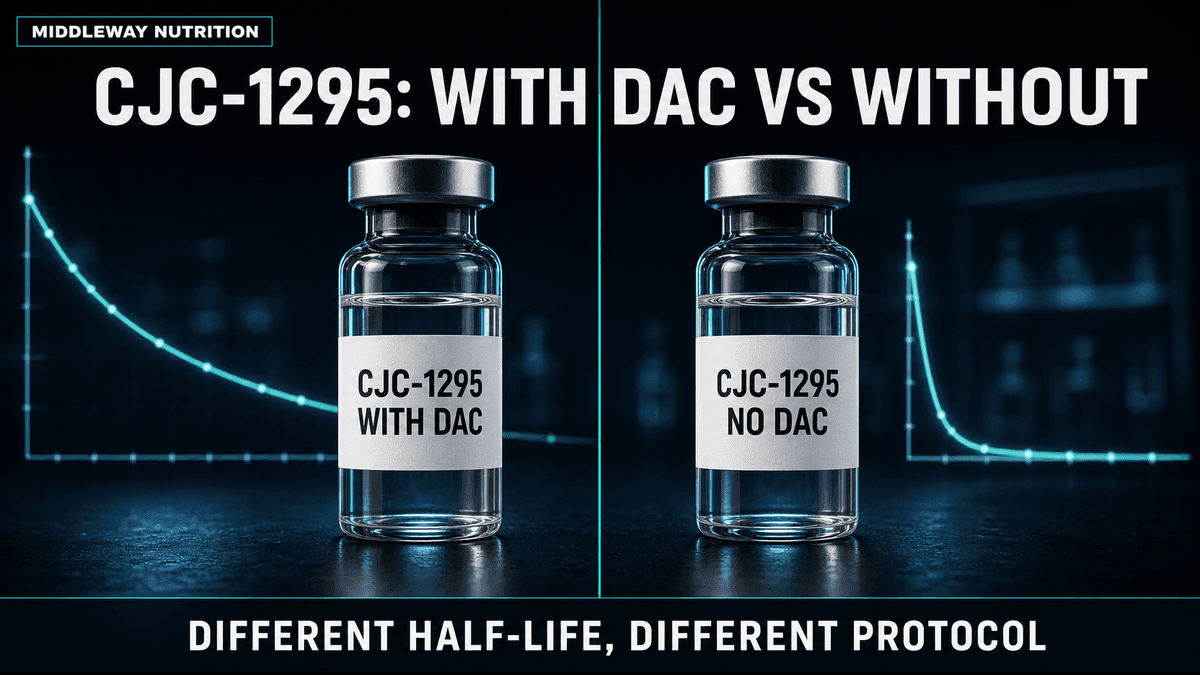
The biggest practical fork is whether the peptide carries a Drug Affinity Complex (DAC). DAC is a chemical group that binds to circulating albumin, which shields the peptide from clearance and stretches its half-life to roughly six to eight days. The version without DAC, usually sold as "modified GRF 1-29" or "CJC-1295 no-DAC," clears in around thirty minutes and produces a short GH pulse rather than a sustained elevation [2].
| Feature | CJC-1295 with DAC | Modified GRF 1-29 (no-DAC) |
|---|---|---|
| Half-life | ~6-8 days | ~30 minutes |
| GH effect | Sustained "bleed" of GH | Sharp, short pulse |
| Backbone | GRF 1-29 + DAC | GRF 1-29 |
| Dosing rhythm marketed | Weekly-ish | Multiple times daily |
| Tradeoff | Less physiological, more accumulation | Closer to natural pulsing |
Neither version restores the natural pulsatile pattern of GH release perfectly, and the sustained DAC version in particular keeps GH elevated in a way the body does not normally produce. That non-physiological profile is part of why regulators and anti-doping bodies treat these compounds cautiously.
What does the human evidence actually show?
Honestly, it is thin. The pivotal human study is Teichman and colleagues, published in the Journal of Clinical Endocrinology and Metabolism in 2006. In healthy adults, single CJC-1295 (DAC) injections raised plasma GH roughly two- to ten-fold for up to six days and IGF-1 about 1.5- to three-fold for nine to eleven days, and it was reasonably tolerated at the doses tested [1]. A companion analysis tracked changes in the serum protein profile after dosing [2].
That is essentially the human dataset. There are no long-term outcome trials, no randomized controlled trials measuring muscle mass, strength, fat loss, recovery speed, or injury healing in people. The documented effect is endocrine: the compound moves GH and IGF-1 on a lab report. Every claim about visible body-composition change, dramatic recovery, or anti-aging is extrapolation from those biomarkers, not a measured outcome. Biomarker movement and a transformed physique are not the same thing, and the gap between them is where most marketing lives. If you want a broader view of this category, our guide to the best growth hormone secretagogues puts CJC-1295 next to its alternatives.
How is CJC-1295 different from tesamorelin?
This comparison exposes the evidence gap clearly. Tesamorelin is also a GHRH analogue, but it is FDA-approved, sold as Egrifta, and was cleared in 2010 to reduce excess visceral abdominal fat in adults with HIV-associated lipodystrophy. Its approval rests on phase 3 trials in which it reduced visceral fat by roughly 15 percent versus placebo over 26 weeks [3]. CJC-1295 has nothing comparable: no approval, no indication, no phase 3 program. Both raise GH through the same receptor, but one has a regulated identity and one is sold as a research chemical. For how injectable secretagogues stack up against oral options, see our breakdown of MK-677 versus injectable secretagogues.
Is CJC-1295 FDA-approved or legal?
No. CJC-1295 is not approved by the FDA for any condition, and vials are routinely sold labeled "for research use only, not for human consumption," which is the grey-market workaround that keeps sellers at arm's length from drug law. In 2023 the FDA placed CJC-1295, along with a group of other peptides, into Category 2 of its interim 503A bulk drug substances list, the bucket for substances that "may present significant safety risks," which meant compounding pharmacies could not lawfully prepare it [4]. The regulatory picture has continued to shift into 2026, but the key point holds: reclassification governs compounding legality, not whether a drug is proven safe and effective. None of these moves give CJC-1295 FDA approval, validated dosing, or established benefit-risk data. If you are weighing supervised options, our overview of peptide therapy explains what regulated care actually involves.
Is CJC-1295 banned in sport?
Yes. The World Anti-Doping Agency prohibits GHRH and its analogues, along with GH secretagogues and GH-releasing peptides, under category S2 at all times, in and out of competition [5]. Any tested athlete using CJC-1295 is risking a doping violation, and the compound's long half-life with DAC means it can remain detectable or active for an extended window.
What are the safety concerns?
The risks fall into two buckets. The first is biological. Pushing GH and IGF-1 above their normal range is not free: it can cause water retention, joint aches, tingling, and insulin resistance, and chronically elevated IGF-1 carries theoretical concern around cell proliferation, which is why people with a history of cancer are generally steered away. The FDA's own review of these peptides also flagged cardiac and immunogenicity concerns [4].
The second bucket is the product itself. Because CJC-1295 trades in an unregulated supply chain, what is in the vial is not guaranteed. Purity, sterility, accurate dosing, and label honesty all vary, and a cheap vial changes the risk equation in ways no protocol can fix. For more on this, see our piece on peptide safety and side effects. Our guide to buying CJC-1295 covers vial sizes and how to verify a supplier's paperwork.
Who should slow down before using it?
Anyone with a personal or strong family history of cancer, anyone with insulin resistance or diabetes, anyone unwilling to run baseline and follow-up bloodwork (IGF-1, fasting glucose, HbA1c), and tested athletes. Beyond that, anyone with vague goals: CJC-1295 is an endocrine tool, not a substitute for training, calories, and sleep, and it will not rescue a weak plan. The most defensible use case is a disciplined person who monitors closely and understands they are buying a modest, unproven endocrine nudge, not a transformation.
Frequently Asked Questions
Does CJC-1295 build muscle?
There is no human trial showing CJC-1295 increases muscle mass or strength. It reliably raises GH and IGF-1 on bloodwork [1], and those hormones support an anabolic environment, but the leap from a biomarker change to visible muscle is unproven in people.
Is CJC-1295 the same as sermorelin?
They share the GRF 1-29 backbone, but CJC-1295 carries amino-acid modifications (and, in the DAC version, an albumin-binding group) that make it far longer-acting than sermorelin, which clears within minutes [2].
How long does CJC-1295 stay in your system?
The DAC version has a half-life of roughly six to eight days, so it can remain biologically active for over a week. Modified GRF 1-29 without DAC clears in about thirty minutes [2].
Is CJC-1295 legal to buy?
It is sold as a research chemical rather than an approved drug, and it is not FDA-approved for human use. It has also been flagged by the FDA for compounding safety concerns and is banned in tested sport by WADA [4][5].
References
- Teichman SL, Neale A, Lawrence B, Gagnon C, Castaigne JP, Frohman LA. Prolonged stimulation of growth hormone (GH) and insulin-like growth factor I secretion by CJC-1295, a long-acting analog of GH-releasing hormone, in healthy adults. J Clin Endocrinol Metab. 2006;91(3):799-805. https://pubmed.ncbi.nlm.nih.gov/16352683/
- Ionescu M, Frohman LA. Activation of the GH/IGF-1 axis by CJC-1295, a long-acting GHRH analog, results in serum protein profile changes in normal adult subjects. PMC2787983. https://pmc.ncbi.nlm.nih.gov/articles/PMC2787983/
- U.S. Food and Drug Administration. Tesamorelin (Egrifta) approval and labeling information, Drugs@FDA. https://www.accessdata.fda.gov/scripts/cder/daf/index.cfm
- U.S. Food and Drug Administration. Certain Bulk Drug Substances for Use in Compounding That May Present Significant Safety Risks. https://www.fda.gov/drugs/human-drug-compounding/certain-bulk-drug-substances-use-compounding-may-present-significant-safety-risks
- World Anti-Doping Agency. The Prohibited List (S2: Peptide Hormones, Growth Factors, Related Substances and Mimetics). https://www.wada-ama.org/en/prohibited-list
This article is for educational purposes only and is not medical advice; talk to a qualified clinician before using any peptide.