Dizziness on GLP-1 medication has several possible causes, so the pattern matters.
Short answer: Feeling dizzy or lightheaded on a GLP-1 can come from dehydration, low intake, vomiting or diarrhea, lower blood pressure, low blood sugar risk with diabetes medications, rapid weight loss, or unrelated vertigo. Dizziness is a labeled adverse reaction: 8% on Wegovy versus 4% on placebo, and 4% to 5% on Zepbound versus 2%.
Can GLP-1 Medications Cause Dizziness?
Yes. Dizziness is listed in the adverse reactions tables of the two most-prescribed GLP-1s, at roughly twice the placebo rate.
| Drug | Dizziness on drug | Dizziness on placebo |
|---|---|---|
| Wegovy (semaglutide 2.4 mg) | 8% | 4% |
| Zepbound (tirzepatide 5 mg / 10 mg / 15 mg) | 4% / 5% / 4% | 2% |
| Ozempic (semaglutide, type 2 diabetes) | Listed among adverse reactions occurring at a frequency above 0.4%; no table percentage published | Not tabulated |
So dizziness is real and expected in a minority of people. On its own it is not proof that something has gone wrong. What matters is which mechanism is producing it, because the fix is different for each one.
| Mechanism | What it usually feels like | What points to it |
|---|---|---|
| Volume depletion from nausea, vomiting, or diarrhea | Woozy, dry mouth, dark urine, worse on standing | Symptoms track with a bad GI day |
| Lower blood pressure | Lightheaded on standing, vision greys out for a second | Home readings lower than before treatment |
| Low blood sugar | Shaky, sweaty, hungry, better within about 15 minutes of carbohydrate | Realistically only with insulin or a sulfonylurea |
| Under-eating | Weak, foggy, worse late in the day | Appetite is gone and intake dropped sharply |
| Inner-ear vertigo | The room spins or tilts, often triggered by head position | Spinning, not faintness |
The semaglutide and tirzepatide labels both carry postmarketing reports of acute kidney injury, in some cases requiring hemodialysis, with the majority of those events occurring in people who had nausea, vomiting, or diarrhea severe enough to cause dehydration. That is why hydration is the first thing to check rather than the last.
What to Check First
| Check | Why it matters |
|---|---|
| Fluids | Appetite suppression can reduce thirst and drinking |
| Electrolytes | Vomiting, diarrhea, and sweating increase losses |
| Calories | Under-eating can cause weakness and lightheadedness |
| Blood sugar | Especially with insulin or sulfonylureas |
| Blood pressure | Weight loss and dehydration can lower readings |
When to Call Urgently
Seek urgent care for fainting, chest pain, shortness of breath, one-sided weakness, confusion, new severe headache, severe dehydration, irregular heartbeat, or dizziness with very low blood sugar.
Dizziness vs. Vertigo: Is the Room Spinning, or Do You Feel Faint?
"Dizzy" covers at least three different sensations, and clinicians work them up as separate problems. Being precise about which one you have changes what happens next.
| What you feel | Clinical name | Typical drivers |
|---|---|---|
| The room spins, tilts, or rotates, often set off by rolling over in bed or looking up | Vertigo | Inner-ear causes; benign paroxysmal positional vertigo (BPPV) is the most frequent cause of peripheral vertigo and accounts for more than half of cases |
| Faint, woozy, greying vision, like you might pass out | Presyncope, usually described as feeling lightheaded | Dehydration, low blood pressure, low blood sugar, low intake |
| Unsteady on your feet while the room stays still | Disequilibrium | Muscle loss, neuropathy, vision, balance |
Here is the part that matters for this page: vertigo is not a listed adverse reaction on the semaglutide labels (Wegovy, Ozempic) or the tirzepatide label (Zepbound). Dizziness is. If what you have is true spinning vertigo, the GLP-1 is not the obvious explanation, and the sensible move is to get the inner ear evaluated rather than assume the medication is at fault.
That does not make the two unrelated in practice. Dehydration, under-eating, and a drop in blood pressure can all make an existing vestibular problem feel worse, and a first BPPV episode can coincide with starting a GLP-1 purely by timing. The distinction still decides the response: rehydrating fixes presyncope and does nothing for BPPV, which is treated with positional maneuvers.
Dizzy and Lightheaded When You Stand Up
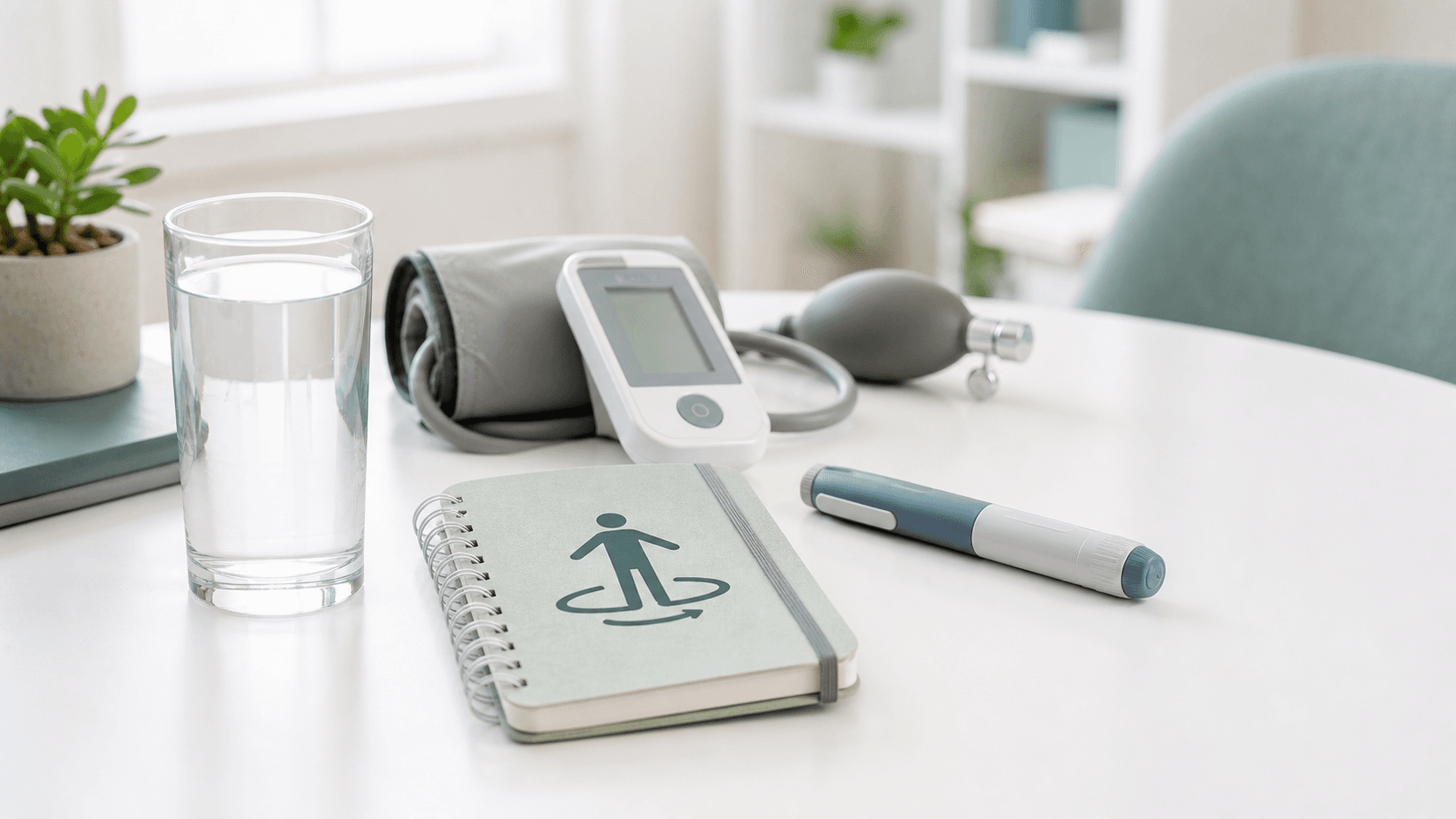
Standing-up dizziness is the most recognizable pattern on a GLP-1, and it has a formal definition. Orthostatic hypotension is a sustained drop of at least 20 mmHg systolic or 10 mmHg diastolic within three minutes of standing after at least five minutes lying down. A home cuff can catch it: take a reading after lying down, stand up, then read again at one minute and three minutes.
Two things push in that direction at the same time on GLP-1 treatment.
Fluid. Appetite suppression cuts drinking as well as eating, and nausea, vomiting, or diarrhea add losses on top of that. Zepbound's label states that hypotension also occurred in association with gastrointestinal adverse events and dehydration.
Blood pressure itself. Weight loss lowers blood pressure, and the trial data show how much.
| Trial arm | Mean systolic BP change from baseline |
|---|---|
| Wegovy 2.4 mg (label Study 2) | −6.2 mmHg |
| Placebo, same trial | −1.1 mmHg |
| Zepbound 5 / 10 / 15 mg (label Study 1) | −6.6 / −7.7 / −7.4 mmHg |
| Placebo, same trial | −1.0 mmHg |
For most people that is a benefit. For someone already taking an antihypertensive or a diuretic, it can stack. Diuretics, alpha-blockers, antihypertensives, and nitrates are recognized contributors to orthostatic hypotension, and the total number of antihypertensive medications a person takes predicts it better than any single drug class does.
The labels put hypotension-type reactions in the low single digits. Hypotension, orthostatic hypotension, and decreased blood pressure were reported in 1.3% of Wegovy-treated adults versus 0.4% on placebo, with syncope in 0.8% versus 0.2%. Zepbound reported hypotension in 1.6% versus 0.1% on placebo. Uncommon, but not rare enough to dismiss when the pattern fits.
The practical version: if you get dizzy specifically in the first seconds after standing, rise slowly, fix fluids first, and ask the prescriber whether your blood pressure medication doses still match your current weight and intake. Do not stop or change a blood pressure drug on your own.
Internal Reading Path
FAQ
Is dizziness a normal GLP-1 side effect?
It can happen, but it should be interpreted in context: hydration, food, glucose, blood pressure, and other medications.
Can a GLP-1 make you dizzy?
Yes, and the labels quantify it: 8% on Wegovy against 4% on placebo, and 4% to 5% across Zepbound doses against 2%. Most of that traces back to fluid, food, blood pressure, or blood sugar rather than a direct effect on the brain, which is why the first response is checking those four rather than stopping the drug.
Can GLP-1 drugs cause vertigo?
True spinning vertigo is not a listed adverse reaction on the semaglutide or tirzepatide labels. Dizziness is. Spinning that starts when you roll over, lie back, or tip your head up looks much more like BPPV, the most common cause of peripheral vertigo, and that needs an inner-ear assessment rather than a dose change.
Why am I dizzy when I stand up?
That pattern points at volume and blood pressure. Check fluid intake over the last 24 hours, check whether a bad GI day preceded it, and measure blood pressure lying and then standing at one and three minutes. A drop of 20 mmHg systolic or 10 mmHg diastolic within three minutes is the clinical threshold worth reporting to the prescriber.
Is lightheadedness worse after a dose increase?
Symptoms commonly cluster around starting treatment and around escalation, which is also when GI losses and appetite suppression are changing fastest. The labels for both semaglutide and tirzepatide direct clinicians to monitor kidney function when initiating or escalating in patients reporting severe GI reactions, for the same underlying reason.
Should I skip my next dose?
Ask the prescriber. Do not make restart or escalation decisions alone if dizziness is significant.
Can electrolytes help?
They may help if fluid or electrolyte intake is low, but dizziness has many causes and may need evaluation.
Why This Symptom Can Happen on GLP-1 Treatment
GLP-1 Dizziness: Lightheadedness, Hydration, Blood Sugar, and Red Flags usually needs to be understood in the context of delayed gastric emptying, appetite suppression, dose escalation, lower food intake, hydration changes, and other medications. GLP-1 and GIP/GLP-1 drugs can change how quickly food moves, how full someone feels, and how much they naturally eat or drink. Dizziness is a recognized adverse effect of GLP-1 receptor agonists, and it often tracks with dehydration from nausea, vomiting, or diarrhea, or with low blood sugar when the drug is combined with insulin or a sulfonylurea. Those changes can improve weight and glucose outcomes, but they can also create side effects when the dose, meal pattern, or hydration plan is not matched to the person's tolerance.
Symptoms often show up during the first few weeks or after a dose increase. They can also appear after a large meal, high-fat meal, alcohol, dehydration, constipation, or a long gap between meals. The timing is useful because it helps a clinician decide whether the symptom is likely dose-related, food-pattern related, or possibly unrelated to the medication.
First 24 to 48 Hours: What to Track
A useful symptom log does not need to be complicated. Record the dose date, dose strength, meals, fluids, bowel movements, alcohol, caffeine, exercise, and any other medications. Include severity from 1 to 10 and whether the symptom affects eating, drinking, sleeping, work, or exercise.
| Track this | Why it helps |
|---|---|
| Dose timing | Symptoms may peak after injection or escalation |
| Meal size and fat content | Large or greasy meals often worsen GI symptoms |
| Fluid intake | Dehydration can worsen headache, dizziness, constipation, and palpitations |
| Bowel pattern | Constipation can drive bloating, reflux, and abdominal pain |
| Blood sugar, if diabetic | Low or high glucose can mimic other symptoms |
| Red flags | Severe, persistent, or systemic symptoms need care |
The GLP-1 "Crash": Under-Eating, Dehydration, and Brain Fog
"Crash" is not a label term, but the pattern readers describe is consistent enough to name: mid-afternoon, hours since the last real meal, dizzy and light-headed, foggy, and no appetite to correct it with. It is usually arithmetic rather than pharmacology. Appetite suppression works, intake falls faster than anyone planned, fluid falls with it, and the day ends up run on far too little food and water.
Fatigue is on the labels at roughly double placebo: 11% versus 5% for Wegovy, and 5% to 7% across Zepbound doses versus 3%. Brain fog is not a labeled adverse reaction and was not quantified in these trials, so treat any specific number attached to it with suspicion. Intake, fluid, and blood glucose can all be measured, and that is usually where a crash pattern gets resolved.
| If the crash pattern is | Try first |
|---|---|
| Long gaps between meals | Anchor protein at fixed times instead of waiting for hunger |
| Very low total intake | Count one day honestly; appetite is no longer a reliable gauge |
| Low fluid | Drink on a schedule rather than to thirst |
| Diabetes medication in the mix | Check glucose during an episode instead of guessing |
If you take insulin or a sulfonylurea, dizziness with sweating, shakiness, or hunger should be treated as possible hypoglycemia and confirmed with a meter, not assumed. In Zepbound's trial data, hypoglycemia occurred in 10.3% of patients taking the drug alongside an insulin secretagogue such as a sulfonylurea, versus 2.1% of Zepbound-treated patients who were not. Wegovy's label advises considering a dose reduction of insulin or an insulin secretagogue when starting treatment. That is a prescriber decision, not a self-adjustment.
Dose Escalation Questions
Many side effects become more disruptive when the dose is increased before the previous dose feels stable. Before moving up, it is reasonable to ask whether symptoms are mild and improving, whether protein and fluids are adequate, whether constipation is controlled, and whether work or daily function is being affected.
Do not adjust the dose independently. The practical question for the prescriber is whether to hold the current dose longer, step down, treat the symptom, review meal timing, or evaluate another cause.
Questions to Bring to the Prescriber or Pharmacist
- Does my current dose and timing match the official label or my prescription?
- Are my symptoms or concerns expected at this stage, or do they suggest changing the plan?
- Should I delay escalation, restart lower, hold steady, or be evaluated before continuing?
- Are any of my other medications increasing risk, especially insulin, sulfonylureas, blood pressure medication, diuretics, or drugs affected by delayed gastric emptying?
- What exact symptoms should make me call urgently or seek same-day care?
- If cost or supply interrupts therapy, what is the safest backup plan?
Bottom Line for GLP-1 Dizziness: Lightheadedness, Hydration, Blood Sugar, and Red Flags
The practical answer is rarely just one number, food list, or yes-or-no rule. For GLP 1 dizziness, the safest approach is to combine the direct answer with the variables that change it: product type, dose, timing, side effects, storage history, other medications, and the person's medical context. When those variables are unclear, the best next step is to ask the prescriber or pharmacist before acting.
Additional Scenarios Readers Commonly Compare
| Scenario | How to think about it |
|---|---|
| Symptoms started after a dose increase | Treat escalation as a likely contributor and ask whether to hold the dose longer |
| The plan changed because of supply | Confirm whether a restart or lower dose is safer after the gap |
| Advice online conflicts with the label | Use the label, pharmacy, and prescriber as the authority |
| The medication is compounded | Verify concentration, BUD, storage, sterility, and dose instructions directly with the pharmacy |
| The goal is maintenance | Prioritize sustainable intake, resistance training, monitoring, and follow-up |
| Dizzy only in the first seconds after standing | Work the orthostatic angle: fluids, GI losses, and blood pressure medication doses |
| The room actually spins | Treat it as a possible inner-ear problem rather than a dose problem |
More FAQ
Why do different websites give different answers?
Most differences come from assuming different products, concentrations, patient goals, dose histories, or risk tolerance. A chart or tip can be mathematically correct but still wrong for a specific prescription.
What can you do when a GLP-1 makes you dizzy at work or while driving?
Stop driving and pull over if it happens behind the wheel. Sit or lie down until it passes, take fluid, and eat something if the last meal was hours ago. Check glucose if you use insulin or a sulfonylurea. Log what preceded it, since the trigger is usually visible in the previous 24 hours of food, fluid, GI symptoms, and dose timing. Recurrent episodes that interfere with work or driving are a reason to contact the prescriber, not to push through.
Should I check my blood pressure at home?
It is one of the few things you can measure yourself that changes the answer. Compare a seated reading against a standing reading at one and three minutes, and compare current numbers against what they were before treatment. If systolic drops 20 mmHg or diastolic drops 10 mmHg on standing, or if resting readings have fallen well below target while you are still on the same antihypertensive dose, bring both to the prescriber.
What information should I keep in my notes?
Keep the medication name, dose, date taken, pharmacy label, concentration if vial-based, side effects, food and fluid changes, weight trend, and any clinician instructions. This makes follow-up safer and more specific.
When is it better not to troubleshoot at home?
Do not troubleshoot at home when symptoms are severe, rapidly worsening, involve chest pain or fainting, include repeated vomiting or dehydration, suggest allergic reaction, or involve a possible dosing or storage error.
Quick Self-Check Before Acting
Before making a decision based on GLP 1 dizziness, pause long enough to confirm the basics: exact medication, dose, date of last dose, product form, storage history if relevant, current symptoms, and any other medications that could change risk. Most GLP-1 mistakes happen when one of those details is assumed instead of verified.
If the question involves dosing, switching, storage, severe symptoms, pregnancy planning, surgery, diabetes medication, or a compounded vial, treat the article as preparation for a clinician or pharmacist conversation. The safest next step is often not to act faster. It is to bring better information to the person who can make the decision with you.
| Detail to confirm | Why it matters |
|---|---|
| Medication and form | Pens, tablets, branded vials, and compounded vials have different rules |
| Current dose | Dose history changes tolerance and restart decisions |
| Timing | Missed doses, gaps, and dose increases change the plan |
| Symptoms | Severity decides whether this is routine or urgent |
| Storage or expiration | Product reliability depends on label and pharmacy rules |
| Other medications | Insulin, sulfonylureas, blood pressure drugs, and diuretics can change risk |
Summary
GLP-1 dizziness is often related to intake, hydration, blood pressure, or glucose. Dizziness sits on the labels at 8% versus 4% on placebo for Wegovy and 4% to 5% versus 2% for Zepbound, so it is common enough to expect and specific enough to work through. Feeling lightheaded on standing points at fluid and blood pressure; true spinning vertigo points at the inner ear. Fainting, chest symptoms, neurologic symptoms, or severe dehydration are urgent.
References
- Glucagon-Like Peptide-1 Receptor Agonists — StatPearls, NCBI Bookshelf (lists dizziness, nausea, vomiting, diarrhea as adverse effects; delayed gastric emptying mechanism)
- Consequences of Alcohol Use in Diabetics — National Institutes of Health (PMC), on alcohol, hypoglycemia, and impaired hepatic glucose release
- WEGOVY (semaglutide) injection — FDA prescribing information via DailyMed (dizziness 8% vs 4% placebo; fatigue 11% vs 5%; hypotension-related reactions 1.3% vs 0.4%; syncope 0.8% vs 0.2%; systolic blood pressure change; insulin secretagogue dose reduction)
- ZEPBOUND (tirzepatide) injection — FDA prescribing information via DailyMed (dizziness 4-5% vs 2% placebo; fatigue 5-7% vs 3%; hypotension 1.6% vs 0.1%; hypoglycemia 10.3% vs 2.1% with an insulin secretagogue; acute kidney injury after dehydration)
- OZEMPIC (semaglutide) injection — FDA prescribing information via DailyMed (dizziness listed among adverse reactions occurring above 0.4% frequency; acute kidney injury reports following dehydration)
- Orthostatic Hypotension — StatPearls, NCBI Bookshelf (20 mmHg systolic or 10 mmHg diastolic drop within 3 minutes of standing; volume depletion and antihypertensive drugs as causes)
- Benign Paroxysmal Positional Vertigo — StatPearls, NCBI Bookshelf (vertigo defined as perceived spinning; BPPV is the most frequent cause of peripheral vertigo, more than half of cases)