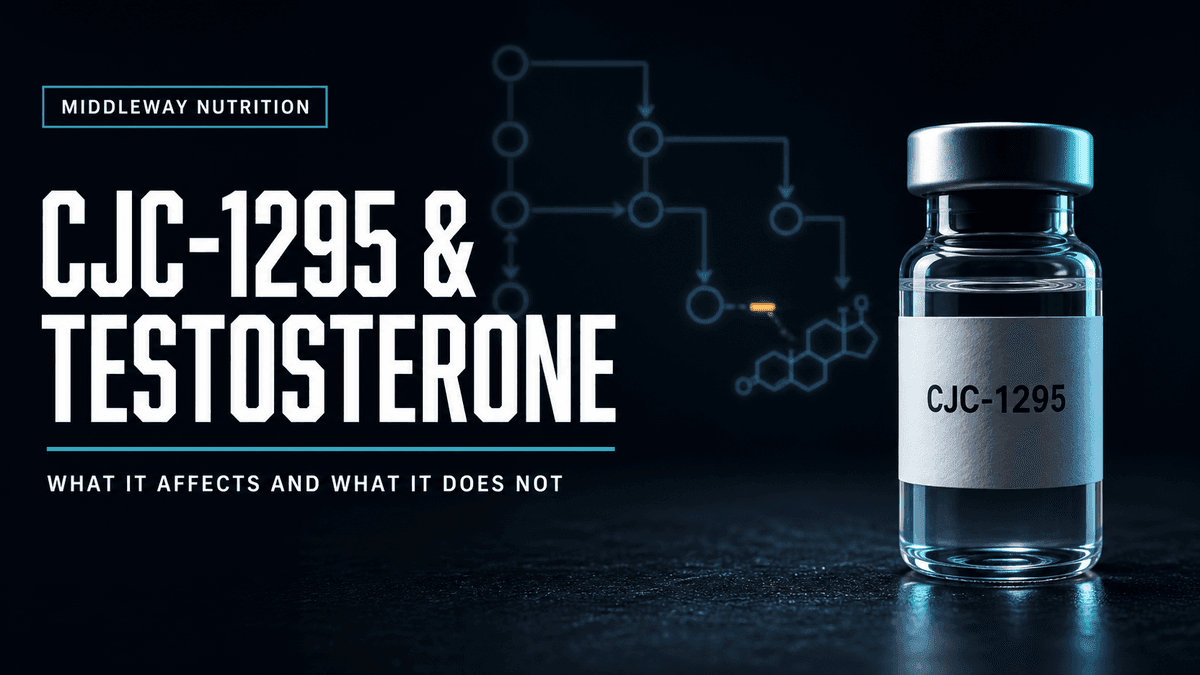
CJC-1295 & Testosterone operate on separate hormonal axes, and CJC-1295 does not raise testosterone directly. Anyone researching CJC-1295 & Testosterone will find claims that it does, and those claims are wrong on the mechanism: CJC-1295 is a GHRH analog acting on pituitary somatotroph cells, while testosterone production runs through a different pituitary output entirely.
The indirect connections are real. They are also modest, slow, and dependent on conditions that may not apply to you.
CJC-1295 & Testosterone: The Two Axes Involved
The pituitary is a single gland producing several different hormones from different cell types.
The somatotropic axis: the hypothalamus releases GHRH, somatotrophs release growth hormone, and the liver produces IGF-1 in response. This is where CJC-1295 acts.
The gonadal axis: the hypothalamus releases GnRH in pulses, gonadotrophs release LH and FSH, and LH stimulates Leydig cells in the testes to make testosterone. This is where hCG, gonadorelin and clomiphene-type compounds act.
CJC-1295 binds the GHRH receptor. It has no meaningful affinity for the GnRH receptor and does not stimulate LH release. That is the mechanistic reason the direct answer is no.
The Indirect Links That Are Actually Plausible
Three connections have reasonable physiological support. None of them is large.
Sleep quality. Testosterone is largely produced during sleep, and total sleep time and quality track with morning testosterone. GHRH signalling is tied to slow-wave sleep, so anything that genuinely deepens sleep can plausibly improve testosterone output. The chain has several steps and each one weakens the effect.
Body fat. Adipose tissue expresses aromatase, which converts testosterone to oestradiol, so higher body fat generally means lower free testosterone in men. GH stimulation promotes lipolysis. Over months, a meaningful reduction in fat mass can improve the testosterone picture. The active ingredient in that chain is fat loss, not CJC-1295 specifically.
GH deficiency states. In people with genuine growth hormone deficiency, GH replacement is recognised to interact with gonadal function and can improve responsiveness to gonadotropin treatment. That is a clinical observation in a deficient population, not a reason to expect testosterone gains in a healthy adult.
What CJC-1295 Will Not Do
It will not treat hypogonadism. If total testosterone is genuinely low with symptoms, that requires proper evaluation, not a GH secretagogue.
It will not restart natural production after suppression from anabolic steroids or exogenous testosterone. That is an LH and FSH problem, and CJC-1295 does not touch either.
It will not raise LH. Any product marketed as doing both growth hormone and testosterone through a single peptide is describing something that does not exist.
What Actually Targets Testosterone
| Compound | Acts on | Raises LH? | Notes |
|---|---|---|---|
| CJC-1295 | GHRH receptor | No | Growth hormone axis only |
| hCG | LH receptor directly | Bypasses LH | Stimulates Leydig cells directly, used to maintain testicular function |
| Gonadorelin | GnRH receptor | Yes, if pulsatile | Short half-life, needs frequent dosing to mimic natural pulses |
| Clomiphene and enclomiphene | Oestrogen receptor in the hypothalamus | Yes | Oral, works by removing negative feedback |
| Testosterone therapy | Supplies the hormone | Suppresses it | Effective and suppressive at the same time |
If testosterone is the actual goal, these are the relevant categories. Our hCG guide covers the most commonly used of them.
Does the Ipamorelin Pairing Change Anything?
Slightly, and for a reason worth understanding. Older ghrelin-pathway peptides such as GHRP-2 and GHRP-6 raise cortisol and prolactin alongside growth hormone. Both work against testosterone: cortisol opposes it directly and elevated prolactin suppresses gonadotropin release.
Ipamorelin was selected for its lack of those off-target effects, which is why it is the usual pairing. So the argument is not that the combination raises testosterone; it is that it avoids a suppressive effect the alternatives carry. That is a real distinction, and it is a much weaker claim than the one usually made.
Why the Claim Keeps Circulating
Two things keep this idea alive despite the mechanism being clear.
The first is symptom overlap. Low growth hormone output and low testosterone produce a similar list of complaints: fatigue, poor recovery, creeping body fat, reduced drive. Someone who feels better on a GH secretagogue reasonably concludes that their testosterone must have improved, when what improved was a different axis producing overlapping symptoms.
The second is that both are sold by the same clinics to the same customers. A protocol combining a GH secretagogue with something that genuinely acts on the gonadal axis will produce testosterone changes, and the credit is easily assigned to the wrong component.
Neither is dishonest, and both are avoidable with a blood test.
What to Expect Realistically
If you are a man in your forties or older with poor sleep and meaningful excess body fat, a GH secretagogue that improves both over six months could plausibly leave testosterone slightly higher than it started. The mechanism is legitimate but indirect, and the effect will be small relative to what fixing sleep and losing fat would achieve on their own.
If you are lean, sleeping well and have normal testosterone, expect nothing on that front.
If your testosterone is genuinely low, this is the wrong tool, and using it delays a proper workup that would identify why.
The useful step in every case is measurement: total and free testosterone, LH, FSH and SHBG give a clear picture, and a repeat after a few months shows whether anything actually moved. Without those numbers, any conclusion is guesswork.
For related reading, see the CJC-1295 guide, the ipamorelin guide and our growth hormone secretagogue comparison. Vial sizes and current vendor pricing are in our CJC-1295 for sale roundup. If you are weighing up sources, our guide on where to buy CJC-1295 covers vendor checks, certificate red flags and what to expect from a legitimate seller.
Frequently Asked Questions
Does CJC-1295 increase testosterone?
Not directly. It binds the GHRH receptor and stimulates growth hormone, which is a separate pathway from the GnRH, LH and testosterone axis. Any change in testosterone from using it comes indirectly through better sleep and reduced body fat, and that effect is small and slow.
Will CJC-1295 suppress testosterone?
There is no evidence that it does. It does not act on the gonadal axis in either direction, unlike exogenous testosterone, which reliably suppresses natural production. The main caveat is that ghrelin-pathway peptides other than ipamorelin can raise cortisol and prolactin, both of which work against testosterone.
Can CJC-1295 be used alongside TRT?
They act on different systems, so there is no direct pharmacological conflict, and some clinicians use GH secretagogues alongside testosterone therapy. Both affect body composition and fluid balance, so effects can compound, and anyone on prescribed testosterone should raise it with the prescriber rather than adding compounds independently.
Does CJC-1295 help with libido?
Not through testosterone. Where people report improvement, better sleep and reduced body fat are the plausible explanations, both of which affect libido on their own. If low libido is the primary concern, a proper hormone panel is a far more useful first step than a GH secretagogue.
Is there a peptide that raises both growth hormone and testosterone?
No single compound does both well, because the receptors and pathways are separate. Some protocols combine a GHRH analog with something acting on the gonadal axis, such as hCG or gonadorelin, but that is two compounds doing two jobs rather than one doing both.