GLP-1 Benefits Beyond Weight Loss: 13 Conditions With Real Evidence
The growing pile of trial data is what makes endocrinologists describe GLP-1 receptor agonists as the most consequential drug class of the decade. As of 2026, the FDA has approved a GLP-1 for type 2 diabetes, cardiovascular disease, chronic kidney disease, obstructive sleep apnea, and metabolic dysfunction-associated steatohepatitis (MASH). Strong evidence is building for Alzheimer's, addiction, PCOS, asthma, COVID-19 outcomes, fertility, knee osteoarthritis, and cancer prevention. Some of the benefits track with weight loss; some don't. Both kinds matter.
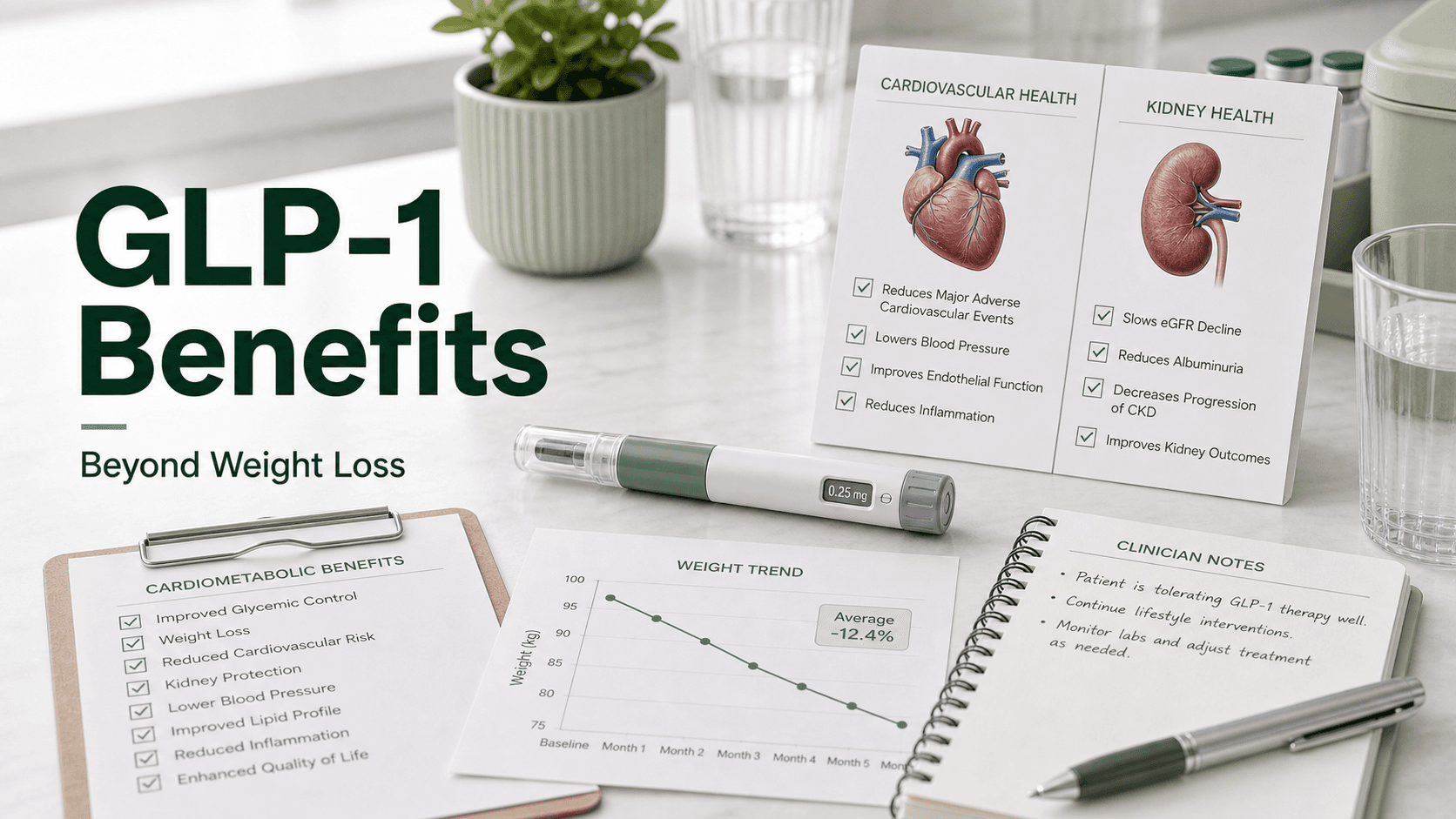
Direct answer: Beyond weight loss, GLP-1s have FDA-approved indications for type 2 diabetes, cardiovascular disease (semaglutide, March 2024), chronic kidney disease in T2D (semaglutide, January 2025), obstructive sleep apnea (tirzepatide, December 2024), and MASH (semaglutide, August 2025). Active trials and large observational data support additional benefits for Alzheimer's disease, addiction (alcohol, opioid, nicotine), PCOS, fertility, asthma, COVID-19 outcomes, knee osteoarthritis, and several cancers. Some benefits (heart, kidney, addiction) appear largely independent of weight loss.
The Confirmed (FDA-Approved) Benefits
1. Cardiovascular Disease
Semaglutide (Wegovy) was FDA approved in March 2024 to reduce major adverse cardiovascular events in adults with overweight/obesity and existing cardiovascular disease.
The SELECT trial (NEJM, November 2023):
- 17,604 patients randomized to semaglutide or placebo
- Primary cardiovascular endpoint: heart attack, stroke, or CV death
- 6.5% of semaglutide patients hit the endpoint
- 8.0% of placebo patients hit the endpoint
- ~20% relative risk reduction
The benefit appeared partly weight-independent — analyses show direct effects on vascular inflammation, blood pressure, and lipids.
2. Chronic Kidney Disease
Semaglutide was FDA approved in January 2025 to reduce kidney disease progression in adults with type 2 diabetes and CKD.
The FLOW trial:
- 3,500+ patients with T2D and CKD
- Primary endpoint: major kidney events (kidney failure, sustained ≥50% loss of kidney function, kidney/CV death)
- 24% reduction in major kidney events
- Critically, benefit was independent of weight loss
3. Obstructive Sleep Apnea
Tirzepatide (Zepbound) was FDA approved in December 2024 for moderate-to-severe OSA in adults with obesity.
The SURMOUNT-OSA trial:
- 469 participants with moderate-to-severe OSA and BMI ≥30
- AHI reduction with tirzepatide off CPAP: −25 events/hour
- AHI reduction with tirzepatide on CPAP: −29 events/hour
- 42–50% of patients reached remission or only mild OSA at one year
- Average weight loss: 18% (off CPAP), 20% (on CPAP)
4. MASH (Metabolic Dysfunction-Associated Steatohepatitis)
Semaglutide was FDA approved in August 2025 for MASH (the inflammatory form of fatty liver disease).
- 63.9% of semaglutide patients showed liver inflammation improvement without worsening fibrosis
- 34.3% of placebo patients showed the same
- In an HIV-specific study, liver fat decreased 31% in six months on semaglutide
Retatrutide Phase 2 showed ~90% liver fat reduction — pending Phase 3 confirmation.
5. Type 2 Diabetes
The original indication. All GLP-1 receptor agonists improve A1C by roughly 1–2 percentage points. They are now first- or second-line therapy in most diabetes guidelines, ahead of sulfonylureas.
Strong-but-Emerging Benefits
6. Alzheimer's and Dementia
Mixed evidence — but some encouraging signals.
Real-world observational data:
- 2024 analysis of 100+ million US patient records associated Ozempic with lower cognitive problem risk
- VA database study of 2.5 million patients showed GLP-1 users developed dementia at lower rates than those on other diabetes drugs
- Nature Medicine analysis of 2 million+ patients (215,000+ on GLP-1) through December 2023 showed decreased risk of neurocognitive conditions
Randomized trials:
- ELAD study (liraglutide, 204 mild AD patients): 50% reduction in tissue loss in memory regions, 18% slower decline in thinking skills
- EVOKE / EVOKE+ (semaglutide, ~1,800 early-stage AD patients): Phase 3, Novo Nordisk reported in 2025 that these trials did not show a significant difference in cognitive decline after three years
Net: real-world data is favorable; the controlled Phase 3 data has been negative. Some researchers argue GLP-1s may need to be started earlier — before clinical symptoms — to show benefit.
Mechanism (proposed): clearance of amyloid plaques and tau, reduced brain inflammation, restored brain glucose metabolism, neuroprotection.
7. Addiction (Alcohol, Opioid, Nicotine, Cocaine)
GLP-1 receptors exist in brain reward areas (VTA, nucleus accumbens). Effects:
- Study of 600,000+ US veterans with T2D: GLP-1 use associated with 14% lower overall risk of developing alcohol, cannabis, cocaine, nicotine, and opioid use disorders
- JAMA Psychiatry 9-week semaglutide trial showed significantly reduced drinking and cravings
- Multiple Phase 2/3 trials specifically for AUD are running
8. PCOS
A 2023 Journal of Clinical Medicine study:
- Low-dose semaglutide produced significant weight loss in ~80% of obese PCOS patients who had not responded to previous treatments
- Menstrual cycles normalized in responders
- Improvements in insulin resistance and androgen levels
9. Knee Osteoarthritis
- An October 2024 study showed semaglutide patients had decreased knee osteoarthritis pain
- Medical claims analysis suggested reduced knee osteoporosis development risk
- Mechanism: less mechanical loading + anti-inflammatory effects
10. COVID-19 Outcomes
- Study of 17,000+ obese adults during COVID-19:
- GLP-1 users had 19% lower risk of death
- Fewer serious complications from COVID infection
- Mechanism: weight loss + reduced systemic inflammation + improved insulin signaling
11. Asthma
- April 2025 study of 60,000 patients: GLP-1 users showed better asthma symptom control
- No measurable spirometry improvement
- Likely anti-inflammatory mechanism
12. Cancer (Multiple Types)
- EMR data from 10.2 million type 2 diabetes patients: GLP-1 users had significantly lower risk of colon cancer
- Small 2023 study suggested semaglutide enhanced natural killer cell activity
- Dozens of clinical trials currently underway for obesity-related cancers (colon, endometrial, post-menopausal breast)
13. Fertility
- Weight loss from semaglutide linked to hormonal and insulin changes that may increase fertility in obese women
- Some evidence of increased sperm count, concentration, and motility in obese men
- Larger trials needed; current evidence mostly indirect (weight loss benefit)
Benefits Patients Notice Day-to-Day
These are not in the official label but show up consistently:
- Quieter food noise — intrusive thoughts about food drop within weeks; clinical trials show reduced reward-region brain activation to high-calorie food cues
- Less knee, hip, and back pain as weight drops
- Less reflux for many (though it can worsen for some at first)
- Better sleep quality, partly from OSA improvement
- Reduced compulsive shopping and other reward behaviors for a subset of users
- Lower interest in alcohol, fast food, hyperpalatable snacks
- Improved mood in some users — likely tied to weight loss and metabolic improvement
Benefits Visible in Routine Bloodwork
By 6–12 months on a GLP-1, most patients see:
| Lab | Typical change |
|---|---|
| A1C | -1 to -2% |
| Fasting glucose | -20 to -40 mg/dL |
| Triglycerides | -20 to -30% |
| LDL cholesterol | -5 to -10% |
| HDL cholesterol | +5 to +10% |
| ALT/AST (liver) | Often normalized |
| Blood pressure | -10 to -15 mmHg systolic |
| CRP (inflammation) | -20 to -30% |
| Uric acid | Often reduced |
Are The Benefits From Weight Loss, Or From the Drug?
The honest breakdown:
- Cardiovascular events: Independent benefit beyond weight loss (SELECT designed to show this)
- Kidney disease: Largely weight-independent (FLOW)
- Sleep apnea: Mostly from weight loss
- A1C: Mix — direct insulin effects + weight loss
- MASH: Mostly weight loss + direct effect on liver inflammation
- Blood pressure: Mostly weight loss, with some direct vascular effect
- Addiction: Looks largely independent of weight loss (brain reward pathway)
- Cognitive benefits: Mixed — observational says yes, Phase 3 trials negative
- Cancer protection: Mixed (likely both weight loss and reduced inflammation)
This matters because some benefits would not be replicable by losing weight through diet alone.
CU Anschutz obesity researcher Dr. Robert Eckel summarizes:
"The evidence is mounting to show that even people who don't experience weight loss can see benefits related to the heart, kidney and even the liver."
The Adoption Gap
Despite this evidence, fewer than 10–12% of eligible patients receive a GLP-1 medication. Among those prescribed, only about 50% continue beyond one year — largely due to cost, insufficient weight loss expectations, side effects, or injection reluctance.
What People Get Wrong About GLP-1 Benefits
- "GLP-1s cure Alzheimer's." Two large Novo Nordisk Phase 3 trials (EVOKE, EVOKE+) showed no cognitive benefit in mild Alzheimer's. The story is not closed.
- "All the benefits come from losing weight." Cardiovascular, kidney, and addiction benefits include weight-independent components.
- "You need diabetes to get the cardiovascular benefit." SELECT was specifically in non-diabetic patients with obesity + CVD.
- "Tirzepatide does everything semaglutide does, plus more." Mostly true for weight loss, but semaglutide has the published kidney and CV outcome data; tirzepatide is still building that file.
- "If I'm not losing weight, the drug isn't helping me." Many benefits accrue independent of the scale.
Frequently Asked Questions
What conditions besides obesity are GLP-1s approved for? Type 2 diabetes, cardiovascular event reduction (semaglutide, March 2024), chronic kidney disease in T2D (semaglutide, January 2025), obstructive sleep apnea (tirzepatide, December 2024), and MASH (semaglutide, August 2025).
Do GLP-1s really help the heart? Yes. Semaglutide reduced major adverse cardiovascular events by ~20% in adults with obesity and existing cardiovascular disease (SELECT trial, 17,604 patients).
Will a GLP-1 prevent dementia? The trial evidence is mixed. Observational studies suggest reduced risk, but two large Phase 3 semaglutide trials in mild cognitive impairment and early Alzheimer's were negative in 2025.
Can GLP-1s treat alcohol addiction? Probably yes, based on early trials and real-world reports — a 14% lower risk of multiple substance use disorders in veterans, and a 9-week RCT showing reduced drinking. No GLP-1 is currently FDA approved for AUD.
Do GLP-1s help PCOS? Yes — about 80% of obese PCOS patients in one 2023 study had significant weight loss and normalized menstrual cycles on low-dose semaglutide. No PCOS-specific approval yet.
Can a GLP-1 help with COVID-19 outcomes? Observational data shows GLP-1 users had ~19% lower death risk and fewer complications in a 17,000-patient study. This is observational, not causal.
Do you need to be overweight to get the benefits? Most current indications require overweight or obesity. Trials in non-obese populations are ongoing for some indications.
Last reviewed: May 13, 2026
Sources
- Beyond weight loss: 13 surprising benefits of GLP-1s — Advisory Board
- GLP-1s and Alzheimer's — Alzheimer's Association
- How GLP-1s Could Transform Alzheimer's Treatment — BrightFocus
- The Underappreciated Benefits of GLP-1 Receptor Agonists — CU Anschutz
- GLP-1 drugs linked to lower dementia risk, higher risk of kidney and stomach issues — Medical News Today